

“Man up. Be strong. Put on a brave face.” When we think about mental health, we often assume that men don’t want to talk.
Men are far less likely to seek help for mental health concerns, and are three times more likely than women to die by suicide. However, young men are underrepresented in mental health research and so the evidence used to inform policy, services and even public opinions might not reflect what men really think.
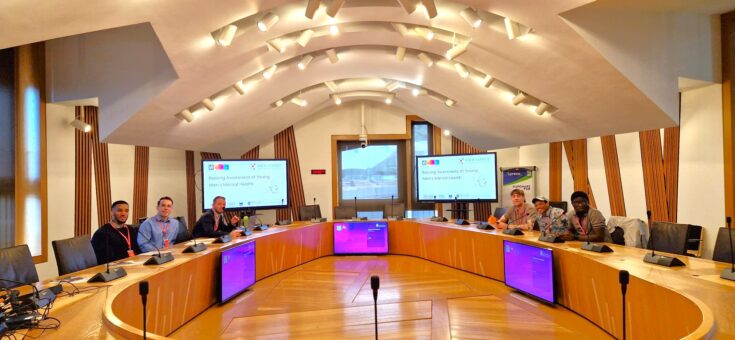
Men Minds wanted to change that. And who better to design a research project to understand young men’s mental health, and to reduce barriers to taking part in research, than young men themselves? Men Minds was coproduced with a young people’s forum of 10 young men, aged between 16 and 24. The forum helped design the research, conducted interviews with 60 young men across Scotland, undertook analysis and helped produce outputs and disseminate results.
Masculinities and misconceptions
Men Minds found that many young men no longer believed in the traditional stereotypes of what it means to be a man. They didn’t believe that men had to be strong and stoic, and they knew that men could experience stress, anxiety, depression and other mental health concerns.
But although these young men had modern ideas about masculinities, they still felt restricted by traditional social norms and expectations from families, friends, schools and other institutions. Sometimes, these were real restrictions, where young men were told to behave in a certain way. At other times, these were perceived restrictions in that young men believed they would be judged or shamed if they opened up.
As a result, diverse young men shared common experiences of shame and stigma and often felt isolated and alone in their mental health.
Reducing stigma and normalising conversations
Men Minds highlighted the value of peer support, and in providing spaces for young men to connect, where there is ‘permission’ but no pressure to talk about mental health. While Men Minds was not therapy, the young men found therapeutic benefits in taking part, and expressed relief to find out that they were not alone.
One young participant said:
Even if we don’t realise it, subconsciously we’re learning from each other. So, while you’re hopefully helping change the future of people’s thoughts and mental health, you’re also learning how to help yourself more.
To reassure other young men, help spark conversations about mental health, and reduce stigma, Men Minds produced a comic, based on real-life stories shared in the research. The young men also presented the findings at the Scottish Parliament, to ask Members of the Scottish Parliament to pay greater policy attention to young men’s mental health.
Passing on the Men Minds baton
Informed and inspired by the work of Men Minds, Glasgow City Council have rolled out a year-long programme across secondary schools. Young Men’s Minds groups in each school in Glasgow will research the issues affecting boys’ mental health and wellbeing, and work with staff and other pupils to codesign relevant solutions.
At the launch event, young men from Men Minds shared their experiences and advice with the next generation of boys and young men. From tips on co-producing research, to reassurance about mental health, they encouraged the pupils in attendance to continue to challenge stereotypes and improve mental health for young men. We can’t wait to see what they achieve.
Men Minds was funded as part of the Adolescence, Mental Health and Developing Mind (AMHDM) programme. AMHDM is co-funded by the Medical Research Council, Economic and Social Research Council and Arts and Humanities Research Council.

Dr Nina Vaswani is a Senior Research Fellow at the Children and Young People’s Centre for Justice, University of Strathclyde. Nina was the Principal Investigator on the Men Minds Project, in collaboration with colleagues across the University of Strathclyde, the Mental Health Foundation, and Monash University in Melbourne.