
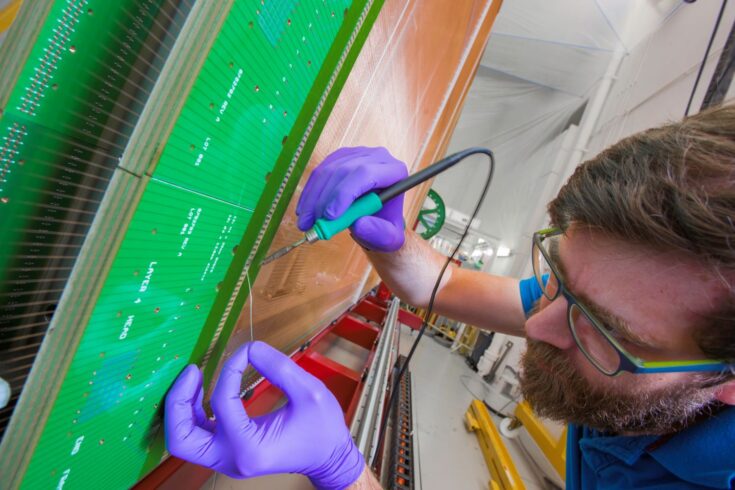

Yet tucked away on the Science and Technology Facilities Council’s (STFC) Daresbury Laboratory site, work is well underway that will ensure a major international science project can open up new understanding of the Universe.
To understand why this anonymous facility is so important, we first need to head over to the US.
Deep underground with DUNE
The Deep Underground Neutrino Experiment (DUNE) is an international scientific experiment currently under construction at Fermi National Accelerator Laboratory (Fermilab) in the US. Two neutrino detectors are being built underground and 1,300km apart: one at Fermilab in Illinois and another at Sanford Underground Research Facility in South Dakota, home of the Long Baseline Neutrino Facility (LBNF).
The plan is that a neutrino beam will be produced at Fermilab. The detector there will measure the particles. The particles will travel in a straight line through the Earth’s crust beneath the curvature of the surface to South Dakota. The particles will then be measured again. There is no accelerator tunnel here.
To measure those differences, the LBNF neutrino detectors will contain 17,000 tonnes of liquid argon. Any neutrino interactions will create both light and electrical signals that are imperceptible to humans.
In order to read these signals, pieces of equipment called anode plane assemblies, or APAs, are needed. STFC and the UK are playing a key role in delivering them.
Anode Plane Assemblies
The APAs needed for the DUNE project are big in size and in numbers.
Each APA measures 6.3m tall by 2.3m wide. They are huge rectangular frames, on to which 24 km of copper-beryllium wires, about the width of a human hair, are wound.
DUNE needs 150 APAs to function, of which STFC is building and shipping 137.
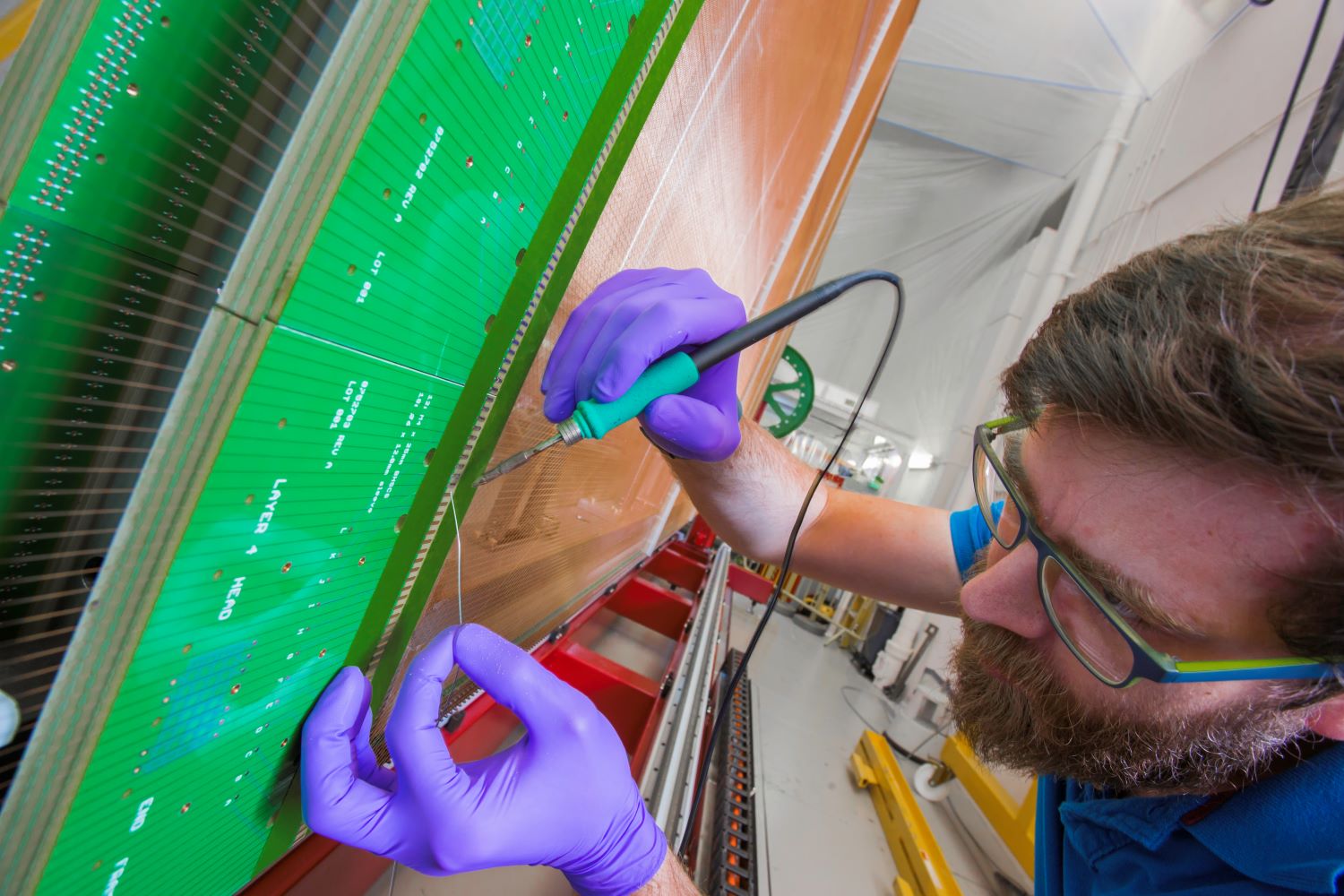
Soldering the delicate wire is a precision job, done by hand.
Credit: STFC
Deep in Daresbury with DUNE
Back in Daresbury Laboratory, the DUNE factory isn’t immediately obvious. But when you walk in, it is immediately obvious that this bespoke facility means business.
The main area is covered in huge winders, five of these giant machines are weaving 24km of the valuable wire tightly across four different directions, expertly designed to keep it at an optimum tension. Once the wire is wound and tension has been tested, 13,000 solder points are added. By hand. Hand soldering ensures that the APAs enter their final underground home with precision at their heart.
This workflow has been optimised over the past 12 months, with the team learning from earlier production runs and making improvements so that the process is as fast and efficient as possible.
There is now a team of approximately 19 working in the facility, including technicians, engineers and project managers. Much of the team has been employed locally, bringing new skills employment to the area.
By the end of 2025, around 50 of these UK-produced detectors will have been completed.
Bespoke elements
Video credit: STFC
Video transcript and on-screen captions are available by watching on YouTube
Once complete, the APAs are loaded into shipping crates, another bespoke element of the work which will be used to lift the frames into their final positions as they cannot be removed deep in the disused gold mine they will call home.
This project will see the UK produce over 90% of the crucial APAs, but our contribution to DUNE and the LBNF doesn’t stop there.
STFC engineers at the Rutherford Appleton Laboratory are creating the target which will produce the neutrinos for LBNF. Another engineering team at Daresbury will construct three cryomodules, each housing six superconducting radio frequency (SRF) cavities. Before installing into the cryomodules, each cavity will be thoroughly tested using the Superconducting RF Lab (SuRFLab) facility. With another bespoke facility now complete, a stone’s throw from the DUNE factory, the first cryomodule build is underway.
Why DUNE will measure neutrinos
Neutrinos are fundamental particles, with very little mass – which is why they require such a big detector to measure them.
We can learn a lot from neutrinos, so there are three major science goals for the DUNE experiment:
- to search for the origin of matter
- to learn more about neutron stars and black holes
- to shed light on the unification of nature’s forces
For the UK experts working in the DUNE APA facility and across the other DUNE-related workstreams, it is a tantalising prospect that they could be part of making such huge discoveries possible. In addition the project is enabling STFC to develop in the North West a team of engineers and apprentices with high level technical skill that will be a continued resource in the local technology economy.