


Coffee causes cancer. Red wine protects your heart. Chocolate cuts diabetes risk.
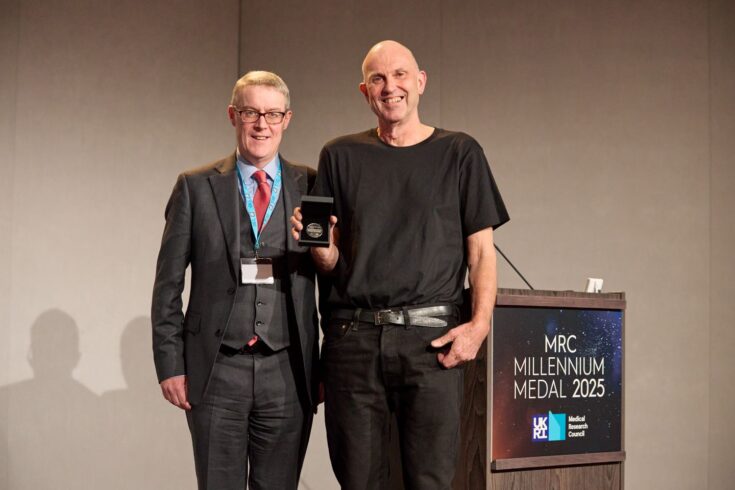
Professor George Davey Smith was awarded the 2025 MRC Millennium Medal
Credit: Joel Knight Photography.
These headlines are familiar to all of us. They catch attention but often mask a more complicated truth.
For Professor George Davey Smith such stories are a symptom of a deeper problem in how we understand health data.
In recognition of his transformative contributions to this field and his pioneering work disentangling correlation from causation, George won the 2025 MRC millennium medal. This medal is MRC’s highest honour for outstanding research achievement.
George says:
Spurious headlines and meaningless findings are harmful to both science and the public. We need to be far more rigorous about making claims about what causes disease.
Questioning conventional wisdom
As a medical student, George skipped the epidemiology module to go cycling around Ireland, only to later become fascinated by the challenge of working out what actually causes disease.
By the late 1980s, he was questioning how reliably conventional statistical approaches could separate out causal from confounded associations.
Alongside colleague Andrew Phillips, he showed how small errors in measurement can make one factor appear to be independently responsible for disease, when it isn’t. Like taking a single blood test or diet survey.
The ‘good cholesterol’ myth
Nowhere was this clearer than in the case of high-density lipoprotein (HDL) cholesterol, long celebrated as ‘good’ cholesterol.
For decades, studies showed people with higher HDL levels had lower rates of coronary heart disease (CHD). The logic seemed obvious: raise HDL, prevent heart attacks.
Pharmaceutical companies invested billions in developing and testing HDL-boosting drugs. Yet huge randomised trials later showed that when HDL levels were increased, CHD rates didn’t fall.
George and Andrew had warned of this in two papers in 1990 and 1991. They demonstrated that the high stability in measuring HDL cholesterol, in comparison to the much greater variability in triglycerides, could lead to HDL appearing protective even when it wasn’t.
This prediction was confirmed many years later by both randomised controlled trials and a new method George pioneered: Mendelian randomisation.
A genetic approach to causation
Mendelian randomisation uses genetic variants as natural experiments to test cause and effect. Since genes are randomly assigned at conception, like a built-in randomised trial, they aren’t biased by lifestyle or social factors.
This approach helped show that while higher HDL levels strongly predicted lower CHD risk, HDL doesn’t actually lower CHD risk.
Mendelian randomisation has since been used to debunk other health myths. These include alcohol’s supposed protective effects on cardiovascular disease risk, and the potential benefits of supplements such as selenium, which was thought to protect against prostate cancer.
Exposing hidden confounding
George also advocates using negative controls, testing for outcomes that are biologically implausible to reveal hidden confounding.
As he points out:
Many studies found that smoking was strongly predictive of risk of suicide. But there are obvious social and behavioural factors that could influence both, and depression could make it more difficult to quit smoking, or smoking could be a form of self-medication.
We showed in the same huge study that smoking was as strongly linked to the risk of being murdered as it was to death by suicide. While it could be argued that the suicide link was biologically plausible, this was obviously not the case for being murdered, which suggested that confounding generated the associations.
Generational insights
Many of these insights stem from long-term population studies. George established several of those to examine how factors early in life may influence health many decades later, including the Boyd Orr cohort and the Glasgow Students study.
He went on to succeed Jean Golding, who established the internationally renowned Avon longitudinal study of parents and children, as director of the study. In that role he was particularly concerned with increasing the accessibility of the data so they could be used by the medical and social sciences research communities worldwide.
Improving the scientific culture
George argues that better methods and openly accessible data are only part of the solution. The scientific culture also needs reform.
He says:
Researchers are rewarded for publishing positive findings. That means spurious correlations are more likely to make headlines than null results.
He believes funders and journals could help by requiring triangulation of evidence, testing whether findings hold up across multiple data modalities. And by valuing replication and negative results.
George adds:
It’s about encouraging scientists to look for ways they might be wrong. That’s how science moves forward.
Why causation matters
Mistaking correlation for causation doesn’t just waste research funding, it can shape real-world health advice.

Triangulation involves using multiple approaches to address one question, like shining a light on evidence from three different locations.
Credit: David Perkins
Vitamin E supplements, for instance, were once promoted as heart-protective based on observational studies. Nearly half of US adults took supplements containing vitamin E before randomised trials showed they provided no benefit.
George says:
That’s money, effort and hope directed at interventions that couldn’t deliver better outcomes, and may distract both the public and researchers from activities that might actually be beneficial.
In an era of rapid information sharing, where claims about diet, genes or vaccines spread instantly, his message is simple.
Evidence matters. Association isn’t causation, and good epidemiology, integrated with data from other disciplines, can help us tell the difference.
A longer version of this article is published on Medium: Why ‘coffee causes cancer’ headlines get it wrong.
Find out more
Find out more about the MRC Integrative Epidemiology Unit
Read the iEureka blog on dark chocolate and diabetes
Listen to George talking about evaluating science on the US Biology podcast

Professor George Davey Smith, Director, MRC Integrative Epidemiology Unit, University of Bristol.
Professor George Davey Smith is a clinical epidemiologist who has focused on methods for improving causal inference in studies of disease aetiology and disease prevention. His work has involved early implementation of ‘negative controls’ in epidemiological studies, the use of cross-context comparisons and randomised trials in thought-to-be difficult situations.
He pioneered the use of germline genetic variants for investigating modifiable causes of disease (‘Mendelian randomisation’), developed several extensions of the basic method, and contributed to its application in many settings. He is an advocate of the pre-specified application of a range of methods to the same question (‘triangulation’), as the key approach to strengthening causal inference. Throughout his career he has promoted increasing the accessibility of data, and implemented this in studies he has led, including the Avon Longitudinal Study of Parents and their Children (ALSPAC).