
Using an unprecedented combination of cosmic measurements, the research doubles the precision of previous DES studies.
The findings remain broadly consistent with the standard model of cosmology, the most widely accepted theory of the Universe.
The international group of researchers, with UK support from Science and Technologies Facilities Council (STFC) and six UK universities, is led by the US Department of Energy’s Fermi National Accelerator Laboratory.
A century of discovery
Around 100 years ago, scientists discovered that distant galaxies appeared to be moving away from Earth.
They found that the further away a galaxy is, the faster it recedes, providing the first key evidence that the Universe is expanding.
Researchers initially expected that this expansion would slow down over time due to gravity.
However, in 1998, observations of distant supernovae revealed that the Universe’s expansion is accelerating rather than slowing down.
To explain this surprising result, scientists proposed the idea of dark energy, which is now thought to drive the Universe’s accelerated expansion.
Astrophysicists believe dark energy makes up about 70% of the mass-energy content of the Universe, yet its nature remains one of the greatest mysteries in modern science.
Combining four cosmic probes
The research combines results from 18 separate studies.
For the first time, it brings together four major techniques for studying dark energy within a single experiment, a milestone envisioned when DES was conceived 25 years ago.
These techniques are:
- weak gravitational lensing (distortions in galaxy shapes)
- galaxy clustering
- supernovae
- galaxy clusters
Intriguing possibilities
Professor Ofer Lahav (University College London), former co-chair of the DES Science Committee and Chair of DES:UK, said:
It is exciting to see results from the full DES data set, more than 20 years after the project was first conceived.
The sample of 140 million galaxies with shape measurements is phenomenal. While the headline results support a constant dark energy, future analyses will test the intriguing possibility of an evolving dark energy.
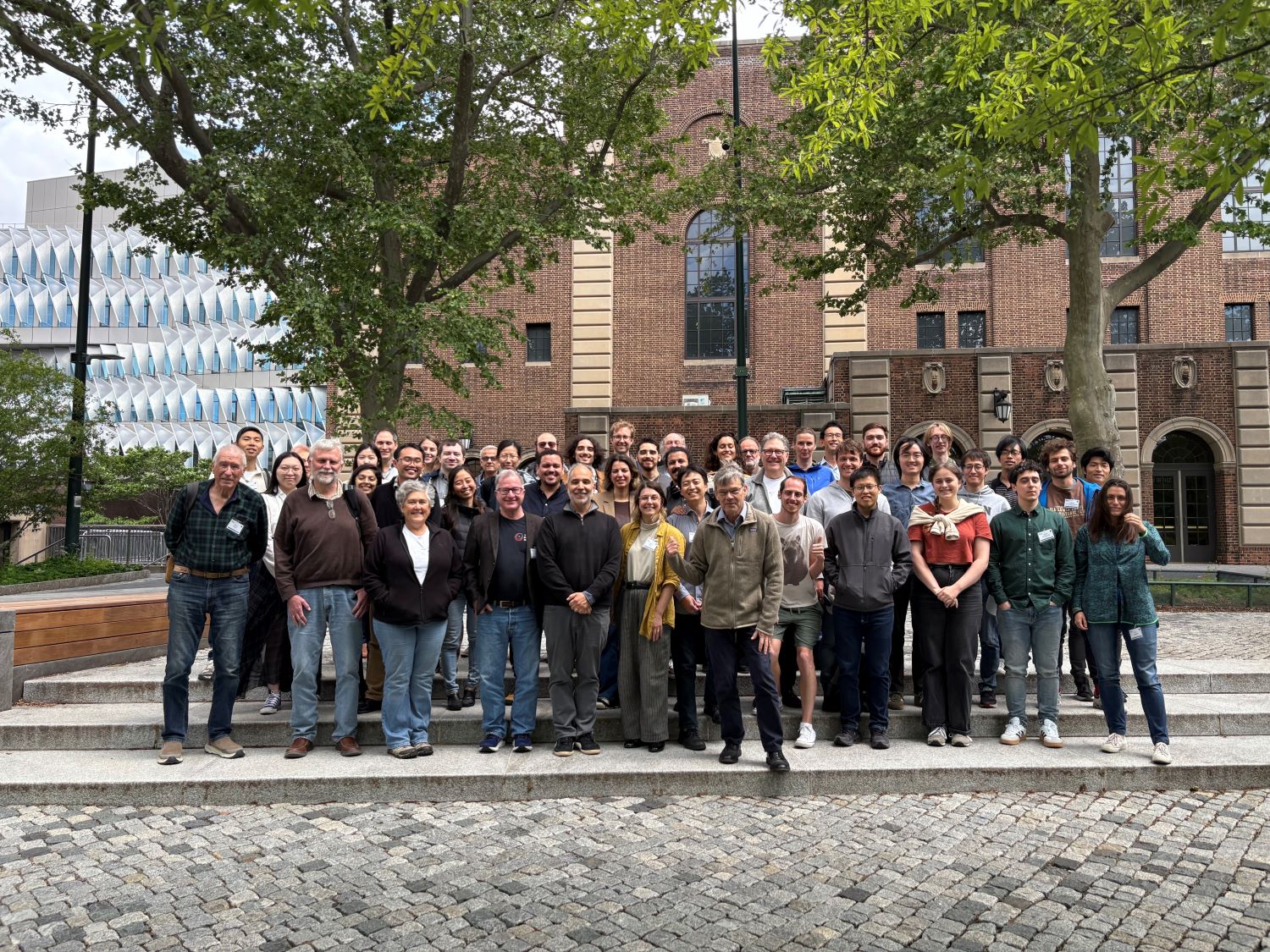
The Dark Energy Survey collaboration released legacy results combining weak lensing and galaxy clustering, incorporating all six years of data.
Credit: Ari McManus, DES collaborator
Far-reaching science
To study dark energy, the DES collaboration carried out a deep, wide-area survey of the sky between 2013 and 2019.
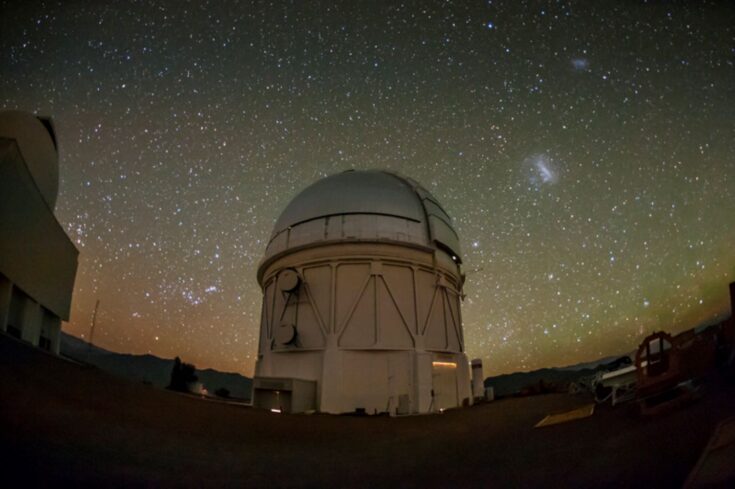
It used a specially constructed 570-megapixel dark energy camera mounted on a telescope at the US National Science Foundation’s Cerro Tololo Inter-American Observatory in Chile.
Over six years, scientists collected images and data from hundreds of millions of distant galaxies, billions of light-years from Earth, mapping roughly one-eighth of the sky.
For the latest results, researchers studied subtle distortions in galaxy shapes, known as weak gravitational lensing, to reconstruct the distribution of matter in the Universe over the past six billion years.
These measurements reveal how dark energy and dark matter have influenced the Universe’s evolution.
A mystery remains
The team compared their observations with two main theories, one in which dark energy remains constant over time (the standard model of cosmology), and another in which dark energy evolves as the Universe expands.
DES found that although the data mostly align with the standard model, there remains a long-standing discrepancy in how matter clusters in the Universe.
This has become more pronounced with the inclusion of the full dataset.
International collaboration
The DES is an international collaboration of more than 400 researchers from over 35 institutions, including several from the UK.
It is led by the US Department of Energy’s Fermi National Accelerator Laboratory.
UK contributions to the latest study include researchers from:
- University of Cambridge
- University College London
- The University of Edinburgh
- University of Nottingham
- University of Portsmouth
- University of Sussex
Through STFC, the UK is also supporting research programmes that will advance the work of the DES collaboration in the next generation of astronomical surveys.
This includes, Vera C. Rubin Observatory, which is under construction in Chile.
Solving universal mysteries
Professor Michele Dougherty, Executive Chair, STFC, said:
This research shows the power of long-term international collaboration and UK investment in world-leading science.
Dark energy remains one of the great unanswered questions in science.
Studies like this demonstrate how bringing together different approaches can give us a clearer picture of our universe and where future discoveries may lie.
Paving the way
Looking ahead, DES will combine these latest findings with results from other dark energy experiments to explore and test alternative ideas about gravity and dark energy.
The work also helps prepare the ground for future breakthroughs at the upcoming Vera C. Rubin Observatory in Chile to do similar work with its Legacy Survey of Space and Time.
Read the full press release at the Fermilab National Accelerator Laboratory website.