
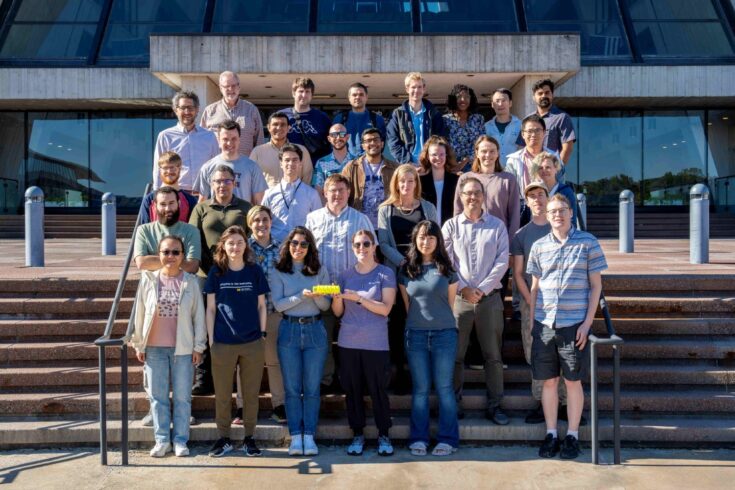
UK scientists have played a key role in solving a neutrino mystery that has challenged researchers for decades.
Scientists, including researchers from several UK universities, working on the MicroBooNE experiment have found no evidence of a long-suspected fourth type of neutrino, known as the ‘sterile neutrino’.
The experiment was carried out at the US Department of Energy’s Fermi National Accelerator Laboratory.
The new results, published in Nature, rule out the single sterile neutrino model with 95% certainty.
Ruling out this long-suspected particle sharpens the search for physics beyond the Standard Model, bringing scientists closer to uncovering the true nature of neutrinos and the fundamental laws that govern the Universe.
Neutrinos: the ghost particles of the Universe
Neutrinos are among the most abundant particles in the Universe, yet they are notoriously difficult to study.
They rarely interact with matter, with trillions passing through our bodies every second without a trace.
According to the Standard Model, neutrinos come in three types, or ‘flavours’:
- electron
- muon
- tau
They can change, or oscillate, between these flavours, a behaviour predicted by the Standard Model.
The Standard Model remains the best framework for understanding the Universe, but it is incomplete.
For decades, some experiments have hinted at unexpected behaviour that challenged this framework.
Unpredictable neutrino behaviour
Previous experiments observed neutrino behaviour that didn’t fit the three-neutrino framework, prompting scientists to suggest that a hypothetical ‘sterile’ neutrino, one that would interact only through gravity, might explain the anomalies.
Professor Justin Evans of The University of Manchester, MicroBooNE co-spokesperson, said:
The team saw flavour change on a length scale that is just not consistent with there only being three neutrinos. The most popular explanation over the past 30 years to explain the anomaly is that there’s a sterile neutrino.
Nowhere to hide
The latest results rule out the existence of a sterile neutrino with 95% confidence, shutting down one of the strongest explanations for the mysterious behaviour of these ghostly particles.
MicroBooNE, a state-of-the-art detector filled with liquid argon, studied neutrinos coming from two separate particle beams at Fermilab over a period of six years.
By combining data from both beams, the experiment probed the theory more deeply than ever, leaving almost no room where a single sterile neutrino could be hiding.
Critical UK contribution
Funded by the Science and Technology Facilities Council (STFC), scientists from UK universities played a central role in this international programme, including:
- University of Cambridge
- The University of Edinburgh
- Imperial College London
- Lancaster University
- The University of Manchester
- University of Oxford
- Queen Mary University of London
- University of Warwick
The experiment brought together nearly 200 researchers from 40 institutions across six countries.
The UK teams were instrumental in:
- developing sophisticated reconstruction and analysis software for interpreting vast amounts of liquid-argon detector data
- leading major physics analyses, from sterile-neutrino searches to detailed neutrino-argon interaction measurements and other searches for new physics beyond the Standard Model
- training and mentoring the next generation of scientists
Through these contributions, the UK has shaped MicroBooNE’s scientific impact and strengthened the foundations for future flagship experiments such as the Deep Underground Neutrino Experiment (DUNE).
DUNE is currently under construction, ensuring continued UK leadership in neutrino physics.
UK leadership
Professor Sinéad Farrington, STFC Director of Particle Physics, said:
These results mark an important milestone in our effort to understand some of the most elusive particles in the universe.
The UK has played a critical role in this latest MicroBooNe result providing leadership across the collaboration and developing the advanced technologies that made this breakthrough possible.
Next steps in the neutrino hunt
With sterile neutrinos now ruled out, the mystery of neutrinos remains.
MicroBooNE is continuing the search for new physics and delivering vital data on how neutrinos behave in liquid argon, crucial knowledge for future experiments, including DUNE.
Professor Evans added:
While this new result doesn’t reveal what is behind the neutrino mystery, it does eliminate what many believed was the most promising explanation.
In science, crossing a wrong answer off the list is often just as important as finding the right one. By narrowing the field, MicroBooNE brings scientists closer to uncovering the true physics behind neutrinos, particles that may ultimately help explain why the universe looks the way it does. In the search for new physics, even a closed door is progress.
Probing new physics
Magnus Handley, PhD student at Cambridge, said:
This result is exciting, showing us that simply adding one additional light sterile neutrino can’t explain the whole picture. We need to continue the hunt using improved techniques and in conjunction with other experiments. While this result strongly restricts the single light sterile model, there are many interesting ways in which neutrino interactions can still allow us to probe new physics.
Solving the mystery
Professor Jaroslaw Nowak of Lancaster University said:
The first MicroBooNE experiments showed phenomena in neutrino physics we don’t understand. The new result shows that the simplest explanation cannot solve this almost 20-year-old mystery. The next step will be to use the short-baseline program at Fermilab, with data from three detectors, to validate other hypotheses.
Exciting prospects ahead
Dr Kirsty Duffy, Department of Physics, University of Oxford, and MicroBooNE Physics Coordinator, said:
Neutrino physics has always held fantastic potential for discovery. Past experiments challenged our understanding of particle physics, and some anomalies even hinted at a new type of neutrino, the ‘sterile neutrino’. MicroBooNE was built to investigate this, and it’s incredibly exciting to publish the results of this decade-long search.
We find no disagreement with the Standard Model, ruling out the simple sterile neutrino explanation at 95% confidence. At the same time, this work demonstrates the precision and power of liquid-argon detectors—a capability we will carry forward into future experiments like DUNE. It’s a major step forward, with even more exciting prospects ahead.