
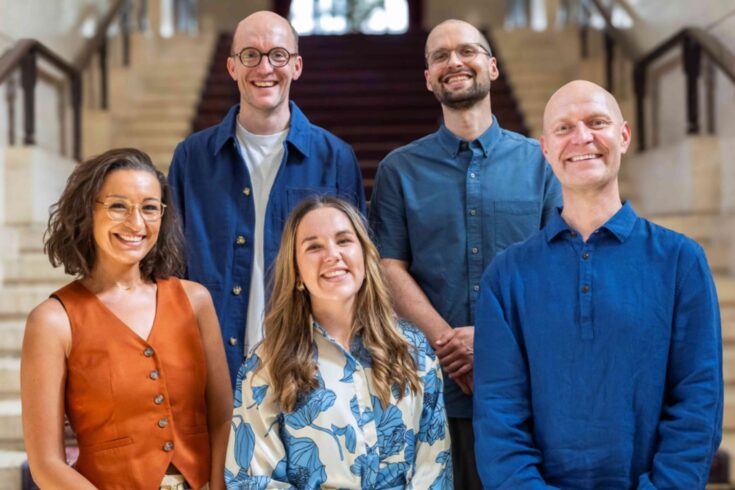
Every year, the BBC and the Arts and Humanities Research Council (AHRC) hold a nationwide search for the best new arts and humanities academics with ideas that will resonate with a wider audience.
These New Generation Thinkers represent some of the best early career researchers in the country.
They will benefit from training and development with AHRC.
They will also spend a year being mentored by producers from BBC radio, where they will appear and take part in discussions during the year.
Showcasing early career researchers
AHRC Executive Chair Professor Christopher Smith said:
Our New Generation Thinkers are a bold advertisement for the power of adventurous thinking, showcasing the way outstanding early career researchers can advance knowledge in varied and unexpected ways.
Our enduring partnership with the BBC allows audiences across the UK to meaningfully engage with a diverse range of ideas, and invites us all to reconsider matters of societal and cultural importance.
New ideas
Matthew Dodd, Commissioning Editor, Arts, BBC Radio 4, said:
Listeners tune into to Radio 4 because they want to be challenged by new ideas and learn more about the world around them, and I know that this year’s cohort of New Generation Thinkers are going to bring some fascinating ideas to the table.
As the UK’s biggest speech radio station, we’re delighted to be able to bring their expertise to the widest possible audience.
The New Generation Thinkers scheme has been running since 2011 with over 100 academics having passed through it.
Many have published books for a broad audience, and hosted events, podcasts and broadcasts.
Further information
The 2026 New Generation Thinkers cohort
Dr Genevieve Robyn Arkle, King’s College London
Working with Front Row, Radio 4’s flagship arts programme
From being forbidden to compose to being called a muse, a monster, and a power-hungry seductress, Alma Mahler is arguably one of the most misrepresented composers of the 20th century.
Dr Genevieve Robyn Arkle is writing a new biography of Alma Mahler and researching how sex and gender influenced 19th and 20th century music.
She is also writing a new book on Gustav Mahler’s Ninth Symphony.
Robyn is a Lecturer in Music History at King’s College London, whose work rethinks the history of classical music.
She has also worked with organisations such as the Royal Philharmonic Orchestra, the Orchestra of the Age of Enlightenment, and Longborough Opera festival.
Frances Hand, University of Oxford
Working with Woman’s Hour, Radio 4’s topical programme featuring women’s voices exploring women’s lives
One in three women in the UK describe childbirth as ‘traumatic’.
Frances’ research, informed by thousands of women’s voices, explores why, despite wealth and health advancements in the UK, women continue to experience differences in access, experience and outcomes under NHS maternity care.
She looks at the terminology used in childbirth, and at the idea of ‘obstetric violence’, arguing for greater rights-focused governmental action to fulfil international obligations to protect women.
Frances is a PhD candidate in the Faculty of Law at the University of Oxford.
She recently spoke at the Mexican Supreme Court, calling for greater collaboration and information sharing across countries.
Her work has been published in The Conversation and the Journal of Medical Ethics and presented at the Royal College of Obstetricians and Gynaecologists World Congress.
Dr Jakub Kowalewski, St Mary’s University, Twickenham, London
Working with Free Thinking, Radio 4’s roundtable discussion programme about ideas
How can Jewish and Christian reflections on the day of rest contribute to contemporary debates about shorter working time and what ‘rest’ means?
Jakub Kowalewski is a philosopher interested in how religious ideas can help us address societal problems.
His latest book, A Philosophy of Climate Apocalypticism, explores the various ways in which the notion of apocalypse is used in discussions about the environmental crisis.
A senior research fellow at St Mary’s University, Twickenham, London, Jakub is working on an interdisciplinary project investigating paths to sustainable and ecologically sensitive change in the Catholic Church.
Dr Siôn Parkinson, Royal Botanic Garden Edinburgh
Working with Free Thinking, Radio 4’s roundtable discussion programme about ideas
Fungi can smell like rotting meat, bedbugs, sewage and burnt bones.
But what can historical descriptions of mushroom odours tell us about how people in the past understood the smells of everyday life?
Dr Siôn Parkinson explores how humans make sense of so-called bad smells, and how stink in the fungal world shapes ideas of disgust, attraction and delight.
An artist and Research Associate at the Royal Botanic Garden Edinburgh, Siôn combines research into natural history collections with sound and performance to investigate our sensory relationship with plants and fungi.
His book Stinkhorn used the cultural history of the stinkhorn mushroom to examine how foul smells in nature can inform listening and music-making.
He is currently writing a new book (and a musical) about the colour brown.
Joe Shute, Manchester Metropolitan University
Working with The Verb, Radio 4’s poetry programme and with the team who produce the Salford editions of Front Row
How to write the story of a ‘lost’ urban river is the focus of Joe Shute’s current research and, more broadly, how to connect communities with Manchester’s post-industrial landscapes.
As a writer, researcher and journalist, Joe’s work explores the overlooked, and often maligned, places where people and nature connect in strange and unexpected ways.
His books include:
- Stowaway: The Disreputable Exploits of the Rat
- Forecast: A Diary of the Lost Seasons
- A Shadow Above: The Fall and Rise of the Raven
Joe is a PhD candidate based within Manchester Metropolitan University’s Centre for Place Writing and School of English.
His research is funded by the Leverhulme Unit for the Design of Cities of the Future.