
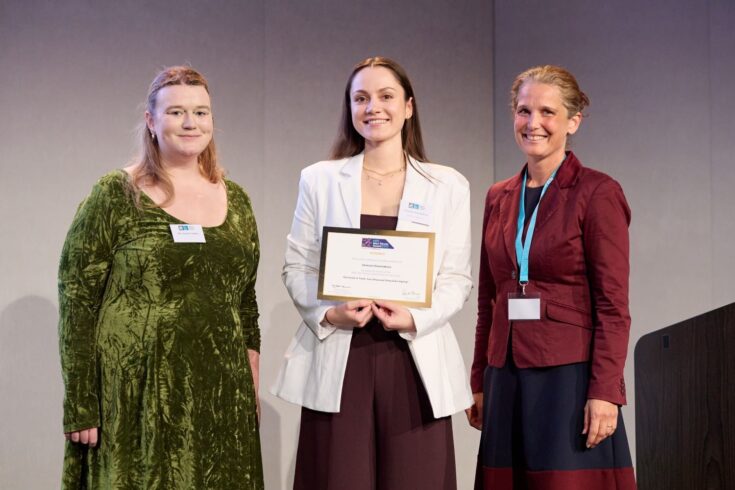
Medical Research Council (MRC) funded PhD student Vanessa Drevenakova won the award’s writing category for her article: ‘The Sound of Youth: Can Ultrasound Delay Brain Ageing?’.
She is looking at the potential of using ultrasound to care for the brain before decline caused by ageing and dementia sets in.
Brain ageing burden
With life expectancy rising, dementia is now one of the leading causes of death in the UK.
Current treatments often come too late and do little to reverse the damage.
As we age, our brain immune cells, known as microglia, become less effective at clearing up damaged proteins.
If these proteins are left to build up, they can damage the connections between neurons, preventing the brain from working effectively.
Over time, these changes can affect learning, memory, and overall cognitive function of the brain, symptoms associated with ageing and dementia.
The potential of focused ultrasound
Commonly known for its use in pregnancy scans, ultrasound technology also holds enormous potential as a safe and non-invasive treatment.
Focused ultrasound uses gentle sound waves that converge like sunlight through a magnifying glass, delivering mechanical signals deep into the brain.
These signals can change the activity of our brain cells, offering a new non-invasive way to influence brain function without surgery or drugs.
This technology is already approved in the UK for the treatment of essential tremor, Parkinson’s disease, and different cancers.
It is also being tested in patients with Alzheimer’s in the US.
Fine-tuned vibrations wake up old cells
In Vanessa’s lab at Imperial College London, she uses focused ultrasound to stimulate microglia, the brain’s immune cells, deep inside the brain.
In her article she describes how the ultrasound’s tiny vibrations cause small waves of pressure that work to open trapdoor-like channels on the surface of the microglia cells.
This allows a rush of calcium inside which acts to wake them up and kick-start them back into action.
In her own words, Vanessa writes:
My research asks whether we can encourage these senescent microglia to behave more like their younger selves: active, protective, and calm.
I watch how they move under the microscope, track the signals they send, and test the chemical messages they release to see if their behaviour is changing.
Acting early to slow brain ageing
Currently in the pre-clinical stage, her research involves testing how microglia respond in the ageing brains of mice.
Early findings suggest that ultrasound can change the behaviour of the cells to be more responsive, to clear the damage and to restore balance in the brain.
Vanessa and her team, based at the UK Dementia Research Institute, are looking at whether ultrasound could be used to intervene early, before too much damage occurs.
This could act to delay or reduce the impact of age-related diseases like Alzheimer’s.
Protecting people’s memories
Vanessa says:
What really drives me is the possibility that we can intervene early to support brain health as people age.
I truly care about protecting people’s memories, because they are so precious and such an important part of who we are.
I am very excited about our early findings and those of others in the field, and I am hopeful that together we could make a real difference to people’s lives.
Although this research is at an early stage, Vanessa’s PhD is part of a wider shift in brain health research, focusing not just on treatments, but also on timing.
If successful, it could open the door to therapies that are safe, non-invasive and effective.
The winning video and article were both published by The Observer.
Further information
The MRC Max Perutz Award, in partnership with The Observer, is a science communication competition for current MRC-funded PhD students.
Now in its 27th year, it aims to encourage and recognise outstanding science communication and help MRC PhD students build their science communication skills.
To enter, students are asked to tell a non-scientific audience why their area of research matters.
In 2025 MRC awarded prizes to a writing and a video winner.
The winning video was produced by Johnny Tam at The University of Edinburgh: ‘Digital speech biomarkers for motor neuron disease’.
All winning and shortlisted entries are showcased in our ‘Shortlist 2025 catalogue’.
Watch the five shortlisted videos on YouTube.