
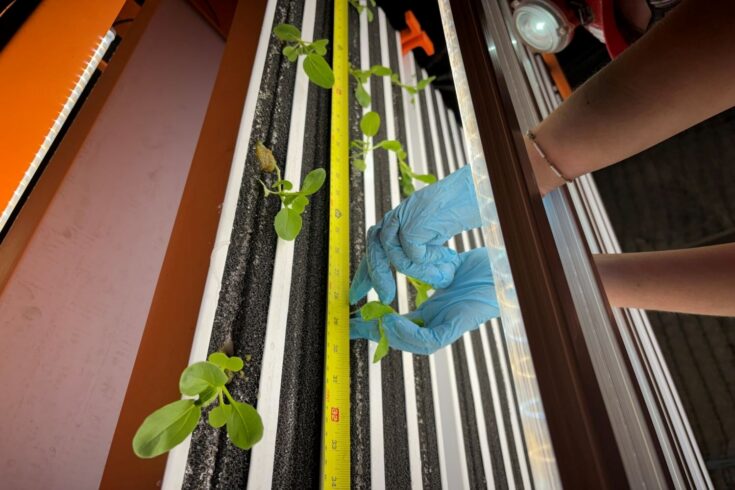
The 12-month study will gather the first real-world evidence on whether underground farming can be run at commercial scale, using a facility built largely for particle physics rather than agriculture.
The study is supported by a UK Research and Innovation Biotechnology and Biological Sciences Research Council (BBSRC) STFC Facility Access Fund award for bioscience partnerships.
The scheme is designed to open STFC’s national facilities to research beyond their original scientific remit.
A new use for a unique facility
The Boulby Underground Laboratory is best known as the UK’s deep underground science facility, where researchers shielded from cosmic radiation search for dark matter and study neutrinos.
It also supports a wider programme of pure and applied research that draws on the site’s ultra-low background radiation environment.
Its enables access to the unique and scientifically important subterranean geology, and the existing science-supporting infrastructure.
Those same conditions are now being tested for a very different purpose: growing food.
The stable underground environment could reduce the energy costs that usually limit vertical farming above ground, where lighting, heating and climate control account for a large share of running costs.
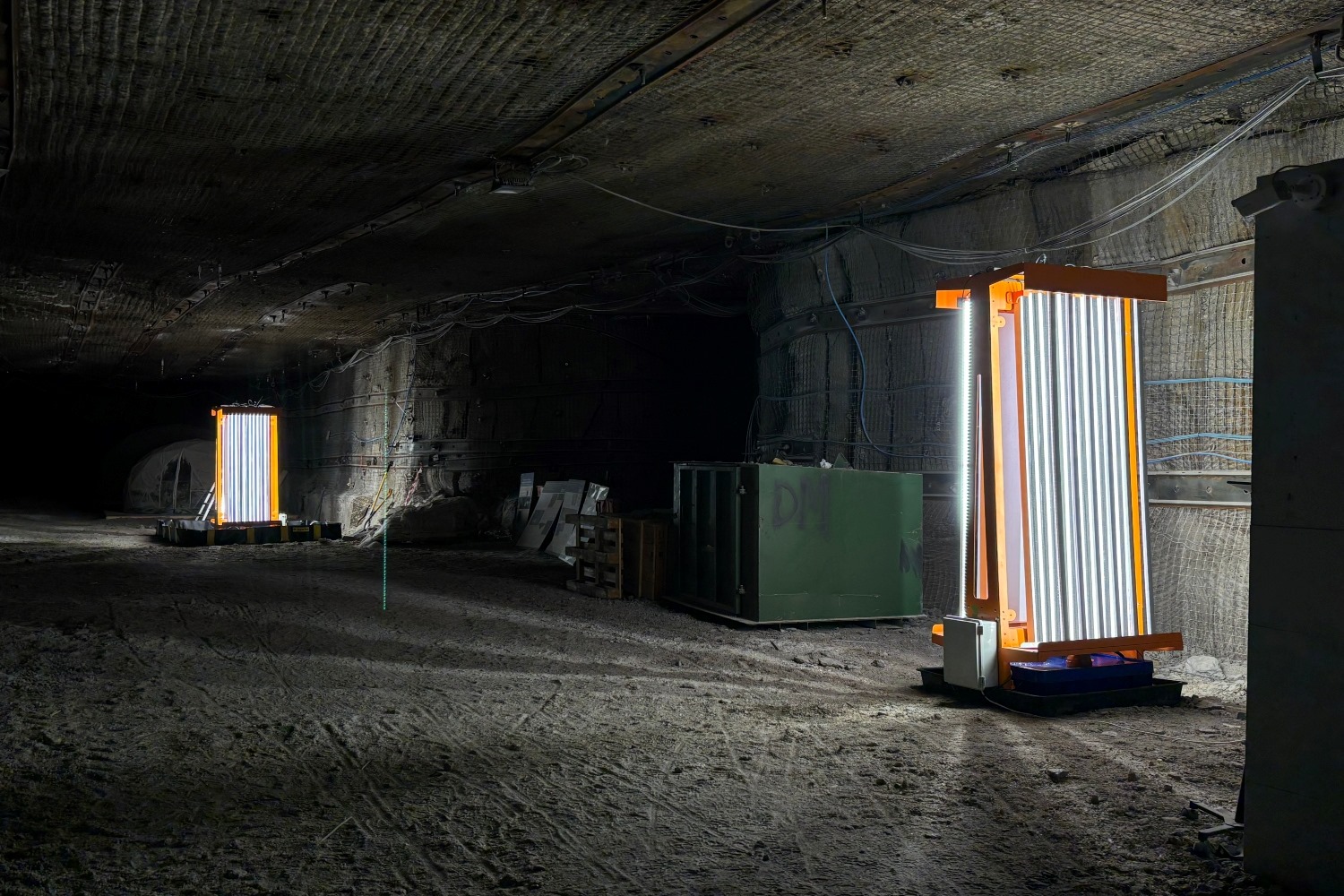
Two of four vertical farms installed 1.1km underground, situated in the Outside Experimentation Area of the Boulby Underground Laboratory. Credit: STFC
A special place for science
Professor Sean Paling, Director of STFC Boulby Underground Laboratory, said:
Boulby Underground Laboratory is a special place for science, hosting research that can only be done in the unique deep subterranean environment.
More than a kilometre underground, shielded from cosmic radiation, we conduct low-background physics including the search for dark matter and neutrino studies, alongside a range of pure and applied research.
And now we’re growing food.
Hosting Farm Urban’s vertical farm study is a natural extension of our science portfolio, using our unique environment to answer questions that can’t easily be answered anywhere else.
If this can work here, it opens real possibilities for what disused mines across the UK could become for the public.
The study
The work is being carried out by The University of Sheffield’s Institute for Sustainable Food, in partnership with food producer Farm Urban, with support from Boulby’s laboratory staff.
Crops planted at depth will be monitored over 12 months to build a practical dataset on yield, energy use and running costs.
This builds the evidence base needed to assess whether underground farming is viable beyond this single site.
Understanding the opportunities
Jacob Nickles, co-lead of the Institute for Sustainable Food’s Controlled Environment Agriculture group at The University of Sheffield, said:
The idea of underground farming is not new, however there is very little real-world evidence to show how this could work.
We’re here to do just that, we’ll be building a robust model to understand the opportunities of these sites using validated, practical data.
We know there will be some challenges, specifically due to the ambient salt or heat from mining activities.
But our goal is to determine the feasibility of growing crops in these and similar conditions.
If successful, we may be able to make use of the thousands of disused mine sites that exist across the UK.
Many of these sites are located in economically deprived areas.
Repurposing them could create skilled jobs, improving access to fresh produce, and supporting local communities while breathing new life into heritage sites.
Why it matters
Underground sites are insulated from extreme weather and seasonal variation, which could make food production more resilient as growing conditions above ground become less predictable.
Moving cultivation underground also sidesteps competition for agricultural land, and may reduce fertiliser run-off and support pollinator habitats by taking pressure off intensive field-based farming.
There are practical implications too.
The UK has thousands of disused mine sites, many in areas that lost jobs when mining ended.
If this study shows underground farming can work at a commercial level, similar sites could potentially be adapted for food production.
This could lead to job creation and improved access to fresh produce in those communities.
Government backed science
Science Minister Lord Vallance said:
This Government backs science because of its power to tackle the most important challenges affecting us all.
Growing fresh food while using less energy and land, and being less reliant on changeable British weather, could strengthen food security across our country and protect our environment.
At the same time, this project could see more disused mines becoming hubs for skilled jobs, creating new opportunities to benefit communities across the UK.