
Introduction and context
The UK’s strength in research and innovation is one of its greatest national assets, advancing knowledge, improving lives and driving economic growth.
Following the 2025 Spending Review, UKRI set out how it would use its budget to deliver its mission to advance knowledge, improve lives and drive growth. This requires investment to be focused on the capabilities, infrastructure and research strengths that can sustainably deliver the greatest long-term scientific, economic and societal benefit.
For the Science and Technology Facilities Council (STFC), this presents a particular challenge. While STFC’s core budget remains broadly flat, it has faced significant historical and forward-looking cost pressures, including:
- rising energy costs
- increasing labour costs
- foreign exchange pressures affecting international subscriptions such as CERN
- the growth of the organisation’s activities and workforce during the previous Spending Review period
Taken together, these pressures mean that STFC cannot continue to deliver its current portfolio unchanged. To ensure resources remain focused on its highest priorities and that public investment delivers the greatest possible impact, STFC has undertaken a comprehensive prioritisation exercise.
Working with Council, Science Boards and expert advisory groups, and informed by engagement with the research and innovation community, STFC assessed where activity could be streamlined, optimised or reduced while protecting the facilities, capabilities and research strengths most critical to its mission. Further information on this process is in the section on ‘How these decisions were taken’.
The decisions set out in this explainer reflect that process. They are designed to place STFC on a more sustainable footing, protect critical national capability and ensure investment remains focused on areas where it can deliver the greatest long-term impact for researchers, businesses and the UK.
Measures agreed to bring STFC to a balanced position
What this means in practice is laid out under the following headings.
Discovery research
Within the context of the STFC portfolio, discovery-led research in particle physics, astronomy and nuclear physics is protected. This includes the protection of Particle Physics, Astronomy and Nuclear Physics (PPAN) grant postdoctoral researchers and ensures that UK leadership in these disciplines can be sustained in a more focused way. Overall, the PPAN science budget will decrease by 2.7% over four years.
Multidisciplinary Facilities
World-class multidisciplinary facilities, including Diamond Light Source, ISIS Neutron and Muon Source and the Central Laser Facility, remain operational, with a focus on ensuring the UK retains critical underpinning capability. Overall, the multidisciplinary facilities budget will reduce by 15% over four years through making efficiency savings in how STFC operates the three major facilities on behalf of UKRI and deliberate choices to prioritise critical capability.
International subscriptions
The UK’s leading position in critical international research infrastructures is maintained by retaining full contributions across the portfolio of international subscriptions, where costs are expected to increase by 19% over four years.
Targeted prioritisation
There are deliberate choices to prioritise within STFC’s National Laboratories portfolio, reducing or reshaping activity in some smaller facilities and focusing technology programmes where the UK has the greatest impact. For example, STFC’s National Laboratories and Estates budget will reduce by 8% over four years. Within this budget, over the same period STFC costs of National Laboratories will reduce by 58%, while Estates costs will increase by 27% driven by critical estates work. As part of the prioritisation process, these Estates costs have been reduced from the original levels of planned spend.
Partnerships and value
STFC will transform its approach to industrial partnerships and the commercialisation of research and innovation assets, enabling the generation of additional revenue to sustain its portfolio of activities.
Specific prioritisation decisions
In line with the commitment made to the Science, Innovation and Technology Select Committee, discovery-led research in particle physics, astronomy and nuclear physics is protected within the context of STFC’s portfolio, ensuring the long-term sustainability of these disciplinary areas. The approach taken to the National Laboratories and Multidisciplinary Facilities portfolios was to eliminate operating inefficiencies before moving to strategic prioritisation, to preserve the most critical capabilities while in parallel driving greater external revenue. This ensures STFC will retain key priorities across PPAN, the three multidisciplinary facilities, and its National Laboratories, delivering for government priorities and for industry.
In the PPAN portfolio, STFC will:
- protect postdoctoral researchers within PPAN grants at the financial year 2025 to 2026 level using the inflationary assumption of 1.88% year-on-year growth as set by HM Treasury during spending review 2025
- support continued investment in PhD studentships and fellowships as agreed through UKRI’s collective talent budget during spending review 2025
- provide bridging funding for XENON, LUX-ZEPLIN and DARWIN consortium (XLZD)
- maintain the UK commitment to the Simons Observatory
- reduce support to a number of national and international projects, the details of the projects are in the annex
- reduce support for STFC’s PPAN supporting departments: Particle Physics department by 20% and UK Astronomy Technology Centre by 20%
In the multidisciplinary facility portfolio, STFC will:
- overall aim to save £28 million each year on operations costs
- make the best use of resources across the multidisciplinary facilities by implementing efficiency savings and reducing user support and technical assistance
- reduce running time at ISIS
- seek alternative funding arrangements or operating models for Lasers for Science Facility and the muon beamlines at ISIS, and if that is not possible close these capabilities
- optimise the use of resources at Diamond, to be identified and agreed with Wellcome as joint shareholder and via Diamond Board governance, by autumn 2026
In its National Laboratories and Estates portfolio, STFC will:
- reduce spending on accelerator and technology support by £8 million each year by 2029, this includes mothballing the CLARA facility
- reduce spending on compute by £10 million each year, reducing access to compute capability
- reduce spending on instrument and technology development to realise at least £5.5 million of savings
- challenge RAL Space and Hartree to become cost neutral to STFC, including through increasing commercial activity and funding from other sources
- reduce the operational budget by 40% at Boulby Underground Mine
- prioritise only the most critical building work across the scientific estate
Across other activities STFC will:
- bring in external income via industrial activity in the multidisciplinary facilities, enhance use of the space across the campuses, place new contracts with private partners, and generate intellectual property
- reduce spending on Professional Services by £12 million each year as part of STFC and Shaping Our Future operating model changes
- maintain all existing international subscriptions in full
Deliverability, risks and gateways
Delivering this programme will not be easy. It requires cultural change within UKRI and a reset in how UKRI and STFC work with partners. However, it provides a credible path to ensure the UK’s research assets deliver maximum impact and value for money.
The approach detailed here avoids closing any multidisciplinary facility. However, this depends on successfully delivering efficiency savings and generating additional income.
Progress will be assessed through two formal gateway points in 2027 and 2028 which will test whether savings and income targets respectively are being met and whether the programme remains sustainable. In the case that key targets are missed at these gateways, further action will be required, including the potential closure of a multidisciplinary facility.
If this programme succeeds in stabilising STFC’s financial position, there will be potential to consider future project approvals beyond 2028.
The decisions taken will support STFC to come to a balanced position in financial year 2029 to 2030. While implementation is in progress, UKRI will provide transitional support to STFC to cover additional costs over the financial years April 2026 to March 2029 (see Table 2, STFC budget allocation and UKRI transitional support). To do this, UKRI will take actions such as using in-year underspends or deferring activity from across its portfolio to support STFC’s costs and avoid making sharp reductions now. Further, as with the rest of UKRI, STFC will manage its budgets dynamically over the spending review period as it implements the agreed measures. This means that figures set out here should be treated as a guide and may not reconcile directly with final figures at the end of each financial year.
Figure 1 and Tables 1 and 2 summarise STFC’s forecast portfolio costs and budget allocations for this spending review period, along with actual costs and budgets for financial years April 2021 to March 2026 for reference. Table 1 presents STFC’s forecast costs across major components of its portfolio, including PPAN, the multidisciplinary facilities, National Laboratories and Estates, and international facilities and infrastructure. Assumptions on revenue generation are embedded across the multidisciplinary facilities and other activities lines.
Table 3 summarises this forecast by bucket. It is not possible to compare this summary with previous explainers.
Note that rounding has been applied throughout the tables, meaning that figures may not sum to their respective totals.
The figures in the tables are also available in Excel format (XLSX 26KB)
Figure 1: STFC costs and budget allocation, showing UKRI transitional support while reaching a balanced position
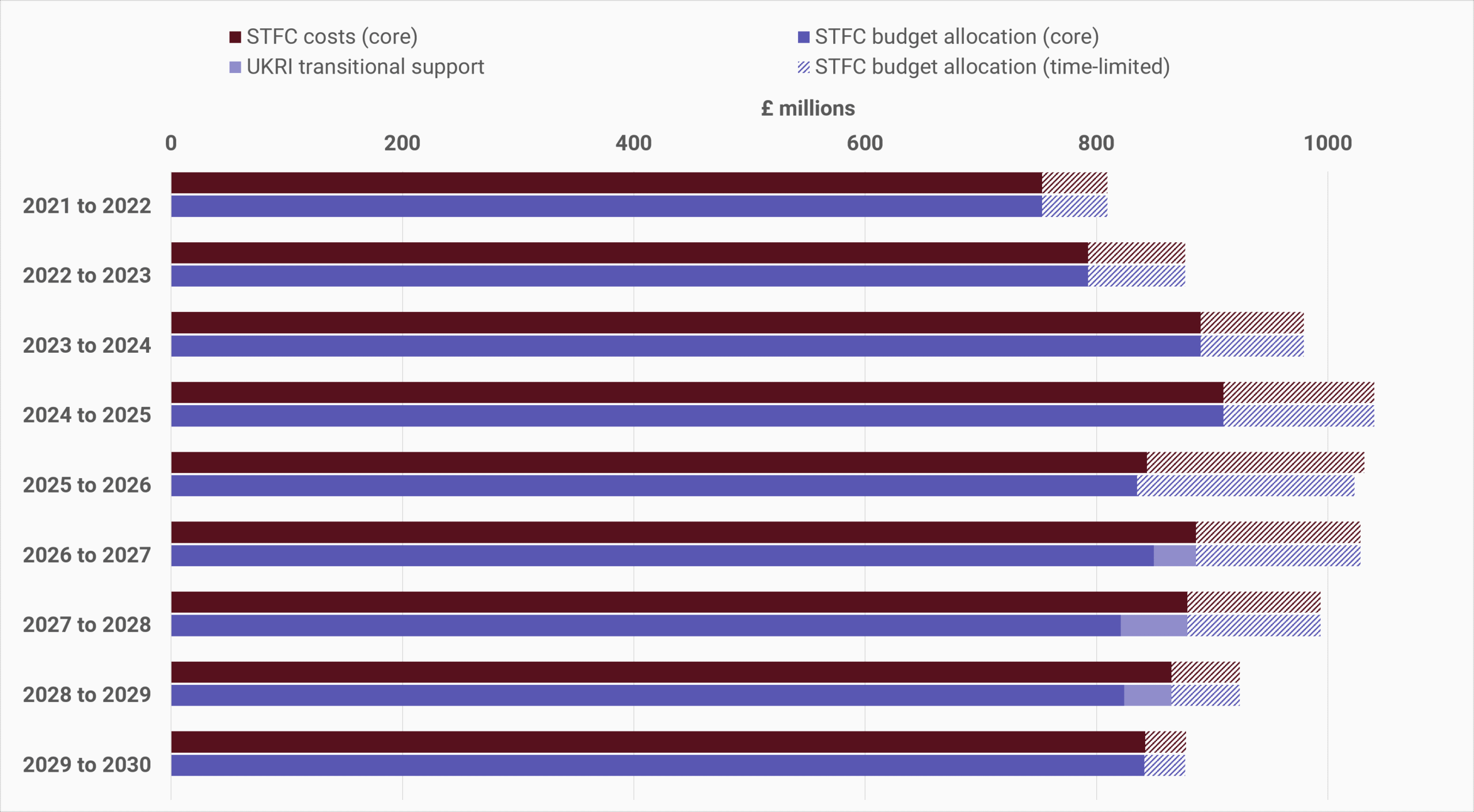
Note 1: values provided for ‘STFC costs’ up to and including the financial year 2025 to 2026 are actual costs. Values provided from the financial year 2026 to 2027 onwards are forecast costs.
Note 2: STFC total cost presented for the financial year 2025 to 2026 and prior years include agreed spend variations to budget. For financial years prior to 2025 to 2026, STFC budget allocation is presented aligned with actual total cost.
Table 1: STFC actual and post-prioritisation forecast costs by sub-portfolio
| STFC sub-portfolio | 2021-22 (actual costs, £ million) | 2022-23 (actual costs, £ million) | 2023-24 (actual costs, £ million) | 2024-25 (actual costs, £ million) | 2025-26 (actual costs, £ million) | 2026-27 (forecast costs, £ million) | 2027-28 (forecast costs, £ million) | 2028-29 (forecast costs, £ million) | 2029-30 (forecast costs, £ million) | Change vs 2025 to 2026 |
|---|---|---|---|---|---|---|---|---|---|---|
| PPAN | 167 | 182 | 198 | 206 | 199 | 211 | 198 | 192 | 193 | -2.7% |
| Multidisciplinary facilities | 161 | 170 | 189 | 182 | 183 | 187 | 171 | 159 | 156 | -15% |
| National laboratories and estates | 102 | 117 | 155 | 145 | 181 | 213 | 175 | 196 | 167 | -8% |
| International facilities and infrastructure | 303 | 308 | 310 | 335 | 295 | 318 | 328 | 335 | 350 | +19% |
| Infrastructure projects | 18 | 36 | 79 | 124 | 143 | 133 | 113 | 59 | 35 | -75% |
| Other activities | 59 | 64 | 47 | 47 | 31 | -32 | 9 | -17 | -24 | -178% |
| Total costs | 810 | 877 | 979 | 1,040 | 1,031 | 1,028 | 994 | 924 | 877 | -15% |
Note 1: A decrease in the ‘international facilities and infrastructure’ line in 2025 to 2026 is driven by the scheduling of international subscription payments and changes in requested contributions to reflect time-bound project delivery.
Note 2: The ‘infrastructure projects’ line decreases over time as it reflects existing delivery plans for ongoing time-bound infrastructure investments, primarily through UKRI’s Infrastructure Fund.
Note 3: The ‘other activities’ line includes STFC’s business and innovation activity and time-bound strategic programmes, as well as reflecting assumptions on revenue generation (with revenue generation also embedded in the ‘multidisciplinary facilities’ line). Where these assumptions result in a forecast net income for the line in a particular year, the cost is shown as negative.
Note 4: Total costs presented for the financial year 2025 to 2026 and prior financial years include agreed spend variations to budget. For financial years prior to 2025 to 2026, STFC budget allocation is presented aligned with actual total cost.
Table 2: STFC budget allocation and UKRI transitional support
| STFC budgets | 2021-22 (£ million) | 2022-23 (£ million) | 2023-24 (£ million) | 2024-25 (£ million) | 2025-26 (£ million) | 2026-27 (£ million) | 2027-28 (£ million) | 2028-29 (£ million) | 2029-30 (£ million) |
|---|---|---|---|---|---|---|---|---|---|
| STFC total budget allocation | 810 | 877 | 979 | 1,040 | 1,023 | 991 | 936 | 883 | 877 |
| Time-limited projects within STFC budget allocation | 57 | 84 | 89 | 130 | 188 | 142 | 115 | 59 | 35 |
| STFC core budget allocation (excluding time-limited projects) | 753 | 793 | 890 | 910 | 835 | 849 | 821 | 824 | 842 |
| Amount of STFC core budget allocation to space priority programme | NA | NA | NA | NA | NA | 1 | 3 | 10 | 12 |
| UKRI transitional support | NA | NA | NA | NA | NA | 37 | 57 | 41 | 0 |
Note 1: The ‘time-limited projects within STFC budget allocation’ line decreases over time as it reflects existing delivery plans for ongoing time-bound investments, primarily through UKRI’s Infrastructure Fund.
Table 3: STFC post-prioritisation forecast costs by R&D bucket
| Research and development bucket | 2026-27 (forecast, £ million) | 2027-28 (forecast, £ million) | 2028-29 (forecast, £ million) | 2029-30 (forecast, £ million) |
|---|---|---|---|---|
| 1. Curiosity-driven research | 343 | 335 | 344 | 355 |
| 2. Strategic government and societal priorities | 35 | 14 | 9 | 9 |
| 3. Supporting innovative companies | 12 | 12 | 6 | 7 |
| 4. Enabling and strengthening UK R&D | 638 | 633 | 565 | 507 |
| Total costs | 1,028 | 994 | 924 | 877 |
Note 1: A decrease in forecast costs in bucket one (curiosity-driven research) in financial year 2027 to 2028 is driven by planned delivery of time-bound project spend in the PPAN portfolio.
Note 2: Forecast costs in bucket two (strategic government and societal priorities) and bucket three (supporting innovative companies’) decrease over the spending review period due to reflecting assumptions on revenue generation. Part of the decrease in bucket two is also attributable to time-bound investments coming to an end.
Note 3: Investments in bucket four (enabling and strengthening UK R&D) support multiple priority outcomes in buckets one to three. As well as the multidisciplinary facilities, this bucket also includes activities that provide this enabling support through talent and skills funding for PPAN disciplines, wider facilities and laboratories, international subscriptions, and infrastructure investments.
Note 4: Total costs include allocation to STFC’s Executive Chair as Senior Responsible Owner (SRO) of UKRI’s Space priority programme.
How these decisions were taken
Since the final budget allocations were confirmed in December 2025, STFC has accelerated its prioritisation process to bring itself into a balanced position by financial year 2029 to 2030. Building on the foundations of the STFC Transformation process that was initiated in September 2025, the options for the Facilities and Laboratories have been developed by STFC Executive Board in partnership with Facilities and Laboratories Directors. Science Board (Facilities and Laboratories) and the cross-UKRI Facilities Strategic Advisory Group were consulted on the range of options under consideration.
Science Board PPAN completed a comprehensive appraisal of options based on the information provided by individual projects on the impact of a range of budget reduction scenarios. The key output of this exercise was a recommended portfolio of savings measures across a range of different funding scenarios that STFC Executive Board then balanced across the broader STFC remit.
STFC also consulted with the broader scientific community through engagement roundtables and townhalls held across the country this spring. That insight, alongside the expertise of our advisory boards and colleagues, shaped our decisions.
The final prioritisation decisions take on board the majority of the advice from STFC Science Boards (both PPAN and Facilities and Labs). In making their final recommendation to UKRI’s Executive Committee, the STFC Executive Board balanced this advice with financial constraints.
In addition, the question of whether PPAN should remain within STFC was considered as part of this process. Following clear steers from the wider research community and STFC’s advisory panels, it was decided that PPAN will remain within STFC. This reflects the strong view expressed through recent engagement that the current arrangement best supports the long-term health of the PPAN disciplines.
Annex: Particle Physics, Astronomy and Nuclear Physics (PPAN) project outcomes
All current PPAN projects will continue in full until the end of their current grant agreements. As existing grant agreements conclude, projects will either be:
- invited to apply for further funding at current levels of investment, subject to expert peer review
- invited to apply for further funding at reduced levels of investment, subject to expert peer review
- not prioritised for further funding beyond the current grant agreement
Table 4 shows the outcomes for the STFC prioritisation process for the PPAN project portfolio.
| PPAN project | Outcome | Anticipated funding % once current grant period ends |
|---|---|---|
| ATLAS experiment M&OA | Invited to apply for further funding | 100% |
| ATLAS upgrade | Project continued to completion | NA |
| LHCb experiment M&OA | Invited to apply for further funding | 100% |
| LHCb Upgrade 2 | Not prioritised for further funding | NA |
| CMS experiment M&OA | Maintain current commitment | 100% |
| CMS upgrade | Invited to apply for further funding at reduced level | 80% |
| Hyper K experiment common fund | Maintain current commitment | Full |
| T2K experiment common fund | Invited to apply for further funding | Full |
| DUNE | Invited to apply for further funding at reduced level | Reprofiled & Capped |
| LBNF/DUNE - Target | Invited to apply for further funding at reduced level | Reprofiled & Capped |
| LBNF/DUNE - PIP II | Project to continue to completion | NA |
| GridPP | GridPP7 to continue, GridPP8 subject to further discussion | Supported through PPAN computing budget line |
| IPPP core programme | Maintain current commitment | Full |
| HL-LHC | Invited to apply for further funding | Supported through full accelerator budget line |
| XLZD Bridging | Invited to apply for further funding at reduced level | 60% |
| PPD - core | STFC allocation at reduced level | 80% |
| Boulby Infrastructure | Invited to apply for further funding at reduced level | 80% |
| Boulby Development | Invited to apply for further funding at reduced level | 60% |
| AGATA operations | Invited to apply for further funding | 100% |
| ALICE M&OA | Invited to apply for further funding | 100% |
| EIC | Not prioritised for further funding | NA |
| FAIR | Now supported from within international subscriptions budget line | 100% |
| ALMA Regional Centre | Invited to apply for further funding at reduced level | 80% |
| BISON | Invited to apply for further funding at reduced level | 60% |
| CUBES | Invited to apply for further funding | 100% |
| ELT Instrumentation (1st Gen) | Invited to apply for further funding | Fixed level |
| e-MERLIN +JIVE | e-MERLIN not prioritised for further funding | NA |
| GAIA CU9 | Invited to apply for further funding at reduced level | 80% |
| GOTO Operations | Invited to apply for further funding at reduced level | 75% |
| HIPERCAM and ULTRACAM | Not prioritised for further funding | NA |
| JCMT Support | Not prioritised for further funding | NA |
| Liverpool Telescope | Invited to apply for further funding at reduced level | 75% |
| LOFAR | Invited to apply for further funding at reduced level | 80% |
| LSST Vera Rubin | Invited to apply for further funding at reduced level | 80% |
| NGTS | Invited to apply for further funding at reduced level | 55% |
| ukSKA Regional Centre | Invited to apply for further funding at reduced level | 80% |
| SKA Construction | Now supported from within international subscriptions budget line | Full |
| Simons Observatory | Invited to apply for further funding | 100% |
| Wide Field Astronomy – CASU | Invited to apply for further funding at reduced level | 80% |
| Wide Field Astronomy – WFAU | Not prioritised for further funding | NA |
| HARPS3 Operations | Not prioritised for further funding | NA |
| ING Staff and Operations | Now supported from within international subscriptions budget line | 80% |
| ATC - core | STFC allocation at reduced level | 80% |
| Next Gen Grav. Waves bridging | Invited to apply for further funding | 100% |
| LIGO Operations | Invited to apply for further funding | 100% |
| DiRAC | Invited to apply for further funding at reduced level | Supported through PPAN computing budget line |
| IRIS | Being considered within STFC Transformation | Supported within the wider STFC compute budget line |
| QTFP | Not prioritised for further funding | NA |
| DarkSPHERE | Not prioritised for funding | NA |
| BlueMUSE | Not prioritised for funding | NA |
| Legacy Infrastructure for EUCLID | Not prioritised for funding | NA |
| RASOR | Not prioritised for funding | NA |
| AWAKE | Not prioritised for further funding | NA |
| H3Beams | Not prioritised for funding | NA |
| Computing budget line | NA | Fixed |
| Nuclear physics budget line | NA | Fixed |
Notes on table 4
Note 1: The column ‘Anticipated funding % once current grant period ends’ sets out planned future support relative to previous planning assumptions. All future funding is subject to expert peer review.
Note 2: Projects described as ‘Full’ reflect where STFC will support to the level required, but this is still to be determined with international partners or through expert peer review.
Note 3: Projects described as ‘Reprofiled and Capped’ will have plans reprofiled over the current spending review period, with funding capped from the 2028 to 2029 financial year.
Note 4: The LBNF/DUNE – PIP II* project will complete in financial year 2027 to 2028 with 100% anticipated funding.
Note 5: Projects described as ‘Fixed’ reflect where a fixed level of support from STFC will be allocated to specific deliverables to be determined through future work.
Note 6: The XLZD and Next Gen Grav. Waves projects will be bridged from their UKRI Infrastructure Fund preliminary project grants through a new allocation from STFC’s core funding.
Note 7: Some projects were included in the prioritisation process for consideration based on their most recent submissions to STFC rather than new pro forma input. This was to ensure that all existing and recently proposed (fundable but unfunded) projects were reviewed, and applies to DarkSPHERE, BlueMUSE, Legacy Infrastructure for EUCLID, RASOR, AWAKE, H3BEAMS.