
Foreword
As the steward of the UK’s research and innovation system, UK Research and Innovation (UKRI) remains committed to building a workplace where diversity, inclusion and respect are part of our everyday culture. We know that when people with different perspectives and experiences feel able to contribute fully, the quality and impact of our work increases. Creating an environment where every colleague feels valued, supported and able to thrive continues to be central to UKRI.
Our organisational strategy is underpinned by four principles that are integral to how we work as an organisation. These principles will help to create the conditions for the UK’s research and innovation system to flourish.
These principles are:
- Diversity
- Connectivity
- Resilience
- Engagement
Equality, diversity and inclusion are fundamental to delivering this strategy. To lead change across the sector, we must demonstrate transparency, use evidence to guide our decisions, and hold ourselves accountable for progress. Our annual pay gap reporting is a key part of this commitment.
This year’s gender pay gap report, our seventh, provides an important opportunity to reflect on where we are making progress and where further action is needed. In 2025, UKRI’s mean gender pay gap has reduced since 2024 and continues to be a downward trend since 2022.
We are also publishing our ethnicity pay gap for the fifth year. In 2025, the ethnicity pay gap has widened in favour of colleagues from ethnic minority backgrounds. However, with 44% of colleagues not yet sharing their ethnicity data, it remains difficult to draw firm conclusions. Improving our data continues to be a priority, and we are working to build the confidence and conditions that encourage colleagues to share this information.
As UKRI continues to mature, we are increasingly able to draw on the strengths of our organisation to create dynamic and diverse career pathways across disciplines and sectors. UKRI plays a significant role in shaping the wider research and innovation system, and it is essential that we demonstrate leadership through our own actions. We remain committed to becoming a more diverse organisation, one that continually strives to improve, and with an environment where our people flourish.
About UKRI
UKRI is a non-departmental public body sponsored by the Department for Science, Innovation and Technology (DSIT). Our mission is to advance knowledge, improve lives and drive growth through our role as a steward of the research and innovation system.
Our organisation brings together the seven disciplinary research councils, Research England, and the UK’s innovation agency, Innovate UK. UKRI has a great depth and breadth of expertise, allowing us to connect research communities, institutions, businesses and wider society, in the UK and around the world.
This combination enables us to work across the whole research and innovation system, informed by our networks and expertise. Alongside its research and innovation investment activities, UKRI also owns and maintains significant research facilities which contribute to the UK research and innovation base.
Employees captured in the band labelled as ‘Other’ are employees that do not have a main band equivalent due to being on very specific pay scales, for example mariners, pilots and apprentices.
The representation of males and females in the more senior bands H and X are similar to the representation in 2024, where proportionally there are more males than females, however this gap is closed at the highest band, Y.
Our structure
We are a diverse organisation employing highly specialised people across the globe, from Antarctic researchers and specialist enabling staff (for example, mariners and engineers) to office-based employees in the UK and in our international offices.
Although UKRI is made up of various councils, institutes and units, the analysis and discussion in this report is presented for the whole of UKRI as a single employer for the year ending 31 March 2025.
UKRI operates a grading system underpinned by a job evaluation system. Bands reflect the level of responsibility that individuals have, with each band having a set pay range. Our main pay scale begins at Band A, the most junior band, and ends at Band H. Our most senior roles are identified as Band X and Y.
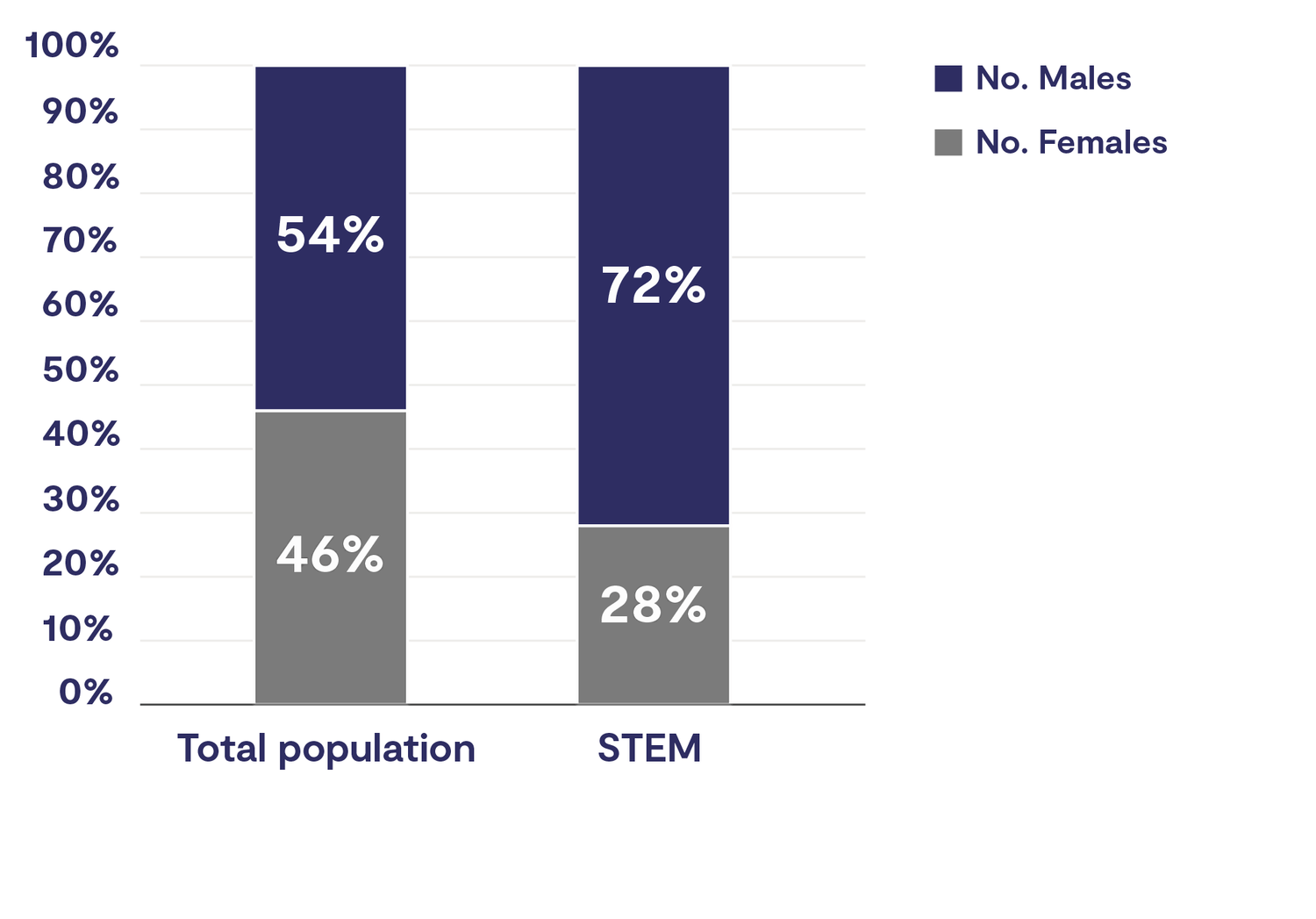
The overall gender distribution as of March 2025 was 46% female and 54% male. The overall proportions of males and females have remained largely static since UKRI’s inception in 2018.
When comparing research-facing and professional enabling areas, the split of males and females is less balanced. Females make up 62% of professional enabling roles and 28% of research-facing roles. This reflects the research and innovation sector, where professions in some areas of science and engineering tend to be more male dominated.
Effective from 1 July 2022, we transitioned roles directly focused on research delivery within science, technology, engineering and mathematical (STEM) areas in three councils on to new pay scales (S1 and S2). The three councils affected were Medical Research Council (MRC), Natural Environment Research Council (NERC) and Science and Technology Facilities Council (STFC). This was to address acute difficulties in recruitment and retention. We evidenced the new pay scales by benchmarking specific roles to similar ones within the wider STEM sector.
In general, S1 roles are engineering, technician and some digital roles, and S2 roles are scientific with some digital roles. The majority of employees (52%) sit within the main UKRI pay scale with S1 and S2 containing a similar number of employees at 24% and 21% respectively. The remaining 3% sit on specific pay scales, for example mariners, pilots and apprentices. In S1 and S2 there are more males than females, with the proportion of males at 82% and 59% respectively. This distribution has remained largely the same as reported in the 2024 Gender Pay Gap report.
The gender pay gap is largely influenced by distribution of males and females within the workforce rather than differences in pay within the bands. A more detailed analysis of equal pay was published in the 2025 Equal Pay Audit.
The following table shows the gender representation across the overall UKRI workforce, in descending order of seniority (Band Y being the highest).
Table 1: representation of employees by band in UKRI
| Row labels | Male | Female | Overall employee count |
|---|---|---|---|
| Band Y | 50% | 50% | 20 |
| Band X | 61% | 39% | 102 |
| Band H | 63% | 37% | 118 |
| Band G | 57% | 43% | 458 |
| Band F | 57% | 43% | 1,365 |
| Band E | 55% | 45% | 2,260 |
| Band D | 51% | 49% | 2,299 |
| Band C | 47% | 53% | 1,105 |
| Band B | 48% | 52% | 358 |
| Band A | 75% | 25% | 168 |
| Other | 72% | 28% | 290 |
| Total | 54% | 46% | 8,543 |
Gender pay gap reporting
Gender pay gap (GPG) data sets out the difference between the average pay of all females compared to the average pay of all males within the organisation, regardless of level or type of work carried out. This means that the representation of male and female staff within the workforce will have an impact on the GPG. A positive figure indicates a pay gap in favour of males, and a negative figure indicates a gap in favour of females.
The GPG is different to equal pay. Equal pay compares pay differences between males and females who carry out the same jobs, similar jobs or work of equal value.
There is increasing interest in understanding pay gaps by other characteristics, and we have published UKRI’s ethnicity pay gap within this report since 2021. Analysis of the 2025 ethnicity pay gap is detailed later in this report.
Methodology
In 2017, the government introduced legislation that made it statutory for all organisations with 250 or more employees to report annually on their gender pay gap.
To comply with government legislation, the gender pay gap must be calculated as the difference between average hourly earnings (excluding overtime) of males and females as a proportion of males’ average hourly earnings (excluding overtime). It is a measure across all jobs in the UK, not of the difference in pay between males and females for doing the same job.
The regulations require annual gender pay gap reporting including:
- mean and median gender pay gap
- the proportions of males and females in each pay quartile
- the mean and median gender bonus gap
- the proportion of males and females who received bonuses
Current reporting guidelines require us to segment the population by males and females. To meet reporting responsibilities, data on sex is used in this report.
The data used to calculate the UKRI gender pay gap is as of 31 March 2025. The mean shows the difference between the average hourly earnings of males and females by taking the total pay of females and dividing this by the number of females, and the same for males.
The median is found by arranging all employees’ pay in two lines, one for females, one for males, in order of pay from highest to lowest. The median gender pay gap then compares the pay difference between the male and the female in the middle of the respective lines.
UKRI's gender pay gap
Table 2: mean and median gender pay gap in 2022 to 2025
| 31 March 2025 | 31 March 2024 | 31 March 2023 | 31 March 2022 | |
|---|---|---|---|---|
| Mean gender pay gap | 8.3% | 9.0% | 8.3% | 9.6% |
| Median gender pay gap | 7.0% | 7.5% | 5.0% | 8.7% |
In 2025 the mean gender pay gap was 0.7 percentage points narrower than 2024. The median gender pay gap was 0.5 percentage points narrower.
In 2024, UKRI’s mean and median pay gaps widened as a result of the introduction of the S1 and S2 pay scales, which were introduced to address external pay market pressures for research delivery facing roles. In comparison to the total UKRI employee population, there is a higher proportion of males than females in these roles (Figure 1).
Table 2 shows that since 2024, the mean GPG has narrowed by 0.7 points to 8.3%, in other words, for every £1 earned by males, females earn 92p. The median GPG has also narrowed by 0.5 percentage points to 7.0%. The data also shows that the mean GPG is narrower than in 2023, continuing the overall trend.
UKRI’s mean GPG is 1.3 percentage points higher than the UK national GPG which stands at 7.0% as of April 2024 (source: Gender pay gap in the UK – Office for National Statistics).
Figure 1: sex split for STEM pay scale compared to the total population
Distribution as a driver of the gender pay gap
The UKRI 2025 Equal Pay Audit published in September 2025 demonstrated that the distribution of males and females in the organisation is a key driver of the GPG. Therefore, analysing the median GPG by quartile can illuminate where the largest gaps are that have the most impact on the overall figure.
Figure 2: median gender pay gap by quartile
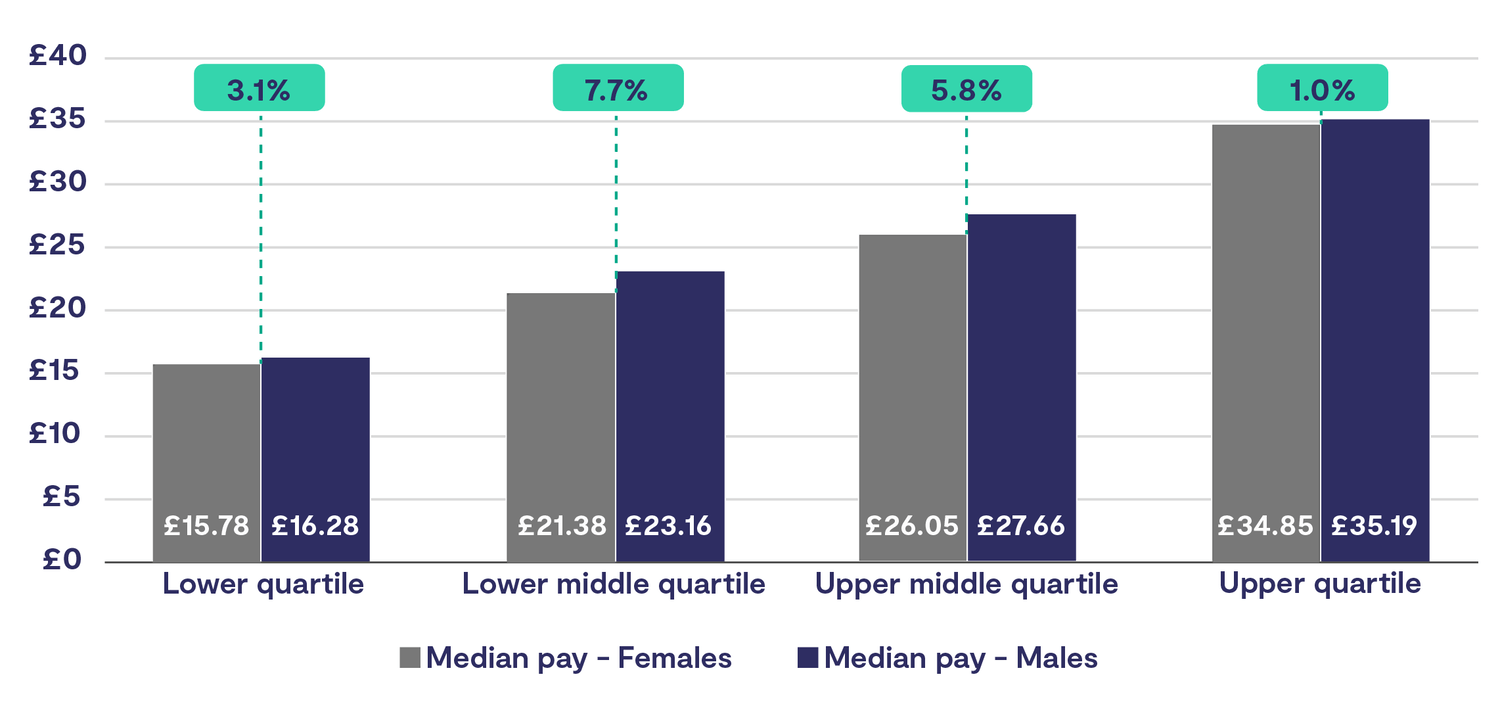
Figure 2 shows that the median GPG is largest in the lower middle quartile at 7.7%. In other words, for every £1 earned by the median male, the median female earned 92p. The gap has widened for all quartiles except the upper quartile, where it has narrowed by 0.6 percentage points but is now in favour of males, whereas in 2024 this was in favour of females. The smallest gap is in the upper quartile at 1.0%.
Table 3: percentage of males and females in each pay quartile
| Pay quartile | % males | % females |
|---|---|---|
| Lower quartile | 51% | 49% |
| Lower middle quartile | 50% | 50% |
| Upper middle quartile | 56% | 44% |
| Upper quartile | 61% | 39% |
Table 3 shows the percentage of females and males within each pay quartile for the year ending 31 March 2025. In all quartiles the percentage of males is greater than that of females. This is consistent with 2024, except for the lower quartile which now has a larger proportion of males. The percentage of females has decreased by 6 percentage points.
The proportion of females in each quartile trends downwards from the lower middle quartile to the upper quartile, with the upper quartile having the lowest proportion of females at 39%. In both the upper middle quartile and the upper quartile, the proportion of females is greater compared to 2024, by 2 percentage points and 4 percentage points respectively.
UKRI’s gender bonus pay gap
The bonus GPG is the difference between the average bonus pay of all females compared to the average bonus pay of all males within the organisation. A positive figure indicates a bonus pay gap in favour of males, and a negative figure indicates a bonus pay gap in favour of females. As for the overall GPG, both the mean and median bonus GPGs are published.
Table 4: mean and median bonus pay gap for 2023 to 2025
| 1 April 24 to 31 March 25 | 31 April 23 to 31 March 24 | 1 April 22 to 31 March 23 | 1 April 21 to 31 March 22 | |
|---|---|---|---|---|
| Mean bonus gender pay gap | 16.0% | 8.3% | 15.0% | 10.1% |
| Median bonus gender pay gap | 0.0% | -21.9% | 0.0% | 0.0% |
In 2025 the mean bonus gender pay gap was 7.7 percentage points wider than in 2024. The median bonus gender pay gap was 21.9 percentage points narrower.
During the year ending 31 March 2025, 99.8% of females employed by UKRI received a bonus compared to 98.8% of males. This includes the end of year award for achieving expectations. The mean bonus GPG is 16.0%, which is an increase of 7.7 percentage points compared to 2024. The median gap has narrowed from -21.9% to 0%.
UKRI operates several bonus schemes, including instant recognition awards, in-year awards and end of year awards linked to performance.
The senior bands (Band X and Y) are only eligible for end of year performance related awards, with bonuses only paid to top performers in the appraisal year. A higher proportion of females in UKRI main bands received awards compared to males for all three types of awards, however the mean award amount for males was higher for end of year awards. This can be explained by the higher proportion of part time employees who are female, as end of year awards are pro-rated for part time hours.
The proportion of males receiving an award in senior bands, X and Y, was considerably higher than the proportion of females, and the average senior bonus amount was £405 higher for males than females. Senior awards are a higher value than the main grade award types and therefore this has a large influence on the overall mean bonus pay gap.
Due to bonuses being awarded for performance, the bonus pay gap will vary from year to year.
Table 5: bonuses awarded to UKRI employees during year ending 31 March 2024 by gender and award type
| Type of award | Percentage of females receiving awards | Percentage of males receiving awards | Mean award amount for females | Mean award amount for males |
|---|---|---|---|---|
| End of year | 99% | 96% | £629 | £694 |
| In year | 30% | 30% | £374 | £326 |
| Instant | 29% | 22% | £97 | £97 |
| Senior | 51% | 84% | £8,838 | £9,243 |
| All bonuses | 100% | 99% | £497 | £591 |
Notes on table 5
Note that:
- instant and in-year awards are nominated and paid throughout the year
- percentages for instant, in-year and end year bonuses are calculated as a percentage of employees in the main bands, whereas percentages for the senior bonus are calculated out of employees in Bands X and Y. The overall percentage is calculated as a percentage of employees in all grades
- figures are rounded to the nearest whole number
UKRI’s ethnicity pay gap
Since 2021, we have published our ethnicity pay gap to understand if there is any difference in pay between ethnic groups within the organisation.
Ethnicity pay gap (EPG) data sets out the difference in average pay of all minority ethnic employees compared to the average pay of all white employees, regardless of the level or type of work carried out. A positive figure indicates a pay gap in favour of white employees, and a negative figure indicates a gap in favour of minority ethnic employees.
Due to the small number of employees identified in each minority ethnic group, all minority ethnic groups were aggregated into one larger ‘minority ethnic group’. This group consisted of all employees reporting an ethnicity different to ‘White-British’. This is in line with the UK government’s preferred style when writing about ethnicity (GOV.UK). This was to enable more statistically robust comparisons and to preserve anonymity.
We recognise that aggregating ethnic groups in this way can mask the experiences, differences and disparities of individual ethnicities and will seek to encourage more employees to share their ethnicity to enable more detailed analysis in the future.
Table 6: UKRI’s ethnicity pay gap, 2022 to 2025
| EPG 2025 | EPG 2024 | EPG 2023 | EPG 2022 | |
|---|---|---|---|---|
| Mean ethnicity pay gap | -5.5% | -2.0% | 5.1% | 6.2% |
| Median ethnicity pay gap | -1.8% | -1.0% | 1.3% | 0.2% |
Table 6 shows the mean and median EPG for UKRI in 2025. On 31 March 2025, UKRI had a mean EPG of -5.4%. In other words, for every £1 earned by ethnic minority employees, White-British employees across the whole of UKRI earned 95p.
The EPG has increased since 2025, however, when comparing this data, it should be noted that due to sharing of this information being voluntary we do not have the ethnicity data for a large group of employees. 44% of our employee population have not shared their ethnicity, which may contribute to the variance in the EPG. The percentage of employees sharing their ethnicity data has increased by 4 percentage points since 2024.
Table 7: number of employees in ethnic groups across UKRI
| Number of employees | % of employees | |
|---|---|---|
| Employees reporting White – British background | 3,648 | 43% |
| Employees reporting minority ethnic background | 1,123 | 13% |
| Missing information on ethnic background | 3,773 | 44% |
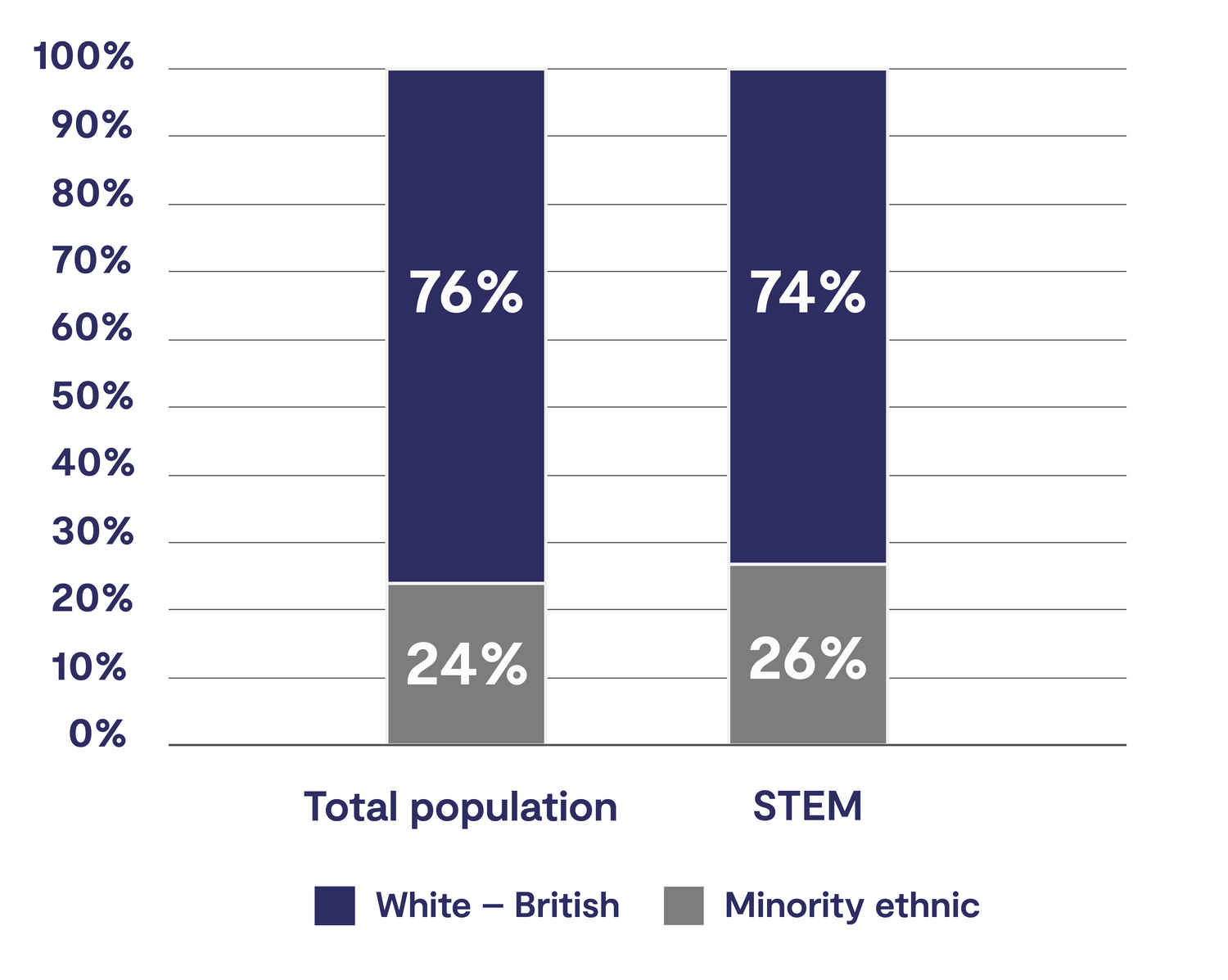
Figure 3: ethnicity split for STEM pay scales compared to the total UKRI population
How we are fostering a more inclusive UKRI
UKRI is committed to creating an inclusive culture that supports a diversity of people, ideas and skills, where everyone can thrive and achieve their full potential. We continue to deliver against the priorities set out in our Workforce Equality, Diversity and Inclusion (EDI) Plan, with progress shared annually in our Workforce Equality Monitoring Report. This work forms an essential foundation for addressing our gender pay gap over time.
Below we outline key areas of focus that contribute to creating the conditions for improved gender equity across UKRI.
Building a culture of dignity, respect and inclusion
In 2025, we launched a new suite of mandatory training modules to equip colleagues with the skills, knowledge and confidence to tackle bullying, harassment and discrimination, and to contribute to a more inclusive workplace. The training reinforces how UKRI meets its statutory responsibilities and highlights ways we can all positively influence the culture we are collectively building in the workplace and wider research and innovation system.
This work strengthens the organisational environment needed for equitable progression, retention and representation, which are all key levers for reducing the gender pay gap over the longer term.
Inclusive leadership
In 2025, UKRI piloted an organisation-wide Reverse Mentoring Scheme, in partnership with the Reverse Mentoring Practice. Colleagues from protected characteristic backgrounds were partnered with senior leaders from a range of business areas. The programme supported purposeful conversations about lived experience, workplace culture and barriers to inclusion.
Insights gathered are helping leaders develop a deeper understanding of how policies, processes and everyday interactions affect colleagues differently, thereby informing more inclusive and equitable decision-making where they hold responsibility.
Preventing sexual harassment in the workplace
We developed a comprehensive toolkit to improve colleagues’ understanding of sexual harassment and inappropriate behaviours in the workplace and clarify the standards UKRI expects. The toolkit provides supportive resources and signposts to routes for seeking support or reporting concerns. Alongside this, mandatory training was launched to provide foundational knowledge on the subject for all colleagues.
Supporting staff networks
All our staff networks have continued to provide valuable support to both UKRI and their members. Our networks have collaborated on several events across 2025 offering an intersectional approach to understanding and working towards achieving gender equity.
Women and Gender Equity (WaGE) have been raising awareness and challenging the organisation on its practice around inclusive recruitment and menopause support.
In 2025, a menstrual health conditions peer support group was introduced. The group offers a safe space for affected colleagues to share experiences, offer support, and discuss ways UKRI can better support colleagues with these conditions, noting the potential impact of these conditions on career experience and progression.
Inclusive policy changes
UKRI aims to be a family and carer friendly employer. In 2025, we introduced several enhancements to our policies, guidance and toolkits to support colleagues. We raised awareness and improved clarity around shared parental leave and produced a helpful guide to support colleagues in navigating their options. We also enhanced maternity support, with eligible colleagues now able to access three weeks of maternity support leave at full pay.
These initiatives represent important foundations for long-term progress. While some impacts will take time to show in our gender pay gap, UKRI is strengthening the culture, policies and leadership behaviours that enable fairer progression and better outcomes for all colleagues. We remain committed to sustaining this work and driving meaningful change.