
Foreword
One of the UK’s biggest assets is the quality of our research and innovation (R&I). It affects all our lives and our livelihoods. UK Research and Innovation (UKRI) stands at the heart of this, powering progress across the UK. That’s why I think it’s one of the most important organisations in the country.
Each year we are entrusted with more than £9 billion of public money to invest in R&I to deliver outcomes for the UK public. As the largest national R&I investor in Europe, we support everything from the arts, humanities and social sciences, through biology and life sciences, to physics and engineering. Our partnerships with universities, institutes, national labs and innovative companies shape the UK’s future.
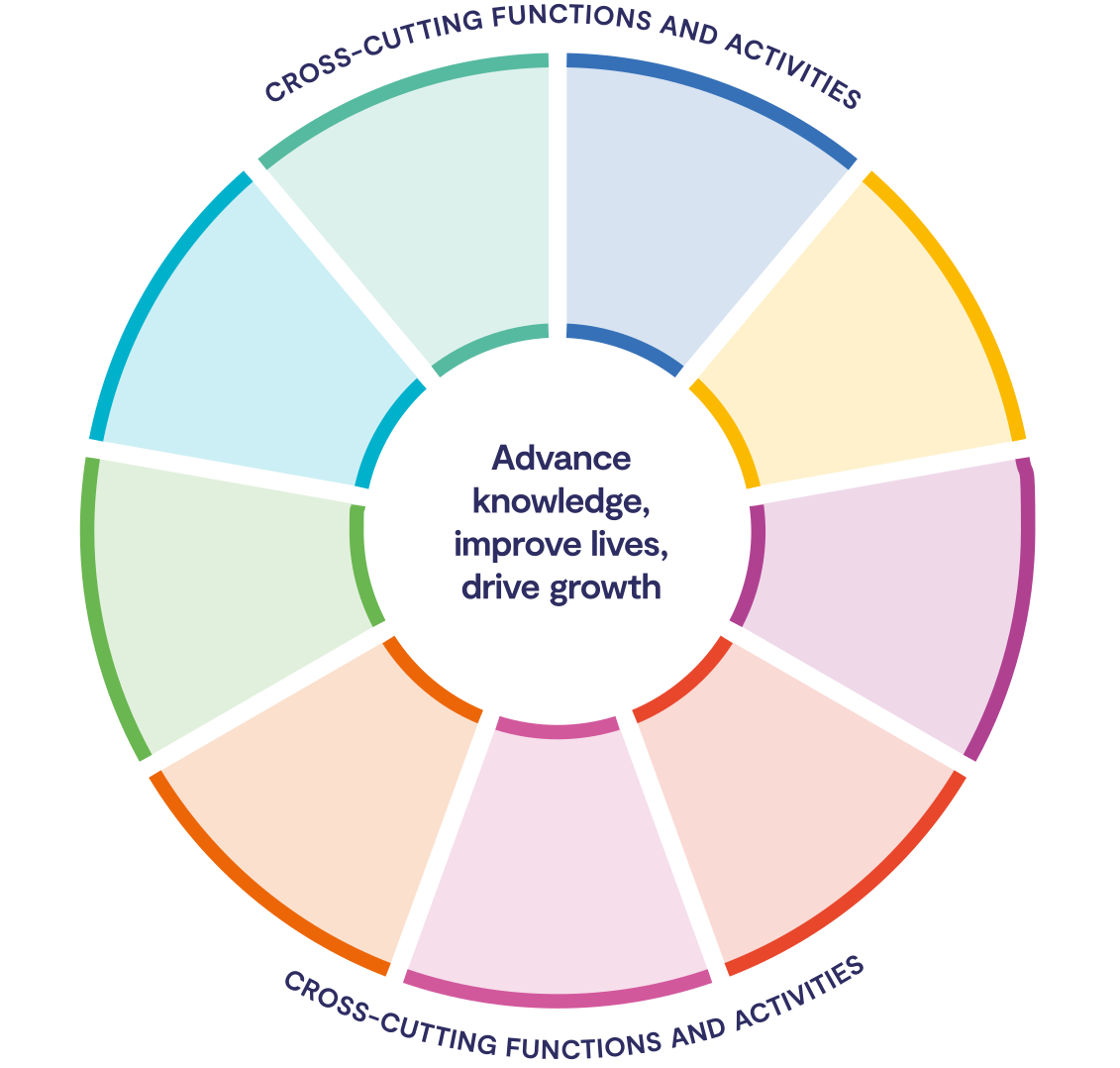
Our mission is simple but powerful and ambitious: advance knowledge, improve lives and drive growth. Each element matters. A knowledge-driven economy thrives on curiosity-driven research, sparking ideas that fuel innovative products and services with the power to change lives.
UKRI is at its best when these parts work together. Enabled by the scale and breadth of our research, we can pave the way for the future of the UK’s four nations: enhancing the UK’s talent and skills base, driving innovation, and improving our health, security and environment. We can turn today’s innovative companies into tomorrow’s industry giants, creating quality jobs and powering economic growth across regions and nationally.
UKRI was established to bring strategic coherence to the national R&I system, enabling multi-disciplinary research at scale, and to ensure that R&I delivers prosperity for the UK public. Having laid the foundations of a united UKRI with extraordinary breadth and remit, the next five years will see us deliver our mission.
UKRI is changing to realise this potential. Over the next five years, we will show a clear line from our mission to our money, from our strategy to our spending. Almost half of our budget will back discovery and curiosity-driven research. Our unrestricted schemes allow researchers to pursue transformative ideas in any discipline, and our block grant funding for universities in England provides the flexibility to explore novel ideas while maintaining longer-term stability.
The other half of our budget will focus on high-growth sectors that deliver more immediate outcomes, supporting companies to start, scale and ultimately stay in the UK. Here, we will be more selective, doing fewer things, better.
Meanwhile, we’re streamlining our decision-making and sharpening our focus on delivering outcomes. We need to elevate our partnerships with investors and delivery partners, at home and abroad, from transactional to strategic. We need to be clearer about our long-term plans and how our interventions fit together, reducing risks for our partners.
Leading UKRI is a huge privilege. Now more than ever the UK public, our investors, count on us to deliver. I am excited to work with all our partners to ensure we do just that.
Professor Sir Ian Chapman, UKRI Chief Executive
UKRI at a glance: organisational structure
Introduction
Our strategic challenges
The world is changing, and fast.
Governments worldwide are seeking ways to stimulate growth, help innovative companies scale, tackle regional economic inequalities, and raise living standards. Technological changes are creating new markets and driving service innovation. Geopolitical forces are introducing new uncertainties and security risks.
Rising demand, driven in part by an ageing society, is putting renewed pressure on health and care systems, and crowding out wider public investment.
Societies are also grappling with wider challenges, from decarbonising energy systems to finding new ways to keep citizens safe in their communities.
These challenges are real. In the UK, long-term growth has fallen to 1.5% over the past 15 years, while healthy life expectancy has stalled. We face renewed security threats from both state and non-state actors. And despite progress in decarbonising our energy systems, heat and transport remain expensive and carbon-based.
R&I cannot solve all these societal challenges on its own, but it can be central to addressing them. While we recognise that R&I cannot always offset the broader factors holding back UK productivity, and that the UK cannot pursue every area of global R&I at scale, evidence shows it can be a key driver of economic success. Time and again, R&I has delivered novel, cost-effective solutions to security, health and environmental challenges, improving lives and livelihoods.
The strength of the UK’s research base is one of our key national assets. Past R&I investments made by UKRI and partner bodies, in some cases dating back more than a decade, are helping us now while also providing solutions for the future. The choices we make over the next decade will be critical in shaping the nation’s path forward.
UKRI’s strategic priorities in response
UKRI must be at the heart of this response.
We account for two-fifths of all public investment in R&I across England, Northern Ireland, Scotland and Wales. We are one of the few public research investors in the world to cover every research discipline with investments that span curiosity-driven research through to company scale-up. Our investments have real-world impact, delivering benefits locally and nationally across the UK, from support for the COVID-19 vaccine, influencing national policies, and backing world-leading start-ups.
This puts us in a unique position to lead from the front. Working with partners across universities, centres, institutes, Catapults and units, investors, charities, large and small companies, and local and national governments, we can build on our tremendous national assets and improve people’s lives.
Our strategy sets out a clear direction for UKRI over the next five years, recognising that the policy, economic and global context will continue to evolve. It is designed to provide a consistent framework for action, aligned with government priorities, with enough flexibility to respond to new priorities and emerging opportunities. It builds upon our budget allocations, published in December 2025, which sets out our new outcome-focused approach to investment.
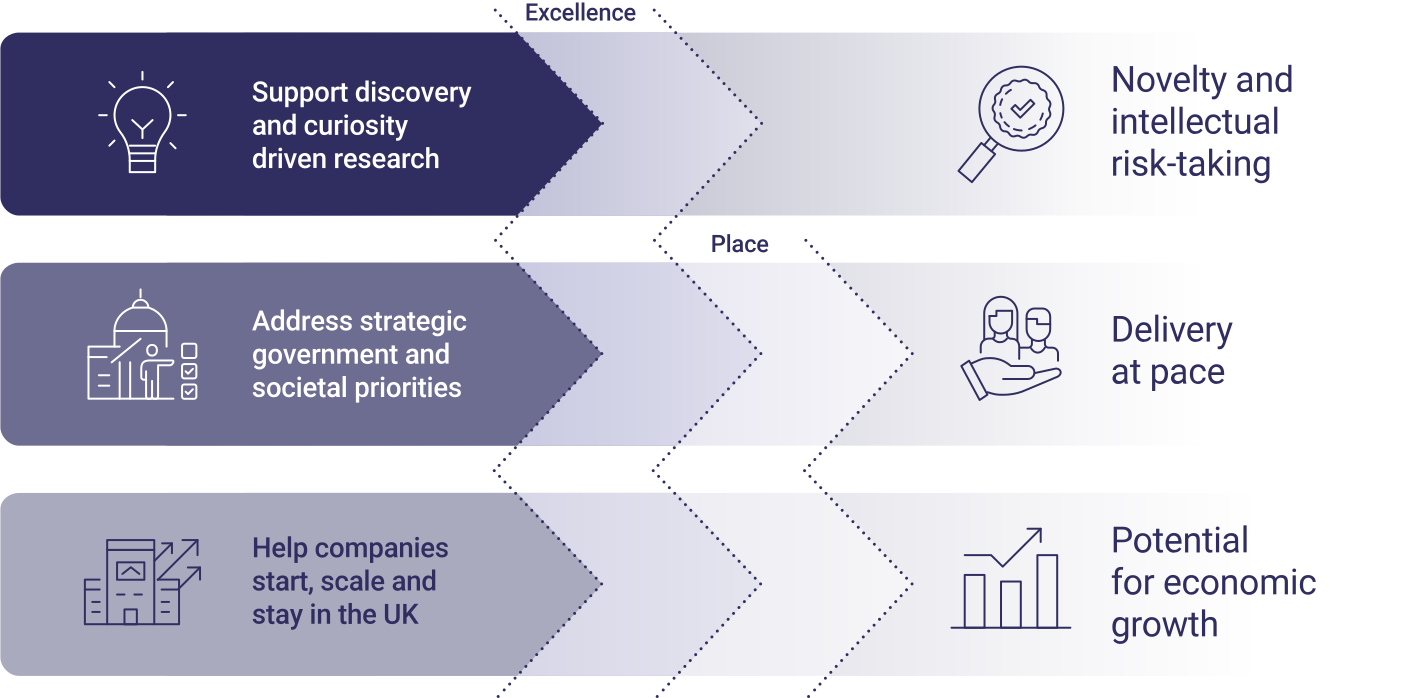
Through our new mission to advance knowledge, improve lives and drive growth we will focus on three priorities.
Support discovery and curiosity-driven research
Investing at scale in UK-wide applicant-led research and block grant funding for English universities, we will ensure UK research remains world-leading, and encourages novelty and intellectual risk-taking.
Address strategic government and societal priorities
We will take a new approach to investing through our Priority Programmes in areas such as AI, clean energy and the creative industries. These investments will benefit all parts of the UK, informed by co-creation with regions, and will take account of where the UK has the potential to be at the forefront of global R&I.
Help companies start, scale and stay in the UK
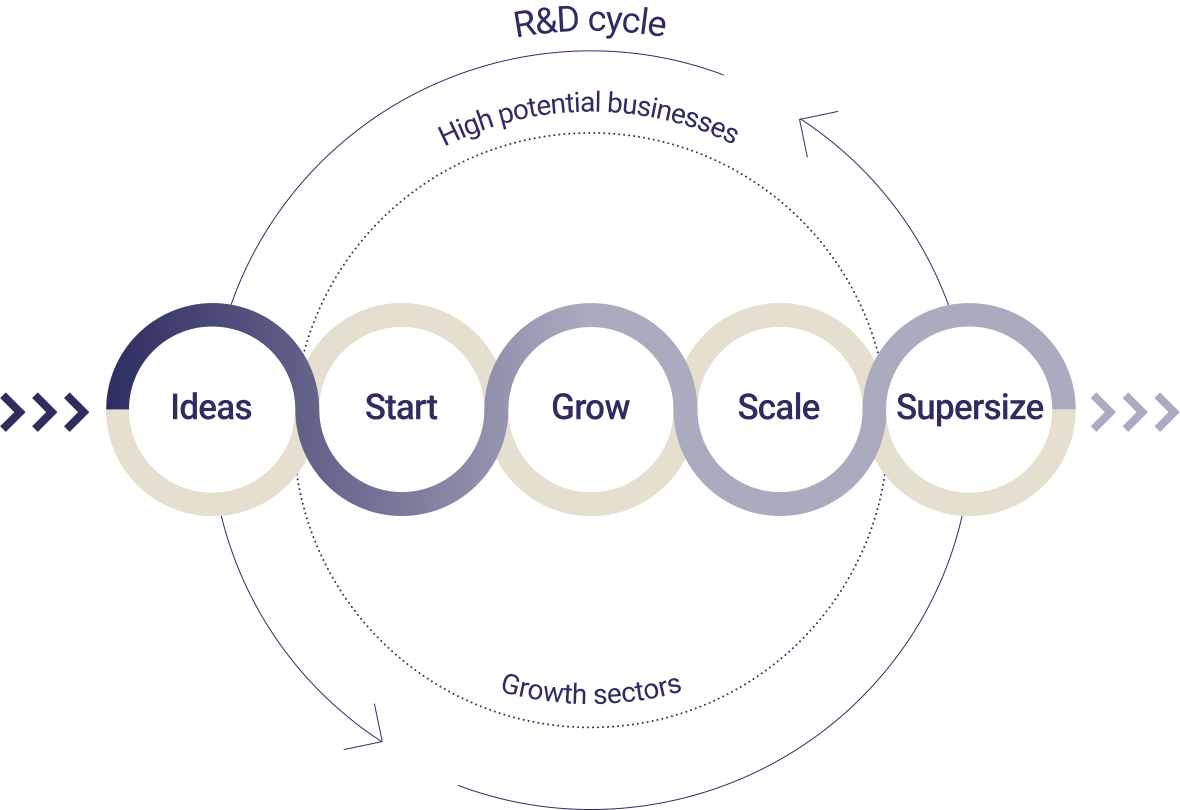
UK companies will shape the nation’s economic future. The UK leads Europe in spin-out value per country, yet few grow into larger companies and fewer still into giants. We want to change that. Resources will be focused on individual businesses and in wider sectors with the greatest growth potential.
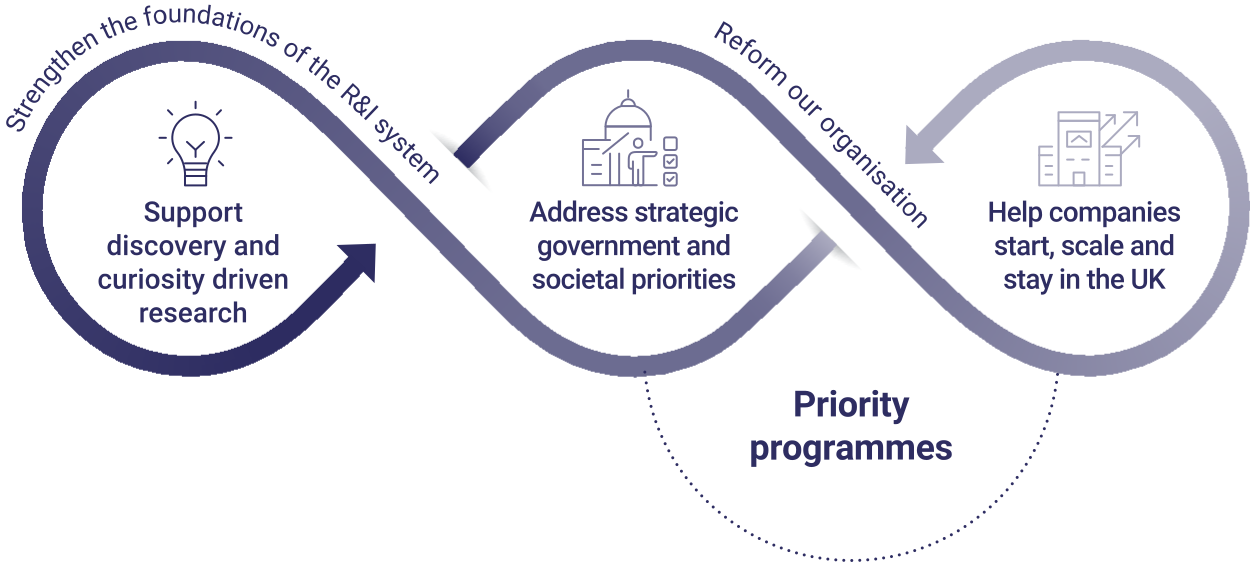
These priorities are not standalone. They are designed to work together as a connected system, reinforcing each other. Discovery and curiosity-driven research fuel insights that translate into real world impact. They create the distinctive value that drives economic impact through established firms, and powers innovative companies as they scale. Ideas emerging from our investment in discovery and curiosity-driven research will inform and strengthen Priority Programmes addressing national challenges. Successful outcomes will in turn be translated into high-potential companies that deliver economic and societal impact across the UK.
The pathways that lead from discovery to application, and on again to company creation, are nonlinear and will look different for everyone. But UKRI has the capability and the expertise to support researchers and innovators in this important journey.
We will always make investment decisions that support excellence. We will also value different additional factors across the three priorities which make up our portfolio.
Within discovery and curiosity-driven research we will look for novelty and intellectual risk-taking. Our investment in government and societal priorities will value social impact, local benefits, and the ability to create partnerships and deliver at pace. Our support for companies will identify market sectors with the highest growth potential, where the UK can secure the largest economic return and where UKRI’s involvement can create new value.
We cannot realise the ambitions of our strategy without investing in the foundations of the R&I system and reforming our organisation. Over the next five years we must also do the following.
Strengthen the foundations of the R&I system
We will continue to support critical national infrastructure (including our world-leading specialist centres, institutes and Catapults and units), our world-leading talent and our international partnerships. This fulfils our unique role as the only public body investing and coordinating people and activities across the entire R&I system.
Reform our organisation
We will become more agile and adopt new technology to improve the transparency, effectiveness and efficiency of UKRI. We will speed up grant-processing times for applicants, and we will measure progress through a single UKRI delivery plan, published annually.
We will invest heavily in universities and in national research organisations, including our specialist centres, institutes, Catapults, units, sustaining an institution base that fosters breadth and diversity by design. We will ensure the UK stays at the frontier of collaborative, multi-disciplinary research.
Alongside stewarding public funding, we will place greater emphasis on unlocking substantial additional investment into the UK R&I system. We will grow our overall impact, building on the intellectual property, data, talent and assets that UKRI helps to create.
The result will build on eight years of progress since our formation in 2018 and enable UKRI to take full advantage of its unique position in the R&I ecosystem.
Place
Continuing to invest in local R&I strengths across the four nations is essential to support the delivery of our strategy. Between 2021 to 2022 and 2024 to 2025 our investment outside the Greater South East increased by 30% compared to 12% in the Greater South East.
From 2031, Mayors of established mayoral strategic authorities will have the ability to decide how and where to target regional R&I investment as we devolve our £500 million Local Innovation Partnerships Fund.
1: Support discovery and curiosity-driven research
Discovery research is the engine of new knowledge. It deepens our understanding of the universe and our place in it. It’s also where truly transformational discoveries and novel ideas are most likely to arise; the breakthroughs that underpin innovation and ultimately change lives and livelihoods. Curiosity-driven research where researchers shape the agenda, ensures that the brightest ideas can be explored.
Discovery and curiosity-driven research also accelerate applied research. They support the adoption of emerging technologies, fuel economic competitiveness and strengthen the UK’s resilience. At a time of increased global and environmental instability, they enable us to respond to existing and unforeseen challenges.
They are the source of the UK’s R&I strength. That’s why they remain a top priority for UKRI.
We supported over
53,000
individuals from
2018-19 to 2024-25
We are the largest funder of discovery and curiosity-driven research in the UK, and we are committed to supporting and sustaining investment, growing as the economy allows.
People, skills, and vital capabilities such as infrastructure are the foundations of discovery and curiosity-driven research. Without investment in these areas, transformative discoveries would not exist.
Our commitment to ‘Strengthen the foundations of the R&I system’ sets out how we will continue to support researchers and innovators, including training future generations, to ensure that novel ideas across all disciplines have space to thrive. Crucially, we will provide researchers with freedom to take risks and empower them to set the research agenda.
We supported almost
11,000
organisations from
2018-19 to 2024-25
We know that impact from researcher-led projects may not emerge for decades, but this foundational discovery remains central to our task of improving lives and livelihoods in the future.
We will:
- invest £3.3 billion over the next four years in applicant-led, discovery research through our seven research councils, ensuring broad disciplinary and interdisciplinary health
- sustain the UK’s levels of global top quality research outputs and contribute to maintaining a high global ranking in field-weighted citation impact
- invest £8.9 billion into quality-related research funding to English universities over the next four years
- review the effectiveness of our block grant funding and allocation mechanisms in England
- deliver a research assessment system that encourages excellence, impact and strategic research environments
- invest £2.3 billion on the capabilities that allow discovery and curiosity-driven research to thrive
- build transparency and trust by championing open access and supporting change in publication practices
Impact: Oxford-AstraZeneca COVID 19 vaccine
UKRI investment underpinned the development and global rollout of the Oxford–AstraZeneca COVID 19 vaccine, estimated to have saved 6.3 million lives worldwide in the initial year of global vaccine rollout. Over 3 billion doses were distributed to more than 170 countries between 2021 and 2024.
The vaccine emerged from a substantial legacy of UKRI investment from the early 2000s. Through careful strategic planning, the university was able to build on UKRI grant funding for specific vaccine programmes to develop a ‘plug-and-play’ adenoviral vaccine platform, ChAdOx1, that was designed to rapidly respond to emerging pathogen threats. This investment meant that the team had the perfect platform when COVID-19 hit and, drawing on previous UK government funding for other coronaviruses, enabled an unprecedentedly rapid response to COVID 19.
The team worked with international partners to deliver a comprehensive clinical trial at pace, demonstrating vaccine efficacy of more than 70% after two doses of the vaccine, in work published less than a year after the virus sequence was first shared. In parallel, the UKRI-funded Future Vaccine Manufacturing Research Hub contributed to process development for these vaccines, vital in ensuring a safe, effective vaccine could be produced in large quantities for a low price.
Impact: semiconductors in Wales
Researchers at the Centre for Integrated Semiconductor Materials (CISM) at Swansea University have established the first 4-inch thin film gallium oxide capability in the UK. This is a type of next generation semiconductor material that can more efficiently support the high voltages, power densities and frequencies required for applications in electric vehicles, renewable energy sources, 5G communications and reduce power consumption in AI data centres.
The breakthrough was achieved using new UKRI-funded technology that can precisely produce or ‘grow’ high quality crystalline thin film gallium oxide on substrates, known as wafers. CISM is now set to become a national hub for thin film gallium oxide research, accessible to academic and industrial partners.
The significant milestone is key to the development of more efficient, compact and cost-effective electronic devices and demonstrates the increasing semiconductor manufacturing and innovation capabilities of the South Wales advanced semiconductor cluster.
The South Wales Advanced semiconductor cluster spans the entire innovation chain, from discovery research to market-ready products, with technology applied across healthcare, digital communications, clean energy, transport and national security. The cluster has generated £436 million for the Welsh economy, creating over 3,000 jobs across Wales.
Protect and promote support for discovery and curiosity-driven research
Taking risk enables discovery. By investing in bold, high-risk ideas within and across both established and emerging fields, we will drive innovation and transformation. We will do this by backing outstanding people, cutting‑edge research infrastructure and ambitious projects.
Setting rigid outcomes or priorities limits exploration, so we will let researchers shape agendas themselves. Through our research councils, we will invest more than £3.3 billion supporting the best ideas through our open funding calls, operating across the full breadth of disciplines. While risk is inherent, we will work closely with all delivery partners to ensure public money is invested responsibly, using increased collaboration to reduce duplication and deliver greater impact. To reach our ambition of directing almost half of our budget towards discovery and curiosity-driven research, we will include a proportion of our investment in the foundations of the R&I system to this total, reflecting their critical role in supporting discovery.
Importantly, we will engage and work with the research and innovation base to identify and foster new areas of discovery and curiosity-driven research that will maintain the UK’s global position at the forefront of advancing knowledge.
Discovery and curiosity-driven research will be further supported through recurrent strategic research block grants for higher education institutions in England, as set out in the next section. This type of funding is critical to let researchers explore novel research ideas and to maintain longer-term stability across the R&I ecosystem.
We will also contribute to maintaining a high global ranking in field-weighted citation impact, through our investments driving high-quality research outputs.
Research strengths
of the world’s population in the UK
of the world’s academic publications
of the world’s most highly cited publications
of UK-linked articles feature in the top 10% most cited worldwide
of UKRI-linked articles feature in the top 10% most cited worldwide
Maintain flexibility through block grant funding in universities
We fund both sides of the dual support system. Applicant-led research grants delivered by the research councils, and our new Priority Programmes provide support for specific projects; Research England delivers block grant quality-related research funding to English higher education institutions. Block grant funding across the UK plays a vital underpinning role, addressing funding gaps and providing the stability and flexibility for institutions to pursue ambitious, long-term research strategies that would not otherwise be possible.
We will sustain core quality-related funding for English universities in real terms, investing at least £2.2 billion a year over the Spending Review period, nearly a quarter of UKRI’s entire budget. This will maintain the balance of dual support at around 64p for every £1 invested over the spending review period.
The proportion of research performed through universities is a source of distinctive strength in the UK. This unrestricted funding provides support for people, the research infrastructure they use, and the environments in which they operate. It anchors long-term strategic partnerships, allowing universities to pursue opportunities and collaborations across sectors, disciplines and regions.
These are the critical foundations of the UK’s R&I system. It is these foundations which ensure discovery and curiosity-driven research can thrive.
Changes to our allocations approach for strategic institutional research funding in England will be implemented by the end of the Spending Review period. We will continue to review the effectiveness of our block grant funding and allocation mechanisms beyond this period.
The distinctive nature of the UK’s funding system also means that universities are not just recipients of funding, they are also important co-investors. They increase funding from industry, public services and other investors. They are willing and able to collaborate with other universities, both domestic and internationally. Universities across the whole of the UK are genuine partners in long-term and novel initiatives.
Lead global standards in research assessment
Research assessment ensures investment goes where excellence thrives, but excellence comes in many forms. We will work with the UK’s other higher education funding bodies and collaborate with our international peers to stay as global leaders in research assessment. We will deliver a system that recognises a diverse range of research outputs and encourages research excellence, impact and strategic research environments.
Working with universities and other major funders, we will continue to review how our institutional research funding operates in England. Our review into institutional research funding will work to deliver the ambition set out in the Post-16 Education and Skills White Paper. We will encourage universities, as autonomous institutions, to specialise and collaborate in ways that build the critical R&I capabilities the nation needs.
Ensure curiosity-driven research can thrive
We will invest £2.3 billion on the capabilities that support discovery and curiosity-driven research: our world-leading centres, institutes, Catapults and units, our international partnerships and top-tier infrastructures.
Metascience is at a turning point, and we have an ambition for the UK to be world-leading in metascience research within the next five years. We will harness its power, using UKRI and the Department for Business, Innovation, Science and Trade’s (BIST) joint Metascience Unit to steer the research system intelligently and amplify the impact of curiosity-driven research.
AI is redefining curiosity driven research and opening new routes for discovery, simulation and analysis. We will empower researchers to adopt and use AI creatively and responsibly, ensuring the UK leads in both developing and applying these tools. In doing so, we will ensure research methods are improving, not undermining, the integrity and quality of scientific research. The Metascience Unit will carry out research to better understand the adoption and diffusion of AI across different disciplines and career stages.
Strengthened open research policies and sustained Open Access investment will accelerate transparency and trust. We will keep building the evidence base that guides and sustains sector-wide change in publishing.
2: Address strategic government and societal priorities
Over the Spending Review period we will target our investments to boost economic growth, improve health and wellbeing, protect the environment and strengthen national security and resilience.
We will create new interdisciplinary programmes designed to deliver government and societal priorities, and to drive innovation across the UK. These new Priority Programmes will identify the areas where the UK should pursue sovereign leadership, the roles it should take, and the outputs needed to succeed.
We will be selective about interventions we make in any sector to maximise the return for the UK. Collaborative working with the UK and devolved governments, with industry, businesses and charities, and with international partners, are vital to realise our ambitions. We will continue to harness the critical role of national research organisations in supporting major government priorities and delivering economic growth.
UKRI will target £6.8 billion of investment across the government’s priority growth sectors, focusing on areas where the UK can lead globally and where funding can unlock the greatest economic and societal impact. As part of our ambition to help companies start, scale and stay in the UK, we will invest a further £5.1 billion to support innovative companies, both new and well-established, operating across the industrial strategy sectors and the government’s wider priorities.
Our investment will support a range of initiatives targeted to drive growth and create impact in each priority area. These might include infrastructure investment, accelerating the commercialisation of products, and collaborating with our partners.
We will also invest in skills and training programmes, delivering our priorities depend on a strong skills pipeline across every sector. We will work with government and our partners to identify gaps, develop talent and ensure expertise is deployed where it is needed the most.
Our new Priority Programmes mark a change in our approach to investment. Truly multidisciplinary, they will operate across the full breadth of UKRI and will be developed and delivered in close partnership with UK government. Portfolio balance and investment priorities will be overseen by dedicated programme boards with membership that draws upon senior UKRI expertise and partners in UK government and devolved administrations, as well as independent experts. This will ensure strong alignment between policy objectives, investment choices and delivery.
Over
£9bn
annual budget
making us the largest national R&I investor in Europe
We will map our priorities to the UK government’s strategic priorities, including the Industrial Strategy growth sectors (IS-8) and frontier technologies, underpinned by the Plan for Change. Investment delivered through the new programmes will drive economic growth, with many of them addressing societal challenges.
We will also identify specialist technologies where the UK can strengthen its global role and leverage, build influence, support allies and gain strategic advantage. Across the portfolio we aim to secure an average of £3 of additional investment for every £1 of public funding, with some sectors achieving an even greater return.
UKRI’s ability to bring together the sciences, arts, and humanities is one of our core strengths. The Priority Programmes are an opportunity to lean into this strength, bringing together a breadth of disciplinary knowledge to solve societal problems.
While we want to foster breadth across our universities, we also want to encourage universities to focus on their research strengths. We will enable universities to be broad enough to form multidisciplinary teams within and among organisations, while supporting specialisation to help grow the UK’s comparative advantage, through increased excellence and a more sustainable research base.
We will:
- target £11.9 billion of investment over the Spending Review period across the industrial strategy sectors and the UK government’s wider priorities
- accelerate growth and innovation in the UK’s most strategically important sectors, converting research excellence into commercial, societal and security outcomes
- target an average leverage ratio of at least £3 of private investment for every £1 of public investment across our Priority Programme investments
- invest £750 million to build the digital and compute infrastructure the UK needs to secure its place as an international leader in computational resources
- translate mission-driven research into real-world impact, investing £500 million through the R&D Missions Accelerator Programme
Impact: Scotland-led research partnership delivers worldwide societal outcomes
Non-governmental organisations (NGOs) around the world can now operate more sustainably, uphold fair pay principles and improve staff wellbeing around the world thanks to UKRI-supported research.
A UKRI grant awarded to researchers at the University of Edinburgh in 2007 explored performance and pay discrepancies between local and international staff in global organisations. Follow-up UKRI support enabled Project Fair to grow and scale, developing knowledge-sharing, free resources, and paid training, conferences and membership for NGOs worldwide.
To date, it has engaged more than 100 organisations, operating in 190 countries, and has positively affected more than 178,000 employees.
Impact: protecting North East communities through innovative natural flood defences
A Northumberland village that flooded seven times in eight years has been protected since 2010 thanks to the introduction of innovative natural flood management techniques.
The pioneering ‘soft-engineered’ scheme at Belford, based on UKRI and Environment Agency funded research, used ponds and ‘leaky’ dams to divert, store and slow flood water. The project cost 90% less than the alternative: a £2.1 million dam.
The scheme’s success paved the way for investment of more than £15 million in natural flood defence initiatives across the country. These projects also offer additional benefits in terms of greater biodiversity, improved soil and water quality and increased carbon capture. This scheme is part of decades-long policy and research partnerships to improve flood management.
Invest in our new Priority Programmes
From life sciences and advanced manufacturing to financial services and creative industries, a central pillar of the UK’s future prosperity is founded on supporting growth sectors and mapping them with regional and national strengths.
Our investments will drive regional economic growth and we will give careful thought to the best models for supporting the place agenda. AI and digital technologies will cut across priority sectors, and digitalisation will be embedded across all programmes.
Investment priorities across our new programmes include the following.
Digital and technologies (£4 billion)
Artificial intelligence
We will drive innovation in AI by focusing on six priority areas:
- advancing AI technology development
- transforming research through AI
- developing AI skills and talent
- championing responsible and trustworthy AI
- accelerating innovation for economic growth and societal benefit
- building world-class AI data and infrastructure
We will build the data and compute infrastructure for projects at all scales, deliver the UK Compute Roadmap and ensure robust assurance systems for safe AI in regulated settings. We will implement our first AI strategic framework, which sets out how we will turn research into practical benefits for everyday life.
Our investments will maintain the UK’s position as a global leader in explainable human-in-the-loop systems, agentic AI, edge computing and sustainable models, with a stronger UK tech ecosystem that accelerates domestic AI champions.
AI adoption is central to achieving our mission. In addition to direct investment in our Priority Programme, UKRI will also invest in this area through our curiosity-driven research and broader programme investments, meaning total investment in AI across the Spending Review period will be more than £1.6 billion.
Quantum technologies
Building on the success of the UK’s National Quantum Technologies Programme, we will accelerate the shift from world-class research to commercial products and large scale deployment. Our priority investments will scale quantum computing hardware and software, advance quantum sensing, imaging and timing, and tackle the challenges of quantum-secure communication networks across key sectors. We will provide continued support for the training and skills required for the UK quantum ecosystem across different career stages and skills levels.
Engineering biology
To secure the UK’s position as a trusted global leader in engineering biology, we will back safe, responsible breakthrough research and support faster commercialisation and scale‑up of high-potential companies. We will strengthen UK infrastructure, cross-sector partnerships, workforce development and responsible innovation. Priorities will include health, manufacturing, food systems and environmental resilience.
Advanced connectivity technologies (ACT), cyber security and semiconductors
Investments in ACT underpin the UK’s critical national infrastructure, enabling secure, resilient and energy‑efficient data transmission. Our focus starts with two challenges: Secure and Resilient Networks and Sustainable Networks. These investments will accelerate the translation of research into real-world solutions and support UK strengths in the sector.
Ensuring resilience and secure operations in a digital world needs constant innovation in cybersecurity tools and approaches. We will prioritise growing cyber security skills and supporting continued commercialisation of novel approaches that can keep the UK’s people and businesses safe from cyber threats.
Semiconductors are needed for a wide range of products vital to UK prosperity and national security. We will prioritise building on the UK’s core strengths in semiconductor design and intellectual property, compound semiconductors and optical interconnectors, ensuring the UK leads in key areas of the global semiconductor industry.
Life sciences (£1.5 billion)
By turning biological discovery into real‑world impact, we will improve health outcomes, strengthen the NHS and grow world‑leading UK life science companies. We will prioritise investments in:
- major diseases
- prevention
- data-enabled diagnostics
- next-generation medicines and medtech
- innovations that support the NHS shift from hospital to community care
We will unlock the full economic potential of the UK life sciences sector, attracting investment from global pharma and medtech industries, and ensuring the UK remains a global leader in biomedical R&I.
Advanced manufacturing (£1.3 billion)
Advanced manufacturing can improve productivity and growth, enabling more efficient and resilient manufacturing systems with improved quality and reduced costs. We will prioritise manufacturing industries with the highest growth potential, including automotive, batteries, aerospace, space, advanced materials and agritech.
We will also support the development and deployment of cross cutting manufacturing technologies and platforms. These include robotics and intelligent automation, sensing and instrumentation, additive manufacturing and digital infrastructure. This will improve coordination across sectors.
Agritech
We will harness UK strengths in precision technologies, including robotics, AI enabled systems and engineering biology, to drive a technology led transformation of UK agriculture. We will deliver user led solutions that boost productivity, build climate resilience and reduce emissions. These investments will also attract private investment and support a sustainable, globally competitive UK agritech industry.
Clean energy (£1.2 billion)
Clean energy technologies can deliver both a secure, low-carbon energy system and growth for the UK. Building on the UK’s technological strengths, we will secure key parts of the supply chain, from wind turbine blades to novel fuels for nuclear fission. We will back UK-developed autonomous and digital solutions for the energy system, both at home and as exportable services.
We will also create the long-term conditions for the UK to lead in the next generation of technologies in the 2030s, from turning fusion breakthroughs into UK power plant designs, to scaling up carbon-removal demonstrator projects.
Defence and national security (£555 million)
The current geopolitical landscape means it is a priority to make the UK safer at home and stronger abroad, and this requires scientific ingenuity. We will work with partners, such as the Ministry of Defence, to deliver growth and national security and defence priorities, leveraging their significant investments in R&I.
We will work collaboratively with our partners to develop a strategic framework that builds on areas of academic strength, anticipates future defence and security requirements, and creates growth opportunities. The framework will guide a programme of investments to deliver a pipeline of talent and skills, greater access to dual use R&I environments, and strategic advantage for a safer UK.
Creative industries (£369 million)
The creative industries are one of the UK’s biggest success stories. We will accelerate growth in the sector by leading efforts to increase public investment in R&I. We will deliver leadership in creative technologies, driving sector and spillover benefits. We will maximise the potential of UK intellectual property.
We will enable this through:
- seamless support for breakthrough ideas, from early-stage research through to commercialisation
- continued investment in Creative Industries Clusters that help regional and city hubs to foster innovation, attract investment, and create jobs
- investment in skills and talent, international partnerships and policy
This will help create a thriving creative and cultural economy, with more people able to access and benefit from culture and creativity.
Professional, business and financial services (£118 million)
We will invest in targeted research to boost competitiveness in the UK’s financial, professional and business services sectors at a time of significant technological change. Working closely with leading firms, ambitious new entrants and innovators, our investments will support the regulatory and standards innovation needed to make the UK the best place to deliver high-value services. We will also promote access to public data to support radical innovation and support the growth of challenger firms and new business models.
Wider priorities (£2.9 billion)
Alongside investing in priority IS-8 sectors, UKRI will support a wider set of critical environmental and social outcomes with over £2.9 billion over four years, with the flexibility to remain open to emerging priorities.
Improve the UK’s resilience
Using insights generated from our global leadership in environmental modelling, we will ensure physical and social systems are resilient and well adapted to a changing climate in line with the National Adaptation Programme.
Strengthen the UK’s position in space
We will establish UKRI as the trusted delivery organisation for space R&I, enhancing the UK’s global space capability. We will prioritise areas needed to deliver the one-government ambition for the National Space Strategy.
Food and animal & plant health
Harnessing UK strengths in food, animal and plant sciences, we will deliver innovation across the food system and advance One Health outcomes for people, animals, plants and ecosystems. Through advances in agriculture, nutrition and life science, we will strengthen resilience, sustainability and biosecurity.
Additional priority investments
Developed with government departments and the R&I community, our £500 million Research and Development Missions Accelerator programme will help tackle key research problems facing the government’s five national missions. Each challenge will have clear and measurable targets with specific deadlines for real-world impact. Projects that are not delivering are expected to stop early, so funding can be used elsewhere.
We will support delivery of the UK AI Hardware Plan, including investments which will support UK industry to develop AI hardware. This will complement a major investment of £750 million in digital research infrastructure set out in the UK Compute Roadmap. This investment will support the next national supercomputing service in Edinburgh, and the national computational resources and supporting software, data and skills required to maximise their impact.
We will continue to invest in translating research into robust evidence for better policymaking, working with government departments and What Works Centres on the UK’s most pressing challenges. A further £240 million will support our infrastructure, centres, institutes and Catapults and units and talent to deliver government priorities.
Impact: reforming policing of live music venues
The UKRI Bass Culture project, led by the University of Westminster, informed policy changes in live music regulation and policing. The project team played an important role in initiating and contributing to ‘State of Play: The Grime Report’ (2017), which combined cultural research with large-scale Ticketmaster data to demonstrate the commercial success of grime and challenge assumptions linking it to heightened risk.
This evidence was used by the UK government Culture Secretary’s team in the successful repeal of the Metropolitan Police’s ‘Form 696’, a licensing practice widely criticised for disproportionately restricting Black British music events.
3: Help companies start, scale and stay in the UK
Innovation powers productivity, growth and better living standards. The UK excels in discoveries, start-ups and spin-outs, yet when it comes to scaling, too many innovative businesses struggle or relocate overseas.
UKRI is uniquely positioned to support the bold ideas born out of universities, labs and communities, helping them grow into the industries of tomorrow. We want to make the UK a place where talent and ambition are not only recognised but realised. This means connecting the journey from discovery through to application and scale. We will ensure that the people, ideas and intellectual property created through this journey are supported to deliver lasting benefit within the UK.
Starting and scaling successful companies depends on people with the skills to turn ideas into products, lead teams and attract investment. We back the brightest innovators, offering credibility, connections and investment pathways that help them launch, grow and remain rooted in the UK. In doing so, we move deliberately from discovery, to application, to impact, providing continuity so that innovators we have supported at earlier stages can continue to grow with confidence in the UK innovation system.
Created at least
1,669
spin-outs since 2004
Working alongside the devolved governments and agencies with responsibility for economic development, skills, innovation and regional growth is critical to realising our ambitions.
UKRI plays a central role in this mission, providing targeted business support, commercial expertise and deep sector insight. To deliver on this ambition, we will evolve into an innovation service providing an integrated, end-to-end offer built around the needs of each business. We will spot potential earlier, tracking companies as they progress, and work with investors, corporations, government and the wider ecosystem to scale innovation in line with national priorities.
We will:
- establish a world-class, end-to-end innovation service, covering everything from early-stage research to scale-up finance, regulatory support and market creation, helping high potential UKRI-backed companies transform ideas into growth
- raise the proportion of businesses in our portfolio that have received private equity or venture capital investment
- refresh UKRI’s intellectual property (IP) policies and frameworks, anchoring IP exploitation and economic value from public investment in R&I in the UK
- promote a vibrant entrepreneurial culture and trusted pathways to capital, keeping value anchored within the UK
- strengthen domestic and global investor partnerships, improving visibility for UK businesses and helping innovators access the capital needed to scale
- review our knowledge exchange funding allocation method to boost capabilities across universities
Impact: driving growth in the North West’s thriving life sciences and bioscience cluster
UKRI Strength in Places Fund played a pivotal role in helping the Liverpool School of Tropical Medicine (LSTM) convert its research strengths into economic, health and societal outcomes. Since 2020 the LSTM-led Infection Innovation Consortium (iiCON) has leveraged more than £280 million in public and private investment, supported over 36 products and technologies towards market, and strengthened the UK’s infection innovation capability. It is directly contributing to UK industrial competitiveness and productivity in the life sciences.
This was supported by UKRI-backed knowledge exchange staff, business development and IP capability at the LSTM to translate research expertise into partner ready propositions: shaping bids, forming consortia, brokering industry and NHS partnerships, and sustaining long term collaboration.
Integrate support to raise the bar on quality
We will target investment towards businesses with the highest potential, prioritising those with the greatest scope for transformation, scale and national benefit. At the heart of this approach, our account-managed service Velocity will fast-track commercialisation of innovation, helping companies turn promising tech into scalable growth.
Drawing on our central role in the UK’s R&I system, we will identify and support promising companies earlier in their journey. Rather than one-off interventions, we will take a more active approach, stepping in at critical moments, providing tailored support over time, and stepping back as private investment takes over.
Accelerating businesses to scale
-
Support
Sector specific expertise and funding
-
Removing friction
For example via procurement, tech transfer, regulation
-
Velocity
A concierge approach to growing innovative businesses
Unlocking talent nationwide is essential for world-class businesses and widespread benefits. We will broaden participation in entrepreneurial activity and support a more diverse, inclusive pipeline of founders and leaders.
We will take a leading role as an ‘innovation service’ running managed programmes for government departments. We will strengthen the UK R&I system through partnerships with organisations such as the British Business Bank, National Wealth Fund and institutional investors to coordinate support and unlock new flows of capital into university funds and early-stage ventures.
Maximise the creation of high-potential businesses from UK research
Collaborative R&I, knowledge exchange, translation and research commercialisation are vital to support government priorities, and to drive regional and social impact. We provide essential bridges between the UK’s world-class research base and challenges faced in the wider world.
By enabling and encouraging entrepreneurship, we will empower researchers with the skills and support to turn their ideas into viable commercial opportunities, ready for development and investment.
A new framework will see us reduce the number of schemes we run, helping simplify our offer and making sure we use consistent terminology across UKRI. All our translation investments will use the framework, including those targeted at government and societal priorities and those driving forward innovation. The four schemes are:
- Prosperity Partnerships enabling collaborative R&I
- Impact Acceleration to test applicability of new ideas to commercial application
- Proof of Concept funding to test these ideas at scale
- Entrepreneurship training support
We will use the Local Innovation Partnerships Fund to work with local partnerships of civic leaders, businesses and universities to co-create place‑based investment portfolios that build on each region’s R&I strengths. This will support high‑potential innovation clusters to grow, attract investment and turn research into new products, services and businesses, creating local opportunities and jobs across the UK.
Anchor R&I benefits in the UK
We aim to maximise the economic, social and cultural value of UK-generated intellectual property (IP) and assets, and to create thriving businesses and skilled jobs that benefit the cities and regions where innovation happens and the whole of the UK.
By working with partners and establishing clearer, more consistent frameworks, we will reduce barriers to IP exploitation and ensure IP is commercialised effectively. We will also ensure our IP frameworks keep pace with emerging digital and AI‑enabled business models.
Fostering a more entrepreneurial culture will boost researcher and student engagement in spin-outs and start-ups. Our national reach and sector expertise will validate those top innovators and create trusted pathways to investment.
Impact: supporting women in innovation
Launched in 2016, our Women in Innovation programme champions women across the UK with the potential to be global industry leaders of the future. It supports their growth ambitions, while spotlighting them as role models for the next generation. The programme has invested over £15 million in more than 260 women innovators and built a thriving community of 11,000 women innovators.
Targeted interventions such as Women in Innovation have increased the proportion of successful women led applications across Innovate UK programmes from one in seven to one in three. Future support will focus investment where barriers are greatest and impact highest for inclusive economic growth.
Enable companies to access scale capital
UKRI invests more than £9 billion into R&I each year, but this is dwarfed by the private capital that could be invested into UK companies. As the largest public investor in research, UKRI has a uniquely privileged overview of the best research, the most transformative ideas, and the highest-potential companies, often well before those founders have even begun talking to potential investors.
We want to increase the appeal of UKRI-supported businesses for private capital. Over the next five years, we will increase the proportion of businesses in our portfolio that have received private equity or venture capital investment to greater than 55%.
We will actively oversee a portfolio of the highest-potential IP born from our investments. Alongside wider government action surrounding access to scale capital, procurement and regulation, we will work with both public and private investors, including the British Business Bank and National Wealth Fund, to connect those ideas to the capital needed to turn them into growing companies.
Strengthen the knowledge exchange capabilities of the higher education sector
Our knowledge exchange funding helps English universities work with partners to de-risk innovation, respond to local challenges and drive national economic growth. We will review the allocation method to encourage focus on government priorities. In the long-term, we will use improved data from our national knowledge exchange metrics programme to enable more robust performance measurement of knowledge exchange activities.
4: Strengthen the foundations of the R&I system
A robust R&I system depends on strong foundations. Our foundations support the curiosity-driven research that underpins our entire national innovation output, helps to translate new ideas into applications, and improves the lives and livelihoods of the UK public.
We will invest over £8.4 billion to nurture and sustain the foundations of the R&I system. This includes talent, places, international partnerships, infrastructure, and our world-class R&I campuses, facilities and centres, institutes, Catapults and units. Increasingly, these foundations also include digital infrastructure, data capability and AI-ready skills that enable the responsible and effective use of new tools.
Together, these foundations support a continuous and connected journey ensuring that advances in knowledge, societal impact and economic growth reinforce one another. Investment in these areas provides support critical to delivering our strategic priorities and realising our mission.
We will work with partners locally and nationally to shape and sustain the UK’s R&I ecosystem. We will work with local leaders across the UK to identify and build upon their strengths and comparative advantage, making them increasingly internationally competitive. Where this requires trade-offs, we will make decisions transparently, guided by evidence of local strength, national need and long-term impact.
We supported
27,000
postgraduate research studentships
2,000
fellowships a year from 2020-21 to 2024-25
UKRI champions a research environment built on academic openness, integrity, equality and inclusion. We will partner with researchers to ensure they have the supporting system to deliver high-quality outputs, and we will support environments where diverse talent can thrive.
We are prioritising safe, secure partnerships and reducing risks. As a global leader in best practice, UKRI will position the UK as a trusted destination for international investment and collaboration.
We will:
- establish stronger place-based partnerships, empowering local leaders, accelerating regional specialisation and driving long-term, innovation-led economic resilience
- target high-value international collaborations that enhance UK scientific influence, secure strategic advantage through major multilateral partnerships and break down barriers to global partnership
- invest over £3.4 billion in talent pipelines that build a diverse, entrepreneurial and globally competitive R&I workforce
- strengthen investment models and coordinate sector-wide action on system health and sustainability
- modernise governance and funding of essential national capabilities, ensuring strategic alignment and robust accountability
- invest over £2 billion in digital research infrastructure and sustaining critical assets
- expand public engagement and strengthen youth engagement programmes
Impact: securing critical minerals with evidence and insights led from the East Midlands
The UK Critical Minerals Intelligence Centre (CMIC) provides robust, independent intelligence that helps secure the UK’s minerals supply for net zero, advanced manufacturing and national security. Department for Business, Innovation, Science and Trade funding builds on decades of UKRI investment in exploring and mapping the UK’s subsurface resources through the British Geological Survey.
CMIC’s detailed insights enable government and industry to identify strategically important materials, including those needed to deliver the Industrial Strategy. They also shape responses to UK supply chain risks, and unlock domestic opportunities including informing existing projects such as lithium in Cornwall.
CMIC analysis is central to key policies like the Critical Minerals Strategy and supports investment decisions, with UK Export Finance using CMIC outputs directly to justify financing for critical minerals projects that strengthen UK supply chains.
Impact: pioneering projects in the North West to support separated mothers and babies
A pioneering social impact initiative rooted in UKRI-supported research at Lancaster University is helping mothers and babies separated close to birth due to safeguarding concerns. ‘Giving Hope’ helps preserve the mother-and-baby connection through HOPE Boxes, a therapeutic cross-agency offer designed to provide comfort, reduce trauma, and offer support as mothers and babies navigate child protection and family justice systems.
Supported by UKRI’s Impact Acceleration Accounts and SHAPE Catalyst, the boxes are now used across more than 30 health trusts and local authorities across England. In 2025, Giving Hope received a Stephen Lloyd Award which supports early-stage projects that have real potential to achieve practical, sustainable social change.
R&I campuses
We host more than 560 companies and 13,000 employees in seven R&I campuses spread throughout the UK.
Invest strategically in city regions and clusters to drive regional growth
Regional growth is critical to the UK’s long-term success. Impact is often greatest where investment is focused and coordinated around distinctive local strengths, such as regional assets, deep rooted industrial and innovation capabilities and strong local partnerships.
We will align our investments with local strengths, ambitions and skills to drive economic growth across the UK and enhance global competitiveness.
The Local Innovation Partnerships Fund adopts this approach to place-based investment. We will invest £500 million through the LIPF, bringing together local insight with our national perspective and business expertise. This will enable civic institutions, businesses and universities to co-create projects with UKRI, reinforcing local priorities and supporting innovation-led growth across the four nations.
Through our well-established relationships across the UK, we have a strong understanding of the assets and capabilities that underpin regional and national growth. Over the next five years, we will deepen our partnerships with devolved governments, city regions, and local leaders to ensure our investments are coherently aligned with place-based ambitions and public investment. Where local and devolved governments set clear ambitions rooted in place, we will work collaboratively, identifying opportunities for co-investment and alignment that increase impact and value.
Our new Priority Programmes will be informed by local capabilities and assets, from talent pipelines to infrastructure, backing innovation clusters, including those requiring relatively small levels of investment with the greatest potential to drive productivity, growth and economic impact. Through this place-focused, partnership-based approach, we will ensure that UKRI investment delivers tangible benefits for people, communities and economies across all parts of the UK.
Examples of national innovation opportunities
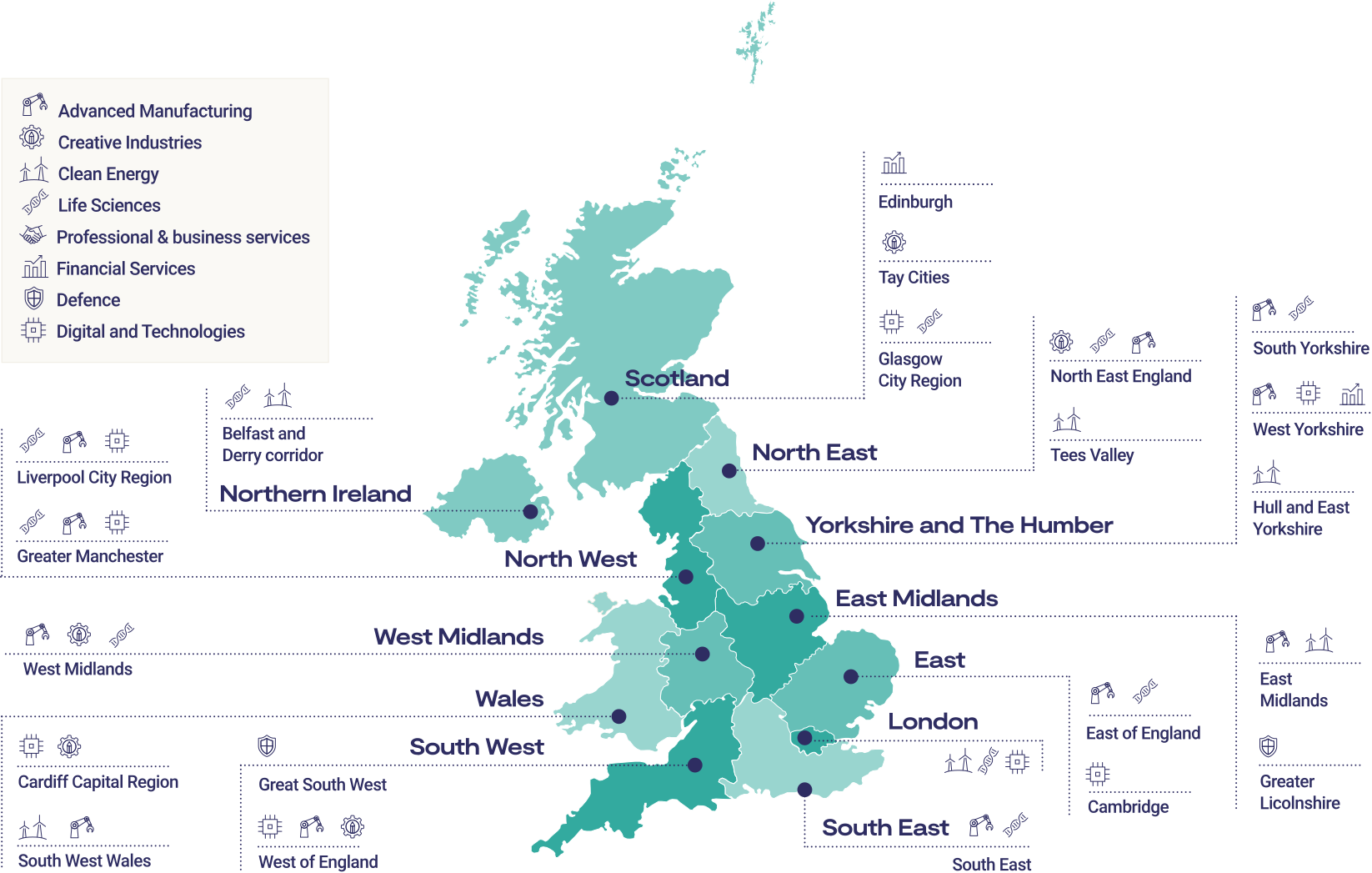
This infographic shows examples of UKRI investments in different sectors across UK regions, outlined as follows.
East
Cambridge:
- quantum semiconductors and artificial intelligence
East of England:
- agritech
- life sciences
East Midlands
East Midlands:
- advanced manufacturing
- clean energy
Greater Lincolnshire:
- defence and security
- food and agritech
London
London:
- climate tech solutions
- life sciences
- quantum technology
North East
North East England:
- creative industries
- health innovation
- materials innovation
- space technologies
Tees Valley:
- clean energy
North West
Greater Manchester:
- health tech and life sciences
- advanced engineering and manufacturing
- applied artificial intelligence
Liverpool City Region:
- life sciences
- materials chemistry
- artificial intelligence and emerging technologies
Northern Ireland
Belfast and Derry Corridor:
- connected health
- green innovation in transport systems
Scotland
Edinburgh:
- fin tech
Glasgow City Region:
- digital enabling technologies
- health and life sciences
Tay Cities:
- creative and digital technologies
South East
South East:
- advanced manufacturing
- connected and autonomous systems
- life sciences
- physical sciences
- robotics
South West
Great South West:
- autonomous systems
West of England:
- artificial intelligence
- composite materials
- creative industries
Wales
Cardiff Capital Region:
- compound semiconductors
- creative industries
South West Wales:
- energy security
- materials security
West Midlands
West Midlands:
- advanced engineering and manufacturing
- creative technologies
- health tech and life sciences
Yorkshire and The Humber
Hull and East Yorkshire:
- clean energy
South Yorkshire:
- advanced materials
- life sciences
West Yorkshire:
- advanced materials
- artificial intelligence and data
- fin tech
Impact: Growing R&I opportunities in every nation and region
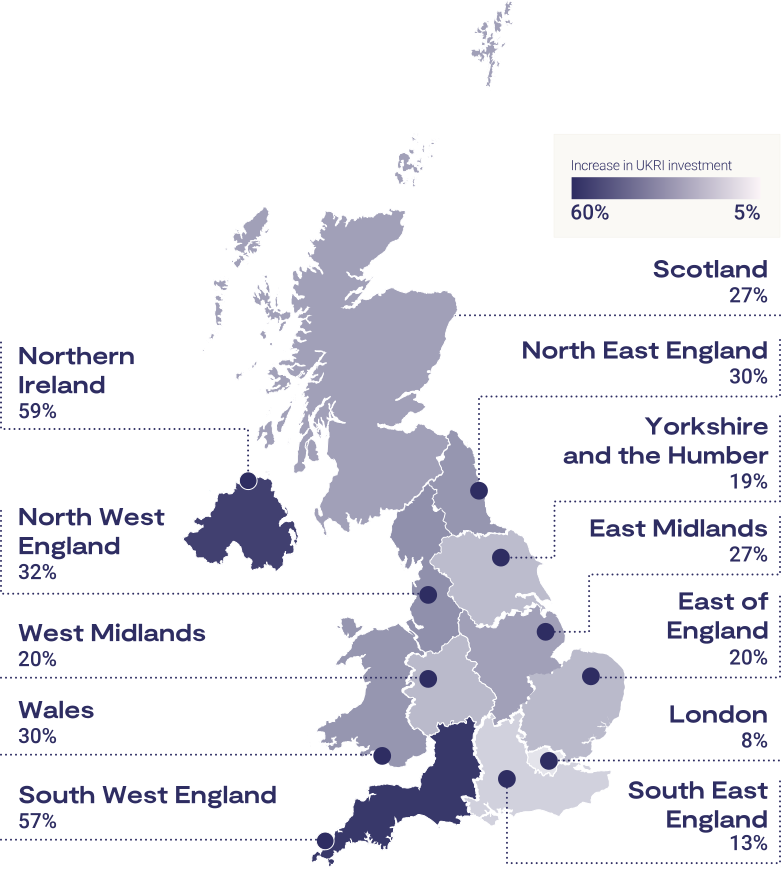
We have been actively building and investing in R&I strengths for a long time. All parts of the UK have seen a growth in investment from year 2021 to 2022 to year 2024 to 2025, with those that have historically received the highest levels experiencing the smallest proportional increases. London saw an 8% increase in investment and the South East of England a 13% increase.
Wales, the North East, North West, South West, and Northern Ireland all recorded above-average proportional growth in UKRI investment in year 2024 to 2025 compared to year 2021 to 2022, with Northern Ireland (59%), South West England (57%) and North West England (32%) receiving the highest. UKRI’s place-focused investments have contributed to this positive R&I growth.
Percentage increase in UKRI investment by UK nation and region between financial year 2021 to 2022 and financial year 2024 to 2025
Local Innovation Partnerships Fund
£500 million to empower local partnerships between civic institutions, businesses and universities to harness research and innovation strengths within their region to drive long-term economic growth. From 2031, the Local Innovation Partnership Fund will be devolved, giving even more power to local leaders to fuel innovation and jobs.
Innovation Accelerators
£100 million UKRI investment from 2022 to 2025 (with an additional £30 million of public funding for 2025 to 2026) to accelerate the growth of three high-potential innovation clusters in Glasgow City Region, Greater Manchester, and the West Midlands.
Strength in Places Fund
£316 million UKRI investment from 2022 to 2027 to support areas across the UK build on existing strengths in R&I to deliver benefits to their local economy. Projects are not limited by nations or by regions.
Enhance international collaboration and connectivity
With 97% of global R&I happening outside the UK, international collaboration is vital for staying competitive and solving shared global challenges.
We will focus on partnerships with the greatest mutual scientific and strategic benefit, making the most of multilateral partnerships such as Horizon Europe as system-shaping investments that can maximise scientific, societal and economic returns. We will take full account of the opportunities provided through EU programmes such as Horizon Europe, and organisations such as CERN.
Our approach will ensure that our international investments are complementary and build on the capabilities and funding available through these routes. We will be a reliable and responsible partner internationally, ensuring equitability is at the heart of what we do.
We have endorsed over
10,000
Global Talent Visas since 2021
Our international leadership on research policy will help shape global standards for shared benefit on openness, academic freedom, equity and reciprocity. Through active participation in major international groups and policy forums, the UK will continue to influence the future of R&I policy development and shape the international infrastructure landscape. We will shape global research best practice and strengthen the UK’s international influence.
UKRI’s international reach
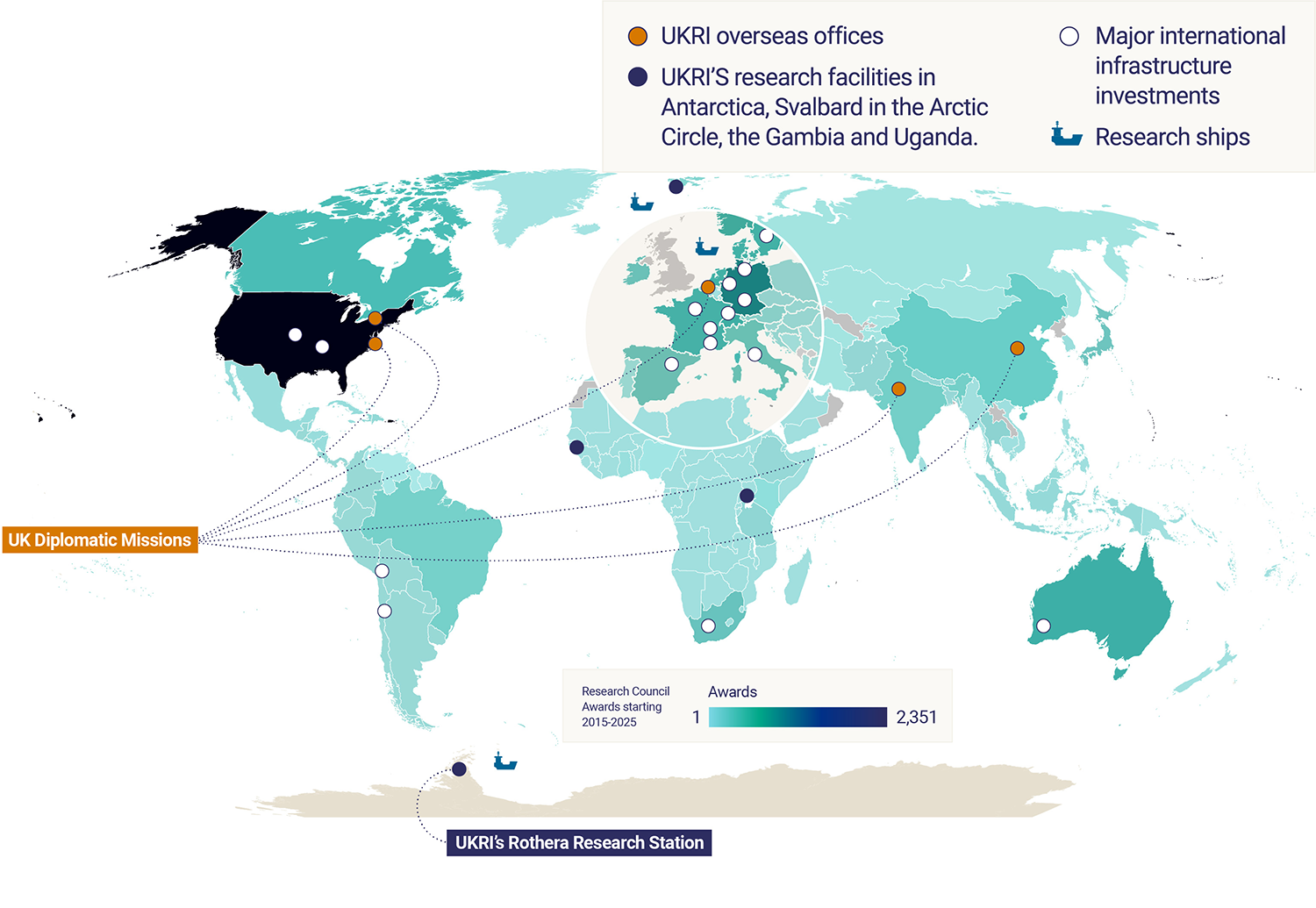
This infographic shows UKRI’s international reach through partnerships, overseas offices, research facilities and international infrastructure investments.
Strategic international partnerships will help UKRI-supported researchers and innovators to:
- advance knowledge: exploring urban climate resilience in China
- improve lives: understanding wildfire risks with Canada and the US
- drive growth: commercialising quantum with German businesses and supporting telecoms innovation in India
Our offices located in UK Diplomatic Missions help drive strategic R&I connections with global R&I leaders, alongside the UK’s wider diplomatic efforts.
Major international infrastructure investments such as CERN enhance international collaboration, pursuing science that would not be possible alone, supporting UK science excellence, leadership and skills.
UKRI’s Rothera Station, operated by the British Antarctic Survey, provides key research capabilities for understanding our planet.
Build the workforce, culture and conditions for R&I excellence
Through our Collective Talent budget, we will invest over £3.4 billion supporting the people who work across the R&I system.
We are committed to fostering environments where diverse talent thrives, building world-class pipelines that anticipate demand. We will invest to ensure national capability across all disciplines and meet critical workforce needs, developing long-term programmes that attract, retain and upskill talent, and strengthening cross-sector collaboration and entrepreneurship. Our ongoing commitment to equality, diversity and inclusion gives us a strategic advantage, enhancing creativity, innovation and research outcomes across all our investments.
We will drive workforce development and system resilience through incentives in our investment portfolio and by ensuring doctoral training remains accessible, attractive and sustainable. Working alongside our partners, we will support 5,000 new doctoral studentships across the UK every year.
Attracting international talent is central to boosting the UK economy and enabling growth. We will create conditions that attract global talent, support effective visa and immigration pathways, and promote the UK as a trusted destination for investment. We will strengthen collaboration across sectors and government to support coherent, evidence‑led policy.
Future Leaders Fellowships
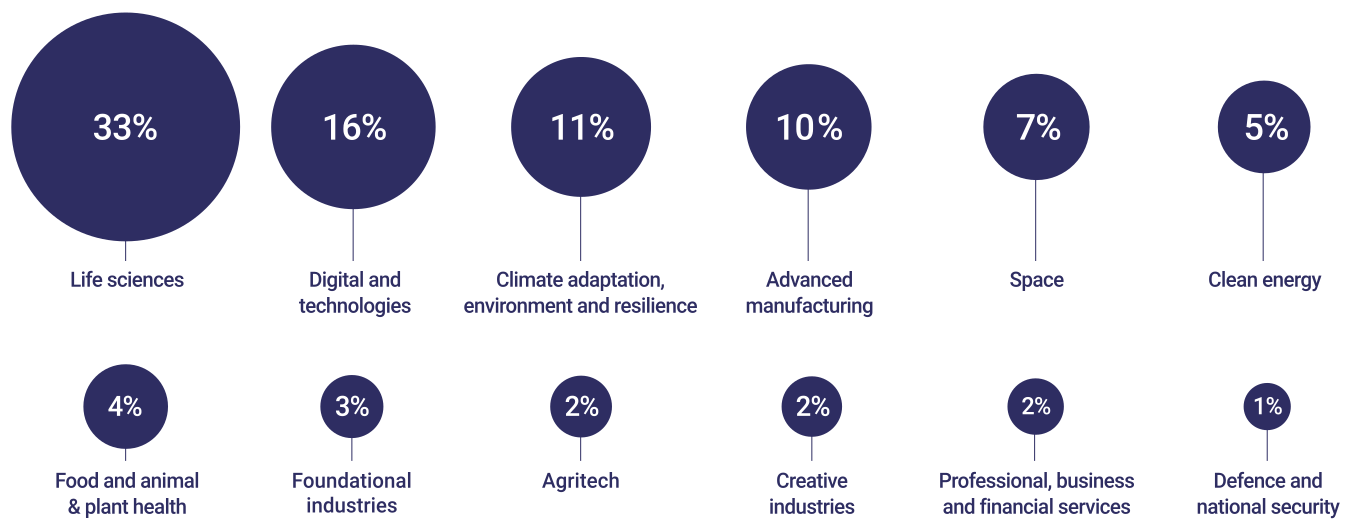
of funded fellows are working on projects aligned with our Priority Programmes
- We have invested in over
700
Future Leaders Fellows since 2018 - We expect to support
1,000
Future Leaders Fellows by March 2030
Case study: advancing knowledge
Tom Gur solved a 28-year-old open problem by constructing zero-knowledge probabilistically checkable proofs, advancing theoretical computer science and laying foundations for practical cryptographic technologies such as blockchains.
Case study: improving lives
Laura Salisbury developed patented wearable technology which helps stroke survivors to restore movement and build strength in muscles in the hands and fingers. Spin-out KnitRegen has so far attracted £1 million in venture capital investment to bring the products to market, and Salisbury won the Mayor’s Entrepreneur Award for Health in 2022.
Case study: driving growth
Siddartha Khastgir translated his research on autonomous transport safety across road, aviation and maritime domains into foundational UK and international safety standards and regulation, helping to address safety concerns which have been a barrier to commercialisation in an industry which could grow to £50 billion by 2035. He has collaborated deeply with leading AI company Wayve Technologies, and his collaboration with Coventry-based AV developer Aurrigo on safety assurance processes allowed the company to capture a multi-million-pound market opportunity.
Invest in research infrastructure
We are making strategic shifts across our infrastructure investment portfolio, which spans lab equipment, datasets, national centres, institutes, Catapults and units, and global facilities. We are growing investment in digital research infrastructure, which plays an increasingly central role in modern R&I, delivering benefits across the whole system.
Infrastructure from
1,100
metres underground to
1.5 million
kilometres from Earth
Where existing assets are strategically needed, we will maintain them to ensure they are fit for purpose and support our globally competitive research. New infrastructure will be funded using coherent and transparent processes, for example competitive equipment funding calls though World Class Labs and cross-UKRI prioritisation of large-scale infrastructure through the Infrastructure Fund. We will maximise UK benefit from major international facilities, ensuring that our participation delivers strong value for money and clear returns for the UK.
Enhance the resilience and sustainability of the UK’s R&I system
From talent pathways to critical infrastructure, we will take a long-term view of sustainability and resilience across the UK’s R&I system, using our insight to identify system-wide challenges, including where critical research capabilities are at risk, and to coordinate sector-wide solutions.
Through our investment models and strategic relationships, we will encourage sustainable behaviour, support a healthy ecosystem and help organisations to specialise within subjects and collaborate. We will also ensure that public sector research establishments (PSREs) can access UKRI funding where appropriate, strengthening their role in the wider R&I system.
Our investments will boost the long-term resilience of the UK’s essential R&I capabilities. We will continue to support national research organisations that are critical to large scale science, the delivery of Government priorities and economic growth. We will align our portfolio of R&I campuses, centres, institutes, Catapults, and units with our strategic priorities, so they can deliver the outcomes needed. As part of this, we will improve governance and ensure their operations are effective, efficient and sustainable.
Centres, institutes, Catapults and units (CICUs)
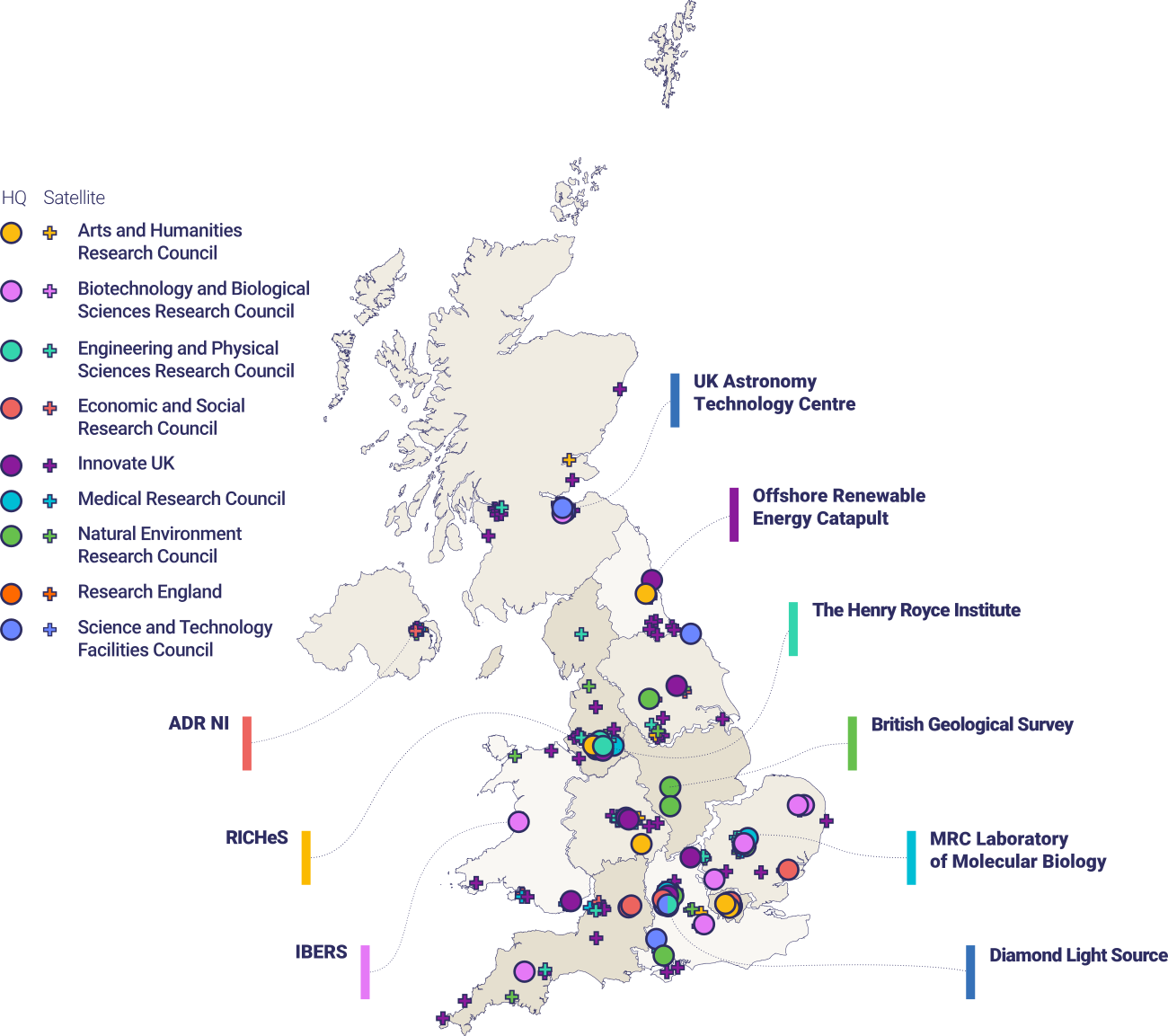
We provide strategic core funding to 58 CICUs to deliver unique, national R&I capabilities.
See our interactive map for a detailed council by council overview.
Download the data table for the CICU investments (XLSX, 52KB)
Engage with purpose
R&I improves lives and livelihoods, but not everyone sees the positive impact on their own lives. We want people and communities across the UK to play a meaningful role in shaping research. We will support UKRI staff, as well as the researchers and innovators we fund, to involve the public so that research is driven by real-world needs.
Through our Sciencewise public dialogue programme and the Public Attitudes to Science Survey, we will deepen our understanding of public hopes, expectations and concerns around research and innovation, informing UKRI’s operational priorities as well as its long-term strategy.
We need to be able to excite and capture the imaginations of young people about R&I. We will support young people to engage with science, strengthening the future R&I workforce, broadening participation, and building science literacy and trust. This will be delivered through our national youth engagement programmes, including museum and festival investments that inspire curiosity, and the STEM Ambassadors programme, which connects volunteers with schools to provide enrichment that complements the curriculum.
5: Reform our organisation
Our role is to ensure public money is invested to deliver outcomes for the UK. To do this efficiently and effectively, we need to become an increasingly integrated, agile and effective organisation.
Inside the organisation, we will streamline many of our processes and decision-making, for example halving our grant processing times by 2031. Greater use of our IT, data systems and the responsible use of AI will help enable such efficiencies.
Our reforms over the next five years will ensure we can deliver the best return on investment for the public.
We will:
- support a high-performing, inclusive workforce through clear governance, strong capability development and a culture that prioritises wellbeing, equity and continuous improvement
- ensure UKRI is an efficient and agile organisation, set up in the best way to deliver our mission, with the right skills and the right tools, in the right place at the right time
- reduce grant processing times by at least 50% by 2031 through both automation and staff expertise, with the research community playing an active role in enabling this change
- lead global conversations on best practice for trusted R&I
- build public confidence in the value of R&I
- modernise our data systems, deploy AI-driven indicators and create a situational awareness function to strengthen decision-making
- remain alert to the implications of increased use of digital tools and technologies on application volumes, assessment quality and fairness, taking a leading role in managing this shift
- be more transparent about our future pipeline of funding opportunities, providing advance notice that enables applicants to prepare and deliver stronger bids
Impact: faster decision-making in assessment
Following a successful 2025 pilot led by the Metascience Unit, UKRI is expanding the use of Distributed Peer Review (DPR) across the research councils. Under the DPR model, applicants also act as the assessors, helping to democratise funding decisions and deliver higher-quality, more consistent feedback.
The pilot demonstrated using DPR resulted in faster decision making, with the time between submission deadline to funding decision cut by 53 to 65%.
Support our people
A high-performing, agile and engaged workforce is essential. We will create a culture that prioritises wellbeing, inclusion and equity. Robust governance, clear decision‑making and equal opportunity will ensure our staff have the capability and capacity to deliver UKRI’s ambitions.
Our organisational values outline the behaviours we need to achieve our mission and strategy and how we support each other in our roles. Our values are:
- spark curiosity
- play our part
- lift people up
- make it count
They are not just about how we already behave; they are about the organisation we aspire to be.
We will support colleagues throughout their UKRI journey by setting clear expectations, fostering belonging, providing continuous development, recognising their successes, and attracting and rewarding talent transparently. This will be underpinned by positive employee relations, active engagement with trade unions and staff networks, and a collaborative environment.
Increase integration and efficiency
Changes since our inception have seen us now operate more seamlessly, bringing together our disciplinary expertise with professional and operational excellence. Increased connectivity across the nine councils will help multidisciplinary teams to work across the organisation. This new approach will help us both champion investment in curiosity-driven research and respond to national strategic priorities.
Demand is growing for R&I to solve increasingly complex problems, and the adoption of new data and compute tools across the system is speeding up how R&I is performed. The pace of change in the R&I landscape has been rapid since UKRI was created: it is imperative we equip ourselves so that we can adapt to changes yet to come.
UKRI and BIST have built a world-first government-backed metascience capability which is optimising the way we support R&I. Bold experiments have already shown that we can reduce assessment and decision-making times while improving outcomes for applicants. We are backing these ideas further, turning attention to policymakers and investing £11.5 million with BIST into an AI-driven evidence synthesis infrastructure.
We are designing the UKRI Future Operating Model for a world-class organisation united in the delivery of its mission. A UKRI built on three pillars collectively delivering societal priorities:
- councils as the delivery engines and partnership builders for world-class R&I
- programmes that support strategic prioritisation
- professions enabling skilled experts and functional teams to create clarity, consistency and pace
Streamlining internal operations will maximise our investments in front-line research. We will make it easier for researchers to pursue their ambitions by substantially reducing application processing times and adopting a collaborative approach to investment. We will make more use of review stages to understand whether continued support remains the best use of public money.
Improve grant processing times
Too much of our brilliant researchers’ and entrepreneurs’ effort is spent writing and assessing a growing number of applications, when it should be focused on delivering outcomes and impact.
Over the next five years, we will work with our strategic partners to ensure UKRI reduces the proportion of our resources used to assess grants year on year. By 2026 to 2027, enabled by our funding platform and a simplified policy and process environment, we will reduce median application to decision times for applications submitted through the UKRI Funding Service.
16,000
applications received a year
- 195 days
median processing time for applicant mode (2025-26) - 127 days
median processing time for targeted mode (2025-26) - 90 days
target for applicant mode by 2030-31 - 60 days
target for targeted mode by 2030-31
We will use demand management where it is most needed, supported by appropriate levels of active post-award monitoring. This will require working closely with the research community, whose engagement will be essential to simplifying requirements and enabling this change.
Our world-leading Metascience Unit will run bold, data-driven experiments, including AI-enabled approaches, to further optimise the speed and quality of our decision making. We will also explore the use of AI to increase efficiency in processes across the funding lifecycle and as an operational tool. We already use AI to analyse Funding Service user feedback and triage needed system improvements, and we will build on this capability.
All such use will be implemented responsibly, in line with UK and international regulatory frameworks, and under appropriate human oversight.
Embed trusted and secure research
We will provide visible leadership on trusted R&I, leading global conversations and working with government and sector partners to embed best practice and support trust. This will require active collaboration with the community, whose engagement is essential to shaping, adopting and championing responsible approaches.
We will continue to develop a culture of responsible security across UK R&I, for both in-house activities and through our investments. Staff will be upskilled to ensure they are equipped with the skills needed for safe, ethical and globally competitive research.
Improve public awareness of R&I
Over the next five years, we will improve awareness of the benefits of publicly-funded R&I in the UK. That means being transparent about how we operate, how funding decisions are made and how those decisions impact lives.
By utilising our engagement and communications expertise and translating evidence of our impact into thoughtful, accessible engagement, we will create opportunities for people to understand what we invest in and see how R&I improves their everyday lives, building public trust of UKRI.
Maximise insights from systems and data
Developing our IT and data systems will support wider UKRI integration and maximise insights from our data platforms. We will strengthen our performance management framework, introducing annual Key Results and replacing the nine separate Strategic Delivery Plans with a single, integrated Delivery Plan.
New indicators of research excellence, including those driven by AI, will strengthen how we measure impact and make decisions. The creation of a new situational awareness function will improve analysis and horizon-scanning, helping us to:
- invest in emerging technologies
- spot areas where the UK has an advantage
- develop the skills to boost UK productivity and competitiveness
Optimise our estate, systems and digital infrastructure
Our large and diverse estate will be managed to ensure it supports our long‑term mission, is financially sustainable and meets the evolving needs of our people. As part of this, we will broaden our regional footprint, so we are better connected to R&I taking place in the communities we serve.
We will deliver on environmental commitments set out in our five-year environmental sustainability strategy and will continue to invest in the digital systems and infrastructure needed for a modern, data-driven organisation. We will also meet our social responsibility commitments under the Social Value Act by implementing the UKRI Responsible Procurement Charter and its accompanying Responsible Procurement Impact tool. Together, these actions will ensure our operations, investments and partnerships deliver long‑term environmental, social and economic value.
The next five years
In 2026 we expect:
- commencement of 15 Priority Programmes
- Local Innovation Partnerships Fund (LPF) Wave 2 launch
- new UK Biobank facility complete
- establishment of new Intellectual Property Framework
- establishment of Velocity (new concierge approach for businesses)
- simplifying access to applicant-led funding
In 2027 we expect:
- four new National Compute Resources operational
- Research Excellence Framework (REF) submissions open
- Higher Education Innovation Funding review
- CreaTech Futures awards commence
In 2028 we expect:
- Wave Five Infrastructure Fund projects initiating
- completion of UKRI reform programme
- reduction in grant processing times interim target
- next national supercomputer service operational
- national cryogenic facility operational
In 2029 we expect:
- REF results published
- R&D MAP Challenges completed
- over 1,000 Future Leaders Fellowships funded
In 2030 we expect:
- Research England research funding formula reform complete
- Diamond-II project complete
- 50% reduction in UKRI greenhouse emissions compared to year 2017 to 2018 baseline
- Extremely Large Telescope scientific first light
In 2031 we expect:
- reduction in grant processing times final target
- completion of first two waves of Generation New Era longitudinal study
- new environmental sustainability goals for 2031 to 2035
References
Foreword
Foundational activity in goal 4 (strengthen the foundations of R&I) underpins goals 1 to 3 proportionately. If this activity is included, the proportion of our budget on curiosity-driven research is approximately 50%.
1: Support discovery and curiosity-driven research
Maintain flexibility through block grant funding
The Scottish Funding Council, Medr, and the Department for the Economy are responsible for administering the equivalent of quality-related research across Scotland, Wales and Northern Ireland respectively. Research England deliver the Research Excellence Framework (REF) assessment on behalf of these partners.
The UK funding bodies use outcomes from the REF to inform elements of their research funding allocation to universities. Each higher education funding body allocates their share of the budget according to their own national research policies and priorities. See Explainer: QR funding and the REF (January 2023).
2: Address strategic government and societal priorities
The frontier technologies are Advanced Connectivity Technologies (ACT), Artificial Intelligence (AI), Cyber Security, Engineering Biology, Quantum Technologies, and Semiconductors.
Invest in our new Priority Programmes
Our investment is explained in more detail in the budget allocations for UKRI. We manage our budgets dynamically as a portfolio to respond to and capture emerging opportunities, and as part of routine financial management, such as necessary budget reprofiling to ensure continued efficient delivery. As a result, allocation figures may change during the year to reflect these adjustments, and operational budgets may not match the final year-end figures exactly.
Defence and national security (£550 million)
In 2024-25, the Ministry of Defence spent £3.1 billion on research and development, a real terms increase of 12% on the previous year. See Ministry of Defence departmental resources: 2025 (January 2025)
4: Strengthen the foundations of the R&I system
Build the workforce, culture and conditions for R&I excellence
Talent: figures based on 2024 company survey data collected across our seven R&I campuses:
- AberInnovation
- Babraham Research Campus
- Daresbury Laboratory
- Harwell Science and Innovation Campus
- Norwich Research Park
- Roslin Innovation Centre
- Rothamsted Enterprises