

Every year, UK government departments create millions of digital records, emails, documents, and audio visual files that form the nation’s democratic memory. Yet most remain inaccessible, locked away by scale, sensitivity, and the cost of manual review. This limits transparency, accountability, and long‑term historical record‑keeping.
Designing ethical, transparent AI systems for public trust
The Arts and Humanities Research Council (AHRC) funded LUSTRE project, led by Professor Lise Jaillant, has transformed how the government addresses this challenge. The project draws on arts and humanities expertise in archives, ethics and law to show how artificial intelligence (AI) can be used to:
- deliver major public value and significant cost savings
- improve the public’s accessibility to government records
Professor Jaillant and the project team worked in close partnership with David Canning MBE and Dr Kelcey Swain at the Cabinet Office, and John Sheridan at The National Archives. Together they organised several workshops to bring together academics with professionals in government, libraries, archives and museums.
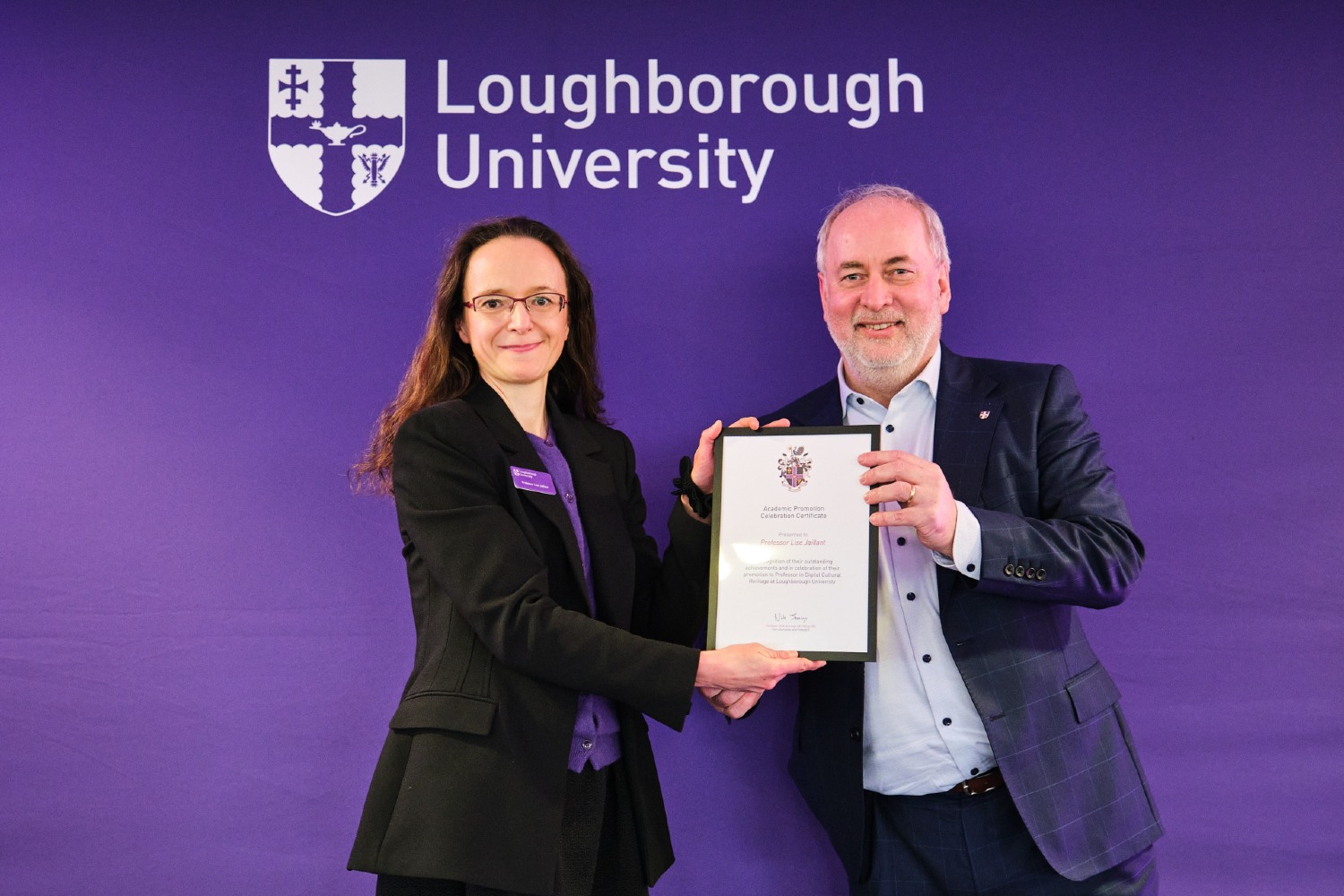
Professor Lise Jaillant receives an Academic Promotion Celebration Certificate, presented by Professor Nick Jennings at Loughborough University. Credit: Lise Jaillant
The project also co-designed transparent, human-in-the-loop AI-assisted workflows to support sensitivity review of born‑digital records. These systems are explicitly auditable, fair, and aligned with public sector values, rejecting black‑box approaches in favour of democratic accountability.
Transforming efficiency and saving millions in public funds
The results have been transformative. The AI system can review over 11 million records in a single cycle, compared with around 200,000 per year by a human reviewer. This has delivered £2.2 million in cost avoidance, alongside £200,000 in recurring annual savings, and is now embedded in Cabinet Office workflows, with adoption across other major departments.
Without this system, reviewing the Cabinet Office’s digital backlog would have taken 59 years, or required dozens of additional staff. This work speaks directly to the UK government’s new vision for archives in England, in particular its recognition that AI has potential to make archival collections more accessible to users.
The project’s impact extends beyond the UK government, having a global reach with over a thousand participants from 30 plus countries attending LUSTRE workshops. These events provided insights to representatives from academic institutions, cultural organisations, technology firms and government organisations.
Project partners have included the:
- Home Office
- Department for Education
- Intellectual Property Office
- Independent Office for Police Conduct
Positioning the UK as a global leader in ethical AI for democracy
This work directly supports UK Research and Innovation’s priorities around responsible AI and digital innovation. It also aligns with the UK Industrial Strategy’s Digital and Technologies priority by demonstrating how trustworthy AI can improve public-sector productivity, transparency and democratic accountability. The project has changed how government departments think about AI governance, shifting practice away from opaque risk management tools towards auditable, values-led systems co-designed with archivists, lawyers and civil servants.
The project generated new ideas in ethical AI, delivering measurable public impact, strengthened national research infrastructure for digital records and positioned the UK as a global leader in democratic technology governance. It demonstrated how arts and humanities research can power ethical AI, unlock public records, and safeguard the UK’s digital democratic memory. It has created a lasting institutional change while delivering efficiency, accountability and public value on a national and international scale.
Scaling internationally to secure the future of digital public records
LUSTRE builds on Professor Jaillant’s sustained AHRC‑funded research leadership and international collaborations. It has since scaled into a UK and US initiative (LUSTRE and GLOW) with additional Higher Education Innovation Fund support.