
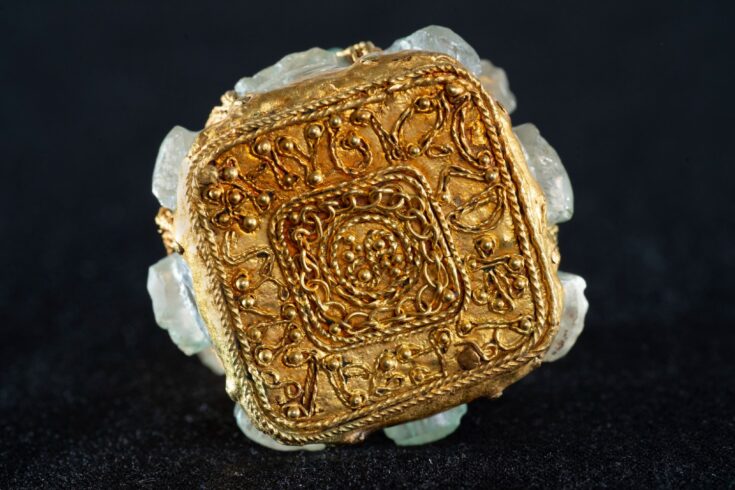
In 2014, a detectorist uncovered an extraordinary hoard in a field in Dumfries and Galloway, now known as the Galloway Hoard, one of the most important archaeological discoveries of the century. Among the treasures was a gold and rock crystal jar, 5cm (2in) high. Decorated with intricate gold metalwork, experts say it resembles a perfume bottle.
This discovery became the central focus of Unwrapping the Galloway Hoard, a three-year research project funded by the Arts and Humanities Research Council (AHRC) (2021 to 2024). The project challenged existing understanding of hoarding practices through an interdisciplinary study of one of the best-preserved hoards found in Britain.
The hoard and the project
Buried around AD 900, and discovered in 2014 near Kirkcudbright, the Galloway hoard is the richest, most varied and best-preserved collection of precious and exotic objects hoarded together in Viking-age Britain.
Led by Dr Martin Goldberg, Principal Curator, Medieval Archaeology and History, National Museums Scotland (NMS), the project generated new insights into why people assembled such collections. It also showed, in surprising ways, how these objects contribute to our understanding of the past.
A partnership between the NMS and the University of Glasgow placed the team in a unique position. The partnership allowed them to combine methods from digital imaging, artefact analysis, archaeological science and social theory and communicate this knowledge to both non-academic and expert audiences.
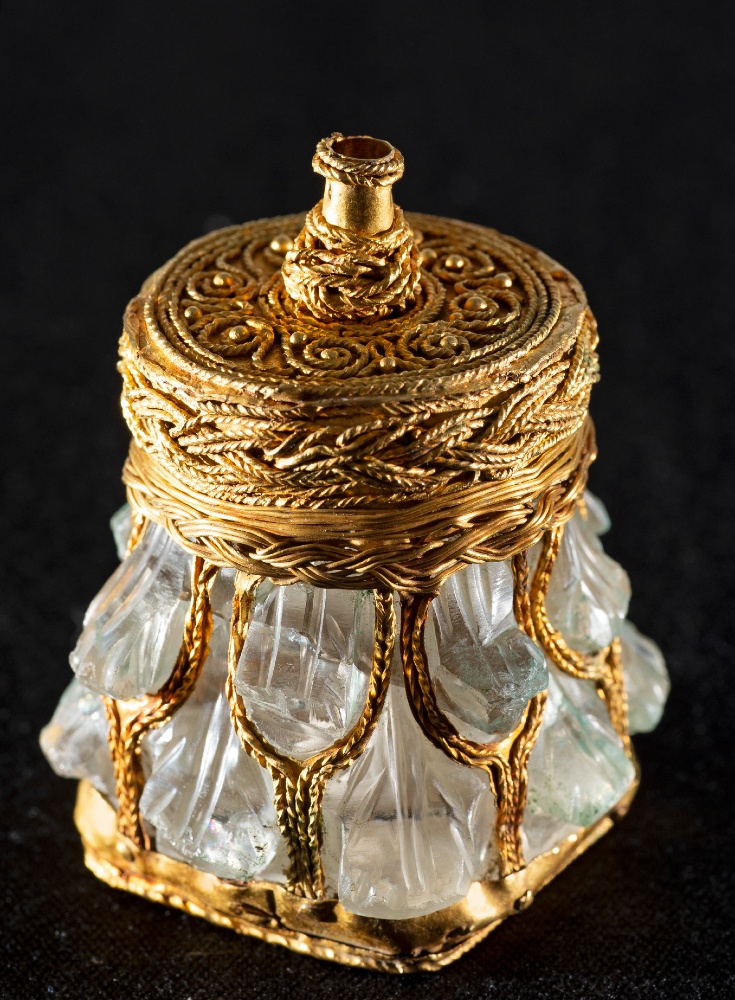
The rock crystal jar from The Galloway Hoard. Credit: Neil Hanna (National Museums Scotland)
A precious object revealed
When first discovered, the jar was wrapped in linen and enclosed in a silk‑lined pouch. To investigate it safely, the team used non‑invasive 3D X‑ray imaging. More than 1,000 scans were taken at the British Museum, drawing on expertise and facilities supported through the Research Infrastructure for Conservation and Heritage Science (RICHeS)).
These scans were digitally combined to create the first detailed 3D model of the object. The scans revealed a hollowed rock crystal encased in a sophisticated gold meshwork with a carefully aligned spout, confirming it was a small jar. Researchers also detected a tantalising glimpse of a gold inscription at the base.
This approach demonstrated the value of shared national research infrastructure for the study, conservation and display of exceptionally fragile archaeological finds.
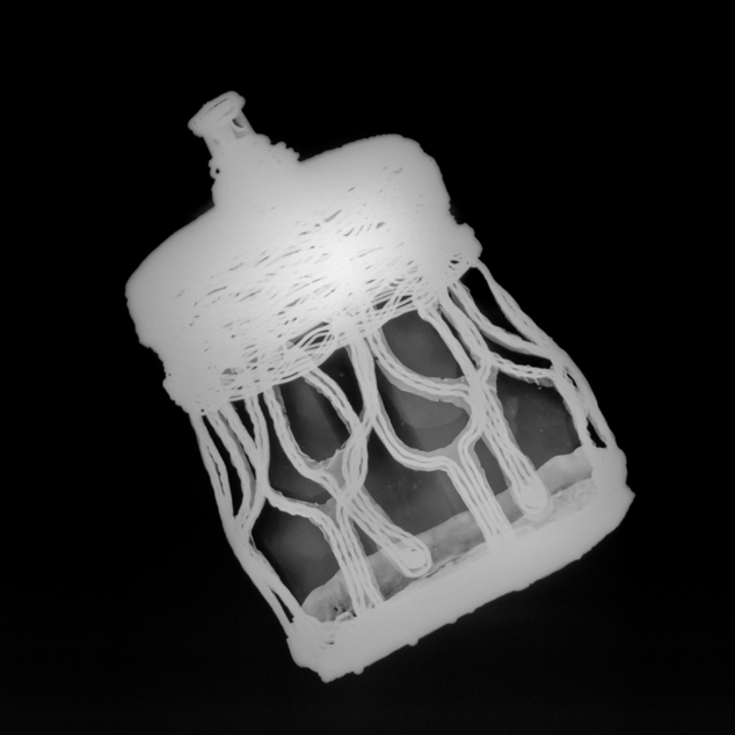
A 3D X‑ray image showing the rock crystal jar from the Galloway Hoard, revealing the delicate gold meshwork surrounding the crystal. Credit Neil Hanna
Deciphering the inscription
The biggest surprise was that the gold baseplate appeared to have an unusual message with letters formed using gold wire (filigree) and granulation (tiny gold balls that act as serifs on the letters). Although difficult to read at first, once free of their textile wrapping, the message became clearer and reads:
+ H Y G V A L D ˑ E P ~ F A C ~ I U S S
Translated as ‘Bishop Hyguald ordered [this] to be made’. Reading confirmed by Rory Naismith, University of Cambridge.
The identity of Bishop Hyguald remains under investigation. Although no bishop of that name is recorded, other Hygualds are recorded in early medieval Northumbrian sources. This is relevant because much of modern‑day Galloway formed part of the Northumbrian kingdom at the time the hoard was buried.
The imaging process also documented the relationship between the organic and metal components. As the textiles deteriorated once exposed to air and light, conservators removed them to prevent further damage. This allowed textile specialists at the University of Glasgow to examine the silk pouch in far greater detail. The textiles are now stored in controlled conditions for future research.
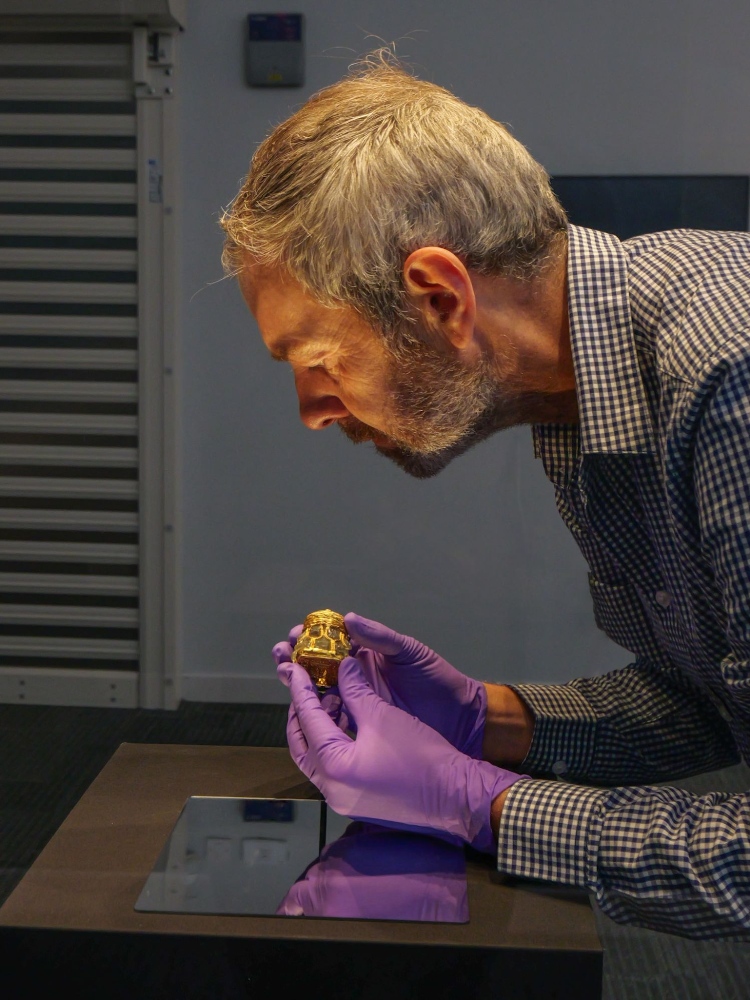
Curator Craig Angus from National Museums Scotland puts the finishing touches to the installation of the Rock Crystal Jar. Credit Andy Jardine
Secured for the nation
The jar is now on display at Kirkcudbright Galleries, the closest suitable venue to its discovery site. Secured for the nation by NMS in 2017 via the Treasure Trove process, the Galloway Hoard will form a centrepiece of the forthcoming redevelopment of the National Museum of Scotland’s permanent galleries.
NMS and Dumfries and Galloway Council continue to work in partnership to ensure the hoard brings lasting regional benefit. The jar will remain at Kirkcudbright Galleries until 14 June 2026.
An ongoing investigation
Parallels for this type of carved rock crystal have been found in the Vatican collections and were made in ancient Rome. This suggests the crystal was a relic, hundreds of years old, when it was transformed with elaborate goldwork into a jar. Further analysis of the object may yet reveal more clues about where and when it was made, and what it was made for.
But there are a few things that are already clear. Like the silver arm-rings inscribed with Anglo-Saxon runes and a pendant made with an early ninth century Mercian coin. Alongside these finds, and the name of a Northumbrian bishop on the Rock Crystal Jar, the Galloway Hoard seems ever more tied into the Anglo-Saxon kingdoms and the wider world beyond Britain.
It is easy to forget that much of what is now in southern Scotland had been part of the Northumbrian kingdom for over two centuries by the time the Hoard was deposited.