
Light does more than enable vision. It influences our health, wellbeing, and productivity by synchronising our body clock to the time of day. This clock is responsible for repeating 24-hour cycles (circadian rhythms) in almost every body system, including sleep and alertness, hormones and metabolism.
At the flick of a switch, humans can manipulate their light environment with artificial lighting. This can disrupt the synchronisation of our body clock. For example, bright light at night may result in us no longer feeling tired when we should be sleeping.
Despite the widespread use of artificial lights indoors and outdoors, artificial lighting design has typically overlooked its effect on the body clock.
Long term Biotechnology and Biological Sciences Research Council (BBSRC) investment supporting research at the universities of Manchester and Oxford has provided new knowledge about how light affects our physiology and behaviour. This knowledge gives us the power to transform our overall health and wellbeing with improved lighting design.
By feeding into international regulations and recommendations, this research has advised how to adjust our lighting to suit our needs, without disrupting our body clock.
Detecting light
At the back of our eye is a thin layer called the retina. This is where cells that are sensitive to light, called photoreceptors, sit. Photoreceptors detect light and convert it into a signal to our brain. This is how we perceive the world around us.
Photoreceptors called rods help us to see in low-light and at night, while other photoreceptors called cones give us colour vision in daylight. Rods and cones are what allow us to form an image of our surroundings. They give us vision.
For over 150 years rods and cones were thought to be our only photoreceptors but research in the 1990s and 2000s revealed the existence of a third type of photoreceptor. It has a key difference to rods and cones: it contains a light-sensitive protein called melanopsin. These new photoreceptors were called ‘melanopsin-containing retinal ganglion cells (mRGCs)’. Researchers, led by Professor Russell Foster at the University of Oxford, and supported by BBSRC investment, provided key contributions to the discovery.
Research at The University of Manchester, led by Professor Robert Lucas, a mentee of Professor Foster, has built on this discovery. The team studied mRGCs, discovering they hold a key role in how we see, particularly in how we detect brightness. They can distinguish even small differences in light intensity.
mRGCs, the body clock, and health
mRGCs report brightness information to the area of the brain involved in setting the body clock. This information is used to regulate a range of physiological and behavioural processes.
What makes you tick: circadian rhythms. Credit: OxfordSparks and Scriberia. Video transcript and on-screen captions are available by watching on YouTube.
If lighting is not appropriate for the time of day this can disrupt our normal biological rhythm, impairing sleep, and affecting our alertness, productivity, mood and health.
Studies have found that:
- metabolism disruption increases the risk of type 2 diabetes, obesity, and heart issues
- clock disruption from night work is associated with an increased risk for heart attacks, strokes, and diabetes
- clock disruption is linked to increased rates of depression and breast cancer
Well-designed lighting should provide bright light during the day and dim light at night to mitigate these risks to our overall health.
Measuring light brightness
Light sources have two key variables that determine how we detect light:
- power, which is the overall intensity or ‘irradiance’
- spectrum, or how light power is distributed across wavelengths (in nanometres (nm)), which relates to the colour we perceive
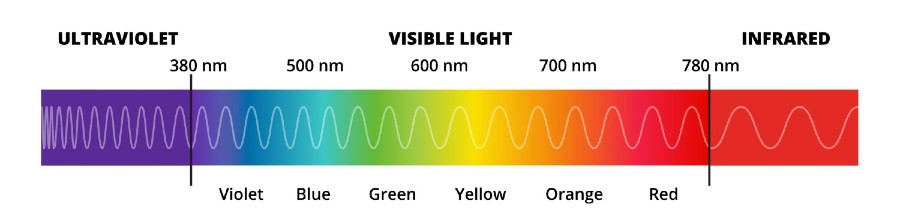
Illustration of the visible light spectrum, showing that shorter wavelengths appear bluer and longer wavelengths appear redder. Credit: petrroudny, iStock Getty Images Plus, via Getty Images
We perceive brightness differently depending on the combination of the wavelength and power of light. This is because photoreceptors are not equally sensitive to all light wavelengths:
- rods are most sensitive to blue-green light (500nm light wavelengths)
- cones are sensitive across a larger wavelength range including blue, green and red light
- mRGCs are most sensitive to blue-cyan light (wavelengths around 480nm), as uncovered by the Lucas group
mRGCs’ blue-cyan sensitivity means we unconsciously see this light as brighter, even if the power of a blue light and yellow light is identical.
Traditional measurements for light brightness, like lumens, were based on the sensitivity of cones. This ignores mRGC’s sensitivity to the blue-cyan wavelength range and old lighting standards focus on factors like visibility and energy efficiency, rather than how light affects our body clock.
Light brightness and mRGCs
So, how do we create a light measurement system that includes the role of mRGCs? This would allow us to adjust artificial lighting and ensure environments were not negatively affecting our body clock.
Professor Robert Lucas and Professor Timothy Brown, also at The University of Manchester and a previous postdoc from Lucas’ lab, found the solution. They established a method of measuring light, considering wavelength and power, which quantifies its ability to stimulate melanopsin and elicit non-image forming responses, like setting the body clock.
Significantly, the researchers recognised that for measures of brightness for mRGCs to have meaningful impact, there had to be consensus among those working in the subject area. Everyone, across academia and industry, needed to use the same standard measure.
Setting the lighting standard
In 2013, they arranged an international workshop uniting academics, industrialists, and representatives from the International Commission on Illumination (CIE), the main international lighting regulatory body. Working with the CIE and Professor Stuart Peirson (Oxford), Lucas and Brown were able to convert their biological research into an international lighting standard, CIE S 026/E:2018. The standard was published in December 2018.
Building on this work, and through a further workshop supported by BBSRC that reviewed the available data, guidelines for lighting based on the standard were agreed. This provided suggested values most appropriate for artificial lighting levels in the daytime, evening and sleep environments, including a maximum brightness value for evening and night and a minimum value during the day.
Refining the guidelines
These guidelines represent an important first step, but more research is needed as the effects of light on the body clock can be altered by:
- the brightness of the light
- the length of light exposure
- when you encounter light during the day
- age and other interindividual differences
As more data is gathered this will be incorporated into refined guidelines.
Professors Foster, Lucas and Peirson are all on the Light and Health Subcommittee of the UK government’s Committee on Medical Aspects of Radiation in the Environment. The subcommittee reviews current evidence relating to the impact of artificial light on human health and identifies where more information is needed to provide the evidence-base for future guidelines.
Illuminating industry
With the light measurement and important first guidelines in place, light designers can now understand if their lighting is likely to disrupt our body clock and make changes to avoid this. As it impacts health, this needs to be prioritised alongside other lighting considerations such as energy efficiency.
Indeed, healthy lighting products based on the standard are already being sold including LEDs from light manufacturers such as Osram, Samsung and Seoul Semiconductor.
The International Well Building Institute has also used the CIE standard to inform its own WELL Building Standard which includes requirements for healthy lighting in buildings from homes to workplaces.
The Building Standard recognises that the design of physical spaces can impact human health and wellbeing. Offices can be certified as following the WELL Building Standard. Other organisations like Public Health England also use the CIE guidance to ensure healthy lighting in workplace and healthcare settings.
The measurement can also be used as a form of quality control for interventions aiming to reduce disruption of the body clock. It can test whether screen dimming or colour filters are achieving what they set out to do.
Uptake of lighting design in our home and work environments
Designing lighting, or altering current lighting, based on the current and evolving guidelines could make a real difference to our health in both our home and work lives.
Correct lighting in the workplace promotes the health and wellbeing of employees and reduces the risk of work-related accidents by supporting brain function.
Ensuring the body clock is not disrupted is also economically beneficial for companies as they can face around 2% gross domestic product loss due to insufficient sleep.
Further research and refinement could inform lighting requirements for individuals in different contexts. Adolescents, for example, may need different light requirements compared to older people and hospital rooms may have different optimum lighting conditions compared to an office.
Considering our animal neighbours
Humans, of course, are not the only ones to experience the artificial lighting we have installed in the world around us. Wildlife can be equally exposed to artificial lighting from homes and streetlights bringing light pollution.
Lucas and Brown are continuing their work to explore how wildlife also respond unconsciously to light. Together their work could ensure that we can adjust our lighting to be safe not just for humans but for all animals that experience it.
Find out more
Read a new international measurement standard and guidelines for healthy lighting REF2021 case study.
Read about illuminating the biological clock.