
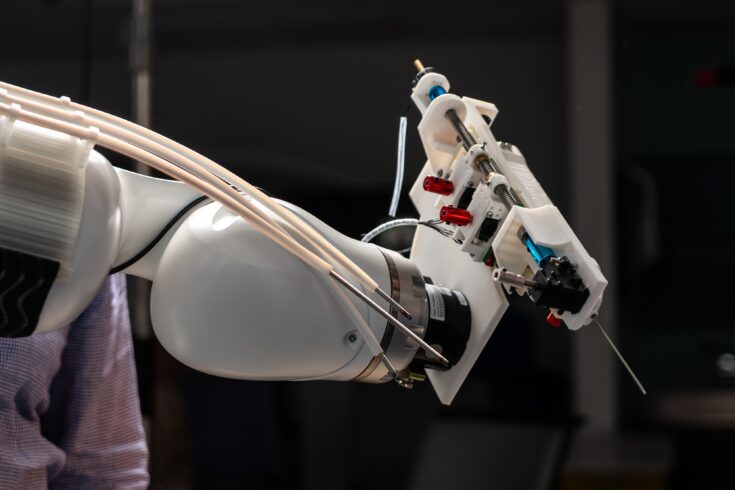
Robotics for cancer detection and treatment
Colorectal cancer is one of the most common types of cancer worldwide. The current diagnostic approach, colonoscopy, relies on multiple sessions to diagnose and then treat. It is an invasive procedure which deters many people from receiving screening at all.
The project was funded through the Horizon Europe Guarantee as a partner of a European Research Council (ERC) Synergy grant.
Led by Professor Sebastain Ourselin and Professor Christos Bergeles, researchers at KCL are contributing to an ERC Synergy grant with Queen Mary University of London and partners in Italy, each bringing a multidisciplinary approach to the project.
The EndoTheranostics project is drawing together miniature soft-robotics, AI-assisted multimodal imaging, and sensing to combine the diagnostics and therapeutic intervention in one go. This will identify tumours and excising tissue in one procedure. The aim is to provide patients with a less invasive and more acceptable procedure, which is cheaper to deliver at population scale.
A screening tool only saves lives if it reaches them, and for any medical device the route to a patient runs through regulation, approval and market.
Watch our video below for more details about how the EndoTheranostics project is using this innovative approach:
From Intellectual Property (IP) to companies – the real test
While developing innovative ideas is a fundamental part of the journey, without commercialisation the impact of this research would not be realised. Historically, the distance between the public and private sectors limits the ability to exploit the IP created.
However, people in the sector are starting to support commercialisation via spinouts. This aligns with UKRI’s own strategic vision to drive growth, investing not only in discovery but in scaling companies and building the supporting infrastructure.
In the domain of medical devices, robotics and healthcare there is a huge amount of opportunity for the UK to create jobs and create companies in this area.
The pathway is already visible; Professor Christos Bergeles is founding Rev-eye-talise, a KCL spin-out miniaturising robotic eye-surgery systems, built on the same motion-transmission technology developed for the colon capsule. As the EndoTheranostics IP matures, a further spin-out for the capsule itself is a realistic prospect.
Professor Bergeles said:
The ideal pathway to maximise the benefit of any engineering or scientific technology is to be able to commercialise it and to keep adding value to the UK ecosystem.
Why the risk is the point
Frontier research at low technology-readiness levels is, by definition, risky, which is why public investment should support it.
As Professor Ourselin said:
If there is no risk in your research, you should wonder why you’re doing it; even a fraction of it succeeding delivers a major return, and the multidisciplinary scale lets teams tackle problems no single group could.
He argues that by having these larger scale, multidisciplinary investments you can really tackle a programme of research that you would never be able to do on your own.
Long-term benefits of frontier research
The funding mechanism mattered too. Without the Horizon Europe Guarantee, researchers at King’s College London could not have been part of the consortium. When the science is ready, and in a fast-moving field the window for collaboration and advancement does not stay open for long. Benefits extend beyond the research outputs, giving researchers and students exposure to other labs, forging connections, building networks, and developing skills that build into future ideas.
Professor Bergeles said:
To allow UK institutions to be part of Horizon programmes has shown us that this excellence that exists in this country, which is phenomenal, can support all these other innovations and our equal partners. This is really important, not just for us, but for the next generation that’s coming.
Find out more
Watch our video below on how the commercialisation of frontier research can drive growth within the UK: