
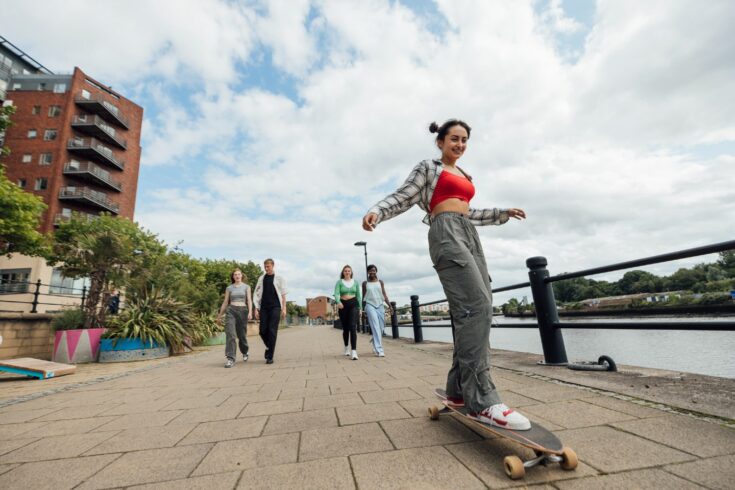
No one likes to feel unsafe while out and about, young people included. From poor lighting to knowing you’ll have to walk past the spot where a local gang hangs out, it’s no wonder teenagers often opt for the bus or a lift from Mum or Dad. Yet there are big benefits to their physical and mental health, and to the environment and local community, if they feel able to walk, cycle or even skateboard in safety.
Historically, initiatives to encourage young people to be more active have been adult led. As a result, they have missed the valuable input of teen perspectives.
Dr Peter Hart, Lecturer in Inclusion, Childhood and Youth at the School of Education, University of Leeds, said:
Young people have their own specific travel needs that are shaped by things like friendship groups or perception of areas in their local neighbourhood. Hearing what they have to say about their experiences of travelling around their communities helps to understand their perspective and, in doing so, create changes that are more likely to be effective.
Listening to young people’s voices
Dr Hart led a project part-funded by the Economic and Social Research Council (ESRC) that demonstrated that young people can be instrumental in kick-starting this process. Researchers worked directly with children and teenagers to understand the barriers they face and develop the Active Travel Toolkit.
The toolkit has been used in Leeds, Hartlepool and Milton Keynes, where youth groups have successfully secured measures to improve the safety and accessibility of journeys within their neighbourhoods.
Developing the toolkit
The toolkit provides step-by-step guides to exercises that raise young people’s (11 to 18 year-olds) awareness of active travel. The activities are designed to encouraged teens to open up about their experiences and explore the obstacles standing in the way of more active travel to create some actionable solutions.
It enables schools, youth groups and community organisations to put young people at the heart of active travel planning, involving them in meaningful discussions about how they travel, and how they’d like to.
Research began in 2021 with an initial project funded by the Yorkshire Sport Foundation and supported by Leeds City Council. The team worked with the council and three local youth organisations to develop a blueprint for the toolkit. They then tried it out with a group of young people at the Kentmere Community Centre. The young people used it to identify their own barriers to active travel, such as the cost of fixing broken bikes and scooters. This resulted in a ‘bike doctor’ visiting to conduct free repairs.
Real-world safety improvements implemented
In 2024, the team used an ESRC Impact Acceleration Accounts grant to further test the toolkit, this time led by youth workers from Hartlepool. Young people used the toolkit to pinpoint locations they felt were unsafe but could boost active travel by shortening walking times to their youth centre. In response, the local council increased police patrols, cleared away bushes in the area, and provided safety equipment, such as personal alarms and torches, for the youths.
Additionally, Hartlepool Neighbourhood Services installed over £20,000 worth of new street lighting to improve safety in those areas.
According to a Senior Youth Worker who used the toolkit with young people:
[The Active Travel toolkit] has been very positive and has gone in more directions, where real changes can be made with young people, than we could ever have imagined.
Presenting potential solutions to decision makers
The exercises for young people included in the toolkit are fun and informal, but they feed into conversations around travel behaviours that offer robust evidence for investing in local active travel initiatives.
Dr Hart explained:
Things like building models in Playdoh or doing a virtual walk on Google Maps helped generate conversation about places that were important to the young people.
These could be negative places, like a specific churchyard they wouldn’t walk past because there was a group of older kids that hung out there. Or positive, such as a roundabout where their friends would congregate to do the final journey to school together.
At the end of the process, responses can be brought together as an evidence base for those who can potentially make changes. For example, in Leeds, they were presented at a meeting that included representatives from the police, council, community centres and local businesses.
Dr Hart said:
The young people then discussed the barriers they were facing and asked the audience what they could do to help.
In response, Police Community Support Officers promised patrols of a local park and schools explored the provision of more secure storage for bikes and scooters.
Encouraging involvement of young people in planning decisions
The project also highlighted the meaningful role young people can play in decisions by councils and other local authorities. The toolkit has been used by youth services in Milton Keynes, who used the kit to secure investment in e-scooters and safer public transport connections. The expectation is that it may be adopted by others across the UK.
Dr Hart said:
In Hartlepool, the feedback we had from local organisations was how impressed they were by the practical and actionable suggestions that came from the young people.
They plan to incorporate those ways of working into other areas, such as housing for the town.