
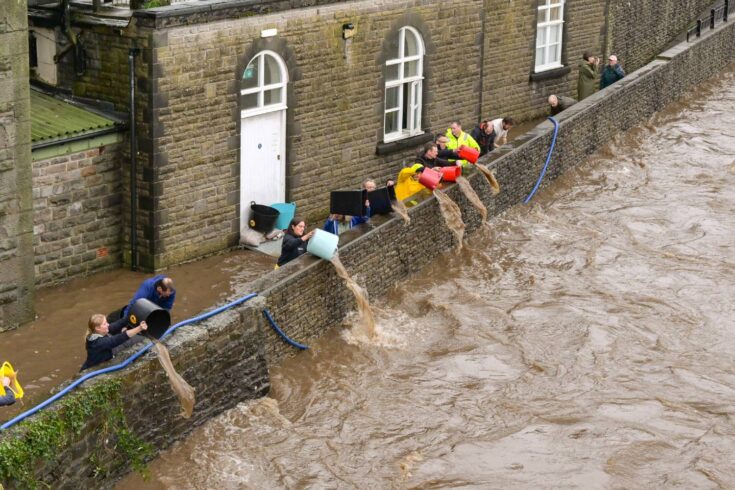
When devastating wildfires struck Dunwich Heath in Suffolk this summer, the community sprang into action. Farmers used tractors to create firebreaks, while locals offered accommodation to holidaymakers evacuated from campsites. Their response reflects what research tells us: in a crisis, far from behaving selfishly, people often want to help each other.
A new community resilience toolkit, Ready Together, aims to turn that instinct into organised action. From street WhatsApp networks and faith communities to flood action groups, it gives local groups practical ways to prepare, share information and support neighbours in a crisis. As extreme weather emergencies become more frequent, that preparation has never mattered more.
New national toolkit
Ready Together was launched nationally in October 2026 by HRH The Prince of Wales and broadcaster Ross Kemp. More than 100 communities across the UK signed up within the first 10 days.
The toolkit was developed through a partnership between the National Emergencies Trust (NET) and researchers at Nottingham Trent University and led by Professor Rowena Hill, Professor of Resilience, Emergencies and Disaster Science. The team built on previous Economic and Social Research Council (ESRC)-funded projects and drew on extensive research to ensure the toolkit’s guidance was both practical and informed by evidence.
Extreme weather, stretched services
Across the UK, extreme weather is no longer exceptional. From flash floods and storms to heatwaves and wildfires, climate change means we now face increased risk of multiple emergencies occurring within a short space of time. As Professor Hill explains:
These incidents are becoming more frequent and severe. Where once we might have faced a bad autumn for storms or a couple of spring floods, now every season can bring multiple adverse weather events across the UK. Managing that risk is becoming more complex and demanding.
Fire and rescue, police, health services and local authorities are already feeling the strain. In its most recent risk assessment, the Climate Change Committee warned the UK’s capacity for emergency response is increasingly being outpaced by climate risks. More organised, community‑level responses are therefore needed to complement and support essential services. Ready Together is designed to complement emergency services, rather than replacing them.
Creating the conditions for community resilience
Traditionally, resilience policy has focused on national issues: keeping energy, water and transport systems going. Creating policies at community level is more challenging.
Professor Hill said:
We tend to write policy for society or sectors; not streets or small groups that want to help one another and share resources in adversity. Communities vary so greatly. They have different geographies, social capital, needs and assets.
While emergency services plan carefully for local risks, communities are not always involved, so their knowledge and voices can be missed.
The community resilience toolkit is designed to address that gap. It supports local groups to:
- understand their specific risks, whether that’s flooding, power outages or wildfires
- identify who is likely to have additional needs, such as the elderly, people who are dependent on medicines, or have babies or young children
- plan how neighbours will check in, share resources and support each other during and after events
Importantly, the toolkit avoids a prescriptive, one‑size‑fits‑all model for community resilience. Professor Hill explains:
Instead of suggesting the ‘ingredients’ for community resilience, such as specific things they need to have or do, the toolkit presents ways to facilitate community resilience and create the conditions for it to grow. Groups can then tailor plans to suit their needs at a local level.
Closing the usability gap in climate research
The toolkit builds on a substantial body of ESRC‑funded work on emergencies and resilience, as well as closing the ‘usability gap’ between academic research and decision makers.
Professor Hill explains:
A ‘usability gap’ appears when valuable research findings do not reach policymakers, responders or communities in a clear, practical form.
There’s a wealth of climate research, which spans environmental science, health, psychology, architecture and many other fields. The volume can overwhelm those making practical decisions.
Professor Hill helped close this usability gap during an 18-month UK Research and Innovation (UKRI) policy fellowship with the Ministry of Housing, Communities and Local Government. During the fellowship, she worked with the department’s Resilience Directorate, helping connect cutting‑edge climate, behavioural and systems research into policy.
She also helped establish the Climate Security National Foresight Group. This brings together government departments, emergency services, the Environment Agency and the Met Office to support the UK response to climate security and adaptation.
Professor Hill’s previous ESRC-funded research, evaluating the National Emergencies Trust’s first major activation during COVID‑19, also helped shape the toolkit. The study looked at how the NET distributed more than £90 million through local charities closest to those in need. It showed why trusted local networks matter: they can identify needs quickly and reach people who may otherwise be overlooked.
Improving resilience at national and local levels
While the toolkit works at community level, Professor Hill’s research insights are also feeding into national planning. The UK’s National Adaptation Programme (NAP) looks at how key sectors can prepare for climate risks across the UK. Professor Hill has contributed to the Climate Change Risk Assessment on Built Environment, which will directly inform the next iteration of the NAP, due to be published in 2028.
Together, these efforts mean that as climate impacts grow, both national systems and local residents are better equipped. They help ensure communities are more organised, informed and connected. This eases the strain on emergency services, speeds recovery and ensures the help people instinctively want to give is planned rather than left to chance.