

Ask any teacher and they’ll say the same thing: teen mental health problems are rising, and schools are on the frontline. Staff and pupils feel the strain in corridors, classrooms and noisy lunch queues. What’s less clear is why, and what schools can realistically do.
The SOCITS (SOCial, sITuational Systems) study, led by Dr Mark McCann at the University of Glasgow, is changing that. It has developed a system that gives schools a tailored picture of pressure points. The spaces, routines and relationships contributing to stress and loneliness can vary widely from school to school. This system enables staff to understand and address the issues in their own setting, rather than taking a ‘one size fits all’ approach. A digital model also lets staff ‘test drive’ potential fixes before trying them in real life.
Officially, it’s a methods development project testing new ways to measure mental health in context. However, it is already having real-world impact, with three pilot schools using its findings to tweak bus queues, reclaim problem spaces and rethink day-to-day support of pupils’ mental health.
When standard approaches fall short
Around one in five young people have a mental health difficulty, according to NHS England. And rates of mental ill health across the UK have doubled over the past decade. Schools have responded by focusing either on individual pupils, through counsellors or mental health referrals, or on whole-school measures such as mental health lessons. But research suggests these broader efforts do not always prevent problems and can heighten anxiety without addressing its sources.
“We’ve seen adolescent mental health getting worse over the past 20 years and there is a real need to understand what’s changed,” says Dr McCann. “But asking individual students how anxious they’ve felt over the past six weeks and producing a school average can’t tell you what’s happening in the day‑to‑day life of a school.”
SOCITS is funded through the Developing Minds initiative by the Economic and Social Research Council (ESRC), Medical Research Council and Arts and Humanities Research Council. It sets out to bridge the gap between the individual and the whole school. How do friendship groups, staff-student relationships and physical spaces affect mental health? And how can these be measured to prompt practical, low-cost change?
A new way of measuring mental health
Rather than giving each pupil a single mental health ‘score’, Dr McCann’s team developed methods to look at where, when and with whom stress and loneliness occur in schools. They then turned that data into a bespoke stress ‘fingerprint’ showing where exactly where problems arise so staff can act.
Dr McCann says:
If you measure it in a certain way, you think about it in a certain way. “With just a small change in how we ask questions, a whole different set of ways of thinking and working to improve mental health opens up.
Walking the corridors
The project tested several innovative methods in the three pilot schools, including walking interviews. Using phones or tablets, pupils guided interviewers around school, pointing out the crowded, dark corridors where stress spiked, or the bright classrooms or welcoming libraries where they felt calmer and more connected.
Classroom workshops grouped pupils with similar experiences, such as younger and older students. On sticky notes, they listed spaces, times, interactions and rules they felt affected their stress or loneliness.
The team then led ‘deep dives’ into selected examples, unpacking who was involved, what happened, how it felt and what could change.
Turning experiences into visual ‘fingerprints’
These sessions helped each school design their own survey. Instead of “How anxious are you overall?”, pupils rated their stress from 1 to 10 in situations and places specific to their school. This included the bus queue, lunch hall, library and exams, and at different times of day.
The results became heat maps: each vertical line representing a pupil and each horizontal line a situation, with blue for low stress and red for high. The results were often unexpected. In one school, exams glowed red while the library stayed blue, thanks to a librarian who had made it a friendly hang-out. In another, exams were not a cause for concern for most but the courtyard varied wildly: extremely stressful for some pupils, neutral for others.
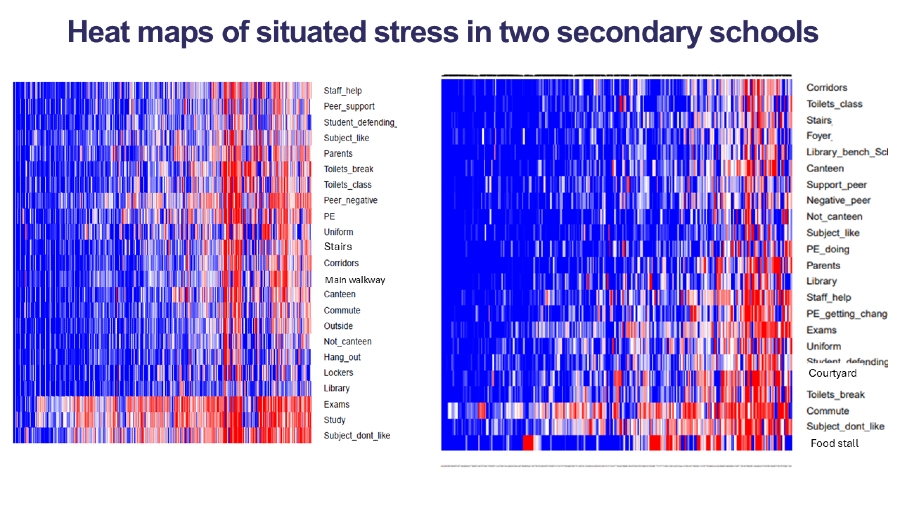
Heat maps from two pilot schools. These show levels of stress experienced by pupils in different situations and places specific to their school. Blue indicates low stress and red indicates high stress. Credit: the SOCITS team.
“Rather than having a single measure for each student or the average for the school, you end up with a ‘fingerprint’ of each school,” Dr McCann says. “The patterns help schools see which spaces or routines need further attention.”
The team combined all the data in a simulation model that created a digital version of the school. This included a map with moving dots representing staff and students and how they feel when they are in particular locations or situations.
Dr McCann says:
This allowed schools to get a feel for what might happen if they try a change, such as opening extra space at lunchtime or increasing staff presence in corridors, before investing time and resources.
Small changes, big impact
Although SOCITs was not designed as an intervention trial, schools quickly began to act on what they saw.
At the school where courtyard stress varied widely, workshops revealed the space had a reputation for homophobic bullying that staff had not recognised. Senior pupils suggested moving fundraising stalls there, giving younger students a positive reason to use it while older pupils kept an eye on what was happening.
At another school, younger pupils identified after-school bus queues as particularly stressful. Staff realised that pre-Covid pick-up arrangements could be reinstated quickly and cheaply.
Crucially, these solutions did not require new, expensive whole-school programmes. “They came from letting pupils talk about the social and spatial contexts that conventional mental health surveys miss,” explains Dr McCann. “As soon as you ask about situations, things that were always there but weren’t measured become visible.”
Next steps: a toolkit any school can use
The University of Glasgow’s ESRC Impact Acceleration Account is supporting Dr McCann’s team to turn SOCITS into a practical toolkit schools can run themselves.
The toolkit will include:
- step-by-step resources for walking interviews and systems workshops
- guidance on involving students as co‑facilitators
- an easy‑to‑use dashboard to generate the visual ‘fingerprints’ without specialist statistical skills
Workshops with teachers and local authority wellbeing leads in Scotland, and soon England and Wales, are shaping the toolkit around school timetables and constraints.
Dr McCann says:
Mental health is not just what’s going on inside the mind; it’s linked to the social and physical spaces people inhabit. By focusing on relationships, spaces and everyday situations, SOCITS helps schools see student experiences more clearly and what change could support wellbeing more effectively.