
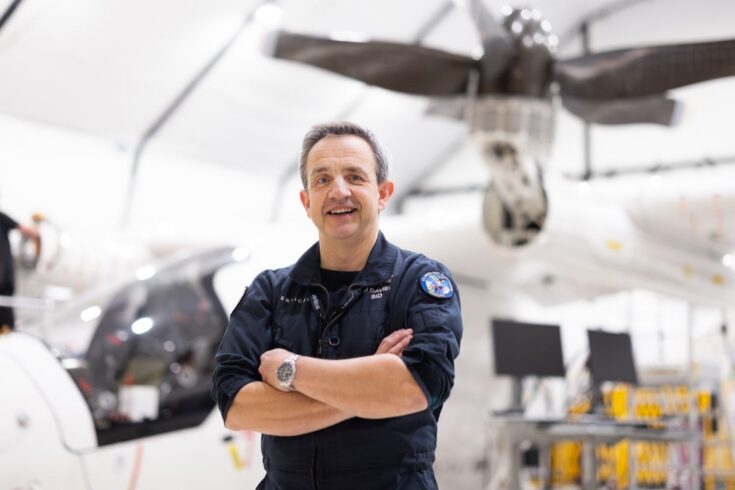
Piloting an experimental aircraft
Si Davies used to fly the Tornado, a supersonic fighter bomber, for the RAF. Perhaps that’s why he’s so relaxed about piloting an experimental aircraft.
A light flickers in his eyes when he talks about getting into the cockpit of Vertical Aerospace’s electric vertical takeoff and landing (eVTOL) vehicle, but there’s not even the suggestion of fear. “We’re quite a boring bunch, test pilots,” he says, downplaying his impact. On 14 April 2026, Davies became the first person in the UK to achieve a two-way piloted transition flight. Which is when the aircraft switches from helicopter mode to airplane mode, and back again, while up in the air.
It’s all about preparation, Davies says:. “We’re safety obsessed, we think ahead to what might go wrong and how we can either prevent it from happening or, if the bad thing does happen, how we can make the outcome better.”
Davies prepares himself mentally and logistically through simulations, but also, as an aeronautical engineer by training, he’s also able to get involved in the aircraft’s design. In 2019, he got an invite to visit Vertical Aerospace through a friend of a friend. He was giddy. Fascinated by electrification, he immediately asked how he could be involved. Now he is their chief test pilot.
There’s only so much preparation you can do on the ground, however. “At some point you’ve got to go fly, and that is a big leap,” says Davies. “You’ve got to take off, and you’re committed to flying for a few minutes.” He remembers his first flight in one of Vertical Aerospace’s aircraft. “The moment the wheels leave the ground, you get this sensation for the first time, and it’s kind of jarring,” Davies says. He’s flown 80-odd types of aircraft, from WWII bombers to modern fighter jets, as well as helicopters, “but this doesn’t feel anything like any of them.”
It’s a familiar environment, but there’s a different feeling to it, he continues, “the aircraft responds in a different way”. There’s no supersonic capability (he does miss that), the level of automation is high (“it takes the stick monkey skills away from the pilot”), and crucially it’s quieter. “It’s a lot less intrusive than a helicopter flying overhead,” says Davies. Which means it has social license that a helicopter wouldn’t have, opening up flying and landing options that wouldn’t have been open before.
The aircraft
The aircraft has a science fiction aura about it, sleek, shiny and unusual, although it’s very much part of the present. Eight propellers jump out of the two fixed wings, four of them rotate 90-degrees to switch from take-off to flight. The cabin will be able to hold four passengers, plus the pilot. “It’s sized to match a London black cab”, Davies says, so he doesn’t mind it being labelled as a ‘flying taxi’. “Not ‘flying car’ though,” he says, “that’s my red line.”
It’s fully electric, so a huge challenge was shrinking the batteries down to a manageable size. The batteries used to fill the space where the passengers would sit. “But that wasn’t going to make us much money,” says Christopher Lyness, Vertical’s Head of Battery. So his team set about shrinking them down. They brought the battery manufacturing in-house, switched from an air-cooling system to liquid-cooling, and iteration by iteration the batteries got smaller. “We’ve pulled out about 100 kilos,” says Lyness, and they’ve still got a few iterations to go.
Vertical Aerospace is currently working to prove the fundamental architecture and design of the final aircraft, which is called Valo. The aim is to have a final review of the design by this summer, then build an initial fleet of seven aircraft. This fleet will go through the testing and verification process with the UK and European regulators. Once Valo is certified, targeted 2029, it will be able to take passengers. Vertical already has £5 billion worth of aircraft on pre-order.
When they get there, the first way they’re expecting the aircraft to be used is as airport shuttles and in intercity travel. The Valo can travel 100 miles before needing a charge, so could take passengers from Gatwick to Cambridge in about 20 minutes. Airports are likely where they’ll start, because they’re already regulated for flight. As Vertical develops the aircraft, other companies are working to setup ground infrastructure. For example London-based Skyports, for example, is converting helipads into vertiports, with built-in charging systems, so flying taxis could become a reality across the UK and worldwide.
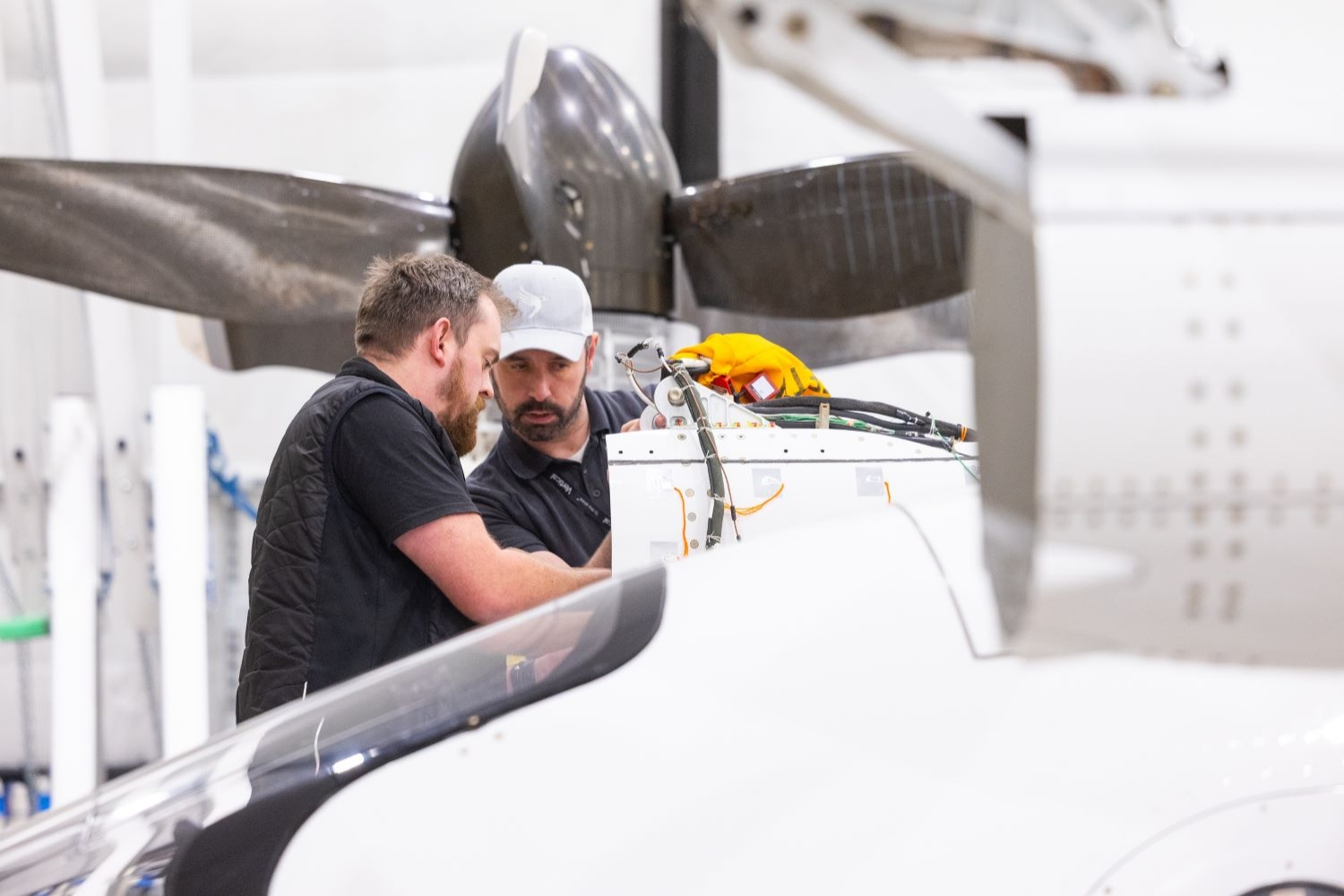
Vertical Aerospace engineers. Credit: Christopher Ratcliffe
Funding
The models we see are two prototype aircraft, which internally go by Aircraft 2 (AC2) and Aircraft 3 (AC3). Visually, they’re twins, but AC3 will ultimately be fitted with a hybrid powertrain to extend flight duration and AC2 is the all-electric craft that completed full-transition flight. We didn’t get to view their predecessor, Aircraft 1, which despite its nickname, wasn’t the first of Vertical’s creations.
“My first question to the headhunter when I was called was: ‘How amenable is the company to changing the aircraft?’,” says Michael Cervenka, Vertical’s chief commercial and strategy officer. Michael joined the company in 2019, after confirming the founder Stephen Fitzpatrick was amenable. “On week two, I shut down the whole aircraft programme.”
Cervenka, who’d been heading up Rolls-Royce’s future business propositions department for nearly four years, was convinced that eVTOLs were a huge opportunity before joining Vertical. But he didn’t think they’d designed the right one. Just as they’d started making good progress, he says, Covid hit, and the possibility for funding evaporated. “At that point in time, we were completely funded by our founder, and he had effectively reached a point where he could just about afford to fund the ongoing cost of the business, but couldn’t afford for us to build any aircraft,” says Cervenka. “So we actually faced a pretty existential question at that point: do we keep going?”
After much discussion, they decided to press on, and Cervenka started working on securing grant funding from Innovate UK. “We had to restructure the business,” he explains, to qualify for an Innovate UK grant, which was no small feat. “But we worked our way through that and it was a massive boost.” Vertical received £12.6 million, and that funded Aircraft 1. “I think it’s probably not overstating it, without that, Vertical may well not exist now,” he continues, “so it was really fundamental to the business.”
The grant funding has had a knock-on effect, with progress now possible private investors became interested. Vertical secured about $50 million of funding, primarily from Microsoft ventures. “We wouldn’t have been able to do that, I think, without the Government support,” says Micheal.
Global markets
Cervenka maintains the level of support Vertical has received from Innovate UK is “unparalleled”, and that the UK does a phenomenal job supporting startups between the proof-of-concept and prototype stages.
Aerospace is however a global market. To enable operations in different countries, first Vertical and other eVTOL developers will need to understand different approaches and potentially different evidence required by certifying authorities. Such as UK CAA, EASA in Europe and FAA in the US.
What UK startups could really learn from US companies is their ability to shout about their achievements, creating a narrative, engaging the public in the progress they’ve made. Davies has training from both sides of the Atlantic. He’s wearing his flight suit, an RAF patch on one shoulder, a NASA patch on the other (he jokes about his resemblance to a boy scout). He knows there is a good story to tell here, quoting David King, Vertical’s chief engineer: “He says, ‘everything in my life has got better, computers got faster, cameras got smaller, everything, information, access, got better, but travel around our cities has got worse. This is just one obvious way that we can start to make things better.”