
Beginnings of Nu Quantum
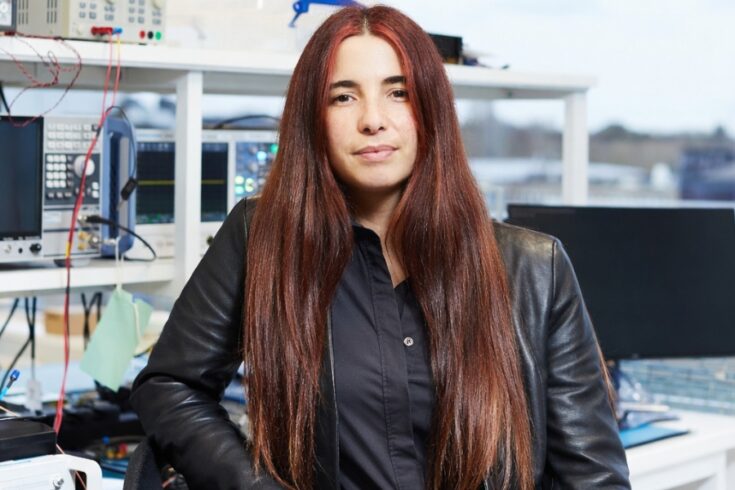
Carmen Palacios-Berraquero wasn’t expecting to start a company. While she was a postdoctoral researcher at University of Cambridge, the Cambridge Tech Transfer Office encouraged her to do something with the patent she’d registered during her research.
“They provided resources for early entrepreneurship training,” she says, “and then it just snowballed.”
She had wanted to find a way to keep working with the quantum technologies she loved, and knew she was good at, and this suddenly seemed like a viable option. She did a few pitches, and then one investor invited her to join their accelerator.
“I incorporated Nu Quantum in my room in London,” she says, trying to remember the exact part of Brick Lane.
“It was just me at the beginning,” she says. Only after getting some grants and an early loan from the university, did it start “to be something”. And only after getting her first seed cheque did she bring in other members of the team.
Building the impossible
As soon as Nu Quantum was real though, Palacios-Berraquero knew it was going to work. “For no reason,” she laughs, admitting that’s one thing that’s stayed consistent through the eight years since. “The drive and the certainty that we’re gonna make it work is still the same.”
That’s almost a necessity, though, to be obsessively optimistic when you’re trying to build something that has never been possible before.
Three funding rounds later, and it’s clear she’s not the only one who believes the startup has longevity. In December Nu Quantum received a $60 million Series A investment, a global record for quantum networking, and for quantum computing in the UK.
Quantum building blocks
Speaking to Palacios-Berraquero, it’s clear the science is ever-present in her mind.
“People think quantum computers don’t exist yet, that it’s ten years away, but actually the people using the latest quantum computers are finding more accurate answers and faster answers already,” she says. “There’s no time to lose in terms of starting to use this technology.”
Nu Quantum began as a quantum components company. It was creating specific building blocks for quantum technology (single photon sources) that had the potential to be used across quantum sensing, communications and computing.
But after maturing that technology, and getting a pre-seed round of funding, Palacios-Berraquero noticed a gap in the quantum computing market.
Quantum networking
“In collaboration with Edward Wood, our VP Product, we interviewed many, many, many potential customers in each of these markets,” she says. And all of the roadmaps from companies in the quantum computing space had one thing in common: quantum networks.
“Every single one of them was relying on networking at some point to get to commercial application.” But the concept was still mostly hypothetical.
Quantum networking is one route to scaling quantum computing. Rather than building bigger, standalone quantum computers, networking allows the quantum information to be transmitted between separate quantum devices using entanglement.
So it’s like a quantum internet? “Yeah eventually,” says Palacios-Berraquero, “but you can think of it more like the infrastructure that interconnects processors inside a data centre.” It’s not about distance, but about amplifying computing resource.
Without networking, quantum computers would be standalone, reminiscent of the early mainframe era in classical computing, where big iron machines were housed in centralised, air-conditioned centres, that people would travel to.
Gap in the market
Still, the gap in the market she’d noticed wasn’t so gaping that anyone else had really clocked it. At that point, in 2021, though quantum networking had been demonstrated in academia, no other quantum networking companies existed.
“You had to really talk to the people in the companies and go through it in detail to understand that it was a pervasive problem, the horizontal problem across the industry,” explains Palacios-Berraquero.
“These patterns in classical computing tell us that this need [for networking] has always been there, and it’s a valuable problem to solve – so we said ‘okay, we’re going to be the company that solves it.’”
Now the startup has made huge headway, and other big players are getting in on the action. IBM and Cisco announced at the end of last year that they’re going to collaborate on building a network of quantum computers by 2030.
“It’s a huge validation,” says Palacios-Berraquero, seeming excited to have competition, but reminds us that her team, trailblazers that they are, have already given names to parts of the network “and those names are now being used by IBM and Cisco”.
Practicalities of funding and running a business
There’s no way to overstate how calm and collected Palacios-Berraquero is when speaking about her pivot into what was, and is, undeniably a great unknown.
The 34-year-old doesn’t flinch. But that doesn’t mean she is ignoring the risks. “We’re shooting for the moon,” she says, acknowledging that Nu Quantum’s risk appetite is higher than most companies. “But high risk, high reward.”
Though she’s always had that intrinsic feeling that her startup is going to succeed, the company’s moves are rooted in hard evidence. “All the validation, and the shaping of our vision, has been absolutely market-led, it has been externally driven,” she says. “We found a problem in the market that needed a solution, and we created the best team to deliver it.”
That’s the best piece of advice she’s been given: “you need to be solving a problem that not just one customer has, but a market has; they need to be willing to pay, and there needs to be urgency.” You can build something amazing, but if no one needs it then you’re never going to be profitable.
Funding sources
Nu Quantum’s combination of funding sources also serves as a de-risking device for investors; the startup has received grants from Innovate UK as well as VC backing.
“The Innovate UK grants were fundamental to our early success, to our first funding round and our second one,” says Palacios-Berraquero, explaining that early-stage deep tech is rarely going to be purely investor, government or customer backed.
“You combine all of them and they all feed into each other,” she continues. “The support from UKRI has been absolutely fundamental to bringing in private capital.”
When asked about her recent, record-breaking funding round, she’s pragmatic: “that’s just what we need.”
Nu Quantum had started with a $40 million to $50 million target because that’s what it takes to build this kind of complex technology, and the round was oversubscribed. “We were able to bring in more, which is always a good idea,” she says.
This was their third round. The first, in 2020, was fast and successful, after getting good results with their UK Research and Innovation (UKRI)-funded projects. The second, after the pivot, wasn’t as easy, because the market was bad, and their offering was more hypothetical, but they still did well. And there will likely be more rounds in the future as the technology continues to unfurl.
Years of discovery
“It doesn’t happen in one moment,” says Palacios-Berraquero, referring specifically to their networking stack, which has slowly come into existence. “The moment we defined the networking stack, the architecture of the technical solution, I think we’ll always remember that,” she says.
“It was not defined before and then we – you know – defined it from nothing.” There wasn’t a single ‘eureka’ moment, the process took years of discovery, pushing through skepticism, figuring out how quantum processors could essentially communicate with each other using photons.
“Everything needs light,” Palacios-Berraquero affirms. And now they know how to use it.
As she says, staying true to form, “I knew there was something there.”