
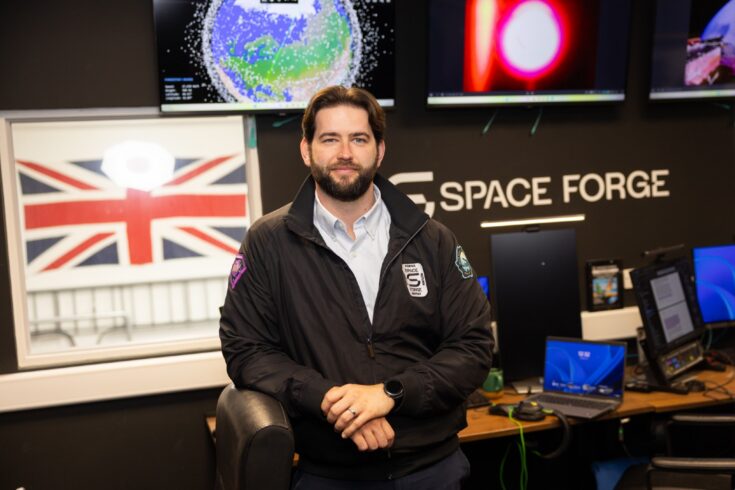
Celebrating failure
The first thing you see when you walk into Space Forge’s headquarters is failure. A cabinet in the lobby is filled with miscellaneous missteps:
- a 3D-printed vacuum chamber that started melting almost immediately after they got it hot enough to work
- £25,000 worth of titanium machined into a completely useless semiconductor chamber, because it was shaped in a way that prevented the filings being tipped out
- a deflated balloon, that hung in a tree for hours sending out the same (expensive) distress call every 10 minutes
It’s not surprising that a startup working to build space factories and send them into orbit won’t have got everything right on the first try. But celebrating failure is clearly central to the company’s culture.
Failure of the month award
Move a little further into the building and you hit a hallway, lined with framed Failure of the Month Award certificates, each listing an employee’s name and their notable foible.
Someone earned said achievement by melting a hole in the carpet during a high temperature test. But the prize was gained by a wide array of flops. Accidentally deleting a structural simulation model, which had taken a week to make. Using real milk rather than powdered in the coffee machine. Destroying two pairs of wire cutters in two failed attempts to cut a piece of metal. Leaving a work laptop in an airport X-ray tray.
Why this irreverent take on Employee of the Month, or the incessant celebration of all that’s gone wrong? “Well,” says Joshua Western, co-founder and winner of a fair few Failure of the Month awards, “if we didn’t do these things, then we wouldn’t have done the things that do work.”
Learning from failure
The awards started in 2020, when there were just four or five team members, so they’d nominate each other based on what they’d seen go wrong. Now the company has grown, employees put themselves forward and the winner is decided by a vote. “People try to win this award,” says Western. “It’s like a company celebration.” Because if you’re not failing, you’re not pushing hard enough.
Only one Failure of the Month was awarded externally. “We gave it to Virgin Orbit when they lost our first mission,” says Western. “We did send it to them. We didn’t hear back.”
The Big Bang
That first mission was ForgeStar-0, an intended prototype for Space Forge’s in-space manufacturing system.
In 2023, it was packed onto Virgin Orbit’s LauncherOne, ahead of the rocket’s first UK launch. It took off from Cornwall, but one of its engines shut down. So instead of reaching orbit, ForgeStar-0 ended up in the Atlantic Ocean, along with the missions of six other customers.
“We were the only mission that had taken out insurance,” says Western, “so that kept us going for a few months.”
Special of the day
He talks about it lightly now, pointing to a cartoon tucked into the corner of a framed tribute to the mission. A server hosts a couple at Rick Stein’s Cornwall fish restaurant: ‘Our special of the day is locally caught space rocket debris.’
He’s proud of the failure, or at least the fact it was chronicled in Private Eye, but that doesn’t mean he enjoyed experiencing it. “I cried,” he admits matter-of-factly, recalling the aftermath. One of their board members, a former chair of Virgin Group, picked him up the next morning at 6am. “He was like, ‘Right, I’m driving you back down to the spaceport, and you’re going to be doing interviews the whole day. Trust me’,” Western remembers. “It was a very cathartic experience. I went through all of the stages of grief in about six-and-a-half hours.”
Emotional mission
During his first interview (“I can’t remember which news outlet”) he was a “blubbering wreck”, but by the end of the press junket he was composed and focused on the next one.
When ForgeStar-1 made it into low Earth orbit in 2025, Western cried again. A romantic tear rolling down his cheek? “Oh, no, no, no, I was bawling like a baby.”
“I cried when it went up; and then I cried again when they said separation confirmed, which meant we had departed the rocket; and then I cried again when we made contact,” he says.
He jokes that his wife is taking bets on whether he’ll cry as much when their child is born.
The next industrial revolution
ForgeStar-1 has been in orbit for just over a year now, and its mission is almost complete. The microwave-sized space factory was designed to be a stable environment in which plasma could be produced at 1,000C, while travelling through space at 19,000 miles per hour. “We have created plasma more than 120 times in 170 days,” says Western.
The next phase is to prove their re-entry technology can take itself out of orbit if something goes awry, rather than causing a terrestrial incident. The technology will eventually be used to transport the factory back to Earth.
So, aptly, Western explains: “This mission is to fail on purpose.” When the satellite de-orbits and burns up in the atmosphere, it will be deemed a success.
The material trial
The next iteration, ForgeStar-2, is bigger, the size of a washing machine (Western likes to define measurements based on household appliances). We can see an exploded view of it at Space Forge’s Cardiff facility, the cube folded out so its eight interior sides are visible.
This mission will be the material trial, using the plasma-producing environment to grow crystal seeds, which can be used in semiconductors back on Earth. Because these crystals are produced in space, they have a higher purity, potentially 4,000 times purer, which translates to better thermal properties, so less energy needed to manage data centres, for example.
“Earth is a wonderful place to live,” says Western. We have gravity, which keeps us here. We have a dense ambient atmosphere, which we breathe. And a fairly consistent temperature, which keeps us warm and cool enough, most of the time. “Those three things are terrible for almost any industrial process,” he continues, “whether you’re milking a cow, you’re making dried pasta, or you’re trying to produce steel, at least one of these factors has to be fought against.”
A better toolset
Space is a vacuum with near-zero gravity, which results in that higher purity but also allows the crystals to grow better. “Nobody’s quite sure why,” says Western, explaining that, as well as producing the crystals, he’s hoping to better understand how microgravity and space’s vacuum has that impact.
“Because the more we understand about why it’s better, the better toolset we have,” he continues, but also “that’s a tool set we can sell to other people who want to develop other types of materials, and they will have a much better running kind of understanding of it than we ever did.”
Microgravity as a service
That’s why Space Forge plans to offer “microgravity as a service”, where other manufacturers, in pharmaceuticals, alloys, telecoms, to name a few, could also create novel materials in its orbital factories.
The final hurdle, of course, will be getting everything back to Earth.
King Arthur’s shield
Returning to Earth’s atmosphere is a ferocious process, with spacecraft encountering temperatures over 1,500C. So reentry, if you don’t want to burn to dust, requires thermal protection. Often these heat shields are built onto the vehicles, and vaporise away as the temperature rises. But Space Forge has Pridwen, a gentle re-entry and return system, shaped like an umbrella, that only unfolds when deployed, and can be reused across multiple missions.
Is Pridwen a Welsh word? “Yes,” Western says, sheepishly, for reasons that become clear when he gives the translation. “So… it means white or pure face.” They chose the namesake because it’s the name of King Arthur’s shield, the pure face in question was the Virgin Mary’s, which apparently was depicted on it. “But a direct translation is quite awkward in the 21st century.”
Funding journey
The first version of Pridwen is on ForgeStar-1, but its only mechanically representative, since the mission is set to disintegrate anyway. In June, the British government announced it was giving £10 million to Space Forge, via an increase in investment to the European Space Agency. The investment will support a mission to develop and launch Pridwen 2.
Space Forge’s funding journey began with Innovate UK in 2020. “We actually started off with like a £90,000 study project really early on,” says Western. The first grant, for just over £95,000, was for Project Fielder, a planned satellite recovery system. “I think it might have even been the first thing we were awarded.” In 2023, they received another £77,000 for in-orbit manufacturing, and another £498,000 in 2024.
Semiconductor ecosystem
Most of Space Forge’s work with Innovate UK has been focused on the semiconductor ecosystem. “And that’s been hugely positive for us,” says Western. “Not least because it’s allowed us to establish our credentials, but also because of Innovate’s focus on the collaborative aspects, the programs we’ve been able to build together.”
Space Forge has been able to build Innovate UK programming across almost all of their beachhead markets, “which is then obviously a wonderful proxy for us demonstrating a customer pool for what we’re doing,” says Western. He explains that “anybody we’ve worked with to date” has been happy to speak to potential investors to confirm their interest in Space Forge’s space factories.
Before handling outer-space manufacturing, Space Forge had to learn to make semiconductors on Earth. Innovate UK was a useful partner in this early stage too: the Compound Semiconductor Applications Catapult helped the startup become a terrestrial semiconductor manufacturer too.
The Space Race
The wider interest in Space Forge’s technology likely stems from the same instinct that led Western and his co-founder Andrew Bacon to start the company in the first place.
“Both of us were very frustrated with the way space claimed to solve problems,” says Western. He explains that while space technology is already very good at locating and identifying burgeoning issues on Earth, those problems still required people on the ground to find a fix. Space Forge was born out of a desire to take what space was offering and use it to solve some of the world’s biggest problems.
Founding story
Every space company has its own story. SpaceX’s founding team was assembled in airport hotels; Jeff Bezos decided to start a space company over coffee in a Seattle café; Space Forge was setup in a pub.
If you’ve travelled around the UK, you’ll have driven past this kind of pub. Huge white building, white farmhouse style, a wooden post holding up the pub sign next to a road-side patio. Inside, the low-ceilinged rooms are all interconnected, mazing around a central bar. This is where Western and his then-colleague Bacon met for a chat in 2018.
Bacon led advanced concepts at Thales, the space technology company they both worked at the time. “I used to describe this as coming up with crazy ideas,” says Western, listing a few: asteroid mining, hotels on the moon, playing Quidditch on the International Space Station. One day, Bacon brought Western the idea for the technologies that now underly Space Forge, it was the first thing Bacon had suggested that Western thought he could sell. So they asked each other: “Shall we go to the pub?”
Startup from £10
They setup the company, after finding out it only cost £10, that same day. They offered the concept to Thales first, who told them to run with it themselves and changed their contracts so they could do so.
The story that follows is a sort of British remake of an American classic: a startup built out of a garage. Bacon’s then-girlfriend’s garage, to be specific, where they had space to run basic hardware experiments.
And this was a British garage, a garage so small even a regular-sized car wouldn’t fit into it, maybe a 90s Nissan Micra. “I go and meet companies that are in garages in America, and it turns out a garage there is bigger than your modern day terraced house over here,” says Western. “It’s astonishing, but if you’ve got that much room then why wouldn’t you?”
Space industrial revolution
While some space entrepreneurs are planning escape missions to Mars, Western and Bacon are thinking more about how we can improve conditions here on Earth. Part of that is another industrial revolution, but in space. “I am by no means proposing all industry should move to space, that would be dumb,” says Western, but he does imagine multiple space factories operating across multiple disciplines. Some suggestions he’s had range from ceramics for turbine blisks in engines to a flouride glass mix that can improve fibre optic cables.
Orbital factories
“The next step in that industrial revolution is that we stop taking raw materials from here,” says Western. Here, of course, meaning Earth. Instead, he imagines that somebody, a company that’s not Space Forge, will take raw materials that they’ve mined from an asteroid. Western is quick to point out that there’d be no risk of alien life on one of those, “we haven’t disturbed someone else’s economy.” And those materials will be placed into one of Space Forge’s orbital factories.
“They’ll get processed, turned into some great semiconductor seed crystals, and then brought home,” says Western. “So that we don’t need to be digging up earth and reducing what we have available to us, and that will be the fundamental shift.” And no doubt the walls of Space Forge headquarter will be lined with the failures that eventually get us there.
Author credit: Sophia Epstein
Top image: Joshua Western