
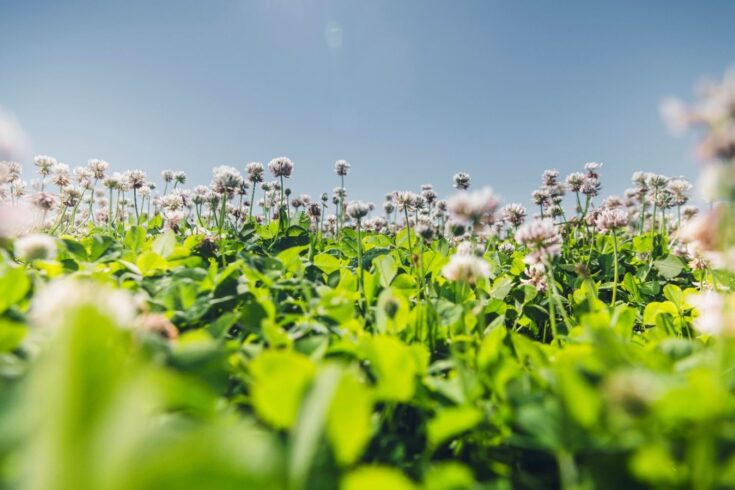
Clover has long been a staple of grasslands across the UK. The most common type in the UK is the white clover. If you’ve ever gone four-leaf clover hunting, to bring you luck, this is probably what you’ve found.
For farmers, good fortune also comes from science, as these plants can improve pastureland for their livestock. Clovers are a great fodder material for livestock while helping to boost grass production and improve grassland sustainability. However, the benefit of white clover is limited by its vulnerability to harsh weather conditions.
Scientists in the Institute of Biological, Environmental and Rural Sciences (IBERS) at Aberystwyth University have combined the traits of white clover with another distinct clover species. This has produced a new hybrid called DoubleRoot. DoubleRoot blends the beneficial characteristics of its parents, resulting in a highly persistent clover variety without compromising on performance.
The partnership of IBERS with a grass and forage seed company, called Germinal, has brought the new variety to market, benefitting livestock farming. For consumers, this means foods are produced with high standards and low environmental impacts.
The challenge: pastureland that does not cost the Earth
Nitrogen is a critical nutrient for plant growth. It is abundant in the Earth’s atmosphere, which is around 78% nitrogen, but plants can only access nitrogen in the soil.
Intensive farming depletes soil nitrogen levels, so farmers add synthetic fertilisers to the soil to restore nitrogen and maintain yields. However, inorganic nitrogen fertilisers are expensive, and their production is a significant contributor to global carbon dioxide (CO2) emissions. Fertiliser alternatives that benefit food security without negatively impacting the environment are a crucial step towards productive and sustainable long-term agricultural practices.
Nitrogen-fixing plants, work with bacteria to convert atmospheric nitrogen into nitrogen compounds that are available in the soil. This means that other nearby non-nitrogen-fixing plants, like grasses, can access this nitrogen.
White clover, as well as being highly digestible for livestock and rich in good quality protein, is a nitrogen-fixing plant. Its use in grasslands can therefore reduce inorganic nitrogen fertiliser requirements and the polluting effects of their production and use. This is also economically beneficial to farmers too, as they spend less on inorganic nitrogen fertiliser inputs.
The limitations of white clover
White clover seems the perfect solution to sustainably feeding livestock. But there’s a problem: our climate is changing. White clover grows by producing shoots which run along the top of the soil and from which new plantlets establish. This makes clover tolerant to grazing but vulnerable to harsh weather conditions, such as extreme temperatures and droughts, which are becoming more common.
The need for a tougher white clover was clear.
A hybrid built for resilience
Plant breeders at IBERS, a Biotechnology and Biological Sciences Research Council (BBSRC) strategically supported institute, have a long-standing history of breeding improved varieties of clover. In research funded by BBSRC and Germinal, IBERS developed the first ever hybrid of white clover and Caucasian clover. This variety was registered by IBERS as AberLasting.
AberLasting combines the favourable attributes of white clover and Caucasian clover. Caucasian clover is more durable than white clover as it has special strong stems that grow underground, called rhizomes. This makes it more resilient to environmental stresses and harsh weather, as well as being grazing tolerant. Like white clover, the hybrid is a good source of protein for animals too.
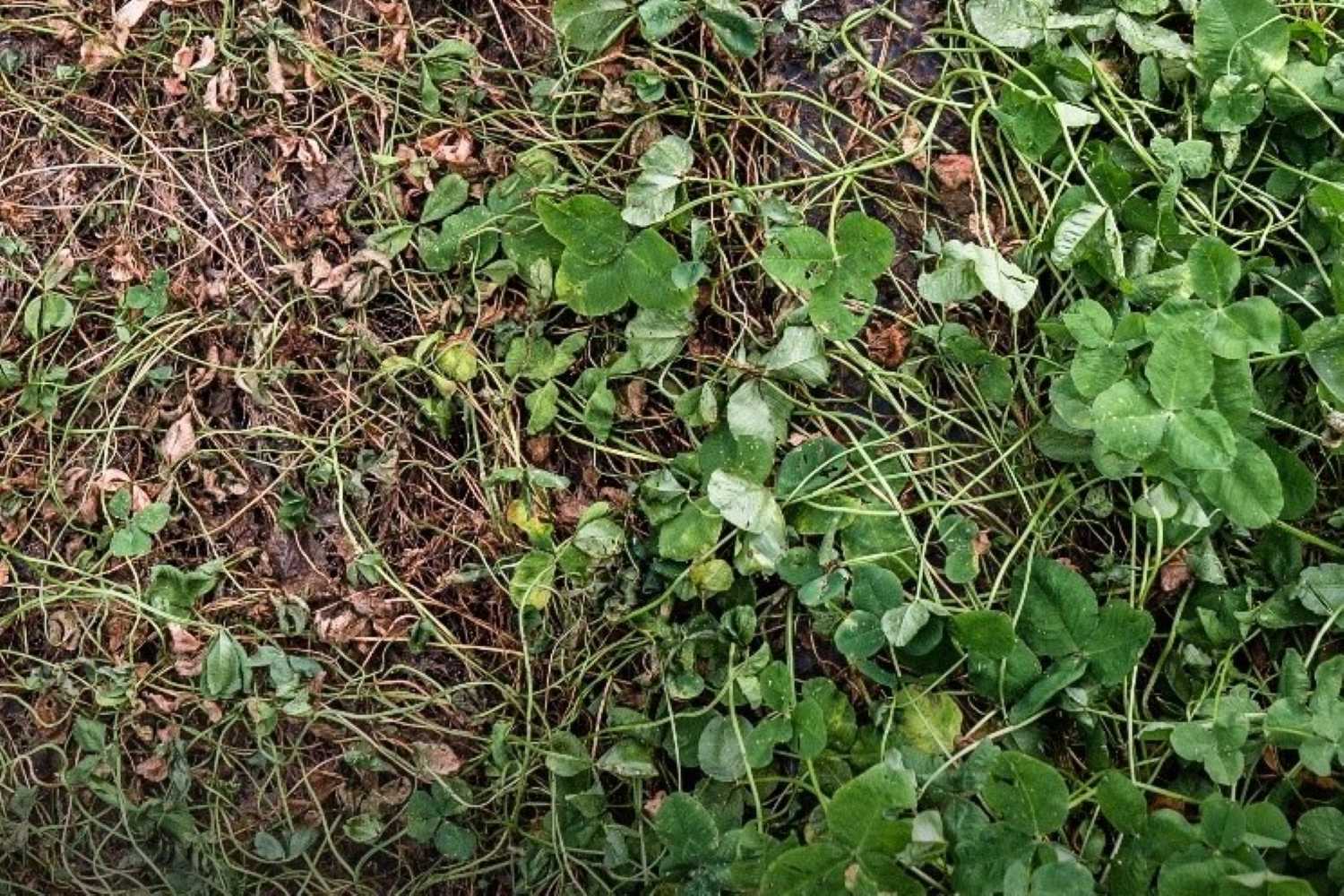
Comparison showing the resilience of DoubleRoot hybrid clover (right) versus white clover (left) after four weeks without water. Credit: Germinal
AberLasting is marketed by Germinal as DoubleRoot, inspired by the plant’s unique dual growth habit, producing stems that grow above and below ground.
Importantly, the hybrid is still able to work with bacteria to ‘fix’ atmospheric nitrogen into the soil and DoubleRoot can ‘fix’ 100kg of nitrogen per hectare per year. For a 200 hectare farm, that offsets 66 tonnes of CO2 equivalent emissions. That’s almost as much as 14 homes’ energy use a year.
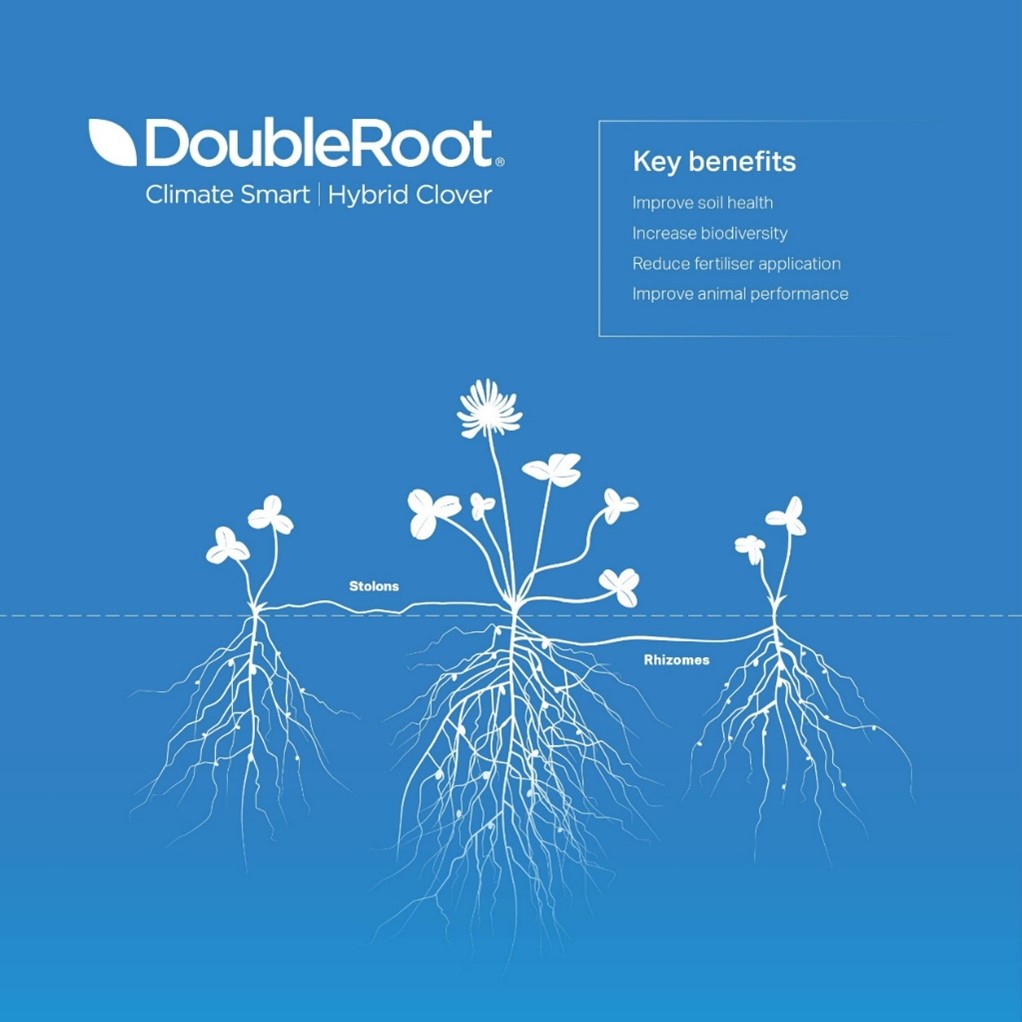
Illustration showing DoubleRoot’s unique dual growth habit. Credit: Germinal
Supporting resilient soils
As well as contributing nitrogen to the soil, DoubleRoot can improve soil structure and health. This is partly due to reduced fertiliser use but also thanks to its growth habit.
DoubleRoot’s taproot system helps to prevent soil compaction, which allows water and nutrients to move through the soil and enables the normal root development of other plants. Meanwhile, its underground rhizome helps to bind soil together, making it more stable with better aeration and drainage. This means plants have a continuous supply of oxygen for root growth.
By supporting soil health, DoubleRoot further aids the growth of its neighbours; poor root development can lead to stunted growth of the whole plant. DoubleRoot’s impact on soil health thus further supports our grasslands.
Lab to field: research and industry collaboration in action
Turning research success into practical impact requires strong industry collaboration. Thanks to support from BBSRC, and long-term partnership with Germinal, DoubleRoot underwent rigorous testing. This was facilitated at IBERS and the North Wyke Farm Platform (NWFP), which provided real world and farm-scale testing to prove resilience in farming conditions. NWFP is part of Rothamsted Research, another BBSRC strategically funded institute.
Further farm scale trials on sites as far away as New Zealand have also proved resilience, revealing positive farmer experience with the product.
DoubleRoot seed is now marketed directly to the agricultural sector in the UK and Ireland and through partners in over 25 countries globally. Germinal has also incorporated DoubleRoot seed into a range of their seed blends, including those for grasslands outside of agriculture such as domestic lawns and public parks. Launched in 2025, Germinal’s ‘Climate Smart’ range, which was designed with sustainable farming in mind, also takes advantage of the DoubleRoot clover.
Germinal DoubleRoot: A World-First Hybrid Clover. Credit: Germinal. Video transcript and on-screen captions are available by watching on YouTube.
Continuing collaboration: building on BBSRC investment
The partnership between IBERS and Germinal continues with Germinal now directly employing the grass and clover breeding team in a division known as Germinal Horizon. The division is embedded at IBERS where work continues on new clover and grass innovations aimed at further supporting the achievement of net zero targets.
This has included the development of a drought and cold tolerant grass hybrid, called AberRoot, which combines Aber High Sugar Grass with Atlas fescue, a deep-rooting grass native to Morocco. The grass hybrid is high in nutrients for livestock, leading to higher meat and milk yields, while simultaneously reducing emissions from the animal and improving soil quality.
IBERS and Germinal Horizon are also involved in a multi-partner project funded in part by the Department for the Environment, Food and Rural Affairs. Known as NUE-Leg, this project aims to optimise nitrogen fixation by legumes, including clovers, to reduce emissions in grassland farming by reducing reliance on inorganic nitrogen fertilisers. Future grassland innovations from IBERS and Germinal are therefore still to come.
Read more about IBERS’ innovations, including their grassland resilience work with Germinal, here: Innovations for a Changing World, IBERS Impact Case Stories.
Learn more
Strategically supported institutes
Institute of Biological, Environmental and Rural Sciences: Aberystwyth University