

We know that what we eat and drink influences our health. Healthy food choices support physical and mental wellbeing, whereas unhealthy food choices can increase the risk of developing chronic illnesses such as cardiovascular diseases, diabetes, cancers, obesity and other linked conditions.
So, what are healthy food choices? What we should eat to support optimum health changes over the course of our lives. In other words, there are differing dietary requirements for:
- the early growth and development of children and adolescents
- key life stages such as pregnancy and menopause
- supporting healthy ageing in older adults
These requirements are considered in our national dietary guidelines. Evidence-based nutrition advice feeds into these giving the public confidence in these recommendations. This is especially important considering the climate of uncertainty and confusion about the relationship between diet and health we live in.
But, guidelines alone cannot ensure that we eat healthily. The whole food system has a role to play in helping the nation achieve its nutritional requirements. For example, consumers can only buy what is available, therefore, building increased nutritional value into our food options can make healthy food choices easier.
Meet Professor Julie Lovegrove

Professor Julie Lovegrove, Director of the Hugh Sinclair Unit of Human Nutrition at the University of Reading. Credit: University of Reading
Professor Julie Lovegrove is Director of the Hugh Sinclair Unit of Human Nutrition at the University of Reading and a UK Research and Innovation (UKRI)-funded researcher.
She is a leading figure shaping nutrition policy in the UK. Her work focuses on the role of nutrition in health, including how diet influences the risk of developing cardiometabolic diseases (for example cardiovascular diseases, type 2 diabetes and obesity). In recognition of her outstanding contribution to the field, she has received the British Nutrition Foundation Prize (2022) and the Venus International Women’s Award for Distinguished Women Researcher in Science (2025).
In March 2026, Professor Lovegrove took on the role of Chair of the UK’s Scientific Advisory Committee on Nutrition (SACN). SACN provides independent advice to all four UK governments on the scientific aspect of nutrition and health, including what constitutes a balanced diet. This advice is based on evidence and informs dietary policy development and the recommendations the government provides to the public, helping the UK to eat well.
Professor Lovegrove said:
It is of critical importance that public health dietary advice is based on robust scientific evidence to ensure effective health promotion.
Current dietary guidance
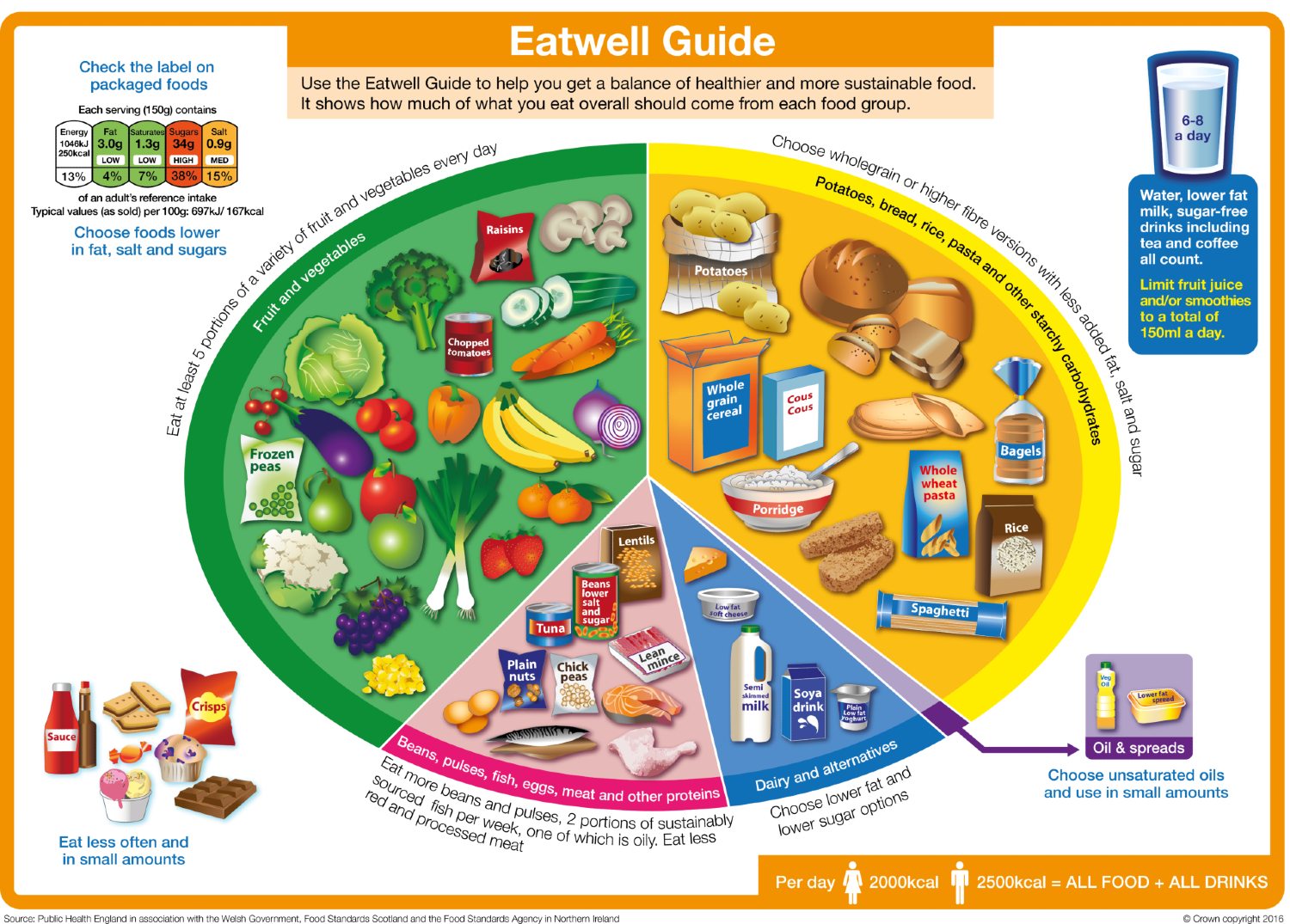
The Eatwell Guide. Credit: Crown copyright. OHID in association with the Welsh government, Food Standards Scotland and the Food Standards Agency in Northern Ireland.
The Eatwell Guide, developed by Public Health England, can help us to meet the government’s dietary recommendations. The guide divides foods and drinks into five groups and illustrates how to balance consumption to achieve a healthy diet.
Professor Lovegrove’s research has covered different food groups in the Eatwell Guide, including:
- milk and dairy products
- pulses
- bread (a carbohydrate)
Milk and dairy products
Dairy products constitute a small portion of our daily recommended intake, but they provide several key nutrients like calcium, protein, vitamin B12, vitamin B2 and iodine.
Professor Lovegrove and her team have investigated the effects of consuming milk and dairy products on our health, both in the short and long term.
Her work has shown that consuming dairy products made from milk with lower saturated and higher unsaturated fats had clear health benefits for people with higher risk of cardiovascular disease. The research, funded by BBSRC and the Medical Research Council (MRC) provided knowledge that can then be used to identify how dairy products can be made healthier. For example, the saturated fat content of milk can be reduced by changing the diet of cows, rather than skimming fat from the milk.
Dairy and cardiovascular disease
Reducing saturated fat intake for adults is recommended for cardiovascular health. Professor Lovegrove’s BBSRC-funded work has contributed to the evidence supporting UK guidelines on saturated fat consumption.
Collaborating with Professor Bruce Griffin, University of Surrey, and Professor Jonathan Swann, Imperial College London (at the time), the team examined the health effects of following UK dietary saturated fat recommendations. In particular, they explored how blood low-density lipoprotein (LDL) cholesterol (often referred to as ‘bad’ cholesterol) levels varied with saturated fat intake. They found that, on average, reduced saturated fat intake (in line with UK guidance), resulted in lower blood LDL cholesterol levels. As high LDL cholesterol is a leading risk factor for cardiovascular disease, these findings demonstrate that current guidance helps to protect cardiovascular health.
The research also revealed significant variation between individuals in the extent to which reducing saturated fat intake lowered their blood LDL cholesterol levels. Some participants showed a dramatic reduction, while others only had minimal changes.
Further research is underway to understand the reasons for these differences. An improved understanding of how different groups metabolise the foods they eat, and a method for determining which group someone falls into would facilitate personalised nutritional advice in the future. Matching diet to metabolism has been shown to be effective in health maintenance through nutrition.
In addition to these effects on blood cholesterol, Professor Lovegrove’s research showed that the type of dairy product consumed may influence its impact on health. Her team found that higher consumption of fermented dairy products (such as yogurt or cheese) was associated with a lower risk of cerebrovascular disease. This is a specific form of cardiovascular disease affecting the brain, commonly known as stroke.
Overall, Professor Lovegrove’s dairy research highlights the continued need to deepen our understanding of the relationship between food and health. This can provide important evidence to shape government dietary guidelines.
Bread and pulses
Dietary fibre is important for supporting gut health and digestion. For example, low dietary fibre intake is linked to increased risk of type 2 diabetes, heart disease, and colorectal cancer. In spite of this, 96% of British adults do not meet the UK government’s dietary fibre recommended intake of 30 grams per day. Average consumption is just over half this amount, meaning that promoting higher dietary fibre intake could provide a meaningful way of improving public health.
Professor Lovegrove’s research is working towards helping people meet dietary fibre recommendations through healthier diets. She is investigating how bread and pulses can be used to achieve this.
Older adults and fibre
Professor Lovegrove has been exploring ways to encourage people to eat more dietary fibre. Working with Dr Vic Norton, in a BBSRC and MRC-funded project, she created a fact sheet and brochure to promote fibre intake, particularly amongst older people.
Older adults are especially at risk of not getting sufficient fibre as they can experience reduced appetites as well as dental issues which can make eating higher fibre foods more difficult.
The resources produced highlighted the benefits and sources of fibre, as well as practical meal ideas. Those who had access to the resources reported increased understanding of dietary fibre and greater confidence in their ability to translate this knowledge into healthier diets. This suggests that wider dissemination of such resources could help older people to meet dietary fibre recommendations.
Putting our dietary fibre goal within reach
Professor Lovegrove’s efforts to make the government’s dietary fibre recommendation attainable for all includes ongoing multi-disciplinary research to increase fibre intake through pulse-enriched bread. Raising the Pulse, a UKRI-funded Transforming the UK Food System (TUKFS) programme, focuses on achieving this. The project considers the health and environmental benefits of consuming more UK-grown pulses, such as faba beans (commonly known as broad beans). Pulses are an excellent source of fibre, protein, and other nutrients, but are only eaten by around a third of the UK population.
Bread, on the other hand, is a dietary staple. White bread in particular is bought by 83% of UK households weekly and can be a low-cost food. Given its popularity, even small improvements to the nutritional profile of white bread could deliver substantial public health benefits, particularly to families with lower disposable income.
Professor Lovegrove leads a multi-disciplinary team investigating whether incorporating faba bean flour into bread could offer a solution to get more fibre (as well as iron and protein) into our diets. They’ve shown that replacing 15% of white wheat flour with faba bean flour increases fibre (50%), iron (35%) and protein content (25%) compared with standard white bread. Importantly, this replacement does not compromise taste or texture, meaning it can deliver health benefits while remaining appealing to consumers.
Professor Julie Lovegrove explains her Raising the Pulse research project and how it is aiming to revolutionise British diets. Credit: University of Reading
Protein and iron, the levels of which are enriched in the bread, are essential during periods of rapid growth. Protein in particular is the basis for the tissue and muscle development that physically enables our bodies to grow. Older adults need high-quality protein not due to growth but because as we age our bodies naturally lose muscle mass. Protein consumption in older adults helps slow this loss, particularly if combined with muscle use.
With the improved nutritional content of the bread, the product could be a welcome addition to the diets of people of all ages.
The Raising the Pulse project is still in progress, with further tests of the faba bean flour in bread underway. In the longer term, Professor Lovegrove and the project team aim to extend this research to further improve the nutritional content of a wider variety of staple foods.
Elsewhere at the University of Reading
Donal O’Sullivan, Professor in Crop Science at the University of Reading, provides expertise in the genetics of faba bean traits on the Raising the Pulse project. He also leads a BBSRC-funded research programme which is working towards breeding improved faba bean varieties. This includes efforts to increase protein content without compromising yield, a common trade-off in crop development. The co-existence of this programme alongside Raising the Pulse means that farming innovations can easily be translated into nutritional benefit by enriching diets with key nutrients.
Another colleague of Professor Lovegrove’s at Reading, Professor Marcus Tindall, is also taking on the challenge of transforming the humble white loaf into a high fibre food. However, Professor Tindall is using a different approach. Instead of adding pulses, the team is developing fibre-enhanced white flour.
This project is funded through TUKFS and led by the University of Reading, in collaboration with the University of Leeds and Rothamsted Research, a BBSRC strategically supported institute. The project has tested consumer attitudes towards the bread, and used mathematical modelling and satellite data to predict future wheat yield and better understand the wheat supply chain. The project team has developed a high-fibre wheat variety, used this to produce high-fibre flour, and aims to bring high-fibre white bread to market.
This trio of active research programmes at Reading underscores the university’s strong Agrifood Futures research strategy. The agrifood programme will be a major driver of change in the way that we produce, consume and think about food as we move towards 2050.
Looking to the future
Awareness of the population’s food preferences, for example, white bread being the most popular bread in the UK, isn’t just important for product development. Insights into consumer choices and habits can also help us to better understand public health and nutrition, and to develop targeted strategies to tackle diet-related diseases.
Acquiring this information can be difficult. It commonly involves asking a group of people to record the foods and drinks they consumed throughout the day. This approach is fraught with problems. It’s easy to forget snacks or underestimate portion sizes. As such, this data is not always an accurate reflection of eating behaviours and dietary intake.
To help overcome these problems, a recent joint BBSRC and MRC-funded project is testing a new way of assessing dietary intake. The study, called SODIAT (Standardised and Objective Dietary Intake Assessment Tool), is a partnership between:
- University of Reading
- University of Cambridge
- Imperial College London
- Aberystwyth University

Camera glasses used in the SODIAT study. Credit: University of Reading.
SODIAT is led by Manfred Beckmann and John Draper at the Institute of Biological, Environmental and Rural Sciences (IBERS), another BBSRC strategically supported institute based at Aberystwyth University. The study integrates multiple methods of assessing dietary intake to improve the accuracy of reporting. This even includes analysis of images of food and drinks captured using camera glasses.
An initial pilot trial has been completed, and its successor, SODIAT-2, led by Professor Lovegrove’s research team, is now recruiting participants. The results could pave the way towards the more accurate recording, and thus better understanding, of dietary intake, which can be used to inform more effective public health guidance.
Connecting science to policy
We have seen several examples of how Professor Lovegrove’s research has revealed the potential impacts of diet on human health. Continued investment in research to expand our understanding of how our diets can keep us healthy and benefit us for longer is therefore essential. However, understanding alone is not enough, it is the influence of this research on policy which ultimately leads to changes to eating habits.
Professor Lovegrove holds dual roles as a leader in nutrition research and advisor to government. This position enables her to bridge a translational gap between scientific evidence and food policy development. It also creates opportunities to put research findings into practice by influencing the foods and drinks we consume. While basic science is fundamentally important, its long-term translation to measurable improvements in quality of life is critical, both now and in the future.