
A rare condition is a condition that affects less than one in 2,000 people in the population. Though individually rare, these conditions are collectively common affecting one in 17 people.
Getting the right diagnosis and treatment as early as possible is critical for many conditions but many of these diseases are not well understood, making them hard to detect.
New method for analysing patient samples
Biotechnology and Biological Sciences Research Council (BBSRC)-funded research at Swansea University, led by Professor William Griffiths and Professor Yuqin Wang, has developed a new method for analysing patient samples. This method, known as EADSA (enzyme-assisted derivatisation for sterol analysis), has been helping doctors to diagnose rare metabolic diseases more quickly and accurately.
The Griffiths-Wang team has assisted in over 119 patient cases, and the numbers go up week by week. This capability and expertise are both internationally scarce.
Professor William Griffiths said:
We’re one of the few labs in the world that look at such a big sphere of ultra-rare diseases. There are not many specialists in this field.
Understanding human health with science
The levels of different substances in our bodies can tell us a great deal about our fundamental biology and health. This includes the levels of a group of molecules called sterols, like cholesterol.
There are many genetic diseases that affect how the body processes sterols, causing them to accumulate and cause disease. So, measuring sterol levels can be used to detect these illnesses. However, measuring and analysing sterols can be difficult. Many look extremely similar, occur in tiny amounts, easily break apart, or are missed by popular standard tools and methods.
The Griffiths-Wang team developed, tested and refined EADSA with BBSRC funding, alongside funding from GSK, Novartis, and the Welsh Government. The EADSA method provides a solution. It can accurately detect, characterise and measure sterols. Researchers can use EADSA to track sterols in different tissues, as well as generating sterol profiles for diagnosis.
BBSRC funding also supported the upgrading of mass spectrometry equipment at Swansea University. This instrumentation was critical to the Griffiths-Wang team’s diagnostic research. EADSA is patented by Swansea University. A license was granted to Cayman Chemical Company, a global chemical supplier, resulting in an analysis kit for global research use.
EADSA in action
The Griffiths-Wang team is using EADSA to detect and monitor a group of very rare genetic conditions called inherited metabolic disorders (IMDs), which cause a build-up of toxic substances. These conditions frequently start in infancy but can present later in life. If caught early, patients can often recover with no permanent damage, although continued treatment will be needed for life.
Fast diagnosis and correct treatment are therefore essential and EADSA’s application to IMDs helps address several diagnostic issues.
Differentiating between diseases
While IMDs are individually rare, they are considered ‘collectively common’. Many IMDs share similar symptoms with each other, as well as with other diseases. Patients with the same IMD can also have differing symptoms. This, combined with their rarity and the previously mentioned sterol analysis challenges, makes diagnosis difficult.
The Griffiths-Wang team has used EADSA to assist over 119 IMD patients worldwide. For IMD diagnosis, EADSA is a fast and accurate method.
EADSA can now also be used for analysing samples to learn more about how IMDs and sterols work. For example, by analysing samples from patients with a particular rare disease the team found new diagnostic flags. The more we learn, the easier it gets to diagnose and monitor treatment.
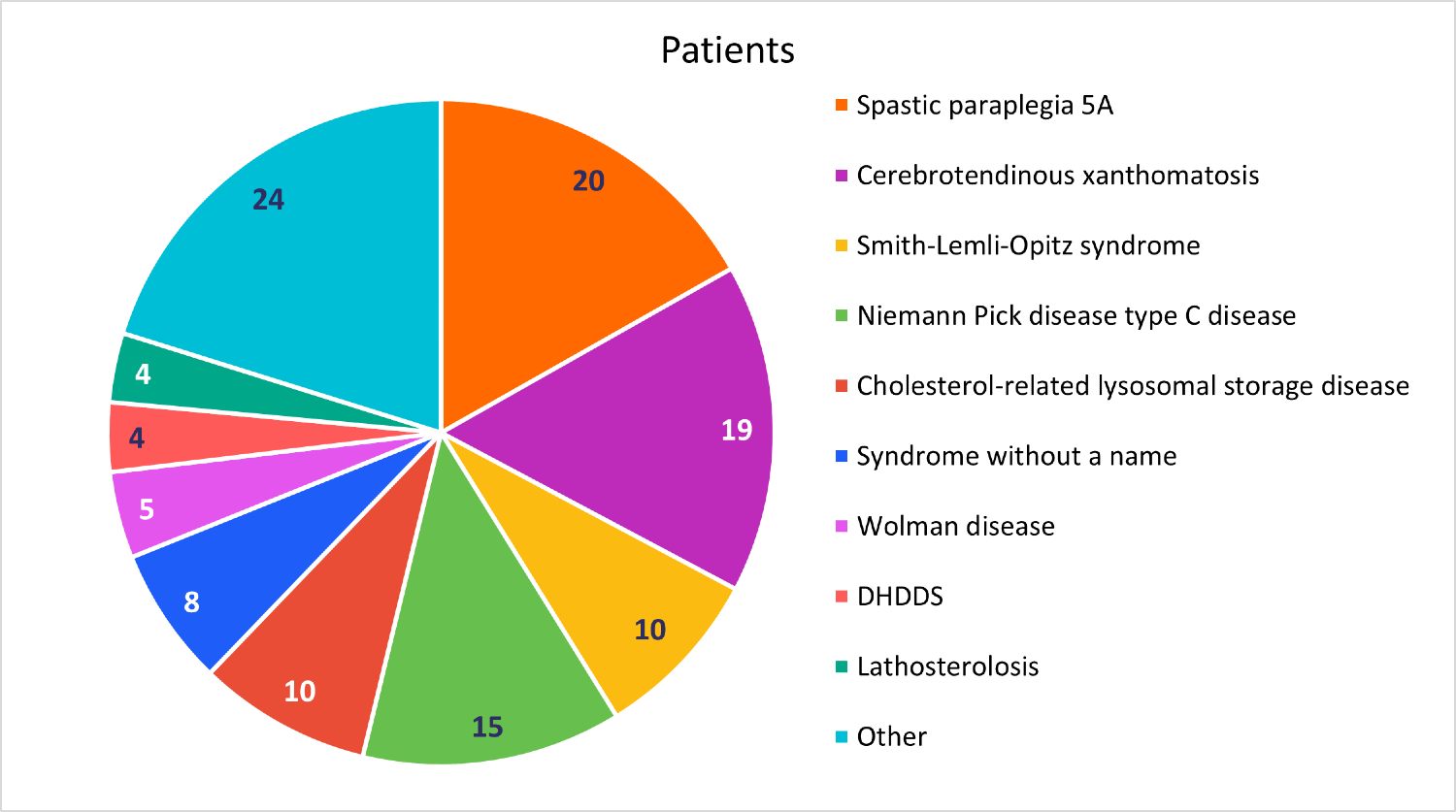
Breakdown of the 119 IMD patients the Griffiths-Wang team has assisted
 Description of pie chart
This pie chart shows the breakdown of the 119 IMD patients the Griffiths-Wang team has assisted. These are:
- spastic paraplegia 5A: 20 patients
- cerebrotendinous xanthomatosis: 19 patients
- Smith-Lemli-Opitz syndrome: 10 patients
- Niemann Pick disease type C disease: 15 patients
- cholesterol-related lysosomal storage disease: 10 patients
- syndrome without a name: 8 patients
- Wolman disease: 5 patients
- dehydrodolichyl diphosphate synthase (DHDDS): 4 patients
- lathosterolosis: 4 patients
- other: 24 patients
Monitoring
EADSA is also an effective way of monitoring sterol levels over time. For research, this can give new insights into sterol-related biological pathways. For application to IMDs, the Griffiths-Wang team has been monitoring responses to therapies, both new and old.
For example, the team has been monitoring patients with Wolman disease who are being given a range of therapies at Saint Mary’s Hospital in Manchester. The Manchester team is using a range of therapies, but responses vary and treatment can become more complex. The Griffiths-Wang team is critical to monitoring biochemical responses.
Next development steps
It was BBSRC-funding that underpinned the development of EADSA as a critical technology for our understanding of sterols.
The team is now being funded by the Medical Research Council, the Michael J. Fox Foundation, and the CHDI foundation to apply EADSA for further medical applications. This includes searching for biomarkers in motor neurone disease, Parkinson’s disease, and Huntington’s disease. The team is now planning to apply the technique to more common disorders like metabolic dysfunction-associated steatotic liver disease.
The team is also investigating how to use artificial intelligence (AI) to interpret EADSA raw data. Currently, experts manually interpret data for diagnosis. Combining AI with human checks will dramatically speed this process up, enabling more patients to receive diagnoses faster.
The ultra-rare and genetic mysteries
Genetic testing has long been the standard way of confirming diagnosis, but what happens when we do not know enough about the genetics behind a disease? This can be the case for ultra-rare conditions. EADSA offers another critical method of diagnosis. This is not to replace genetic testing but to work together with it.
Solving uncertainty
Sometimes a genetic mutation is so rare that there isn’t enough research to know if it is linked to a condition or not. These are known as variants of uncertain (or unknown) significance (VUS).
The study of individual VUS is resource-intensive, leaving many unexplored. This can leave patients with a lot of uncertainty, as well as preventing diagnosis by doctors. For this, they need additional information beyond what genetic testing can provide.
Hospitals can send samples to the Griffiths-Wang team to assist with this. EADSA can reveal whether a patient’s biochemical profile matches a disease, confirming diagnosis. This process is also helping to gradually fill our knowledge gaps around VUS, helping to highlight which ones are linked to diseases.
Filling knowledge gaps
Beyond genetic uncertainties, sometimes we simply do not know enough about how diseases work. EADSA is helping to solve cases of tricky diagnosis, where the disease progression, presentation, or mechanism strays from the norm.
For example, the Griffiths-Wang team has been assisting with cases of adult Neimann-Pick type C disease (NPC) by generating and analysing biochemical profiles. NPC used to be considered as a childhood disease, often beginning in infancy. Researchers now know adults can be affected with milder forms that develop later in life, often with no clear genetic evidence.
The team is also researching the ultra-rare DHDDS disorder, which is poorly understood. Researchers still do not know what mechanism causes the symptoms, even if we know what genes are affected. Without this knowledge, it’s nearly impossible to know how to treat this condition.
The Griffiths-Wang team suspect DHDDS is cholesterol-related and are using their unique expertise in this area to study the disease. They’ve been analysing samples, working with the tiny number of international patients with DHDDS. If the team can pinpoint the mechanism, this will enable new therapies to be developed.
Cure DHDDS:
The technology used by the [Griffiths-Wang] team is world-leading, and we are hugely grateful that it is being applied to such a rare and neglected condition. Their work is of real importance to the DHDDS community and offers hope to affected individuals and families.
Griffiths will soon move to pastures new, but the Griffiths-Wang collaboration continues.
Find out more
Developing new technology to diagnose and treat rare diseases (Universities Wales)
Read more on how Wolman disease is being treated (Manchester University NHS Foundation Trust)