
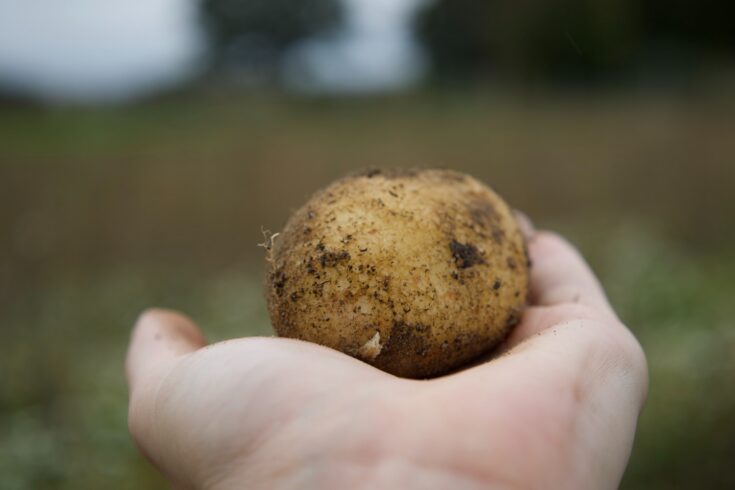
Potatoes are the most popular vegetable in the UK, with around 70% of us picking these up when we do our food shop. They’re second only to wheat as a vital food staple in the UK. Spuds are highly versatile to cook with, cheap to buy and packed with nutrients.
Growing potatoes is not without its challenges. Climate change is impacting our crop yields with the hot, dry summer in 2026 likely to see a reduced potato harvest. Pests and pathogens also have an impact. Over 30% of potatoes are lost globally each year to pests and disease, which presents a huge problem for food security both in the UK and worldwide.
At The Sainsbury Laboratory (TSL), which is based at the Biotechnology and Biological Sciences Research Council (BBSRC) supported Norwich Research Park campus, researchers have been improving our potatoes. Led by Professor Jonathan Jones, scientists at TSL are developing potatoes with resistance to the pathogens that present the biggest threats to potato production.
Excitingly, we may see the new and improved potatoes on our supermarket shelves soon.
Protecting our potatoes
In the UK, we each eat around 103 kilograms of potatoes annually, that’s several hundred spuds per person.
There are health and nutritional benefits to eating potatoes too as they:
- provide us with the calories (energy) we need to be active but are filling to help us regulate our weight
- are a major source of essential vitamins and minerals, like vitamin C, vitamin B6 and potassium
- contain fibre, especially in their skins, that can support our gut health
- are rich in antioxidants
It’s not just humans that like potatoes, plant pathogens also target the crop, causing damage. Late blight, also known as potato blight, is a fungus-like pathogen that attacks the plant’s leaves and the potato itself. In 1845, late blight infected potatoes in Ireland and led to the devastating potato famine. The pathogen is still wreaking havoc today, causing £50 million in potato losses in the UK each year.
Farmers apply large quantities of chemical pesticides (fungicides) to mitigate the damage and protect food security, but this has its disadvantages as:
- fungicides are expensive
- fungicides can be environmentally damaging
- pathogens can eventually become resistant to the fungicides applied
Finding the key to resistance
Researchers at TSL have developed potatoes resistant to the late blight pathogen as well as the potato viruses Potato Virus Y and Potato Leafroll Virus.
Key to developing disease resistant potato varieties is the ability for a potato to recognise a pathogen and activate its defences to stop the spread of infection. Unfortunately, most commercial potato varieties cannot detect the late blight pathogen. This means that the infection can spread and destroy whole fields of crops in just weeks.
Wild potato relatives with resistance to late blight, and other significant diseases like Potato Virus Y and Potato Leafroll Virus, have been found.
The precise genetic instructions that enable such resistances were identified thanks to the research of Professor Jones and his team, funded by BBSRC.
Unlocking potato’s potential
Further BBSRC investment to Professor Jones’ team has allowed them to transfer the pathogen resistance instructions for late blight and the two viruses into Maris Piper potatoes. Maris Piper is widely grown and enjoyed throughout the UK. It is a versatile potato great for fluffy roast potatoes, crispy chips, and smooth mash.
The new potato variety has been aptly named PiperPlus as it has all the benefits of the standard Maris Piper, plus pathogen resistances.
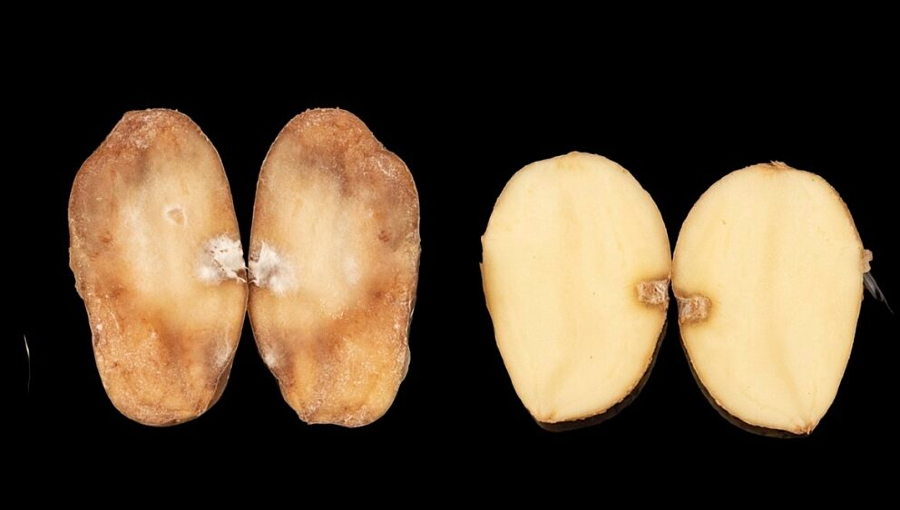
A comparison of Maris Piper (left) and PiperPlus (right) after infection with potato late blight. A standard Maris Piper shows severe symptoms of disease while PiperPlus remains healthy.
Potato pathogens and the weather
Dry and warm weather significantly reduces potato yields. Warmer weather also increases infection by pathogens, including potato late blight, further limiting yields.
The same is true for both Potato Virus Y and Potato Leafroll Virus. These viruses are spread by aphids, which have higher reproductive rates at higher temperatures, increasing the risk of virus spread to potatoes.
We particularly want to protect our seed potatoes. These are potatoes that are grown specifically for farmers to plant to produce a new potato crop. If these become infected whole harvests can be poor or completely fail.
To prevent virus spread in the UK we currently produce most of our virus-free seed potatoes in Scotland where the climate is cooler. This suppresses aphid populations which in turn reduces virus spread. With the added virus-resistance in PiperPlus, we could not only continue to grow potatoes in these areas if they become warmer, but we could also grow them across the UK. This would reduce the need for long-distance transport of seed potatoes and the associated carbon emissions.
We cannot control the weather. But adding PiperPlus to the mix of potatoes we grow, can help to mitigate the compounding negative impacts of warm weather on some of our potato yields, reducing overall losses. Of course, we need to grow a variety of other potatoes too, for differing culinary purposes and for genetic diversity. PiperPlus may not solve the issue of climate change for potatoes, but it does help make one of our favourite varieties more resilient.
Meeting regulatory standards
Several iterations of the PiperPlus potato have been developed, but it is the most recent iteration, PiperPlus 3.0, that could reach our dinner plates.
PiperPlus 3.0 was produced through precision breeding, a technology endorsed by the UK government in 2023 through the Genetic Technology (Precision Breeding Act) and associated regulations signed into law in 2025.
Precision breeding can bring benefits to both farmers and consumers, enabling the development of crops that are pest and disease-resistant, climate resilient and more nutritious too.
It can take more than 10 years to produce a new potato variety through conventional breeding. Precision breeding, whereby targeted changes to the genetics of the plant are made, is a much quicker and more precise way of achieving the same result: pathogen resistant potatoes. The breeding precision means that we can maintain the desirable traits in our favourite varieties that can be lost during conventional breeding.
Where is PiperPlus now?
PiperPlus has become the UK’s first precision-bred potato approved by the Department for Environment, Food and Rural Affairs (Defra).
Professor Jonathan Jones said:
I’m delighted to see that after dedicated and extensive effort from my outstanding team of scientific colleagues at The Sainsbury Laboratory, supported by grants from BBSRC, we’ve identified two potato lines that have been approved by Defra for a marketing notice under the Precision Breeding Act.
He added:
We believe PiperPlus will become a flagship example of what’s possible through precision breeding, showing how these technologies can reduce fungicide use, improve sustainability, and deliver real benefits to the public.
The potatoes still need approval from the Food Standards Agency, confirming that they are as safe as a conventional Maris Piper, before PiperPlus is available to consumers. But this marks a huge step forward towards commercialisation.