

Insulin, vaccines, and gene therapies are all examples of biopharmaceuticals, a wide and varied group of medicines that are revolutionising how we treat disease. They can be more precise and cause less side effects than traditional chemically synthesised therapeutics, and can increasingly target illnesses which currently have no treatments.
Most medicines (or pharmaceuticals) are made via industrial processes that use chemicals as building blocks. In contrast, biopharmaceuticals are derived from living sources such as human or animal cells, or microbes.
High growth sector
In the UK, the life sciences industry generated £147 billion for the economy in 2023 to 2024, 67% of which was from the biopharmaceutical sub-sector. The global biopharmaceutical sector is now a high growth sector, valued at over £350 billion.
Pioneering companies within this sector support local and national economies, provide jobs, and generate vital health impacts. Supporting R&D and manufacturing within the sector via government funding enables these impacts to continue to grow and create benefits for the nation.
Biotechnology and Biological Sciences Research Council (BBSRC) has supported two recent biopharmaceutical spin-outs, Amphista Therapeutics and Trogenix, both based in Scotland and en route to developing a new generation of disease biotherapeutics. BBSRC has funded:
- people and talent who generate the ideas for novel therapies
- refinement of new technologies
- infrastructure that allows research to progress from concept to medical treatment
Amphista Therapeutics
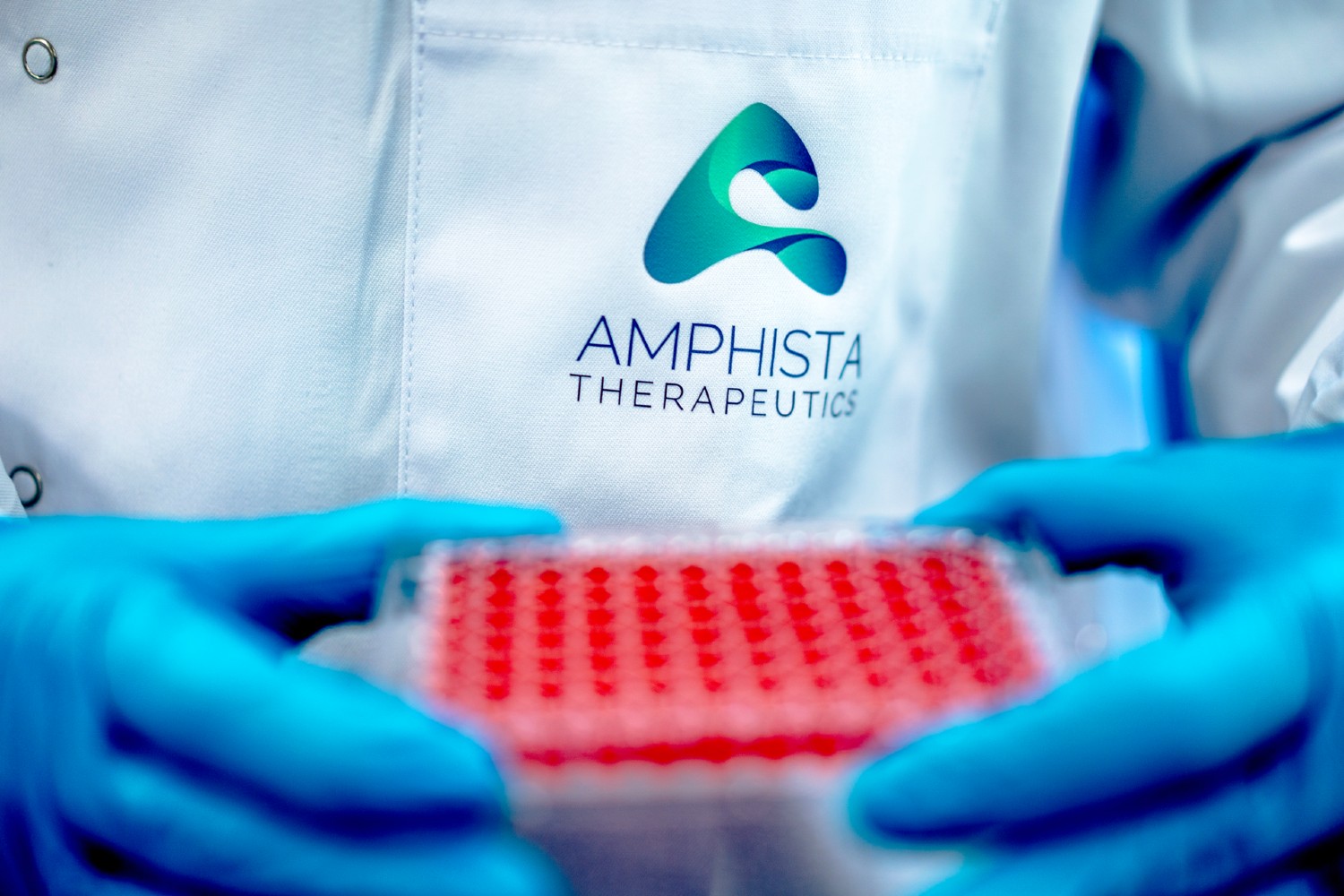
An Amphista Therapeutics scientist carrying samples. Credit: Amphista Therapeutics
Amphista Therapeutics was founded by the University of Dundee in 2017 based on the work from Professor Alessio Ciulli’s laboratory. Amphista is developing a platform for targeted protein degradation (TPD) therapeutics.
Proteins enable all the key processes that keep us alive but, when they do not work as they should, they can also cause diseases. Researchers have been working to find new ways of combatting these disease-causing proteins for decades.
Amphista’s therapeutics recruit the body’s natural protein degradation system for removing damaged, old, and faulty proteins. This enables Amphista to target diseases with no currently available treatments. Their therapeutics have the potential to significantly improve patient quality of life.
Developing the technology
The foundations of Amphista’s platform lie directly in Ciulli’s own research into a group of small molecules called proteolysis-targeting chimeras (PROTACs) that tag disease-causing proteins for destruction. Although the concept of PROTACs was first described in 2001, the technology stalled for years as a scientific curiosity with limited therapeutic promise.
Ciulli’s work, beginning in 2009 with a pivotal collaboration between him (then at Cambridge) and Craig Crews (Yale University) and continued independently at Dundee, proved a decisive turning point. Supported by BBSRC investment (a fellowship and responsive mode grant), his team designed much more compact, drug-like PROTAC molecules and, critically, revealed at atomic resolution exactly how they work.
That work propelled the technology to the forefront of pharmaceutical industry interest and directly provided the scientific blueprint on which Amphista was founded. Since then, over 25 PROTAC drugs have entered clinical trials. The first PROTAC drug was approved by the US Food and Drug Administration (FDA) in May this year for the treatment of certain breast cancers.
Amphista’s extension of the technology
Since its creation, Amphista has:
- raised £45 million of investment
- partnered with leading health sector companies like Bristol Myers Squibb and Merck Healthcare
- employed approximately 80 people
Building on Ciulli’s PROTAC work, the company has several next-generation TPD drugs in the pipeline, many of which focus on targeting cancers. Its lead therapeutic, Targeted Glue™ Degrader, AMX-883, for acute myeloid leukaemia (AML) has shown promising results in preclinical trials.
When used on its own, AMX-883 can inhibit tumour growth. When it is combined with venetoclax, an existing cancer therapy for certain types of leukaemia including AML, the therapeutics work synergistically. If both therapeutics are used in combination, their inhibition of tumour growth is greater than if used individually.
Though venetoclax can be used in isolation as a cancer drug, resistance is a significant clinical issue, as cancer cells can stop responding to the drug. The use of AMX-883 alongside venetoclax prevents this resistance, addressing this major clinical challenge.
The first clinical trials of AMX-883 have received FDA-clearance to commence later this year.
Trogenix

A Trogenix scientist using a pipette. Credit: Trogenix
Trogenix, a spin-out from The University of Edinburgh founded by Professor Steve Pollard and the investor 4BIO Capital, seeks to tackle cancer. The company is paving the way towards not just new treatments for cancer but potentially cures.
Trogenix emerged from research at the UK Centre for Mammalian Synthetic Biology (CMSB), The University of Edinburgh’s Institute for Regeneration and Repair and the Cancer Research UK Scotland Centre. Development of their original concept and innovation was also supported by the Edinburgh Genome Foundry. Both the CMSB and Edinburgh Genome Foundry were BBSRC-supported infrastructures that supply tools, expertise, and technology for engineering biology research, including translation into therapeutics.
To progress their treatments, the company has developed a gene therapy platform, Odysseus®, named after the Greek mythological hero and creator of the Trojan Horse strategy.
The platform identifies signals that are only present in cancer cells. It then uses this information to design constructs (engineered DNA) that dictate the strategy to attack cancer cells.
How the therapies work
Trogenix’s therapies are set to follow the approach of the Trojan Horse. They are to be injected directly into a tumour, delivering the engineered DNA to the affected cell, and infiltrating it. The construct can detect the cancer, activate a cancer cell-killing drug, and signal to the immune system to attack the cancer.
Altogether, Trogenix’s therapy provides a precise and long-term attack on the cancer. Importantly, targeting treatments to signals of cancer means that healthy cells are untouched.
The future of Trogenix
Last year, Trogenix unlocked £70 million investment to progress their programme of treatments.
Their lead programme is in glioblastoma, an aggressive form of brain cancer that affects around 200,000 people each year. Only 25% of patients live beyond a year after their diagnosis. Current treatments help to extend lifespan, but they do not provide a cure.
Trogenix’s therapy has shown curative potential in preclinical studies using a mouse model. Clinical trials have opened in May 2026 in the UK and the US with the first patient doses in Edinburgh. This will determine whether the positive results in mice can be replicated in humans.
Alongside glioblastoma, Trogenix is also exploring treatments for cancers of the liver and lungs. It is also investigating the potential application of their technology to regenerative medicine to treat fibrosis, where scarring forms following injury that can inhibit organ or tissue function.
Find out more
Trogenix doses first patient in Phase I/II clinical trial of TGX-007 gene therapy for glioblastoma