
Introduction
This document sets out the actions UK Research and Innovation (UKRI) will take in 2026 to 2027 to deliver our ambitious new strategy and our mission to advance knowledge, improve lives and drive growth.
As the UK’s largest public investor in research and innovation (R&I), with a budget of over £9 billion, we will act to keep the UK at the forefront of the global R&I system. To achieve this, we will continue to protect and promote curiosity-driven research through our nine councils, supporting the health of all academic disciplines and sectors across the UK. We will sustain our unique role in supporting the foundations of the wider R&I ecosystem, including through our strategic institutional investment and support for diverse talent and critical infrastructure across the UK.
But our plans are not all continuity, given our ambitions to deliver our new strategy. In this foundational year we will introduce several important new ways of operating to make the most of growing government investment in R&I. To support curiosity-driven research, deliver against government and wider societal priorities, and help companies to start and scale in the UK, we will work at pace to:
- reform many of our applicant-led programmes so we can back bold, unconventional and cross-disciplinary ideas quickly and with greater agility
- launch our new priority programmes to support strategic investment in growth-promoting Industrial Strategy sectors, such as life sciences and artificial intelligence, through single, integrated UKRI programmes rather than multiple programmes across UKRI councils
- strengthen pathways from research to commercialisation and business growth by reforming our Innovate UK service offer and strengthening our focus on intellectual property
- prioritise our investments in areas where the UK has an opportunity to lead globally and where our contribution can genuinely change outcomes
- establish clusters of excellence across the country by working with devolved governments and local authorities to identify and build upon world-class R&I strengths, creating opportunity in every region
- speed up our grant processing times to minimise delays to the delivery of world-leading research, alongside reforming our own organisation
To achieve these ambitions, we will continue to work in close collaboration and partnership with our stakeholders, delivery partners and investors across the country.
This plan sets out examples of the activity we will undertake this year to achieve collective outcomes, in line with our strategic direction of travel, recognising that the policy, economic and global context will continue to evolve. Our new strategy is designed to provide a consistent framework for action, aligned with government priorities, with enough flexibility to respond to new and emerging opportunities. Likewise our outcomes for the year provide a focus for monitoring progress, not a full account of everything we will do.
Our strategy and plan build upon our budget allocations, published in December 2025, which sets out our new outcome-focused approach to investment. We will be transparent about how our plans are evolving through quarterly forward look planners and an annual update of this Delivery Plan.
Our budget for 2026 to 2027
In the 2025 Spending Review, government allocated £38.6 billion to UKRI, structured for the first time around three cross-government ‘buckets’ to describe public R&I spending:
- discovery and curiosity-driven research
- strategic government and societal priorities
- support for innovative companies to start and scale in the UK
Our budget aligns with these buckets, with an additional cross-cutting line reflecting our underpinning investment in the R&I system.
Our investment in each of these buckets is explained in more detail in the budget allocations for UKRI. We manage our budgets dynamically as a portfolio to respond to and capture emerging opportunities, and as part of routine financial management, such as necessary budget reprofiling to ensure continued efficient delivery. As a result, allocation figures may change during the year to reflect these adjustments, and operational budgets may not match the final year-end figures exactly.
Budget for financial year 2026 to 2027 by strategy goal
| Strategy goal | 2026-27 (total in millions) |
|---|---|
| Goal one: support discovery and curiosity-driven research | £3,653 |
| Goal two: address strategic government and societal priorities | £1,924 |
| Goal three: help companies start, scale and stay in the UK | £1,638 |
| Goal four: strengthen the foundations of our R&I system | £2,004 |
| Total | £9,220 |
Table note: Budget for ‘goal five: reform our organisation’ is incorporated within goals one to four.
Goal one: support discovery and curiosity-driven research
UKRI plays a unique role in supporting outstanding, internationally leading curiosity-driven R&I, which underpins the long-term strength, diversity and international standing of the UK R&I system. Our commitment to curiosity-driven research is fundamental to everything we do. We support discovery through the dual support system of applicant-led and our considerable strategic quality-related institutional investment, which represents nearly 40% of our budget. Foundational activity in ‘Goal four: strengthen the foundations of R&I’ underpins goals one to three proportionately. If this activity is included, the proportion of our budget on curiosity-driven research is approximately 50%.
This provides researchers and our partner institutions with the flexibility to pursue their strategic priorities and invest in new areas, and the conditions in which knowledge creation and discovery can thrive. This dual support underpins the discovery research that is the foundation of R&I excellence across the UK. It invests in ideas today, and generates the breakthroughs we cannot foresee, and that are the basis of a resilient R&I system with the potential to drive future innovations to improve lives.
Our priorities for financial year 2026 to 2027
As in every year, we remain committed across all parts of UKRI to championing discovery and curiosity-driven research, both for the generation of knowledge for its own sake, and to draw on those ideas in delivering our wider goals. Delivering opportunities for curiosity-driven research is our everyday work. In 2026 to 2027 we are sharpening and strengthening how we enable excellence in curiosity-driven research and empowering researchers in ways that support the health of disciplines.
We will protect our investment levels to sustain balanced investment across the dual support system. We will continue to invest in research excellence through applicant-led research while our strategic institutional investment will give research organisations the stability and confidence to support researchers as they develop their ideas.
We will achieve the following.
Be clear on our allocation to discovery and curiosity-driven research, and protect it
In 2026 to 2027 we will invest £3.7 billion in excellent discovery and curiosity-driven research and critical investment in institutions and facilities that give researchers the freedom to explore new ideas. This figure reflects the published 2026 to 2027 curiosity-driven research allocation which includes £815 million in applicant-led research, as well as Research England quality-related research, and other investments supporting curiosity-driven research. This will protect the scale and breadth of our investment to sustain a resilient and internationally leading UK R&I system across all research domains, including, for example, ensuring half of our life sciences investment is discovery research.
We are increasing the transparency of the scale of our investment in discovery and curiosity-driven research through both applicant-led and strategic institutional funding, as set out in our Budget allocations for UK Research and Innovation. Alongside wider improvements to our data and analysis capabilities, we will strengthen our ability to describe and understand our portfolio of discovery and curiosity-driven research. This will also inform future planning and help us to protect the scale of investment.
Back bold ideas flexibly
We will reform our applicant-led programmes to achieve simpler, faster processes to back excellent, bold and novel ideas in a more agile way, encouraging intellectual risk-taking and greater responsiveness to opportunities. We will introduce more flexibility to weight assessment processes for novelty and excellence in applicant-led opportunities and publish revised guidance about this approach by January 2027. Alongside existing open council schemes, we will launch open applicant-led schemes for Biotechnology and Biological Sciences Research Council (BBSRC), and five new Economic and Social Research Council (ESRC) schemes (React, Connect, Grow, Explore, Challenge).
Support sustainable conditions for world-leading discovery and curiosity-driven research
Working with the sector, we will develop guidance and criteria for the Research Excellence Framework (REF) 2029 by November 2026, giving institutions the clarity they need, while working towards simpler approaches for the future.
We are sensitive to researchers’ desire for clarity about our Science and Technology Facilities Council (STFC) particle physics, astronomy and nuclear physics (PPAN) programmes. We commit to maintaining support for postdoctoral researchers across PPAN at least at the same levels as the 2025 to 2026 financial year. We also aim to produce an optimised plan by September 2026, for the budget for STFC programmes across the next four years to support long-term sustainability and continued internationally leading contributions.
Draw on curiosity-driven ideas to underpin future investment
We will build more deliberately on our foundational investment in curiosity-driven research to shape future investment by strengthening how we identify and support high-potential emerging fields, enabled by our work to improve our capabilities for data insights. By spotting promising areas earlier, where the UK has a genuine opportunity to lead globally, we will inform future strategic investment to nurture ideas and innovation and amplify impact through our wider portfolio and goals.
Enable access to infrastructure for exploration
We will invest in critical shared centres, institutes, units, facilities, data resources and digital tools that lower barriers to trying new methods or entering new fields. For more detail on underpinning investment in capabilities, see ‘Goal four: strengthen the foundations of the R&I system’.
Highlight: strengthening strategic institutional investment to support efficiency, transparency and transformation
Mainstream quality-related research (QR) funding is the biggest investment through Research England’s strategic institutional research funding (SIRF), using the REF results to inform allocations to higher education providers (HEPs). This investment provides the stability HEPs in England need to plan and deliver ambitious, long-term institutional research strategies.
Our SIRF review will support enhanced and meaningful specialisation and collaboration across the sector to achieve the greatest impact. Our work to increase the transparency of our QR deployment supports the delivery of the SIRF review, building a clearer picture of institutional decision making and use of SIRF investment. We will engage with HEPs, on how our approach to SIRF can support and incentivise specialisation and collaboration, recognising the diversity of institutions. Our approach is grounded in a shared commitment to sustaining world-leading, curiosity-driven research as the essential foundation for future impact.
Highlight: from world-leading curiosity-driven research to real-world autonomous solutions
Public investment in curiosity-driven research carries inherent uncertainty but it is the foundation of long‑term innovation and impact. When sustained and complemented by strategic support across our other goals, it can drive transformational economic and societal benefits.
Oxa, an autonomous vehicle technology company founded in 2014 by researchers at the University of Oxford. Its journey illustrates how UKRI’s portfolio approach supported it; from early applicant-led discovery research, through strategic investment to foster innovation, to business scale up.
Over more than a decade the Engineering and Physical Sciences Research Council (EPSRC) and Innovate UK supported Oxa’s development. Beginning with applicant-led funding for curiosity-driven research to apply the mathematics of probability to robotics navigation, their support helped to de‑risk early innovation and commercialisation, and secure private capital to grow and scale.
Oxa now employs more than 300 people, with its technology deployed across the UK and internationally. It leverages large scale investment, including £78 million this year, of which £37 million is from the National Wealth Fund to commercialise automation of repetitive industrial driving tasks, such as in ports, airports and manufacturing sites (see Oxa raises $103 million in Series D first close, backed by National Wealth Fund and leading Investors). Its journey demonstrates how sustained public investment in curiosity-driven research, combined with business support and private finance, can foster technological breakthroughs that drive business growth and that are changing the way we live and work.
More details of this journey can be found in the Oxabotica REF 2021 impact case study and Oxa’s timeline and news stories including:
- Oxa powers Northern Ireland’s first self-driving shuttle
- Autonomous logistics project at the Port of Tyne demonstrates the North East’s leadership in connected and automated mobility
Goal two: address strategic government and societal priorities
Working at pace and closely with government and delivery partners, we will align our portfolio with government priorities, including the eight Industrial Strategy sectors and the five Missions, to deliver UK-wide impact. We will be deliberate in our choices, directing major investment into targeted, outcome-focused programmes aligned to priority sectors.
Our priorities for the 2026 to 2027 financial year
Co-design programmes to drive Missions and Industrial Strategy outcomes
We are developing and driving our ambitious new priority programmes in close partnership with government and industry, described in full in the next section. We will also deliver the first substantial year of the R&D Missions Accelerator Programme, in close collaboration across government, to address specific R&I gaps needed to progress the government’s five missions, backed by at least £50 million of investment. The programme will deliver practical co-designed solutions with government partners, based on clear plans to ensure pathways to adoption (see ‘Highlight: R&D Missions Accelerator Programme’).
Leverage private sector investment to drive growth and improve lives
To maximise public benefits, we will strengthen our approach to attracting private capital across investments aligned to this goal and ‘Goal three: help companies start, scale and stay in the UK’, including facilities and infrastructure. We will work towards at least £3 of additional investment for every £1 of public investment over at least five years. From the outset, applicants will set expectations for private investment, including investment pledged at grant award and anticipated follow-on funding and venture capital. We will track progress against these expectations to inform portfolio-level projections as supported businesses or spin-out companies develop.
Ensure national capabilities support government priority outcomes
We will refocus STFC’s world-leading facilities and technology-development capabilities on government priorities, delivering a 10% increase in activity aligned with Industrial Strategy sectors and wider government priorities’ across STFC’s national laboratories and multidisciplinary facilities. Our wider priorities around investment in national capabilities is described under ‘Goal four: strengthen the foundations of the R&I system’.
Work actively with delivery partners, including research organisations, to accelerate benefits from investment
We will maximise impact from existing investments through active programme management and, where needed, targeted additional investment, including for example, through Arts and Humanities Research Council (AHRC)-led major strategic programmes. These strategic programmes include: Bridging Responsible AI Divides (BRAID); Mobilising Community Assets to tackle Health Inequalities; Future Observatory Designing the Green Transition; StoryArcs; AHRC’s Place Programme; Creative Communities programme; Research Infrastructure for Conservation and Heritage Science (RICHeS).
Increase public confidence that R&I improves lives
We will develop our communications approach to achieve a statistically significant increase in public confidence that public investment in R&I can improve the lives of people in the UK (see ‘Highlight: R&I improving lives’).
Highlight: R&I improving lives
Insight shows that while people recognise the value of R&I, they are less clear on how it benefits them personally. UKRI’s communications approach plays an important role in responding to this by making the outcomes of public investment more visible, relatable and grounded in everyday experience. Through people and place-based storytelling, we will help bridge the gap between research and society by showing how UKRI funded work supports jobs, improves public services and strengthens local economies. Building on pilots such as ‘It starts in Swindon’ and ‘Shaped in Sheffield’, we will embed this approach across our communications activity, contributing to greater public understanding, trust and support for continued investment in R&I.
Highlight: R&D Missions Accelerator Programme (R&D MAP)
Building on initial investments last year we will deliver the five R&D MAP challenges launched in 2025 to 2026 and continue to launch and deliver additional R&I challenges co-developed with government departments to address specific evidence gaps to drive the government’s Plan for Change. Areas of focus will include using R&I to:
- address Safer Streets challenges around: knife crime, preventing and intervening in violence against women and girls, and improving confidence in policing and justice
- create effective home learning environments for children and young people
Our new priority programmes
A central pillar of the UK’s future prosperity is founded on supporting growth sectors, and mapping them with regional and national strengths, from life sciences and advanced manufacturing to financial services and creative industries. Our new priority programmes will harness expertise from across the whole organisation, government and industry to target investment in areas of genuine UK strength and opportunity for global leadership across priority growth sectors. These sectors are aligned with the eight Industrial Strategy Sectors and additional government priorities. As enabling platforms, AI and digital technologies will cut across the priority sectors and digitalisation will be embedded across all programmes.
This represents a genuinely new model of strategic investment: single integrated UKRI programmes, led by single senior responsible owners and delivered through cross-council teams, rather than multiple programmes across UKRI councils. Through these programmes we will turn the UK’s scientific excellence into economic advantage, by strengthening regional clusters, supporting high-growth technologies and sectors to drive national competitiveness, and helping create high-quality jobs.
We will develop programme plans through targeted consultation with UK and international R&I sector, and industrial and financial sector partners, to deliver our complementary ambitions across goals two and three, bringing together our investment through their aligned budget lines (see figure 1).
Our priorities for the 2026 to 2027 financial year
This first year, we will launch and establish these cross-organisational programmes. We have appointed Directors for each Priority Programme to oversee initial investment, coordinate and make best use of our existing portfolio of investments, centres, institutes, Catapults and units (CICUs), as well as finalise further investment plans over the year.
Programme plans will vary as appropriate to the specific portfolio, depending on the extent of existing commitments and where R&I interventions can most effectively drive sector growth and impact. Over the year programme boards will mature, and will learn and adjust their plans for further activity, with clear logic models to inform monitoring and evaluation. This will enable testing and adaptation to drive intended outcomes.
The following details some of the key investments planned this year to kickstart programmes. We will publicise further opportunities as they are agreed.
Figure 1: total allocation by Priority Programme sector over 2026 to 2027
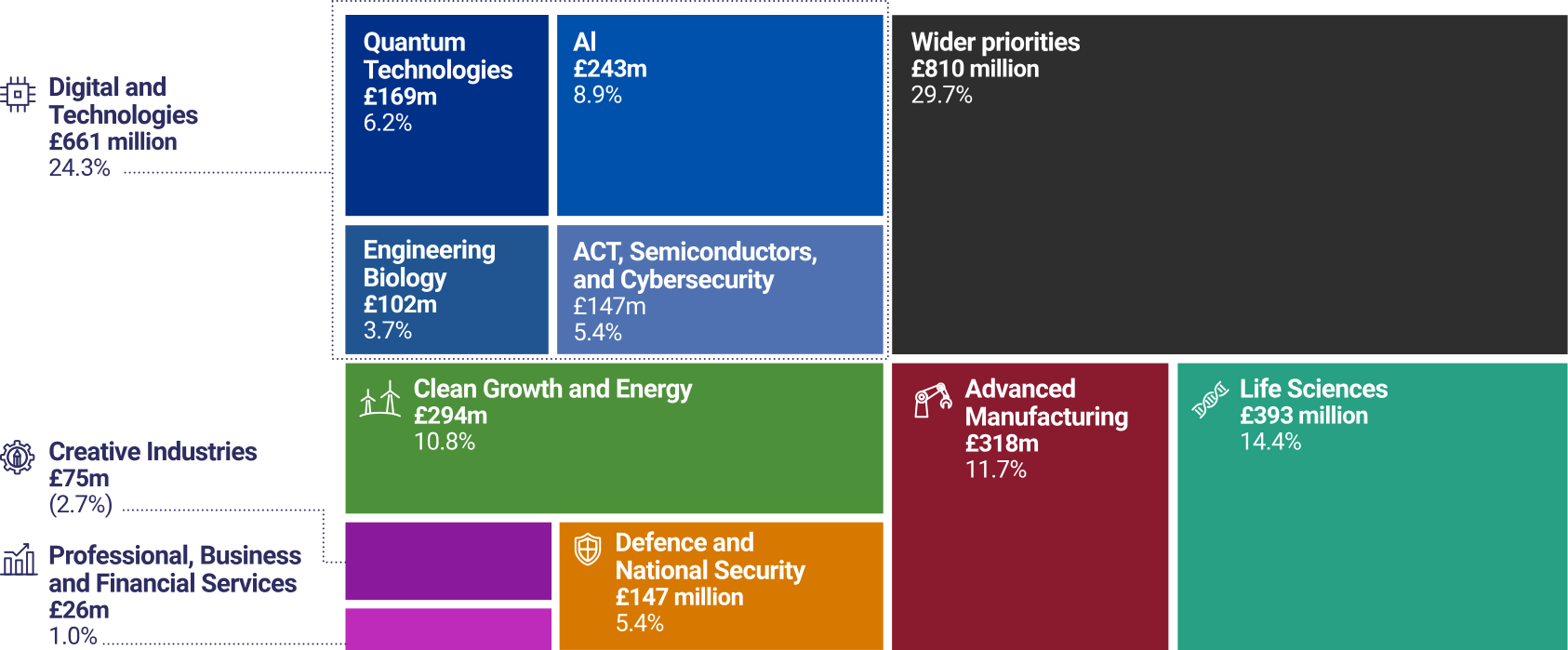
Figure 1 notes: figures reflect the priority programme budget for 2026 to 2027 goals two and three combined, as published in the budget allocations for UKRI (Table 2) published in December 2025. Allocation figures may change during the year to respond to and capture emerging opportunities, and as part of routine financial management, and budgets may not match the final year-end figures exactly. Advanced manufacturing allocation amount includes agritech. Wider priorities includes space, climate resilience, food and animal and plant health, and further emerging priorities.
Digital and technologies
This year we will kick off delivery of our new AI strategy (see ‘Highlight: Kick-starting delivery of our new AI strategy’). To underpin this, we will place UK researchers at the forefront of applying AI to research by embedding postgraduate AI training across disciplines. We will increase the proportion of UKRI-funded doctoral students with access to relevant AI training to at least 90%, and with clear progression routes and early career support for more advanced AI skills. As part of delivering our AI strategy, we will also invest to accelerate market readiness of early-stage AI innovation businesses, for example through investment in early-stage AI projects and support for small and medium-sized enterprises (SMEs).
We will strengthen UK capabilities in engineering biology through new doctoral studentships and digital infrastructure platforms to pilot technology convergence with AI.
We will build quantum readiness in key industrial sectors through access to the National Quantum Computing Centre (NQCC), harnessing government’s 10-year funding commitment to the NQCC to lead on key engineering challenges and support the UK’s quantum ecosystem.
We will also de-risk adoption of advanced connectivity technologies (ACT), for example through the EPSRC Joint Open Infrastructure for Networks Research Infrastructure project.
Life sciences
We will deliver a broad portfolio of life sciences research, tackling major disease burdens, including dementia, obesity and cardiovascular disease, and drive forward the delivery of Life Sciences Sector Plan ambitions. This includes establishing a new pre-clinical, translational human in vitro models hub to accelerate the translation of research into new medicines and medical technologies, and position the UK as a world leader in pre-clinical modelling (see ‘Highlight: Driving forward the Life Sciences Sector Plan’).
Advanced manufacturing
We will accelerate industrial adoption of innovations in advanced materials by investing £59 million in a new Materials Innovation Programme and a further £52 million in robotics adoption hubs across the UK. Our new pilot scaling supply chains programme will invest a further £16 million in innovative approaches to improve supply chain productivity, resource efficiency and resilience. We will continue to invest in key enabling innovation infrastructure, including £167 million core funding for the High Value Manufacturing Catapult for 2026 to 2027. Overall, we will increase commercialisation of advanced manufacturing industries through a 5% increase in match funding and follow-on industry investment.
Clean energy
We will invest £15 million in a new Offshore Wind R&I programme to accelerate deployment into deep water sites and drive UK business growth, from rapid testing to adoption of innovation. We will also invest £20 million to pilot new approaches to supporting scale-up of high-potential clean energy businesses, working with public and private investors to build coherent pathways to growth.
Defence and national security
We will work closely with government and industry to launch at least five defence and national security activities, securing at least £20 million partner investment over the lifetime of the programme.
Creative industries
We will deliver support for at least 120 SMEs, from early-stage R&I to scale-up. Alongside this we will launch a £25 million Creative Technology Futures programme to increase access to facilities for creative businesses as part of our creative industries strategy.
Professional, business and financial services
We will establish three new programmes in key subsectors of professional, business and financial services sectors to support the use of AI in new business models, removing barriers to making data more available for innovation
Wider priorities
We will:
- develop our plans to strengthen the UK space sector’s R&I foundations in line with the National Space Strategy
- drive delivery of government priorities on food and, animal & plant health through joint programmes with government, industry and the EU on innovative vaccine technology, therapeutics, and wheat yellow rust, including delivering on the Food Strategy (see ‘Highlight: Improving diets and strengthening the resilience of the UK food system’)
- invest in improving the UK’s climate resilience, including in support of the National Adaptation Programme
- support three further priority strands on evidence and innovation infrastructure, economic growth and the capability to respond to urgent government needs
Highlight: kickstarting delivery of our new AI strategy
This year we will drive delivery of our first UKRI AI strategy, complementing the government AI for Science Strategy and its AI Opportunities Action Plan and AI Hardware Plan. Our strategy will give researchers and innovators across the UK better access to the right tools, training and infrastructure to break down barriers to commercialisation and seize growth opportunities in this central growth sector in the UK Industrial Strategy. We will progress our plans across six priority action areas for AI investment, which cut across all our goals to deliver tangible benefits and UK prosperity. This includes key investments to:
- advance AI technology development and future foundations, including through curiosity-driven R&I and the new Fundamental AI Research Labs dedicated to novel AI research
- transform research through AI, ensuring at least 90% of UKRI-funded postgraduate students have access to relevant AI training, with clear progression routes to more applied and advanced AI skills where appropriate
- develop AI skills and talent, including in AI hardware and chip design skills, and continued investment in fellowships to retain and develop global AI talent in the UK
- champion responsible and trustworthy AI, including new responsible AI training for UK SMEs through our AHRC-led Bridging Responsible AI Divides investment and enabling the UK to be co leaders on global standards for safer, greener AI through UKRI-funded studies and international partnerships
- accelerate AI innovation and adoption for economic growth and societal benefit, including investments which will support UK industry to develop AI hardware, and support for high potential early-stage AI innovation businesses and SMEs to increase market readiness and provide the strongest opportunities for private investment to scale-up
- build world-class AI-enabling data and infrastructure, including foundational investment in critical national super-computing capability for AI and other data intensive R&I, including delivering at least four new National Compute Resource (NCR) supercomputing services
Highlight: driving forward the Life Sciences Sector Plan
We are investing in world-leading life sciences research from our commitment to discovery research and critical investments in skills and infrastructure, through to strategic investments that address government priorities and accelerate the translation and commercialisation of novel treatments and interventions. We will help unlock the potential of the UK’s life sciences sector to drive breakthroughs that improve health and drive economic growth.
As part of this, the Medical Research Council (MRC) will lead the delivery of key actions within the government’s Life Sciences Sector Plan, including:
- committing to investing in life sciences discovery research at scale as well as the government’s 10-year commitment to support the MRC Laboratory of Molecular Biology
- increasing capability to translate research to medicine development through a new national pre-clinical in vitro models hub, developed with the Office for Life Sciences, bringing together cutting-edge human disease modelling and essential data to address industry-identified needs for robust, standardised and scalable models (see Association of the British Pharmaceutical Industry 2026 landscape review)
- expanding and enhancing major national R&I assets, such as UK Biobank and Our Future Health, to maximise the value, security and impact of their data to drive improved health outcomes
Highlight: improving diets and strengthening the resilience of the UK food system
We are working with government to deliver the ambitions of the Food Strategy and safeguard UK food security, informed by public dialogue, engagement with local government and industry, and evidence on potential solutions. We will:
- develop a UKRI Strategic Action Plan for Food to reduce health inequalities, improve diets and strengthen the resilience of the UK food system, building on the Transforming UK Food Systems programme and the Public Dialogue on Ultra-Processed Foods
- protect the UK wheat crop by identifying varieties with natural resistance to emerging strains of yellow wheat rust, reducing reliance on chemical fungicides
- strengthen preparedness for epidemic and emerging diseases by developing next generation veterinary vaccine technology platforms, addressing critical gaps in the innovation pipeline
Goal three: help companies start, scale and stay in the UK
We are transforming and simplifying our support for knowledge exchange, translation, research commercialisation and innovation-led business growth, enabled by our commercial and digital transformation. Our support helps researchers and innovators influence policy and public service innovation, and bridge market gaps in investment in businesses to start and scale. We will redesign our sector interventions to align with Industrial Strategy growth sectors and regional strengths, reflecting R&I cluster and UKRI R&I campus capabilities, regulatory environments and skills needs. This will strengthen the UK’s innovation and investment environment for scaling companies.
Our priorities for the 2026 to 2027 financial year
Strengthen local and regional innovation-led economic growth
We will unlock the potential of people and places by nurturing high-potential regional R&I clusters, aligned to regional, devolved government and national priorities, including the eight Industrial Strategy sectors, and stimulate private investment. We will enhance and expand our place-based support by working with local partners to identify local strengths and opportunities, and by publishing a refreshed place funding policy this year. A flagship element will be programmes with 17 places this year through our Local Innovation Partnership Fund, alongside wider investment to support the UK government’s ambitions for the Northern Growth Strategy, OxCam Arc, and other clusters of place-based innovation-led growth across the UK (see ‘Highlight: Regional growth partnerships’).
Simplify translation and commercialisation and tracking success
We will introduce a simplified UKRI framework for translation and commercialisation investment, focused on turning UK research into new products and services aligned with the eight Industrial Strategy growth sectors. Where appropriate, we will explore partnerships to deliver improved commercialisation outcomes, building on existing initiatives, such as the UKRI-Zinc Food Systems Catalyst and UKRI-Science Creates. We will also identify and track high-potential spin-outs from existing and past translational investments, including UKRI Impact Acceleration Accounts and Proof of Concept, to strengthen pathways from research to business growth.
Bridge the investment gap for early commercialisation and spin-outs
We will target UKRI investment at critical early-stage commercialisation gaps (pre-incorporation, pre-licencing and before attracting private capital) identified in the Hickson review of university-investor relationships. Our launch of a pilot Innovate UK Venture Builder Programme will help new deep tech spin-outs become investable ventures, ready to join Industrial Strategy growth sector opportunities. We will also deliver a discipline-agnostic Proof of Concept portfolio, by awarding up to £9 million to new projects, that builds commercial readiness of new products, processes and services, alongside technical development, strengthening pathways to market.
Target support to back companies with the highest growth potential
We will strengthen how we identify and support the UK’s most promising businesses, and embed a clearer, evidence-led view of company maturity within our ‘growth sector’ support, enabling more tailored and coherent experience as businesses secure investment and scale (see ‘Highlight: dynamic support for high potential business growth’).
By spotting promising businesses built on breakthrough technologies early, we can provide credible validation, through our unrivalled access to technical due diligence, for investors across the UK’s deep tech ecosystem. We are embedding investor-readiness pathways into our support and actively connecting UKRI-backed businesses to specialist private capital to help them scale faster and stay in the UK (see Innovate UK turning breakthrough ideas into industry giants for further detail).
Work with partners to strengthen the UK innovation system
We will work with partners to better coordinate support for high-growth potential businesses. This will include delivery of managed programmes and focused action plans that translate regional growth ambitions into direct investment in clusters driving sector growth. We will embed inclusivity into the design, planning and delivery of our sector programmes with active data capture and monitoring to track diversity and inclusion.
As a key delivery partner for our strategy, we are reviewing our portfolio of Innovate UK Catapults to ensure alignment with Industrial Strategy growth sectors. We will make decisions about any changes to our portfolio this year.
Anchor UKRI-generated IP exploitation in the UK
A refresh of UKRI’s intellectual property (IP) policies, with new IP grant terms implemented by November 2026, will better anchor IP exploitation and economic value from public investment in R&I in the UK (see ‘Highlight: new approach to IP and university patent register’).
Highlight: regional growth partnerships
We are working with partners across the UK to foster regional R&I strengths through more connected, place-based investments and collaboration, to support local innovation-led growth with economic, social and cultural benefits. This local coordination approach based on partnerships and co-creation will be supported by our refreshed ‘place’ funding policy. The Local Innovation Partnerships Fund embodies these principles and is central to our work with local and regional leaders to strengthen R&I clusters and increase regional impact by enhancing synergies and catalysing further connections, between UKRI’s, and other stakeholders’, investments.

Highlight: dynamic support for high potential business growth
We are sharpening our focus on where our interventions can deliver the greatest long‑term business growth, becoming more deliberate about which technologies, sectors and businesses we support to drive growth in priority sectors. Our focus is on the UK’s deep tech innovators. These businesses are built on significant scientific or engineering breakthroughs that drive long-term competitiveness but face market failures due to long development timelines, high capital intensity and technical and market risk. This is where our support can add the greatest value.
We will look for innovative businesses that demonstrate:
- potential: a novel idea, strong team, credible technology, clear market and the resources to move forward
- progress: evidence of performance, growth and momentum
- need: a need that Innovate UK can meet, which the market alone will not
To underpin this approach, we are developing a robust business assessment framework that looks at team capability, the breakthrough nature of the technology, the talent pipeline, alignment with Industrial Strategy priorities, and technology strengths relative to market demand. We help businesses become investment-ready and brief investors on what is coming through the pipeline so the right investors know who they are and why they matter.
Our approach will be dynamic: through our Velocity approach, we will track the UK’s most promising deep tech companies as they scale, stepping in when our support can make the greatest difference and stepping back as private investment grows. This will help us target investment more effectively and support business growth alongside wider innovation and investment ecosystem partners, delivering economic and societal benefits at scale.
Highlight: new approach to IP and university patent register
We are taking a more proactive approach to maximising UK benefits from IP generated through our investments. Our new IP strategic statement sets out our commitment to take an effective, system-wide approach to IP management, exploitation and capture of IP generated from our investments to unlock value creation. This statement also outlines our expectations of all recipients of UKRI investments to implement robust, transparent and high-quality commercialisation practices.
In addition, work to develop the first UK university patent register will provide an authoritative source of patents from the UK’s excellent university research base, providing unprecedented visibility, including for businesses and investors.
Highlight: reviewing HEIF to strengthen incentives to drive growth
We will review Higher Education Innovation Funding (HEIF) to sharpen its focus on the delivery of government priorities and driving local and national economic growth where HEPs are well-placed to contribute to place-based and sector competitiveness. HEIF already drives consistently high economic benefits with around £14.8 return for every £1 invested. We will build on the flexibility it provides institutions to invest in opportunities, respond rapidly to challenges and de-risk innovation.
We aim to strengthen incentives across a range of mechanisms, from skills pipelines to support for commercialisation and innovation-led growth. This means some technical changes to allocation formula, which will be implemented in 2027 to 2028 at the earliest. This will give HEPs time to embed the new HEIF focus in their strategic plans from August 2026, enabling them to optimise their distinctive institutional strengths and specialisms to contribute to economic growth.
Goal four: strengthen the foundations of the R&I system
To enhance sector resilience and strengthen the foundations of the UK R&I system, we will take coordinated action across our investments in talent, infrastructure, campuses and our regional and international partnerships. In doing so, this goal underpins the achievement of all our other goals.
Our priorities for the 2026 to 2027 financial year
Deploy policy levers to strengthen our investment model and system resilience
We will increase investment in university-based R&I, with a total of £2.6 billion of formula funding, and develop interventions to improve research cost recovery on our programmes to contribute to longer-term resilience of the R&I system. This total includes Research England quality-related research funding, Higher Education Innovation Funding and Research Capital Investment Fund for the 2026 to 2027 financial year (see ‘Highlight: higher education collaboration and specialisation’).
Support sustainable and resilient national R&I infrastructure to meet UK strategic needs
We will support critical infrastructure for R&I, including:
- increasing cross-disciplinary access to national digital research capability aligned with government priorities, through at least four new National Compute Resource supercomputing services, with a range of hardware technology, aligned with the implementation of the UK Compute Roadmap and of our new AI Strategy
- enhancing the capacity and impact of UK Biobank through completion of its new facility and the proteomic analysis of all 500,000 participants, and oversee the delivery of Our Future Health, which will reach 3.75 million participants this year
- ensuring all new STFC infrastructure investments demonstrate long term financial sustainability through an enhanced assessment process
- transforming Natural Environment Research Council (NERC)’s centres to achieve long-term financial sustainability and improved value for money by delivering an accelerated strategic change programme
- strengthening our open research policies to enable discovery and innovation, including data and software, with a streamlined research data policy framework published by September 2026
Build a diverse and sustainable talent pipeline
We will increase investment in talent to maintain national R&I workforce capability across disciplines to meet UKRI and government priorities, balancing improving the attractiveness of postdoctoral training to students and financial sustainability, including:
- supporting 5,000 new doctoral studentships, leveraging at least £1.25 of partner investment for every £1 invested by UKRI in priority areas
- strengthening advanced science and technology skills by increasing home students’ participation in EPSRC-supported PhD studentships
- attracting and retaining UK and international talent through targeted flagship fellowship and mobility schemes, and enhancing commercialisation training
We will also drive solutions to systemic workforce challenges, such as career precarity and barriers to progression in critical roles, such as technical professionals. This will include a new Women in R&I programme, aligned with the Secretary of State’s Charter for Research Funders, and piloting new approaches to embed consideration for people and teams within assessment and award processes.
Strengthen UK international R&I leadership and partnerships
We will demonstrate the benefit of UK international R&I leadership through focused management of priority international partnerships (see ‘Highlight: driving impact and influence through international partnerships’ ), including:
- partner investment in flagship international programmes
- improved support for Horizon Europe applicant success and overall value for money from UK association
- partner policy connectivity to help manage geopolitical security risks
Highlight: addressing workforce needs in the eight Industrial Strategy areas
We will address key workforce needs in priority areas and deepen industry collaboration, including new enterprise fellowships, and entrepreneurship-focused doctoral training.
To enable recruitment of new students starting in 2027, we will launch a funding opportunity for entrepreneurship-focused doctoral training in summer 2026. This opportunity will provide up to £25 million to support around 100 students in total over the next six years.
Enterprise Fellowships will be supported through our priority programmes, with funding built into existing or new investments to support around 25 fellowships a year focused on research commercialisation and spin-out creation.
Highlight: higher education collaboration and specialisation
We will work, through Research England, in partnership with key agencies, including the Office for Students, the Department for Business, Innovation, Science and Trade and the Department for Education to deliver a coordinated, system-wide view of the resilience of the sector that identifies the necessary diversity of the system. We will ensure robust joint governance arrangements are established to facilitate sharing of information, coordinate decision-making for the benefit of the sector and to deliver a coherent regulatory environment.
Highlight: driving impact and influence through international partnerships
We will develop a coherent, strategic portfolio for UKRI international activity, aligned with Industrial Strategy and wider government priorities, to deliver impact, influence and value for the UK.
Our focus includes:
- delivering International Science Partnership Fund opportunities on behalf of government, supporting both Official Development Assistance (ODA) and non-ODA ambitions
- implementing flagship bilateral programmes, such as the UK-China Sustainable Cities programme, and new UK-India partnerships in high growth sectors, including the India-UK Connectivity and Innovation Centre
- maintaining UKRI’s leading position in multilateral policy fora to help shape the global conditions for research cooperation, including co-hosting the European Regional Meeting of the Global Research Council and the OECD Global Science Forum, with a joint session on ‘Curiosity-Driven Research in a Mission-Driven World’ in October 2026 in London
Goal five: reform our organisation
To deliver our strategy we are driving forward continued organisational transformation; modernising our operations, culture, communications and systems so that we can work with more clarity, agility and cohesion. This will enable us to focus resources on delivering value for money and ambitious outcomes through R&I for public benefit. Over the next five years we will become an increasingly integrated organisation with clearer accountability, driving performance through unified corporate functions and cross-organisational programme teams.
Our priorities for the 2026 to 2027 financial year
Through our transformation programme this year, we will build on progress already made to further reduce bureaucracy, streamline funding policies and processes, and improve the speed and experience of our services. We will strengthen the integration of our data and digital foundations to support better insight, transparency and portfolio management, while evolving our estates to enable new, mission-driven ways of working. Continued investment in our workforce will ensure colleagues have the skills and confidence to work together effectively, with unified professional services, and clear standards and accountability.
We will deliver the following.
Strengthen our role as responsible steward of public R&I investment
We will ensure public investment is managed rigorously and effectively, targeting spend within 1% of budget and meeting all assurance, governance and reporting requirements, so that benefits are realised as intended.
We will also deliver full end-to-end digital traceability of funding flows by integrating our UKRI Funding Service, finance and outcomes data into a single end-to-end reporting ecosystem. This will strengthen UKRI-wide transparency, support better portfolio management, and enable more informed, evidence-based investment decisions.
We will progress our action plan to deliver our refreshed UKRI environmental sustainability strategy 2025 to 2030, supporting more efficient, resilient and environmentally responsible ways of working across our organisation and portfolio of activities. We will also ensure social value is embedded consistently within our supply chain decisions in line with our social responsibility commitments under the Social Value Act.
Improve the efficiency of our workflows and user experience
We will establish clear and consistent service standards for timeliness, accuracy and quality, laying the groundwork for a more consistent and improved user experience of our funding services.
We will work with delivery partners to improve the speed and effectiveness of funding delivery, ensuring a timely flow of funding to researchers and innovators, and increasing the responsiveness and impact of our investments. We will reduce processing times for research through our Funding Service to achieve a median decision time of 180 days for applicant-led investments (reducing from 194.5 days in 2025 to 2026), and of 120 days for targeted investments (reducing from 127 days in 2025 to 2026), with an ambition to further reduce times in future as the benefits of a new digital platform take effect.
We will retain a strong focus on reducing decision times in our Innovation Funding Service to achieve our current target of 90 days or less this year (continuing a downward trajectory reducing from a 12-month rolling average of 125.58 days over 2024 to 2025, and 99.61 days over 2025 to 2026), and as we shift our operating model to support our new approach to business support.
Trial innovative approaches to funding, delivery and evaluation
We will embed experimentation and advanced data analytics into our funding processes to support appropriate risk‑taking, faster decision-making and improved outcomes. This includes:
- strengthening metascience capability to develop indicators of research quality for evaluation and budget allocation
- testing innovations at scale, such as distributed peer review and desk rejection
- establishing a new ‘situational awareness’ horizon-scanning function to help direct investment towards high-potential areas within priority programmes
These approaches will enable us to become more adaptive, evidence-driven and strategically focused in how we invest.
Support our people to develop, deliver and thrive
We will support a high-performing, inclusive and engaged workforce by ensuring colleagues have the skills needed to operate effectively though our future operating model. This includes targeted reskilling and upskilling to develop and retain talent, informed by robust baseline data on workforce capability, resourcing mix and costs.
We will foster a diverse, inclusive and collaborative workplace that supports innovation and reflects our values, enabling flexible and hybrid working, encouraging strong engagement through pulse surveys, and improved experiences of belonging, dignity and respect.
Foster a positive security culture to protect our people, information and assets
By improving cyber assurance across the technical estate and reporting of near-miss and hazardous conditions, we will strengthen organisational resilience across cyber, technical and operational safety. This will reinforce proactive risk management, improve risk awareness and support a sustained reduction in serious health and safety incidents, ensuring we operate as a safe, secure and trusted organisation.
Highlight: innovating to enhance efficiency, consistency and insight
We are increasing the use of AI and automation to streamline and enhance our key business processes, improving the efficiency, consistency and quality of insight across UKRI.
We are using advanced text analysis to automatically apply subject classifications to funding applications. These classifications will support consistent reporting and faster insight generation for users of the UKRI data warehouse (Databank). Combined with up-to-date information from our new enterprise contact management system, automated categorisation will also be used to suggest shortlists of suitable expert reviewers. This will help us to identify potentially appropriate reviewers from across a large, UKRI-wide database of experts, improving both the speed and quality of our peer review process.
Highlight: developing indicators of novelty and quality
Under the Metascience Programme, we will harness advances in AI technologies and improved data availability to develop and validate new indicators of research excellence in areas such as novelty and policy relevance. These indicators are intended to improve how we measure our impact and guide future investment plans.
Highlight: our values
We are embedding our new organisational values this year. Developed through collaboration with colleagues across UKRI, they are designed to reflect who we are, what we stand for and how we work together every day.
Spark curiosity: together we are guided by curiosity, creativity and collaboration. We work as one team to explore new approaches, take calculated risks and share what we learn.
Play our part: we take ownership of our work as individuals. We act with integrity and do what we say we will do. Whatever our role, we know our contribution matters.
Lift people up: we listen to, respect and take care of each other. We value our differences and communicate with clarity and kindness, so everyone can thrive.
Make it count: we put our energy where it can have the biggest impact. We are bold and decisive. We always focus on making a difference to people’s lives and livelihoods.