
1. Introduction
Chair’s statement
I am delighted to present UK Research and Innovation (UKRI)’s Annual Report and Accounts for 2025-26. Over the past year UKRI has continued to make excellent progress in delivering its ambitions.
A thriving national research and innovation (R&I) system underpins long-term economic growth and strengthens our nation’s agility to respond to a rapidly changing world. The UK is home to world-leading scientific discoveries, technological advancements and entrepreneurial innovation. To realise these strengths nationwide, public investment must support the entire innovation pathway, from discovery to business growth and improved public services. UKRI is critical to this national endeavour through its unique capacity to invest at scale in the curiosity-driven research, emerging technologies, and innovative companies that drive national prosperity.
In October, the government confirmed its confidence in UKRI and our R&I communities by committing to increase our annual budget over the next four years, rising to almost £10 billion by 2029-30. This is a privileged position amid constrained public finances and reflects the hard work that we have been doing to reinforce the centrality of R&I in general and UKRI specifically to the fabric of the country. UKRI plays a vital role in improving lives and driving growth across the UK and we have a responsibility to align our investments with national and social priorities to deliver the greatest benefits.
This year, we began the most significant reform of our investment and budget management approach since UKRI’s formation in 2018, reaffirming the importance of curiosity-driven research while sharpening our focus on the industries of the future. Our new organisational objectives, agreed with our sponsor government department, the Department for Science, Innovation and Technology (DSIT), are providing a clearer, more focused strategic direction for UKRI, and increase the integration and coordination of our Councils into and across UKRI.
We have welcomed opportunities this year to strengthen our role as a trusted government partner, helping accelerate the economic and societal impact from public R&I investment. Our significant work on government missions and the Industrial Strategy demonstrates how our investments can be harnessed and captured to deliver cross-government priorities, highlighted by the launch of our first R&D Missions Accelerator Programme (R&D MAP) challenges in August and our first AI strategy in February.
As part of our evolving mission, we have been making difficult but necessary choices about where to focus our portfolio to maximise our impact. Our Board has been crucial in shaping UKRI’s ambition for the next five years, guiding the development of a new organisational strategy for publication in 2026. We have simplified our approach to governance and challenged the organisation to make faster decisions and prioritise critical technologies and high-growth sectors across the UK’s innovation ecosystem.
I thank Professors Dame Ottoline Leyser and Sir Ian Chapman for their strong leadership through a period of extensive change, and for their tireless efforts to better position UKRI to deliver the best possible outcomes for the UK. I am also grateful to Siobhan Peters for her effective stewardship as interim Accounting Officer in July and August 2025, and to our talented staff, whose continued excellence and unwavering commitment enable us to maximise the impact of every pound we invest.
As my term as UKRI Chair concludes in July 2026, this is my final foreword. It has been an immense privilege to lead a Board of such invaluable expertise over the past five years. As the organisation changes to meet the UK’s rapidly evolving needs, I remain highly confident that it will continue to deliver the benefits for individuals and communities that only research and innovation can bring.
Sir Andrew Mackenzie
(Chair)
CEO’s statement
Research and innovation (R&I) are vital to solving the UK’s greatest challenges. With our mission to advance knowledge, improve lives and drive growth, I passionately believe that UKRI sits at the heart of public good, powering progress across the UK. Each year we are entrusted with more than £9 billion of public money to invest in R&I to deliver outcomes for the UK public.
UKRI plays an integrating role in the UK’s research and innovation sector: enabling foundational world-class discovery research; applying that invention to tackle societal priorities; and helping innovative businesses to start and scale into industry giants. Each delivers significant value individually, but UKRI is uniquely able to find the mutual symbiosis between these three parts, working together so that they achieve the best possible outcomes for the country. UKRI is a unique organisation, with an unrivalled breadth of scope and remit. As the largest national research investor in Europe, we support everything from the arts, humanities and social sciences, through biology and life sciences, to physical sciences and engineering. Our partnerships with universities, institutes, national labs and innovative companies will shape the UK’s future.
After nearly two decades of economic stagnation in many of the leading economies in the world, including in the UK, governments globally are focused on stimulating growth. This year’s Nobel Prize winner in economics, Philippe Aghion (who is supported by UKRI), recently said that “growth is created by the emergence of new talents and ideas, which challenge yesterday’s innovators and force them to keep innovating”. UKRI exists to provide the fertile conditions for invention, and then to use that discovery to improve the lives of the public and enhance their economic opportunity.
I am delighted to outline our progress against our strategy and new organisational objectives as set out in our Corporate Plan 2025-27 Update. In October, we welcomed a record £38.6 billion allocation over the next four years as a sign of government’s trust in UKRI and our R&I communities to deliver for the UK. Alongside this endorsement, government has been clear that we must prioritise our investments to strengthen outcomes aligned to national needs and deliver maximum value for the public whose money we invest. 2025-26 has been a transitional year as we have started to make difficult choices to prioritise R&I with the potential to deliver the greatest impact against our mission.
Curiosity-driven research is essential to the health of the UK’s R&I ecosystem, as this is where the truly transformational discoveries and novel ideas most often emerge. We remain committed to protecting budgets that yield such discoveries over the next four years, ensuring that our communities have the resources, infrastructure and stability to thrive regardless of geography or background. UKRI continues to support groundbreaking research all over the country, with all UK nations and regions seeing a growth in investment between 2021-22 and 2024-25. However, extending the analogy of groundbreaking, one typically ‘breaks ground’ to lay the foundations for something that improves people’s lives, be it a home, a school, a hospital or a workplace. We too must take the foundations afforded by groundbreaking research and apply it to make a difference for the public and their economic opportunity. Through targeting our investments, we are amplifying and accelerating the impact of our researchers and innovators in delivering the Industrial Strategy and wider national and local priorities.
The UK is outstanding at generating IP and then spinning out and starting up companies, with the nation hosting five of Europe’s top 10 universities for spin-out value creation, according to the Royal Academy of Engineering’s Spotlight on Spin-outs 2026 report. However, too many innovative businesses fail to scale in the UK or simply move overseas. To help address this, in 2025-26, we began repositioning our portfolio to prioritise companies with the highest potential for scaling, becoming more deliberate about which technologies, sectors and businesses we back. This approach builds on recent successes enjoyed by UKRI-supported businesses. In July, Belfast-based Re-Vana Therapeutics, an Innovate UK iCURE-supported spin-out, signed a £744.1 million licensing agreement with Boehringer Ingelheim, one of Germany’s leading pharmaceutical companies. In October, Glasgow-based Chemify, supported through the Innovate UK-led Innovation Accelerator programme, raised over $50 million in private investment to accelerate its mission to revolutionise chemical manufacturing. This followed the most significant commercial investment in Welsh life sciences to date, with the Cardiff-based Draig Therapeutics raising $140 million in June to advance its transformative treatments for major neuropsychiatric disorders, building on eight years of UKRI investment through MRC’s Developmental Pathway Funding Scheme (DPFS).
We made strong progress in 2025-26 in reducing organisational complexity and advancing digital transformation. A major milestone was the launch of Oracle Fusion in June 2025 as our new, secure cloud-based Enterprise Resource Planning (ERP) system. Installing a new ERP system, especially across a large complex organisation, is always a significant challenge and I am grateful to all who delivered its implementation. While our technical progress has been strong, I recognise that there is still significant work to do to develop and embed a robust organisation-wide data operating model. In the year ahead, our priorities will be to improve data capture, governance and analysis, and maximise the value and impact of R&I investment by improving our active portfolio management.
While we have made great progress this year, like every large organisation, we have numerous challenges too. We identified that our forecast for STFC’s costs significantly exceed their flat budget over the next four years. To remain sustainable, we are taking active decisions to prioritise the capabilities that retain the UK’s position at the forefront of discovery research and continue to operate all the facilities which make the biggest international impact.
I would like to thank our brilliant people for their dedication, creativity and altruism over the past year, as well as the warm welcome they have given me as an incoming CEO. I am keen to give them the delegations, tools and agency in the coming year that will enable us to move at a higher cadence as an organisation. I would also like to thank my executive team for their effective leadership in this transitional year. I hope that a few key additions will enable us to go from strength to strength in the year ahead. I would like to express my gratitude to Angela Paradise for her positive contributions as Interim Chief People Officer, while we have been delighted to welcome Mike Baker and Gemma Bailey as Chief of Operational Delivery and Chief People Officer, respectively.
I would also like to thank Sir Andrew Mackenzie for his five years of tremendous service to UKRI. It has been a joy to work with, and learn from, Andrew over the last couple of years from my time as a non-executive on the board, and now as CEO. I am equally excited to work with Sir Leszek Borysiewicz when he takes up post in July. Borys brings a wealth of experience from many leadership roles across the R&I sector.
We have a massive opportunity to harness the talent, determination and ingenuity of researchers and innovators across the UK to address the biggest challenges facing the country and improve both lives and livelihoods. I look forward to working with all partners on this shared purpose, as we harness the unique strengths of our R&I system across the different parts of the country to deliver benefits that matter to the public we serve.
Professor Sir Ian Chapman
(Chief Executive Officer)
Our year in numbers
In 2025 to 2026
We supported 32,045 individuals.
In 2024 to 2025: 31,220
In 2023 to 2024: 31,359
We assessed 19,082 funding applications.
In 2024 to 2025: 27,669
In 2023 to 2024: 28,177
We supported 3,145 organisations.
In 2024 to 2025: 3,980
In 2023 to 2024: 4,409
We made 3,567 awards.
In 2024 to 2025: 5,733
In 2023 to 2024: 7,606
Since 2023-24, we have supported over 30,000 individuals annually, with investment in core research increasing each year since 2022-23. We made fewer awards in 2025-26 but average award values rose to £1.43 million from £1.19 million in 2022-23.
The reduction in award numbers also reflects policy funding decisions in 2025-26, including:
- a shift late this year towards committing less funding upfront to retain greater budget flexibility
- pauses to some funding opportunities
- adjustments to over-profiling to mitigate the risk of underspend
- the transition between Spending Review cycles as existing programmes wind down ahead of new ones
Figures for 2023 to 2024 and 2024 to 2025 have been revised since the 2024 to 2025 annual report and accounts following the availability of improved data.
Advancing knowledge
At least 1.2 million years of the Earth’s climate history captured by a pan-European team including UKRI-supported British Antarctic Survey researchers, unlocking secrets about the Earth’s climate cycles through analysis of ancient Antarctic ice.
128 black hole collisions detected by an STFC-supported international research team, more than doubling the number of known gravitational-wave events across the universe.
33 oat genomes sequenced by a BBSRC-supported international team, creating the most comprehensive oat gene atlas to date to boost crop health and climate resilience.
37.6% of indoor light converted by new perovskite solar cells into electricity (a world record for this cell type) through EPSRC-supported research to create more efficient ways to harvest energy from indoor light.
Improving lives
25 UK and international museums have adopted the AHRC-supported Workshop for Inclusive Co-Created Audio Description (W-ICAD) framework, supporting more inclusive visits for blind, partially blind and sighted people.
4,500 oesophageal cancer cases could be prevented annually through a new MRC-supported ‘sponge-on-a-string’ test, piloted in 2025-26 in pharmacies across London and the East Midlands.
1.7 billion annual UK rail passenger journeys safer through Network Rail’s use of pioneering satellite monitoring technology, commercialised by Satsense from NERC-funded research.
9 new Policing Academic Centres of Excellence launched via ESRC in partnership with the National Police Chiefs’ Council, to ensure policing is shaped by the latest and best scientific expertise and the adoption of new tools, technologies and techniques.
Driving growth
£337 million in commercial investments secured by Mykor, a Bristol-based clean-tech company through bespoke business growth support from Innovate UK.
£76.6 million of investment raised by CoMind, a London-based company supported through Innovate UK’s Biomedical Catalyst.
Nearly 550 additional full-time equivalent jobs generated through the Innovate UK-led Innovation Accelerator programme in Glasgow City Region, the West Midlands and Greater Manchester.
£8.4 billion turnover of active spin-outs launched from EPSRC-supported research and employing 31,300 individuals (as of November 2025).
2. Performance Summary
A summary of our performance in 2025-26, outlining our responses to opportunities and challenges over the year.
Our operating model
Who we are
UK Research and Innovation (UKRI) is a non-departmental public body sponsored by the Department for Science, Innovation and Technology (DSIT).
We are the UK’s largest public investor in research and innovation, bringing together nine councils which invest across all disciplines and sectors. We work across the R&I system and government to maximise the outcomes from R&I, ensure the most effective use of public money, and deliver our mission to advance knowledge, improve lives and drive growth.
Find out more about our nine councils
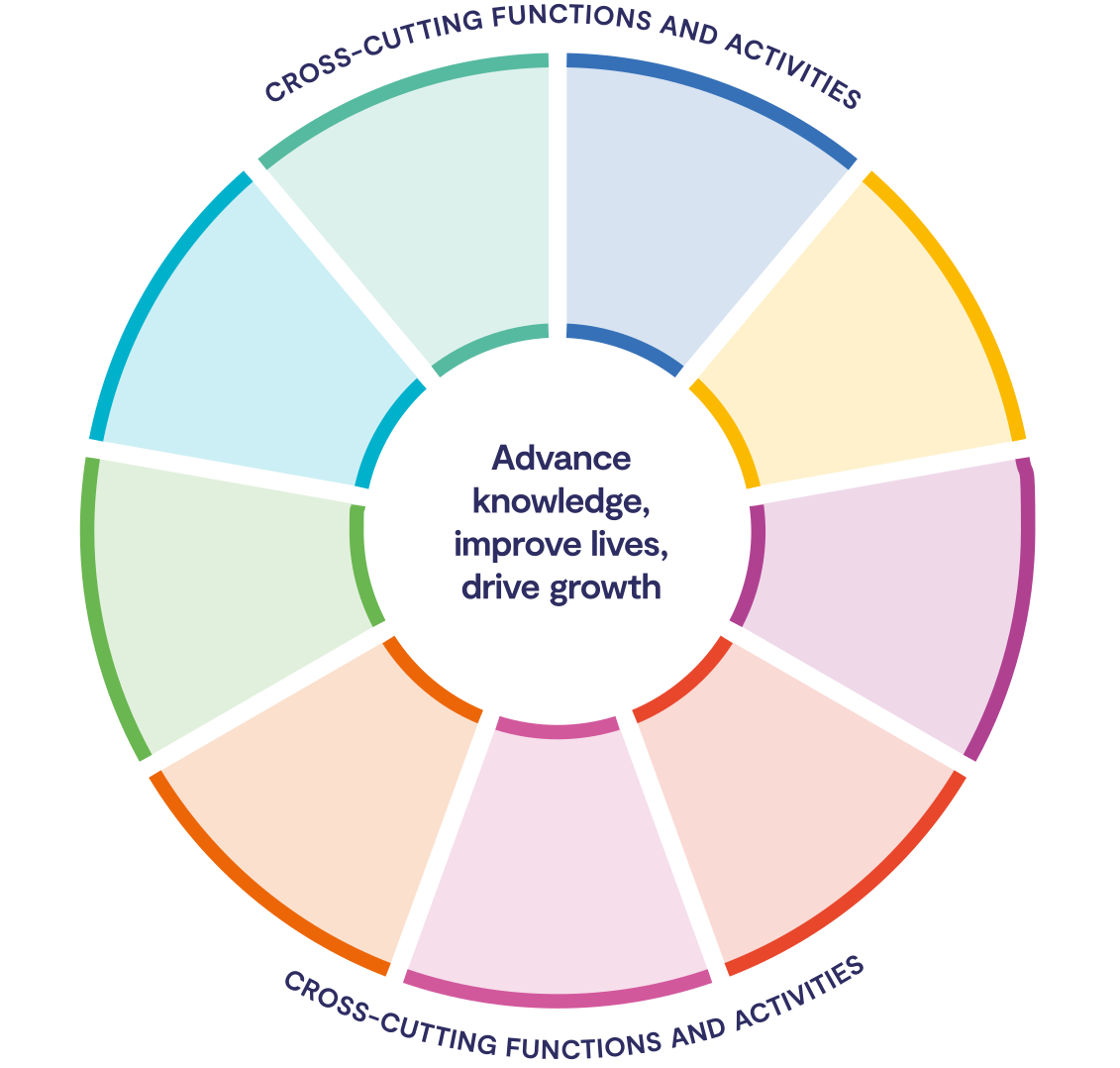
Arts and Humanities Research Council (AHRC)
Biotechnology and Biological Sciences Research Council (BBSRC)
Economic and Social Research Council (ESRC)
Engineering and Physical Sciences Research Council (EPSRC)
Medical Research Council (MRC)
Natural Environment Research Council (NERC)
Science and Technology Facilities Council (STFC)
What we do
Research and innovation have the power to improve how we live and work. The people, organisations, ideas, infrastructure and networks that make up the UK’s R&I system are essential to building a green, inclusive knowledge economy and securing future prosperity.
We invest over £9 billion each year to advance knowledge, improve lives and drive economic growth, catalysing new knowledge and innovation, attracting global talent and businesses, and strengthening the UK’s position as one of the world’s most competitive and creative R&I nations. With a reach that spans all disciplines and sectors, we are uniquely placed to deliver on government priorities and support a thriving, sustainable R&I system that delivers the best outcomes for communities across the UK and beyond.
How we do it
We invest in:
- curiosity-driven foundation research which underpins the UK’s R&I leadership
- targeted R&I addressing strategic government and societal priorities
- supporting innovative companies’ growth, helping firms to start, scale and remain in the UK
- strengthening UK R&I enabling essential capabilities including talent, infrastructure, institutes and facilities
How we are organised
UKRI comprises nine councils shaping a coherent investment portfolio to deliver multiple, aligned objectives. Our cross-council directorates support the nine councils by delivering core professional services and harnessing their collective expertise to deliver our mission and foster an outstanding UK R&I system.
Over £9 billion annual budget, making us the largest national R&I investor in Europe.
58 centres, institutes, Catapults and units receive strategic core funding from us.
Infrastructure from 1,100 metres underground to 1.5 million kilometres from Earth.
How we are governed
The UKRI Board is our primary governing body. It oversees our activities, including delivery of our strategy. The Board provides updates and advice to the Secretary of State for Science, Innovation and Technology.
Our Executive Committee (ExCo) provides strategic advice to the Board and is responsible for delivering the Board’s vision by overseeing the organisation’s overall performance and delivery. ExCo comprises the Executive Chairs of each of our nine councils, each of whom is advised by a Council of external members from across the academic community, business, civil and public sector, as well as leaders of our professional services. Further details of our committees can be found in our Governance Statement.
Our external stakeholders
External stakeholders include:
- the UK government
- UK academia
- the UK public
- UK researchers and innovators
- UK businesses
- our global partners
Centres, institutes, Catapults, units (CICUs)
We provide strategic core funding to 58 CICUs to deliver unique, national R&I capabilities. Also available in interactive format.
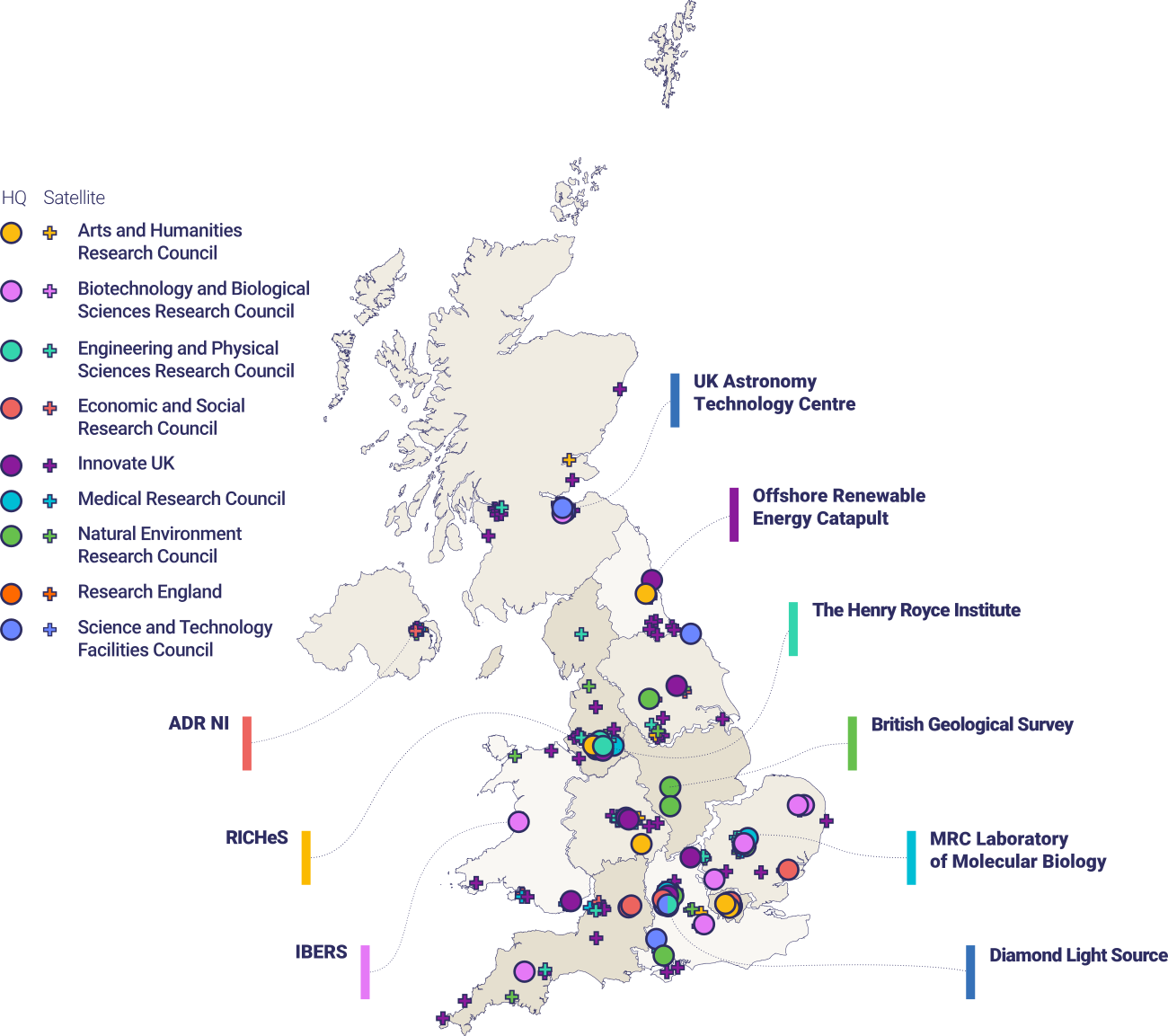
ADR NI
Part of Administrative Data Research UK, ESRC’s flagship data-sharing partnership, ADR NI enables secure access to linked UK public-sector data for over 6,000 researchers. From crime and justice to education, the economy, and health, this UK-wide partnership is transforming public sector data into research insights and policy evidence to improve lives.
Research Infrastructure for Conservation and Heritage Science (RICHeS)
Based at the headquarters (HQ) in Daresbury, RICHeS leads the UK’s national infrastructure for conservation and heritage science, connecting a distributed network of specialist facilities, collections and expertise. It safeguards irreplaceable cultural assets, supports a £45 billion heritage economy, and drives interdisciplinary innovation with spillover benefits for digital technologies, forensics and materials science.
The Institute of Biological, Environmental and Rural Sciences (IBERS)
IBERS is a UK national capability in grassland and plant breeding science, driving innovation to address challenges in food security, climate resilience, bioenergy and sustainable agriculture and supporting a resilient and low-carbon bioeconomy.
UK Astronomy Technology Centre
The UK Astronomy Technology Centre (UK ATC) is a world-leading centre designing and delivering cutting-edge astronomical instruments and collaborations to explore the origins of planets and galaxies.
Offshore Renewable Energy Catapult
The Offshore Renewable Energy Catapult is at the heart of North East England’s offshore wind cluster, leveraging £150 million in local investment and helping create 170 high-quality jobs to support regional growth and lead the UK towards a net zero future.
Diamond Light Source
Diamond Light Source is the UK’s national synchrotron, powering world-class research and industry innovation. It supports thousands of users, underpins patents valued at over £10 billion, generates around £80 million annual economic impact, and delivers strong returns on public investment through spin-outs, partnerships and productivity gains.
MRC Laboratory of Molecular Biology
The MRC Laboratory of Molecular Biology is a world-leading centre for fundamental biomedical research, tackling major challenges in human health. Its discoveries have transformed molecular biology and medicine, underpinning the global monoclonal antibody industry now valued at around $230 billion, and have been recognised with 12 Nobel Prizes for scientific excellence.
Our strategy
There have been material changes to our operating context in the past two years. These include a change of government and the allocation of our £38.6 billion budget for the 2026-27 to 2029-30 spending review period.
We are therefore refreshing our strategy to set out our ambitions for the next five years. Shaped around our mission to advance knowledge, improve lives and drive growth, it will show how our budget will be used to deliver the best possible outcomes for the UK. Due for publication in 2026, our refreshed strategy will outline a clear direction for the three priorities that underpin our 2026-27 to 2029-30 budget: supporting discovery and curiosity-driven research, addressing strategic governmental and societal priorities, and helping companies, start, scale and stay in the UK. It will also explain how we will strengthen the foundations of the R&I system and reform our organisation over the next five years.
Our objectives and 2025 to 2026 key results
Objective 1: protect and promote curiosity-driven research through a long-term sustainable funding model that underpins the UK research ecosystem.
Objective 2: align UKRI’s portfolio with the government’s priorities, including the five missions and Industrial Strategy and their ambitions to deliver UK-wide impact.
Objective 3: provide targeted innovation, commercialisation and scale-up across the UK to drive economic growth.
Objective 4: deliver local impact and enhance national and international collaboration, security and resilience.
Objective 5: develop and sustain an R&D environment that supports national science capabilities and attracts and nurtures the best research and innovation talent.
2025-26 has been a transitional year for UKRI. In November, we agreed a set of five objectives with DSIT, reflecting a broader shift in our approach to be more focused and selective as an organisation. The objectives make clear our position as a publicly accountable body, working on behalf of government to deliver public benefit.
We have transitioned to measuring our performance against our new objectives through a series of annual key results. Key results are specific, measurable outcomes that will help us progress achievement of our objectives.
Our 2025-26 key results include a mix of strategic cross-organisational measures and sector-specific measures supporting delivery of the Industrial Strategy. They do not cover our entire investment portfolio, providing a focus on key priority outcomes for this year.
The 2025-26 Annual Report and Accounts sets out the progress we have made against our new objectives and 2025-26 key results, as laid out in our 2025-27 Corporate Plan Update.
We provide a summary of this progress in the following ‘How we performed in 2025-26’ snapshot.
How we performed in 2025-26
Our Performance Framework
The UKRI Performance Framework assesses our performance across the R&I cycle, guided by a high-level logic model linking our activities to expected outcomes and impacts. Regular reports across the year monitor delivery against the inputs, outputs and outcomes set out in our strategy and corporate plan.
Our quarterly progress and performance report tracks 28 measures that assess progress against our strategy and organisational objectives. These measures focus on where and how we invest across our portfolio and on near-term organisational performance outputs.
Our annual balanced scorecard includes around 100 measures that cut across our strategy and track the longer-term outcomes of our work across the R&I system and economy. These cover what UKRI investments deliver, such as new knowledge and policy engagement, and our progress in driving wider R&I system and culture change.
We will update our performance framework in 2026-27 to align with our new organisational strategy and priorities. The refreshed measures will continue to act as an early-warning system, highlighting strengths and areas for attention to help our Board and committees focus on priorities for improvement.
Quarterly progress and performance report: tracks 28 measures of near-term progress and performance
Annual balanced scorecard: tracks almost 100 measures of longer-term outcomes and impacts
Annual Reports and Accounts: draws on both to provide a holistic overview of our performance
2025-26 Performance Overview
In 2025-26, we achieved 13 of the 17 2025-26 key results prioritised under the new objectives. We partly achieved 3 key results, with 1 unclassified due to unforeseen delays in data collation. A breakdown of key result statuses per objective is below:
Objective 1: protect and promote basic curiosity-driven research through a long-term, sustainable funding model that underpins the UK research ecosystem (fully achieved: 2).
Objective 2: ensure UKRI’s portfolio is aligned with delivering the government’s priorities, including the five missions and Industrial Strategy (fully achieved: 6, partly achieved: 2).
Objective 3: provide targeted innovation, commercialisation and scale-up across the UK to drive economic growth (fully achieved: 2).
Objective 4: deliver local impact and enhance national and international collaboration, security and resilience (fully achieved: 1).
Objective 5: develop and sustain an R&D ecosystem that supports national science capability and attracts and nurtures the best research and innovation talent (fully achieved: 2, partly achieved: 1, unclassified: 1).
We provide a summary of our performance in delivering against our objectives and 2025-26 key results as outlined in our 2025-27 Corporate Plan Update. We outline whether each key result was fully or partly achieved, the progress we made towards achieving each objective, and the outcomes that we have delivered for the UK.
We provide more detailed overviews of our performance against selected key results in the Performance Analysis.
Objective 1
Protect and promote basic curiosity-driven research through a long-term, sustainable funding model that underpins the UK research ecosystem.
Key Results (KR)
- Supporting curiosity-driven research and investing strategically in R&I excellence (fully achieved).
- Aligning the Research Excellence Framework (REF) to achieving the outcomes for the Vision for Higher Education (fully achieved).
How we performed
In 2025-26, we distributed £2 billion via Research England in quality-related research funding to higher education providers and invested in curiosity-driven research programmes such as ESRC’s Administrative Data Research UK and MRC’s Centres of Research Excellence (CoRE) (KR1). Such investments are continuing to deliver excellent outcomes for the UK and beyond, including the use of the first bioengineered bone marrow model to advance cancer research, and the Dark Energy Survey (DES)’s publication of the most detailed picture yet of the Universe’s expansion over the past six billion years.
Broad delivery timelines are on track for REF 2029 (KR2). Opportunities to align incentives with the Vision for Higher Education were explored holistically across REF 2029 and Research England’s funding mechanisms, with the funding emerging as the most effective means to achieve alignment without impacting the REF 2029’s timeline. We also made changes to the design of the REF’s submissions to minimise bureaucracy, including mirroring the REF 2021 approach to impact assessment and simplifying the ‘Contributions to Knowledge and Understanding’ section.
2025-26 in review: transforming milk allergy diagnosis for children
A new blood test could transform how cow’s milk allergy is diagnosed, offering a faster, safer and far more accurate alternative to current methods. The basophil activation test (BAT), developed through UKRI-supported research led by King’s College London and Guy’s and St Thomas’ NHS Foundation Trust, outperformed standard skin prick and IgE tests in a study of 150 children. With the potential to dramatically reduce the need for stressful and clinically risky oral food challenges currently used to confirm diagnosis, BAT is also around five times cheaper, offering major savings for the NHS. With cow’s milk allergy affecting 2-3% of young children, this quick, non-invasive test has the potential to prevent unnecessary milk avoidance and ease pressure on allergy services, delivering faster, more confident care for families.
Objective 2
Ensure UKRI’s portfolio is aligned with delivering the government’s priorities, including the five missions and Industrial Strategy and their ambitions to deliver UK-wide impact.
Key Results (KR)
- Launching the R&D Missions Accelerator Programme (fully achieved).
- Demonstrating our progress towards at least a 3-to-1 ratio in leveraged co-investment for selected programmes (partly achieved).
- Securing government approval for UKRI’s next four-year budget (fully achieved).
- Delivering initial proof-of-concept work for fleets of marine autonomous vehicles (fully achieved).
- Enabling next-generation biotechnologies to deliver societal impact (fully achieved).
- Supporting a dynamic portfolio of clinical translational projects (fully achieved).
- Supporting government departments to achieve their priorities through our UKRI Policy Fellowships (partly achieved).
- Equipping over 50 places with step change improvements in local capacity to deliver net zero projects (fully achieved).
How we performed
We made strong progress in 2025-26 in aligning our portfolio with the government’s priorities, securing its approval for our 2026-27 to 2029-30 budget in November and remaining on track to publish our refreshed strategy in line with agreed timelines (KR5).
Across the year, we launched the first four R&D Missions Accelerator Programme (R&D MAP) challenges, delivering on government priorities in areas including clean energy, and concentrations of crime data (KR3). We also placed 41 UKRI Policy Fellows across 27 government departments, devolved administrations and arm’s length bodies, just outside our target of 43 fellows, to tackle ambitious and pressing policy challenges (KR9). Aligning with government expectations, we reviewed gaps in our monitoring of leveraged co-investment across our portfolio. We are embedding this further in the strategic design of our programmes, and will formalise in 2026-27 how we will progress towards our three to one (private to public) target for select investments (KR4).
In 2025-26, we aligned our investments to deliver the Industrial Strategy’s priority areas. Through three themed knowledge exchange programmes and the Creating Better Places handbook, among other targeted interventions, our investments strengthened the local delivery of net zero projects by addressing barriers such as financing and citizen engagement (KR10). We also supported a dynamic portfolio of 172 clinical translational projects across our Gap Fund and Developmental Pathway Funding Scheme programmes (KR8) and successfully demonstrated the feasibility of an AI planning tool that allows users to define and refine complex mission plans for hundreds of marine autonomous systems (KR6). Such investments are delivering outcomes vital for the UK’s future prosperity, including the first-of-its-kind genetic engineering of pigs to resist classical swine fever, creating healthier animals, reducing losses for farmers and mitigating threats to the livestock sector (KR7).
2025-26 in review: advancing UK and Welsh semiconductor capability
The UK has achieved a major breakthrough in semiconductor innovation, with researchers at Swansea University establishing the country’s first 4-inch thin-film gallium oxide manufacturing capability. This enables more efficient, compact and cost-effective technologies for electric vehicles, renewable energy and 5G communications. Supported by UKRI investment, this milestone overcomes key barriers to producing high-quality gallium oxide, unlocking its potential for next-generation electronics. It also strengthens the South Wales semiconductor cluster, CSconnected, which supports over 3,100 jobs across Wales and contributed £436 million in Gross Value Added (GVA) to the Welsh economy in 2025, demonstrating growing UK capability across the semiconductor innovation chain.
Objective 3
Provide targeted innovation, commercialisation and scale-up across the UK to drive economic growth.
Key Results (KR)
- Increasing the proportion of Innovate UK’s funding targeted towards key Industrial Strategy sub-sectors to at least 70% (fully achieved).
- Devolving funding to anchor higher education providers to support place-based economic growth in the creative industries (fully achieved).
How we performed
We continued this year to pull the strongest ideas through to commercialisation, turning innovation into economic growth. In 2025-26, Innovate UK-supported businesses self-reported securing £220 million in private follow-on-funding, increasing the number of FTE employees by 2,153 and launching 1,871 new products or services – 89% of the businesses surveyed expect to launch new products, services or processes due to Innovate UK support.
Aligned with government priorities, over 70% of Innovate UK’s funding is targeted towards Industrial Strategy sectors (KR11). This year, we have evolved our Women In Innovation and Growth Catalyst programmes to focus on key sectors such as advanced manufacturing, life sciences, and digital and technologies. We also continue to devolve strategic creative industries R&I funding to boost regional growth including the Birmingham-based CreaTech Frontiers and Liverpool MusicFutures creative industries clusters. Both launched in 2025 and are already delivering place-based benefits including £445,000 in co-investment as of March 2026. (KR12).
Our support across the full breadth of Industrial Strategy sectors continues to enable high-potential UK businesses to scale, including Xampla, which secured $14 million in Series A funding in September following UKRI support to develop its high-performance plastic-free alternatives for industry.
2025-26 in review: Inclusive mobility for ageing drivers
An AI-powered system that uses dashcam data to directly analyse driving behaviour is supporting older drivers to understand and improve their own driving safety, as well as reduce bias in insurance decisions. Mind Foundry, a University of Oxford spin-out, was supported by the Ministry of Defence’s and our Defence and Security Accelerator to develop this new AI technology for defence, insurance and infrastructure sectors. The company has now raised over £40 million in investment and was ranked at number 11 in The Times 2025 Tech 100 list of the UK’s fastest-growing private tech companies.
Objective 4
Deliver local impact and enhance national and international collaboration, security and resilience.
Key Result (KR)
- Completing the design of the £500 million Local Innovation Partnerships Fund and securing approval for the fund’s business case (fully achieved).
How we performed
In 2025-26, we designed and launched the new Local Innovation Partnerships Fund (LIPF)’s Earmarked (for allocated areas with established governance) and Competed strands (a competitive route for other places outside the earmarked strand) (KR13). Following HM Treasury’s approval of the final business case, we confirmed that seven regions will each receive up to £20 million of investment through the fund’s Competed strand. LIPF builds on lessons from the £130 million Innovation Accelerator programme led by Innovate UK, which has leveraged around £240 million of realised private co-investment and created nearly 550 additional full-time equivalent jobs across the West Midlands, Greater Manchester and Glasgow City Region.
These programmes build on the vital place-based outcomes emerging through our wider portfolio, from new reusable, plant-based theatre caps improving patient safety in Clydebank, to over 500 new jobs in Ballymena via Wrightbus’s UKRI-supported partnership with Queen’s University Belfast. We have also continued this year to expand international R&I collaboration through new funder-to-funder investment partnerships with India, Japan and Canada, as well as awarding £490 million of Horizon Europe Guarantee investments on behalf of DSIT. In addition, we have further strengthened our security R&I portfolio by welcoming 26 new projects into the ninth year of Innovate UK’s Cybersecurity Academic Startup Accelerator programme, which to date has seen the formation of 36 start-ups securing over £43 million in further funding.
Objective 5
Develop and sustain an R&D ecosystem that supports national science capability and attracts and nurtures the best R&I talent.
Key Results (KR)
- Investing in talent development and supporting the recruitment of at least 5,000 doctoral students and 300 new fellows (Unclassified)
- Growing the UK’s clinical research capacity through Future Leaders Fellowships awards (Fully achieved)
- Enhancing the efficiency, effectiveness and coherence of UKRI by spring 2026 (Fully achieved)
- Increasing the speed of grant processing and raising the user satisfaction rate of the Funding Service and Innovation Funding Service (Partly achieved)
How we performed
We invested this year across the R&I talent pipeline to sustain the UK’s capability, reduce career barriers and address skills gaps. (KR14) We launched the £54 million Global Talent Fund and endorsed 3,169 individuals for Global Talent visas (up 10% from 2,882 in 2024-25), attracting world-class researchers to the UK. We also supported 349 new fellowship starts (exceeding our target of 300) and advanced clinical research careers through a new national clinical research career support map, expanding our Future Leaders Fellowships scheme, and investing £9.7 million via MRC in a regional programme enabling clinicians to remain research active (KR15). Our continued investment in doctoral training, including new Doctoral Focal Awards in nuclear skills, is delivering strong outcomes. For example, around one-third of AstraZeneca-supported projects under EPSRC’s Industrial Doctoral Landscape Awards and forerunner programmes have led to results that were later used in the company’s R&D.
We also made strong progress in improving UKRI’s efficiency, effectiveness and coherence. (KR16). With DSIT, we published an updated Framework Document in November 2025, clarifying core responsibilities and strengthening governance and accountability, and further work is now underway to refine roles and collaboration in key shared business areas. We demonstrated effective financial control and efficiency by meeting our 2025-26 Operating Expenditure (OpEx) cap (actual spend of £268.7 million against a £272.3 million budget) and increased our 2025 People Survey employee engagement index score by one point from 2024 to its highest level to date.
To support a professional and efficient funding service, we also improved our understanding of the factors influencing our application processing speed (KR17). We reduced the median overall Research Council processing time by 23 days from 2024-25 to 173 days (under the 180-day target), though the median applicant-led mode processing time remains above target at 194.5 days. We also reduced the end-to-end Innovate UK application processing time by 26 days to 99.6 days.
2025-26 in review: Publishing our refreshed environmental sustainability strategy
In December, we published our environmental sustainability strategy for 2025 to 2030, outlining our ambitions to further lessen our environmental impact while fostering world-class research and innovation. Building on our first strategy, which led to a 33% reduction in overall emissions, the refreshed strategy aligns with the UK government’s net zero target of 2050 with an interim goal of reducing our emissions by 50% by 2030. More information can be found on page 62 on our performance in delivering our environmental sustainability ambitions in 2025-26.
Risk summary
We use effective risk management to support delivery against the objectives and priorities identified in our strategy. Our goal, through early identification and active management of risks, is to anticipate uncertainties that may impact the delivery of goals, undertake relevant and timely assessments, plan mitigations and manage issues (should they arise) with an agile and effective response.
Our approach to managing our principal risks includes a robust schedule of deep-dive evaluations of each of our principal risks. This has been further strengthened this year with the introduction of the new governance framework, ensuring that internal stakeholders and subject matter experts conduct the detailed deep dive. The outcomes are then reported to our monthly Executive Committee (ExCo) meetings.
These deep dives enable ExCo to scrutinise the risk elements and the measures we are taking to reduce risk. Through the deep dives, we analyse the flight path of each risk and track the planned activity from residual score through to our target, where the risk is expected to come within our risk appetite.
A summary of our principal risks is presented in the following listing, including risk titles to indicate the types of risk. The risk management overview of this report provides more information about the nature of these risks and how they are being managed.
Our principal risks include:
- R-1930: financial resilience of the UK research system (high likelihood, high impact, risk target score very high)
- R-0020: failure to deliver HR and people-related strategic objectives (high likelihood, high impact, risk target score high)
- R-0028: trusted research and innovation (medium likelihood, very high impact, risk target score high)
- R-1794: failure to deliver the benefits of UKRI’s Organisational Change Portfolio (medium likelihood, very high impact, risk target score high)
- R-1640: data and information management (medium likelihood, high impact, risk target score medium)
- R-1756: failure to influence and respond to changes in the policy landscape (medium likelihood, high impact, risk target score medium)
- R-2802: managing UKRI’s strategic direction to achieve UKRI’s intended impact (medium likelihood, high impact, risk target score medium)
- R-2771: effectiveness of UKRI systems and IT infrastructure (high likelihood, medium impact, risk target score high)
- R-0024: failure to deliver against UKRI Environmental Sustainability and Greening Government Commitments (high likelihood, medium impact, risk target score low)
- R-2146: major gap or failure in our internal control environment (low likelihood, medium impact, risk target score low)
Our year in review: delivering the Industrial Strategy
In 2025-26, UKRI, and the R&I we support, delivered across all Industrial Strategy sectors, translating government ambitions into real-world outcomes, boosting productivity, accelerating innovation and driving economic growth nationwide. Click on the images below and go to page 29 in the Performance Analysis section to find out more:
May 2025
Defence: Zentraxa, a spin-out company from the University of Bristol’s EPSRC and BBSRC-supported Centre for Synthetic Biology, secured seed funding to accelerate the development of its biomaterial technologies. This followed a collaboration with the Ministry of Defence’s Science and Technology Laboratory (Dstl) and the British Army to create and test a nature-inspired underwater glue, used to quickly repair wetsuits, damaged dinghies and other equipment in extreme environments. Find out more.
Life sciences: UK Biobank’s new purpose-built headquarters at Manchester Science Park ‘topped out’, with plans in progress to deliver a robotic system that can retrieve its 20 million biomedical samples four times faster. Supported by UKRI with other partners, the dataset is the world’s most comprehensive collection of longitudinal biomedical data, and 11 NHS memory clinics are now using its rapid 15-minute brain scan to provide faster, more accurate dementia diagnoses and more personalised patient care. Find out more.
July 2025
Life sciences: Re-Vana Therapeutics, an Innovate UK-supported spin-out from Queen’s University Belfast, signed a licensing agreement with Boehringer Ingelheim, one of Germany’s leading pharmaceutical companies, worth up to £744.1 million ($1 billion). Through participation in Innovate UK’s ICURE programme, following previous MRC support, Re-Vana gathered insights to shape its business model, refine its technology focus, and build the confidence required to engage investors and global industry leaders. Find out more.
August 2025
Digital and technologies: Companies participating in the UKRI Challenge Fund Commercialising Quantum Technologies programme reported an average £4 million rise in annual revenue, compared with £1.2 million for unsuccessful applicants, according to a programme evaluation published by Technopolis. Participating businesses also added an average of 67 Full-Time Equivalent (FTE) roles from their starting position, and 97% advanced the Technology Readiness Level of their product, with an average uplift of 2.3 levels. Find out more.
September 2025
Creative industries: The 2025 CoSTAR (Convergent Screen Technologies and Performance in Realtime) Ideate Growth Lab and Residency Programme concluded, having supported 24 ambitious early-growth creative technology start-ups and Small and Medium Enterprises (SMEs) to scale new IP through CoSTAR’s AHRC-supported national R&D infrastructure. Early impacts are emerging. For example The Grey Hill accelerated development of new digital products for the theatre sector, including a data analytics minimum viable product to improve audience insight and reduce investment risk, while strengthening its commercial capability and expanding into international markets. Find out more.
November 2025
Advanced manufacturing: Nyobolt, a Cambridge-based pioneer in high-power, fast-charging energy solutions, was one of 10 UKRI-supported businesses spotlighted during our Innovation for Growth Summit at the Science Museum. Based on EPSRC-funded research and supported by Innovate UK, Nyobolt has developed a concept car based on its innovative battery technology that can charge from 10% to 80% in less than five minutes, eliminating the problem of lengthy waits for electric vehicle drivers. The company now employs 120 people worldwide and has secured a deal to roll out its battery technology with a major US robotics firm. Find out more.
Professional and business services: Technology in Professional Services (TIPS) Accelerator, an ESRC and Innovate UK-supported innovation adoption project, was featured in the 2025 edition of the Association of Chartered Certified Accountants (ACCA)’s Digital Pathways Playbook, a global guide designed to help SMEs navigate their journey from manual processes through to fully AI-enabled operations. From January 2024 to May 2025, TIPS, led by Lancaster and Oxford Brookes Universities, directly supported over 60 mid-tier and smaller law and accounting firms to deliver faster processes and better client outcomes. Find out more.
December 2025
Clean energy: The Ammonia Synthesis Platform using Intermittent Renewable Energy (ASPIRE) came online, supporting the UK’s commitment for a zero-carbon electricity system by 2030. Developed by STFC’s Energy Research Unit, it converts surplus wind power into green ammonia – a storable, zero-carbon fuel that could contribute 10-15% of global CO2 reductions. ASPIRE is demonstrating how intermittent renewable energy can be turned into a stable fuel, and its data will be key to scaling production and making green ammonia commercially competitive. Find out more.
Financial services: Future Finance, an ESRC and Innovate UK-supported programme designed to help SME and mid-tier financial services businesses adopt innovative products and processes, celebrated its impact at a finale event in Bristol. By September 2025, more than 80 companies, spanning services including financial advice, savings, lending and credit brokers, had benefited from its Innovation Adoption Accelerator, with 95% improving their performance after implementing at least one new innovation. Find out more.
February 2026
Multi sector: We published, via Research England, an independent report by Tony Hickson, Chief Business Officer at Cancer Research UK, outlining 20 recommendations for universities, policymakers, public R&I funders and investors to better set up spin-outs for success. In response, we committed to developing a UKRI vision structured around seven key themes. These include working with the British Business Bank, the National Wealth Fund, and institutional investors to unlock new flows of pension capital, and exploring the expansion of proof-of-concept and pre-seed funding. Find out more.
March 2026
Multi sector: The Innovation Accelerator pilot celebrated its completion, having demonstrated a new way to drive regional innovation and unlock local economic growth. The programme was led by Innovate UK, on behalf of UKRI and DSIT, and invested £130 million over three years across three city regions: West Midlands, Greater Manchester and Glasgow City Region. The regional partnerships worked with DSIT and Innovate UK to align their local strategies to national strategies and identify support to unlock further potential. Funded projects have reported around £240 million of realised private co-investment and nearly 550 additional full time equivalent jobs as a result of the programme. Find out more.
Digital and technologies: Independent analysis of ARCHER2, the UK’s national supercomputer, found it had generated over £4.2 billion in economic benefits in its first five years of operation – an £8.30 return per £1 of public funding. A further £517 million has been delivered via spin-outs, new products and services, and highly skilled staff trained on ARCHER2 moving into industry and boosting computational R&D capability across the UK. Hosted by EPCC at the University of Edinburgh and funded by EPSRC and NERC, ARCHER2 demonstrates how world-class digital infrastructure drives economic growth, innovation and skills while enabling breakthroughs across disciplines. Find out more.
Performance analysis
An analysis of our performance in delivering the ambitions of our organisational objectives and key annual results in 2025-26.
Please note: Objective 1: August 2025 Field Citation Ratio data cited under Key Result 1 was taken from a report written using data obtained on 1 August 2025 from Digital Science’s Dimensions platform, available at app.dimensions.ai. Access was granted to subscription-only data sources under licence agreement with UKRI. The 2024-25 infrastructure investment figure has been updated since its publication in the 2024-25 Annual Report and Accounts.
Objectives 3: The declared co-investment totals for 2023-24 and 2024-25 have been updated from our 2024-25 Annual Report and Accounts due to the availability of improved datasets. Objective 5: The 2023-24 and 2024-25 research council grant processing times have been updated since the 2024-25 Annual Report and Accounts due to the availability of improved datasets.
Objective 1
Protect and promote basic curiosity-driven research through a long-term, sustainable funding model that underpins the UK research ecosystem.
Protecting and promoting curiosity-driven research
Curiosity-driven research underpins the UK’s R&D strength. Our curiosity-driven investments are fundamental to the UK’s long-term national resilience in driving transformative discoveries and delivering often unforeseen benefits that power long-term economic growth and improve lives.
Performance overview: 2025-26 Key Result 1
We will support curiosity-driven research, including by distributing £1.7 billion in quality-related research funding to higher education providers in England to invest strategically in R&I excellence by April 2026, and by maintaining a mean Field Citation Ratio of UKRI grant funded publications of 3.5 to 4.
How we performed
Fully achieved: In 2025-26, we distributed £2 billion in quality-related research funding to higher education providers in England. The latest Field Citation Ratio of UKRI grant-funded articles (2023 publications) is 3.77 (August 2025), well above the UK average of 2.63. Across the year, we also advanced Research England’s Strategic Institutional Research Funding review (SIRF), completing its SIRF impact evaluation (to be published in early summer 2026). The review is an ongoing programme to deliver funding reforms in the period up to and after publication of the next REF (Research Excellence Framework) results and will continue into 2026-27.
Highlights from 2025-26
Highlights include:
- launching a further three MRC Centres of Research Excellence (MRC CoRE), investing up to £150 million to tackle major health challenges through disruptive, interdisciplinary research
- awarding over £20 million to four ambitious new team science projects through BBSRC’s Strategic Longer and Larger Grants (sLoLa) programme, deepening our understanding of fundamental biological processes
- awarding £31.7 million to 32 research grants to support interdisciplinary research, through round two of our Cross Research Council Responsive Mode pilot scheme
- launching the £42.8 million Generation New Era birth cohort study of 30,000 children born in 2026, via ESRC and the UKRI Infrastructure Fund, to support governments, researchers and service providers to improve the lives of children and families in the UK
- celebrating 100 years of UK research exploration and cutting-edge marine science at the NERC-supported National Oceanography Centre’s 100 Years of RRS Discovery exhibition in September
Knowledge outputs
133,237 knowledge outputs have been generated by UKRI awards with a funding decision date between 2021-22 and 2025-26, including 114,803 publications and 18,434 diverse R&I outputs such as research models and databases and medical products, interventions and clinical trials
Note: in our 2024-25 Annual Report and Accounts, we noted that awards starting between 2020-21 and 2024-25 generated 166,410 knowledge outputs (143,195 publications and 23,215 diverse R&I outputs).
Enabling transformative discoveries
Uncovering hidden galaxies to better understand our Universe
Almost 2,000 distant galaxies have been revealed by a team of scientists led by STFC’s RAL Space and Imperial College London. The team created the deepest-ever image of the Universe in long far-infrared wavelengths, which suggested the existence of a population of ‘hidden galaxies’ that could account for the missing energy in the Universe’s infrared light budget. To create the complete image of the Universe, Herschel’s SPIRE (Spectral and Photometric Imaging Receiver) instrument routinely monitored a single patch of ‘dark sky’ every month or so during its nearly four-year mission in space.
New antibiotic for drug-resistant bacteria discovered
A promising new antibiotic that is effective against drug-resistant bacterial pathogens, such as MRSA, has been identified by UKRI-supported researchers at the University of Warwick and collaborators at Monash University. The new compound is a compelling candidate due to its simple structure, strong antibacterial activity, low likelihood of resistance, and ease of synthesis. If pre-clinical testing is successful, pre-methylenomycin C lactone could become an important tool in the fight against antimicrobial resistance, potentially helping to save some of the 1.1 million lives lost each year to drug-resistant infections.
Mapping hidden Antarctica
The most detailed map of Antarctica’s subglacial landscape to date has been produced by a University of Edinburgh-led international team, revealing thousands of mountains, valleys and ridges that control ice flow. Using advanced Ice Flow Perturbation Analysis and satellite data, and supported by over £20 million from the UK-US International Thwaites Glacier Collaboration, the study offers critical data for next-generation climate models and highlights priority areas for future surveys. The resulting map is also enhancing the evidence base required by policymakers and insurers to develop resilient coastal adaptation strategies.
Strengthening the Research Excellence Framework
Performance overview: 2025-26 Key Result 2
We will develop options, during a brief pause, to ensure that the next Research Excellence Framework is aligned to achieving the outcomes for the Vision for Higher Education, within the existing 2029 timeframe, including supporting government priorities for R&I expressed in the Industrial Strategy and the Post-sixteen Skills White Paper, testing more proportionate approaches, and minimising bureaucracy for the sector.
How we performed
Fully achieved: Following the autumn pause, broad delivery timelines are on track for REF 2029. Changes have been made to the design of the REF 2029 submissions in order to minimise bureaucracy for the HE sector, including simplifying and further clarifying the ‘Contributions to Knowledge and Understanding’ section and impact assessment largely mirroring REF 2021’s approach. To reduce pressure on individual researchers, the recommended maximum of five outputs per researcher was reinstated and the minimum of one removed. We tested alternative approaches to the REF that would represent a proportionate burden for the sector’s less research-intensive parts, but found little sector appetite for such interventions in the short term due to the perceived status and credibility gained through participation in the full exercise.
Opportunities to align incentives with the Vision for Higher Education were explored holistically across both REF 2029 and Research England’s funding mechanisms. Funding emerged as the most effective means to achieve alignment without impacting the REF 2029 timeline and work is underway to develop this further as part of Research England’s review of its Strategic Institutional Research Funding.
Sustainably managing a portfolio of world-class research and innovation infrastructure that meets the UK’s strategic needs
Access to cutting-edge capabilities drives discovery, innovation and the UK’s global competitiveness. Our investments strengthen national capability, unlock long-term benefit, and ensure the UK is ready to meet emerging challenges and opportunities. In 2025-26, we invested £1.163 billion on infrastructure, an increase of 1.5% from 2024-25 (£1,146 billion) and 23% from 2023-24 (£946 million).
Highlights from 2025-26
Highlights include:
- announcing our investment of up to £750 million in the Next National Supercomputing Service (NNSS) at the University of Edinburgh, equipping the UK with advanced computational power needed to drive breakthroughs in key growth sectors such as clean energy
- extending the UK’s world-class National PET Imaging Platform to Scotland via MRC, Innovate UK and the Medicines Discovery Catapult (MDC), with the launch of the latest total-body scanner at the Royal Infirmary of Edinburgh, up to 10 times faster and able to scan 50% more patients per day than existing machines
- announcing a five-year £168 million boost for the ESRC-supported Administrative Data Research UK to drive economic growth and improve lives through better use of health and administrative data
Leading the world into the quantum age
£8.6 million in leveraged funding has been secured by businesses building on initial support from the National Quantum Computing Centre (NQCC). The NQCC, which opened in Harwell Campus in 2024, has also delivered at least 77 highly-skilled roles, at least 27 highly skilled jobs created in external organisations, and 60 scientific outputs, including publications, preprints, technical reports, and white papers. Jointly run by STFC and EPSRC, the NQCC is central to the UK’s growing quantum ecosystem – driving expansion across sectors and strengthening our global position.
Improving lives in England
Our investments in England are delivering real-world impact aligned with all five of our organisational objectives, improving lives through place-based partnerships that turn discovery research into practical benefits.
Rare immune disorder treatment reaches NHS patients
A teenager who has lost family members because of a rare genetic hereditary illness has become the first patient in the UK and Europe to receive leniolisib (Joenja), a newly-approved targeted treatment for Activated P13-Kinase delta syndrome (APDS). For 19-year-old Mary Catchpole, the treatment has been described as ‘life-changing’, enabling her to reduce her heavy medication burden and envision a more typical future.
APDS is an ultra-rare inherited immunodeficiency that leaves people vulnerable to repeated infections and increases their risk of developing blood cancers. Researchers at MRC’s Laboratory of Molecular Biology collaborated with those from the University of Cambridge, the BBSRC-supported Babraham Institute and clinicians at Addenbrooke’s Hospital to identify and validate the biological target underpinning the new treatment, with its adoption by the NHS offering immediate benefit to the 40-50 eligible patients in England.
Ensuring safer sleep for babies
Groundbreaking research into co-sleeping has transformed national and international guidance on baby sleep safety. Professor Helen Ball and her colleagues at Durham University’s Durham Infancy and Sleep Centre (DISC) have played a major part in transforming understanding of infant sleep and challenging concerns about bed sharing.
Supported by UKRI funding in 2011, this research underpinned the creation of the Baby Sleep Info Source (BASIS), an accessible, evidence-based resource now widely recommended by NHS trusts across the UK, NHS Scotland and UNICEF UK’s Baby Friendly Initiative. With further UKRI funding in 2018, DISC developed online training for healthcare practitioners covering normal infant sleep and safety. Since launching in 2020, over 4,000 practitioners have completed the programme, with 99.6% reporting new learning and 98.6% increased confidence in advising parents.
Discovery science protects UK rail from landslides and floods
University of Leeds spin-out SatSense has secured a multi-million pound contract with Network Rail to monitor the entire UK rail network. The deal sees SatSense’s advanced satellite analysis integrated directly into safety management systems, allowing engineers to detect ground movements and map flood water extent in near real time.
Working with satellite data experts at UKRI’s British Geological Survey (BGS)-based Centre for Observation and Modelling of Earthquakes, Volcanoes and Tectonics (COMET), University of Leeds researchers realised that the same techniques used to map these movements of the Earth’s crust could be repurposed to identify infrastructure risks. Now a seven-figure turnover business supporting 15 high-skill jobs, SatSense demonstrates how discovery science can be translated into solutions to industrial challenges.
Objective 2
Ensure UKRI’s portfolio is aligned with delivering the government’s priorities, including the five missions and Industrial Strategy and their ambitions to deliver UK-wide impact.
Delivering the Industrial Strategy
We have a responsibility to drive economic growth and generate wider public benefit by leveraging the strengths of the UK’s world-class R&I system to deliver the government’s Industrial Strategy. In 2025-26, a transitional year, we prioritised investing in the strategy’s eight priority sectors to address national challenges and advance prosperity across the UK.
Performance overview: 2025-26 Key Result 5
We will publish, by spring 2026, how UKRI’s R&I strategy and portfolio will deliver against the Industrial Strategy and government’s wider objectives. We will undertake a zero-based review of future allocations in the spending period year 2026 to 2027, to year 2029-2030, securing government approval for UKRI’s four-year budget.
How we performed
Fully achieved: We secured government approval for UKRI’s 2026-27 to 2029-30 budget in November and published an online explainer in December, following an internal zero-based review of future allocations and existing financial commitments. At the end of March 2026, we were on track to publish our strategy in line with agreed timelines, subject to government approval, and this will outline how UKRI’s portfolio will deliver against the Industrial Strategy and wider government priorities over the next five years.
Highlights from 2025-26
Highlights include:
- launching, via AHRC and Innovate UK, our high-level R&D strategy for the creative and cultural economy to ensure R&I drives and sustains growth in the creative industries
- welcoming the Department for Business and Trade’s announcement of a £452 million investment in the Innovate UK-managed Battery Innovation Programme, as part of the Industrial Strategy’s Advanced Manufacturing Sector Plan
- launching the Clean Energy R&D Mission Accelerator Programme to improve the UK’s power grid flexibility through AI and digital innovation, making best use of our clean energy sources and reducing our reliance on imported gas
- investing over £14 million in 14 projects, via Innovate UK’s Contracts for Innovation programme, to accelerate the development and adoption of quantum technology and position the UK as a global leader in quantum-enabled solutions
Perovskite solar cells pave the way for indoor use
New perovskite solar cells capable of efficiently and inexpensively harvesting energy from indoor light have been developed by UKRI-funded researchers at University College London, meaning devices such as keyboards, remote controls and alarms could soon be battery free. The team reported that their solar cells converted 37.6% of indoor light (equivalent to a well-lit office) into electricity, a world record for this type of solar cell optimised for indoor light. The cells are about six times more efficient than commercially available indoor solar cells, are more durable than other perovskite devices, and could be used for an estimated five years or more, rather than just a few weeks or months.
Performance overview: 2025-26 Key Result 6
By March 2026 we will have completed the initial phases of proof-of-concept work for fleets of marine autonomous vehicles, using AI as an enabler, to assess the efficiencies and improved effectiveness of this approach for large fleets. Early outcomes will support engagement with operational partners in 2026-27 and generate data and insights to complement parallel developments in wider defence and commercial capabilities.
How we performed
Fully achieved: This proof-of-concept project has demonstrated the feasibility of an AI planning tool that allows users to define and refine complex multifunctional mission plans for hundreds of marine autonomous systems. Full realisation of target outcomes is dependent on finalising the design of an Application Programming Interface (API) to integrate the tool with UKRI’s research ship planning system, and this work continues in 2026-27.
Manchester company pioneers low-carbon graphene concrete
Concretene, a Manchester-based nanotechnology company supported by UKRI, has developed an innovative concrete admixture that incorporates graphene to potentially cut the embodied carbon of concrete by 20% to 30% and reduce carbon dioxide emissions generated through cement production. Concrete is one of the most widely used building materials, but its environmental impact is significant due to the energy-intensive process of cement production. Concretene’s patented technology enhances concrete by incorporating graphene, a material said to be 200 times stronger than steel, improving strength and durability while reducing the need for cement.
Accelerating R&D in key sectors through the UKRI Challenge Fund
From 2017 to 2025, we invested in the UKRI Challenge Fund to drive collaborative R&I across 20 Challenges focused on Healthy Society, Data and Digital, the Future of Mobility, and Clean Growth. As of July 2025, over £8.68 billion had been realised in co-investment, more than tripling the initial £2.82 billion target. At least 9,469 jobs were created and 12,546 retained across sectors such as AI, genetics, robotics and R&D management.
A fund evaluation published in November 2025 by RAND Europe and Frontier Economics identified its impacts to date:
- increased external investment: participation in a Challenge Fund project led on average to a 57% increase in external investment three years after the project began, compared with a matched control group of unsuccessful applicants
- £1.2 billion attributable investment: of the £3.6 billion in total investment secured by Challenge Fund-treated firms in the three years following treatment, approximately £1.2 billion is attributable to fund participation
- advancing technology readiness levels: across 12 Challenges reporting TRL advancements, projects increased by approximately 2.4 TRLs, with one-third of projects across all TRL-reporting Challenges reaching TRL 7-9, indicating readiness for commercial deployment
Strengthening the development, adoption and diffusion of critical technologies
Highlights from 2025-26
Highlights include:
- launching our first UKRI AI strategy to turn AI research into practical benefits for people, from real-world products to better public services
- investing at least £15 million in three future communications research hubs to develop faster and more secure connectivity technologies
- welcoming the UK Government’s 10-year funding commitment to our EPSRC and STFC-sponsored National Quantum Computing Centre, to secure technological breakthroughs across healthcare, cybersecurity and beyond
- investing, via EPSRC, in two new Innovation and Knowledge Centres driving emergent semiconductor technologies towards market, in partnership with DSIT
AI Chatbot to help protect our national infrastructure
Resilience in systems that power homes, deliver clean water, and keep transport moving could be boosted through a new AI chatbot for cybersecurity. Supported by UKRI, experts at the University of Warwick’s Cyber Security Centre have developed ICSThreatQA to tackle the problem of cybersecurity breaches. Unlike general chatbots, the new chatbot is a specialised analytical tool built on a trusted knowledge base, designed to deliver accurate, context-aware answers for industrial control system (ICS) security. This speeds up decision-making during fast-moving cyber incidents, offering a new way to help digital security teams respond to threats quickly.
Unlocking societal impact and national prosperity through biotechnologies
Performance overview: 2025-26 Key Result 7
We will enable next-generation biotechnologies that deliver societal impact across health, food, environmental sustainability, and clean growth, by March 2026. This includes research underpinning the engineering of plant-based systems that demonstrate scalable production of products for use in human health and sustainable agriculture.
How we performed
Fully achieved: We made strong progress across our engineering biology portfolio in 2025-26. We expanded and extended our 22 Engineering Biology Mission Awards to drive their research further towards translation into societal impact. For example, this will enable pilot-scale testing of a plant-based approach to producing chemicals that can be used to improve human and plant health. We also established the Engineering Biology Innovation Network, achieving over 1,000 engagements across academia and industry. In 2026-27, our priority will be the launch of the UKRI Engineering Biology Programme, including new opportunities for engineering biology research, innovation, commercialisation, skills and infrastructure.
Critical technologies to new cancer therapies
Trogenix, a biotechnology spin-out from the University of Edinburgh, completed a £70 million Series A financing in October to advance its new cancer therapy into first-in-human clinical trials. With the first patient dosing expected in 2026, this investment will accelerate the development of Trogenix’s pipeline of potentially curative therapies for several aggressive, treatment-resistant solid tumours, transforming outcomes for patients with unmet medical needs. Emerging from research at the UKRI-supported Edinburgh Genome Foundry and the UK Centre for Mammalian Synthetic Biology, Trogenix’s Odysseus® platform uses a synthetic super-enhancer vector to target glioblastoma, one of the most aggressive and hard-to-treat forms of brain cancer.
Delivering the UK government’s missions
In 2025-26, we transitioned to delivering the government’s five missions, partnering with government, industry and the third sector to create a more resilient and prosperous nation. We support individuals and teams to translate their research into business growth, productivity gains and public service improvements that directly benefit lives across the UK.
Performance overview: 2025-26 Key Result 3
Successfully launch the first set of challenges in the £500 million R&D Missions Accelerator Programme (R&D MAP) to support the government’s five missions, and to establish a second phase by April 2026.
How we performed
Fully achieved: In 2025-26, we successfully launched the first four R&D MAP challenges focusing on clean energy, concentrations of crime data, dementia patient flow, and SEN identification and support. Following the government’s approval of our proposed second phase of R&D MAP challenges in March, we will continue to build on this work in 2026-27 by scaling successful R&I approaches across the five mission areas, strengthening cross-sector collaborations, and accelerating the translation of innovation that directly benefits communities.
Highlights from 2025-26
Highlights include:
- investing £4.5 million in the Bath-based Brunel Centre via Research England, which is providing open access and real-time economic intelligence to kickstart sustainable and inclusive regional growth in the West of England, including its first report published in September, ‘Closing the Productivity Gap’
- launching nine new Policing Academic Centres of Excellence (P-ACEs) via ESRC, in partnership with the National Police Chiefs’ Council, to bring leading scientific expertise into policing and drive innovation to deliver safer streets
- investing nearly £10 million via EPSRC in six projects developing new technologies to diagnose common mental and physical health conditions earlier, more accurately and closer to home, working with charities and NHS trusts to foster an NHS fit for the future
- announcing in March 2026 that Liverpool City Region will host the first pilot from the UKRI-supported £85 million Industrialising and Digitalising Construction Challenge, aimed at overhauling how Britain delivers sustainable social housing
Boosting breast-screening uptake
Breast-screening uptake in Liverpool’s most underserved communities has been boosted by the UKRI-supported ReCITE project, which cut missed mammogram appointments by 25% and sparked over 2,000 conversations through creative, community-led storytelling. Led by the Liverpool School of Tropical Medicine and co-created with local women and health partners, the project is supporting earlier diagnosis through measures including advocacy networks and learning events, aligning with the government’s Women’s Health Strategy for England.
Portable drug-detection technology
A portable device that detects dangerous street drugs on the spot and at very low concentrations has been developed at the University of Bath, following investment from UKRI. Devon and Cornwall Police are using it to provide real-time drug warnings to drug treatment services, avoiding a wait of several months for results. The device can identify substances such as benzodiazepines, that are difficult to detect with existing mobile technologies and are major contributors to drug overdoses.
Delivering wider government priorities
Performance overview: 2025-26 Key Result 9
We will support government departments to achieve their priorities, including the five missions, through placing 43 UKRI Policy Fellows across 25 government departments, arm’s-length bodies and the devolved administrations.
How we performed
Partly achieved: In 2025-26, we placed 41 UKRI Policy Fellows across 27 government departments, devolved administrations, arm’s-length bodies and six What Works Networks. Through 18-month fellowships, fellows are tackling ambitious, pressing policy challenges and helping shape effective public policy in areas including the COVID-19 commemoration programme and future national resilience. The 2026-27 funding opportunity launched in June 2026 and has attracted a strong and diverse range of expressions of interest, which are now being developed into full proposals aligned with the remits of all seven research councils.
Highlights from 2025-26
Highlights include:
- launching, via AHRC, the first £10 million statutory gambling levy R&I funding opportunity to create a Gambling Harms Research Coordination Centre, investing in up to 20 R&I partnerships and a Rapid Response Review aimed at reducing gambling harm
- launching, via BBSRC and MRC, a £15 million UKRI Transdisciplinary research programme to tackle antimicrobial resistance, with the Department for Environment, Food and Rural Affairs (DEFRA) and the National Institute for Health and Care Research (NIHR)
- investing, via ESRC, in The Productivity Institute to support the Department of Business and Trade (DBT) to host the OECD Global Forum on Productivity in September and develop its Post-16 Education and Skills White Paper
- awarding £36.7 million to 25 projects in cycle four of the Ofgem Strategic Innovation Fund, delivered by Innovate UK, to deliver a cleaner, more affordable energy system that enables us to address climate change
Supporting the UK government to unlock the pathway to a £400 billion global carbon market
Reaching Net Zero requires the UK not only to cut emissions but to remove them at scale. UKRI’s Greenhouse Gas Removal Demonstrators (GGR-D) programme has strengthened the evidence base needed to grow this emerging sector by publishing a major synthesis report in December 2025 and positioning the UK to capture a share of a future £400 billion global market.
It has delivered the CO2RE Evaluation Framework, a new standardised tool that enables government and investors to assess any carbon removal method on a consistent basis of integrity and sustainability, as well as smarter land-use tools that help planners pinpoint where tree planting can double or triple carbon removal. These findings are already informing the UK government’s biomass strategy and future monitoring standards, ensuring that deployment is safe, scalable and commercially viable.
Improving lives in Wales
Our investments in Wales, across all five of our organisational objectives, are creating jobs and training opportunities, supporting businesses, and helping to ensure a cleaner, healthier and more prosperous place to live. From driving innovation-led growth in South Wales’ compound semiconductor industrial cluster to finding innovative solutions to socio-economic challenges facing rural Welsh communities, we are advancing knowledge and improving lives from Bangor to Newport.
AI-powered solutions to combat digital hate
Safer digital spaces are being fostered by Nisien.ai, a Cardiff University spin-out from the UKRI-supported HateLab. Backed by 2025 seed investment from the British Business Bank’s Investment Fund for Wales and the Development Bank of Wales, the company is accelerating advanced AI tools built on HateLab’s Hero Detect technology to deliver real-time detection and classification of harmful content.
Nisien.ai’s technology is now used globally, including by TikTok, which applied HateLab’s behavioural insights to strengthen protections for users targeted for minority characteristics. The company has also supported major brands in designing anti-hate campaigns for international events, including the Eurovision Song Contest, Men’s Football World Cup, and Women’s European Football Championships.
Driving Welsh leadership in Sustainable Biomanufacturing
ARCITEKBio, a UKRI-supported Aberystwyth-based cleantech company, is helping to position Wales as a leader in renewable bioprocessing and sustainable manufacturing. Supported by over £1 million in UKRI investment and hosted at AberInnovation, a BBSRC-supported R&I campus, the company is strengthening local supply chains, creating skilled jobs, and driving sustainable, circular, waste-to-value manufacturing that contributes to Wales’ and the UK’s wider bioeconomy growth. ARCITEKBio converts sugar-waste streams into xylitol – a 100% renewable, high-value sweetener in a $1.4 billion global market – using a scalable yeast-based biomanufacturing platform. The company has developed a robust commercial-scale bioprocess and is now accelerating towards market through an Innovate UK Agri-Tech and Food Technology Launchpad project.
Landmark $140 million deal marks biggest life science investment
Draig Therapeutics, a Cardiff University spin-out company, announced in June 2025 that it had raised $140 million in Series A financing to advance transformative treatments for major neuropsychiatric disorders. This milestone builds on sustained investment from multiple funders, including eight years of UKRI investment through MRC’s Developmental Pathway Funding Scheme (DPFS). This raise is the most significant commercial investment in Welsh life sciences to date, accelerating Draig Therapeutics’ pipeline of novel therapies targeting key brain processes.
Objective 3
Provide targeted innovation, commercialisation and scale-up across the UK to drive economic growth.
Supporting R&D firms to scale up and bring ideas to market
The UK is home to transformative scientific discoveries, innovative technological advancements and entrepreneurial mindsets. To unlock the full value of R&I, it is essential to forge stronger pathways to scale, helping ventures expand from fledgling start-ups to global enterprises. Our role is to bridge the gap between world-class research and scalable market impact, making sure that high-potential ideas and businesses can gain market share momentum.
Performance overview: 2025-26 Key Result 11
We will increase the proportion of Innovate UK’s funding targeted towards growing and scaling companies in key Industrial Strategy sub-sectors to at least 70%.
How we performed
Fully achieved: Building on our strong track record in investing in Industrial Strategy sectors in recent years, the proportion of Innovate UK’s funding targeted towards these sectors is over 70%. This year, we evolved our Women in Innovation programme to focus on advanced manufacturing, life sciences, and digital and technologies, delivering an improved funding product package to enable scaling up, and refocused our Growth Catalyst funding towards key Industrial Strategy sectors.
Highlights from 2025-26
Highlights include:
- investing £54 million in eight Grand Challenge projects to scale innovations to strengthen the UK’s medicines manufacturing sector through Innovate UK’s Sustainable Medicines Manufacturing Innovation Programme (SMMIP)
- investing £15 million in 33 projects to accelerate the growth of the UK’s most promising health and life sciences businesses through Innovate UK’s Biomedical Catalyst
- launching a new ‘Agri-Scale’ pilot programme with partners including the Department for Environment, Food and Rural Affairs (DEFRA), enabling agri-tech businesses to scale and drive growth in the UK
- publishing Innovate UK’s new prospectus in March 2026, outlining our new approach to help breakthrough technologies become scalable businesses and turn innovation into commercial and economic growth
Scaling up businesses to drive economic growth
In February 2026, the Financial Times, in its annual rankings compiled with Statista and Sifted, recognised STFC’s Deep Tech Catalyst as one of Europe’s leading start-up hubs. Since 2011, the Deep Tech Catalyst has supported over 230 start-ups in biotech, space, quantum and advanced healthcare to scale, helping them to secure more than £300 million in private investment, create around 1,100 high-skilled jobs and achieve a 95% survival rate.
Innovate UK-supported businesses self-reported in 2025-26 securing £220 million in private follow-on funding, increasing the number of FTE employees by 2,153 and launching 1,871 new products or services. These figures are based on 1,840 project participants who are businesses that provided Project Impact data at the closure of their project between April 2025 and March 2026.
Harnessing plant power to drive growth
The power of plants is being harnessed by Xampla, a Cambridge-based company, to create natural materials designed to eliminate the world’s most polluting plastics. Supported by UKRI funding, Xampla was able to develop its high-performance plastic-free alternatives for industries such as barrier coatings, flexible films and edible packaging, as well as expand its intellectual property portfolio. This paved the way for its product launch earlier this year with Just Eat Takeaway – a corrugated takeaway box featuring Xampla’s plastic-free Morro Coating. It also gave investors confidence, resulting in a successful $14 million Series A funding round. Now employing 40 people, Xampla’s plant-based materials are produced without chemical modification, making them fully biodegradable.
Enabling businesses to access the most appropriate finance and innovation support
The UK remains a world leader in innovation, a core driver of productivity, economic growth and rising living standards. We want to sustain and deepen this comparative advantage by ensuring that innovative businesses have the motivation and conditions to start, scale and stay in the UK.
Highlights from 2025-26
Highlights include:
- investing £9.4 million in Innovate UK’s Growth Catalyst for Early-Stage Start-Ups programme, supporting 194 SMEs with no previous Innovate UK funding with an integrated package of funding and wider support to accelerate their journeys to becoming scale-ups and beyond
- announcing the Engineering Biology Innovation Network’s investment in 15 SPARK Awards to tackle real-world challenges faced by UK SMEs and accelerate their development of new products and services
- delivering Future Finance, an Innovate UK and ESRC-supported accelerator which helped more than 100 financial services businesses adopt or trial an innovation through initiatives including an Innovation Leadership Programme
- publishing three new practical guides, via Innovate UK and ESRC and in partnership with Whitecap Consulting, to help financial and professional services firms strengthen their capabilities in Responsible Innovation, Digital Adoption and AI Literacy
Percentage of Innovate UK-supported businesses that expect to launch or have launched products, services or processes due to Innovate UK support
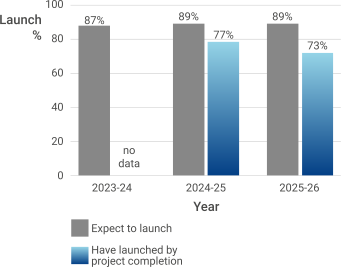
Chart note: Innovate UK Project Completion Form (PCF) and Impact Management Framework (IMF) data. The number of businesses supported, monitored, and reporting varies annually. Expectations reflect indicative outcomes rather than confirmed launches.
Performance overview: 2025-26 Key Result 12
By March 2026, we will devolve strategic funding to anchor higher education providers to support place-based economic growth in the creative industries, directing funding to freelancers, micro-companies and SMEs. New products, services, experiences and content will be supported through increased co-investment in creative R&D, improved access to infrastructure and upskilling on the use of creative technologies.
How we performed
Fully achieved: We are devolving strategic R&I funding to drive place-based growth across the creative industries. Our investments in the Birmingham-based CreaTech Frontiers and Liverpool-based MusicFutures creative industries clusters (both launched in 2025) had, by March 2026, generated £445,000 in leveraged co-investment, established 36 new partnerships and collaborations, and trained or upskilled 108 people.
As well as launching the second round of Creative Industries Clusters commissioning, AHRC and the Department for Culture, Media and Sport (DCMS) also co-hosted a workshop in November 2025 to inform policy recommendations aimed at maximising the growth potential of UK creative technology businesses.
Bohr powers ahead in green gas innovation
With support from Innovate UK, Staffordshire-based Bohr has expanded from 10 to over 60 employees across three UK sites, achieved 200% year-on-year revenue growth in its first three years, secured multimillion-pound investment, and entered European and US markets through strategic partnerships. The company is rapidly scaling with new technologies, including a zero-emission gas analyser that measures gas mixes, such as hydrogen in natural gas, without releasing harmful emissions. This low-cost, accurate solution offers a cleaner, more sustainable alternative to traditional methods, improving safety and efficiency in the UK’s transition to cleaner energy.
Guiding SoundView Media’s smart glasses vision with growth support
Smart glasses that project captions directly into a viewer’s field of vision are being developed by SoundView Media, a Plymouth-based production company, transforming cinema and TV accessibility for deaf and hard-of-hearing audiences. With support from Innovate UK Business Growth, the company has secured over £85,000 in funding, refined its person-centred design approach, and strengthened its commercial strategy. Grants from Innovate UK’s Creative Catalyst programme, the University of Plymouth, and a Catapult and Research and Technology Organisation (RTO) initiative have enabled prototype development, user testing and design improvements. The smart glasses have already been trialled in Europe’s largest immersive dome, and SoundView is now poised to expand access to inclusive entertainment across the UK.
Catalysing commercialisation and knowledge exchange to drive economic growth
Research commercialisation, knowledge exchange and translation act as critical bridges between the UK’s excellent curiosity-driven research and real-world solutions that deliver on government priorities and create and grow new businesses. By maximising the translational value of the UK’s curiosity-driven research and derisking novel technologies to leverage private sector investment, we are fostering a globally-leading R&I ecosystem and driving economic growth.
Highlights from 2025-26
Highlights include:
- investing £9 million in a new Proof of Concept programme, supporting 48 cutting-edge projects to support researchers and innovators to enhance the readiness of new products and services before attracting private investment
- agreeing a refreshed strategic direction for Research England’s Higher Education Innovation Funding (HEIF) programme, focusing on driving economic growth in line with government priorities
- simplifying our research translation and commercialisation opportunities to make our offer clearer and more consistent
Co-investment on new grants
At least £661 million of co-investment declared on new UKRI grants in 2025-26 (2024-25: £1.558 billion, 2023-24: £1.362 billion). This is the sum of the financial contribution (in cash or in kind) planned to be made by project partners to awards granted during the financial year, rounded to the nearest million pounds.
The decrease in declared co-investment from 2024-25 to 2025-26 coincides with reductions in both award volumes and total UKRI funding commitments. It is also influenced by a reporting lag. Currently there are 733 applications from our project partner co-investment data that have progressed within Innovate UK’s system towards award status, but are not yet recorded as awards in Databank, with a co-investment value of up to £240 million. These are therefore excluded from the current 2025-26 co-investment total.
Reducing flood-related costs and risks for national infrastructure and businesses
Ranked 4th in Deloitte UK’s 2025 Technology Fast 50 Awards, Previsico’s asset-level insights into flood risk and flood events are enabling clients including BT and Zurich Insurance to reduce risks and costs. A spin-out derived from UKRI-supported research at Loughborough University, Previsico uses a world-first surface water nowcasting technology that analyses hyper-local rainfall, drainage capacity and topography in real time, forecasting where surface water flooding is likely to occur. The company provides flood forecast and sensor data for National Grid Electricity Transmission (NGET) primary substation locations, increasing the resilience of the energy supply that underpins our economy and day-to-day lives.
Oxford spin-out joins Amgen’s fight against leukaemia
Amgen, the US biotechnology company, has acquired in a deal worth up to $840 billion, Dark Blue Therapeutics (DBT), a precision oncology spin-out building on fundamental science conducted at the University of Oxford’s MRC Molecular Haematology Unit. DBT’s lead investigational therapy is DBT-3757, a first-in-class small molecule designed to target and destroy the proteins that drive aggressive subtypes of acute myeloid and lymphoblastic leukaemia. UKRI funding supported the underpinning mechanistic research, generating early proof-of-concept data that helped validate the scientific approach and de-risk its translation. DBT’s rapid trajectory, from an Oxford spin-out leveraging academic partnerships to a high-value global acquisition, demonstrates the power of UKRI investments in translating UK biomedical innovation into therapies with real potential to transform patient outcomes worldwide.
Improving lives in Northern Ireland
From Belfast to Portbradden, UKRI investments across all five of our objectives are improving lives by driving inclusive economic growth and accelerating the transition to net zero. By working with businesses, universities and cultural institutions, the research and innovation we support in Northern Ireland is creating skilled jobs, reducing carbon emissions, and opening up new economic opportunities for communities.
Unlocking access to Ulster maritime heritage
A new immersive app, created through UKRI-supported research led by Ulster University and the Ulster Transport Museum, is transforming access to Northern Ireland’s maritime heritage. Launched in 2025, the Maritime Trail app uses augmented reality and audio archives to let users explore the museum’s fragile collections normally stored on site.
Through immersive digital experiences, the app is supporting local tourism by encouraging the exploration of coastal areas beyond traditional tourist spots including Lough Erne and Portbradden. Backed by Invest NI, the project team is now developing a start-up model to help museums create commercial digital heritage services and unlock long-term economic opportunities.
Turbocharging economic opportunity across Northern Ireland
£204 million was invested via Innovate UK in innovation projects in Northern Ireland from 2019-20 to 2025-26.
£96 million (47%) of the £204 million total invested was awarded to small and medium-sized enterprises (SMEs).
Businesses supported include Belfast-based Movetru, which has developed a wearable SportsTech device for real-time, on-field movement quality analysis providing data-driven insights on key performance metrics. Following support from UKRI grants and Innovate UK Business Growth’s Innovation and Growth Specialists, Movetru secured £1.2 million pre-seed investment in 2025.
Delivering zero-emission buses and jobs in Ballymena
Our investment in an academia-business Prosperity Partnership has led to the order of over 1,000 zero-emission buses across the UK and beyond, and the creation of over 500 jobs in Ballymena since 2023. Wrightbus, a Ballymena-based bus manufacturer, partnered with Queen’s University Belfast (QUB), to develop a next-generation zero-emissions urban bus system, designed to cut pollution and transform public transport. Using advanced modelling methods developed at QUB, Wrightbus became the first UK bus manufacturer to build a portfolio of zero-emission buses, supporting a further 7,500 jobs across the UK.
In April 2025, Wrightbus announced a £25 million investment to accelerate the development of next-generation electric and hydrogen vehicles and further reduce carbon emissions from transport. The manufacturer’s buses also collectively passed 50 million zero-emission miles in 2025, preventing the emission of over 85,000 tonnes of carbon dioxide compared to diesel alternatives.
Objective 4
Deliver local impact and enhance national and international collaboration, security and resilience.
Driving local innovation and benefits for UK communities
R&I-led economic growth is key to reducing regional disparities across the UK. We are strengthening R&I capability and capacity across all four UK nations, harnessing local strengths to improve lives and livelihoods. Our targeted place-based investments are designed to support innovation diffusion, strengthen skills pipelines, and help businesses scale, ensuring the benefits of R&I reach people nationwide.
Performance overview: 2025-26 Key Result 13
We will successfully complete the design of the £500 million Local Partnership Innovation Fund (LIPF) to unlock the potential of at least seven regional cluster economies, with the business case approved and the programme on track to commence in April 2026.
How we performed
Fully achieved: The LIPF supports partnerships between local government, businesses and research organisations to turn local research breakthroughs into practical solutions that improve lives. In 2025-26, we designed and launched its Earmarked element (for allocated areas with established governance including West Yorkshire, Cardiff City region and Greater London) and Competed element (a competitive route for other places outside the Earmarked element). Following HM Treasury’s approval of final business case, we confirmed that seven regions will each receive up to £20 million of investment through the fund’s Competed element (Tay Cities Region, Great South West, Oxford-Cambridge Growth Corridor, Greater Lincolnshire, South West Wales, East Midlands, and Hull and East Yorkshire and Tees Valley).
Geographical distribution of UKRI investment
All ITL1 regions and nations across the UK have seen a growth in investment between 2021-22 and 2024-25.
International Territorial Level (ITL) is a geocode standard for referencing the subdivisions of the UK. The ITL1 statistical regions correspond with the regions of England as used by the UK’s Office for National Statistics.
ITL1 regions that have historically received the highest levels of investment have experienced the smallest proportional increases. London saw an 8% increase in investment and the South East of England a 13% increase. In contrast, Wales, the North East, North West, South West, and Northern Ireland all recorded above-average proportional growth in UKRI investment in 2024-25 compared to 2021-22, with Northern Ireland being the highest (59%). Overall, London, South East England and the East of England continue to receive the highest investment per person (£211, £181, £152 respectively in 2024-25).
Percentage increase in UKRI investment from 2021-22 to 2024-25
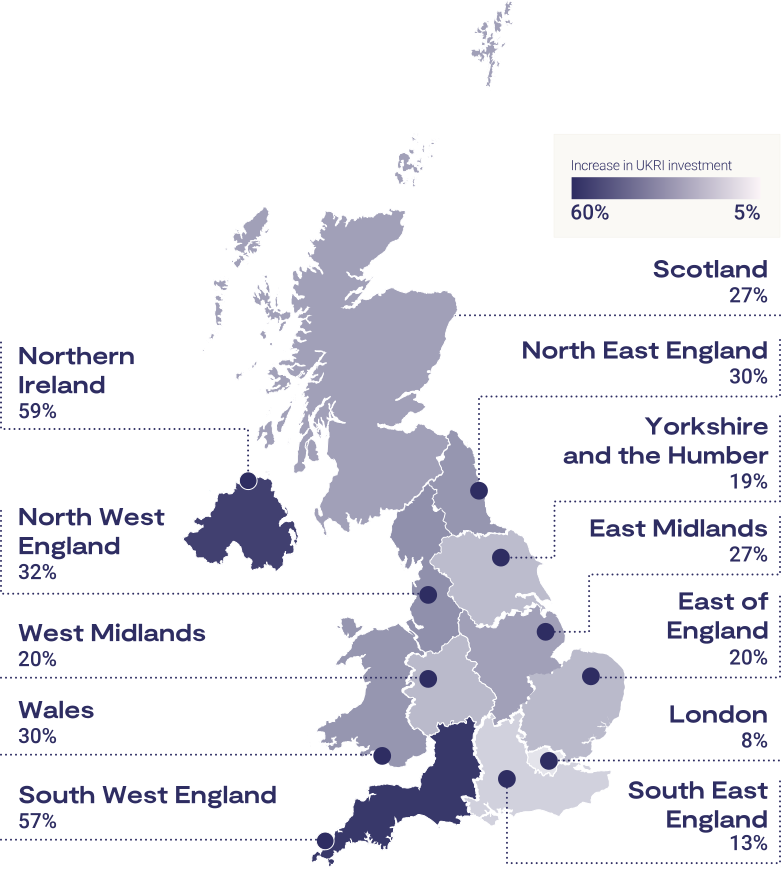
Highlights from 2025-26
Highlights include working with partners to:
- strengthen place-based commercialisation ecosystems in North East England, the Midlands, Liverpool City Region, and Greater Lincolnshire and East Anglia by investing £30 million through Research England’s University Commercialisation Ecosystems initiative
- accelerate economic growth across Scotland and Northern Ireland by publishing new Innovation Collaboration Plans co-led by Innovate UK and aimed at growing high-potential R&I sectors
Enhancing the benefits from R&I by building and enhancing regional clusters
The UK’s R&I and economic strength can be found across the country, in clusters of excellence with world-leading universities and science parks, talented people and R&I infrastructure. Our portfolio of cluster-focused investments aims to unlock the economic growth and wider benefits that stem from the clustering and agglomeration of local R&I capabilities.
Highlights from 2025-26
Highlights include:
- bringing together government, academia and industry to further accelerate quantum innovation by launching the Harwell Quantum Cluster at STFC’s Harwell Science and Innovation Campus
- accelerating the growth of three high-potential clusters in Glasgow, Greater Manchester and the Midlands by investing an additional £30 million into Innovate UK-led Innovation Accelerator programme
- strengthening our successful AHRC Creative Industries Clusters programme by launching a new £27 million investment opportunity for a second wave of clusters across the UK
Lighting the way to economic growth in Southampton
UKRI’s long-term investment in the University of Southampton’s Optoelectronics Research Centre and the CORNERSTONE Photonic Innovation Centre has helped create a strong photonics cluster in the Southampton area, generating an estimated regional GVA of £240 million. Around £47 million (around 20%) comes directly from spin-outs commercialising outcomes from UKRI-supported research, which employ over 700 people and have raised £70.5 million from major international investors. CORNERSTONE provides cost-effective prototyping and small-volume fabrication of advanced silicon photonic chips, which use light rather than electrons to process and transmit data.
Driving videogame innovation and economic growth in Dundee
InGAME, the UK’s dedicated R&D centre for videogame innovation, has driven sector growth by transforming how studios scale. Based at the University of Dundee and supported by UKRI’s Creative Industries Clusters programme, the centre upskilled 2,283 professionals and stimulated £11.5 million in industry co-investment during its first five years (September 2018-March 2024). An independent economic evaluation shows that InGAME is expected to generate £55.3 million GVA and 115 new jobs in the Tay Cities Region between 2023 and 2032, and the cluster is continuing to shape regional innovation activity, including up to £20 million of investment from the UKRI-led Local Innovation Partnerships Fund.
Positioning the UK as an international partner of choice
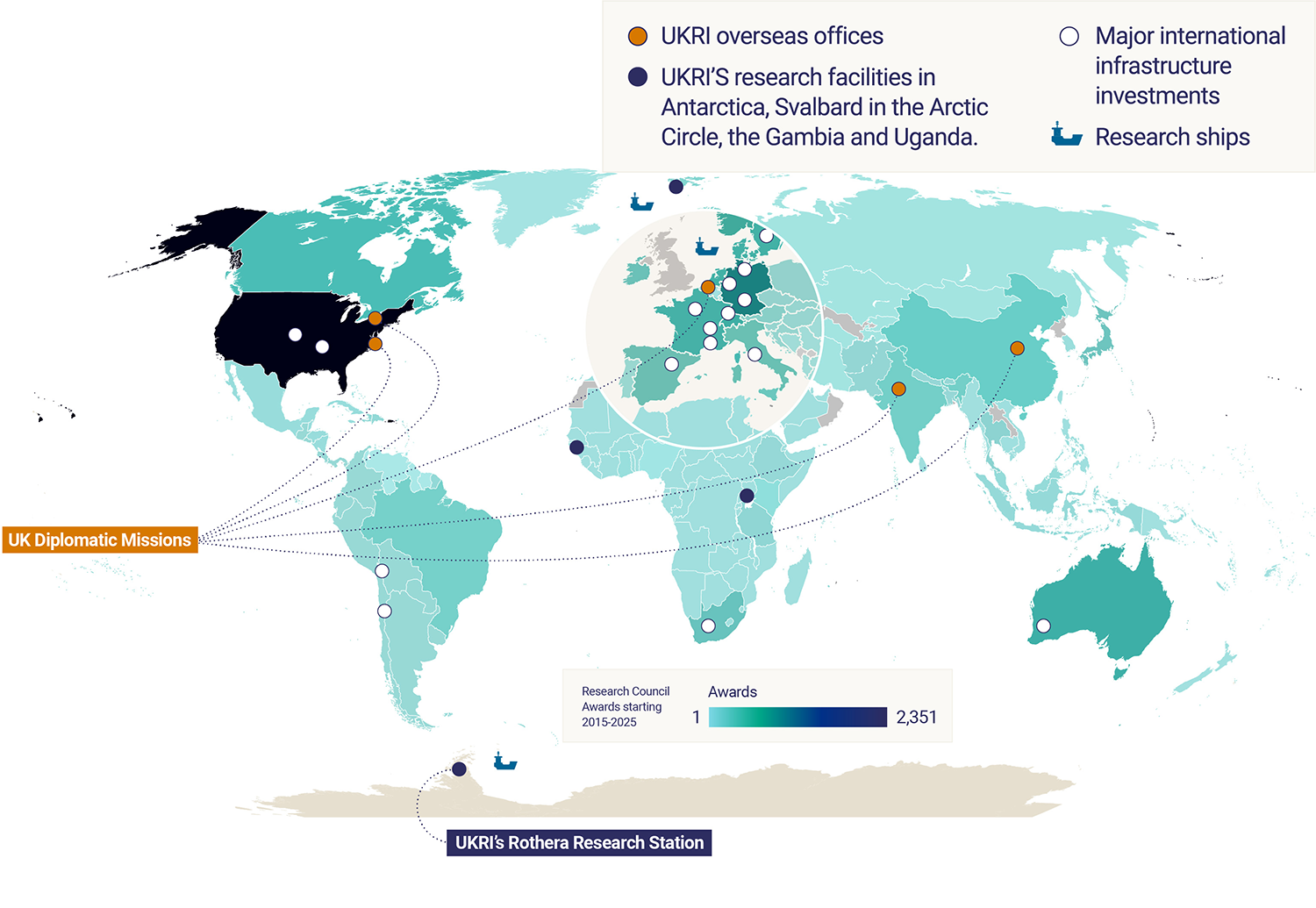
With 97% of global R&I happening outside the UK, international collaboration is essential for the UK to remain competitive. We aim to position the UK as a globally recognised R&I leader and an international R&I partner of choice for equitable and secure collaboration.
Highlights from 2025-26
Highlights include:
- launching the UK-India Connectivity and Innovation Centre (CIC) with DSIT and India’s Department of Telecommunications (DoT), aimed at transforming telecoms with AI and telecommunication cybersecurity
- advancing, via EPSRC, a £6 million UK-Japan research programme exploring advanced connectivity technologies, and a UK-Canada partnership through NERC bringing researchers together to tackle critical mineral challenges
- awarding £490 million of Horizon Europe Guarantee investments on behalf of DSIT, enabling UK researchers and innovators to continue to participate in high-quality collaborative projects
- hosting the UK-US Global Research and Innovation Impact Showcase in Washington DC, via UKRI North America, demonstrating the strength and breadth of UK-US R&I collaboration to executive leaders from the UK Embassy and US federal and non-federal stakeholders
- delivering a series of workshops via UKRI China to help shape the agenda of the 11th UK-China Joint Commission Meeting (JCM) on Science and Technology in November 2025, which reviewed progress and priorities for scientific research collaboration between the two countries
- signing an MoU with Research Ireland to deliver a range of collaborative programmes to stimulate technological innovation and economic growth, including the AHRC-led UK-Ireland Collaboration in the Creative Economy programme which will build new partnerships between researchers, industry experts and policymakers
New technology moves dark matter detection closer to reality
A UK-US collaboration has developed a world-leading cold atom source of atomic strontium, a key building block for next-generation quantum sensors. Developed by experts from STFC Rutherford Appleton Laboratory, Imperial College London and Stanford University, these advanced sensors could enable breakthroughs in detecting gravitational waves and searching for dark matter, with wider applications in navigation, communications, and Earth observation. This achievement highlights the global impact of UK-US research partnerships and was supported through the International Science Partnerships Fund and the Gordon and Betty Moore Foundation.
Enhancing national security and resilience
Highlights from 2025-26
Highlights include:
- investing up to £21 million, via Innovate UK and EPSRC, to support the integration of innovative Capability Hardware Enhanced RISC Instructions (CHERI) into the systems that power everything from critical infrastructure to consumer electronics
- welcoming 26 new projects into the ninth year of Innovate UK’s Cybersecurity Academic Startup Accelerator programme, which to date has seen
the formation of 36 start-ups securing over £43 million in further funding - partnering with Singapore’s SpeQtral and Dutch company ISISPACE via STFC RAL to launch the SpeQtre satellite in November, testing quantum communication technologies from space that are so secure that any attempt to eavesdrop is instantly detectable
Accelerating cyber security sector innovation through university collaboration
NW CyberCom (North West Cyber Security Connect for Commercialisation) has strengthened regional capability and advanced the UK’s cyber innovation ecosystem, engaging over 800 academics, generating 32 proof-of-concept proposals, and supporting three new spin-outs since December 2023. Backed by £1.2 million from Research England’s Connecting Capability Fund, it has brought together six universities and specialist partners including the National Cyber Force and GCHQ to accelerate cybersecurity innovation in North West England and support national resilience. The project’s ‘Innovators in Residence’ programme – bringing together experienced founders and cyber security leaders – has provided real-world expertise and bespoke training to accelerate the commercialisation of advanced research. In November, NW CyberCom was recognised with the Sector Collaboration Award at the 2025 Knowledge Exchange UK Awards.
Improving lives in Scotland
Our investments in Scotland, across all five of our objectives, are improving lives and fostering prosperity for communities from Dumfries to Wick. With an annual investment of £107 per person in Scotland in 2024-25, we are supporting research and innovation underpinning improvements to lives up and down the country, including the development of Glasgow-based Biosers’ award-winning FoodShield rapid listeria detection device and the following examples.
Reusable headwear improving hospital patients’ experiences across Scotland
Reusable, plant-based theatre caps are reducing NHS waste and improving patient safety at the NHS Golden Jubilee Hospital in Clydebank, with rollout planned across 14 more NHS Scotland boards.
Designed by UKRI-funded researchers at the University of Strathclyde and Heriot-Watt University, the colour-coded caps help staff identify one another quickly in busy clinical areas and reduce patient anxiety by making staff more clearly identifiable.
Around 800,000 single-use disposable theatre caps are consumed every year in Scottish hospitals. The reusable caps replace single-use Viscose caps, whose manufacturing depletes natural forests and relies on harmful chemicals associated with chronic skin and heart conditions linked to cancer.
Accelerating wireless communications through new technology
Technology stemming from UKRI-supported discovery research was identified as one of the top 25 most innovative and useful products of the year at the Las Vegas Consumer Electronics Show in January 2026. Developed by PureLiFi, an Edinburgh-based spin-out, the Bridge XC product was recognised for solving one of the most persistent problems in modern connectivity: the short but critical ‘last metre ’– the gap between the outdoor network and the indoor user. PureLiFI’s new technology uses invisible infrared light and wireless power connecting units each side of a window, allowing users to self-install gigabit broadband through any window in minutes.
Delivering economic opportunity in Scotland
We currently have 116 EPSRC-enabled active spin-out companies in Scotland, with a total turnover of approximately £1.6 billion and employing over 2400 people.
Companies based at STFC’s Higgs Centre for Innovation in Edinburgh have secured over £25 million in funding since the business incubation centre opened in 2018, creating over 150 jobs.
Over the last seven years, the Higgs Centre has incubated a total of 28 companies, with 10 currently in residence. Impressively, 26 of these companies remain active, reflecting a remarkably high 93% survival rate.
Objective 5
Develop and sustain an R&D ecosystem that supports national science capability and attracts and nurtures the best research and innovation talent.
Investing in talent and skills to build the R&I workforce the UK needs
We invest across the R&I talent pipeline to make the UK a destination of choice for talented people, teams and businesses, reducing barriers, closing skills gaps and building a world-leading innovation economy.
Performance overview: 2025-26 Key Result 14
Invest in talent to build national capability and address skills gaps. In 2025-26, support the recruitment of 5,000 doctoral students and 300 fellows, launch targeted doctoral training awards in priority areas, and improve grant terms to remove barriers to training.
How we performed
Unclassified: This is due to unforeseen delays in accessing the end-of-year data on the doctoral student target. As of January 2026, we reported 349 new fellowship starts, exceeding the target of 300. In October, we published new training grant terms to widen access to the diverse and fulfilling careers that research and innovation has to offer. We also delivered doctoral focal awards in government priority areas, including engineering biology, AI and data in the biosciences and nuclear skills, with the latter supported by £65.6 million of funding from the Ministry of Defence and the Department for Energy Security and Net Zero. In Round 9 of the Future Leaders Fellowships, we made 77 awards at a total cost of £120 million for their first four years.
Highlights from 2025-26
Highlights include:
- delivering our commitment to ensure the minimum PhD stipend provides at least the equivalent of the take home pay for the National Living Wage.
- supporting the government’s ambition to recruit highly skilled global talent by launching the new £54 million Global Talent Fund, enabling 12 UK research organisations to attract international research teams in key industrial strategy areas
- introducing a new UKRI fellowship investment framework to streamline our schemes and improve talent flow across the R&I system
Our Future Leaders Fellows
UKRI’s flagship Future Leaders Fellowships (FLF) programme empowers researchers and innovators to pursue bold ideas and groundbreaking research. It supports diverse career paths and drives innovations that can impact society and the economy.
One example of the programme’s real-world impact is the work of UKRI FLF Professor Oliver Hauser, whose research is delivering measurable global improvements in fair and inclusive recruitment. His evidence-based interventions increased the shortlisting and hiring of women and underrepresented candidates by 20 to 40% through a large-scale Randomised Control Trial, spanning over 100 countries, 12,000 job vacancies and 360,000 applicants. Oliver’s work has driven real-world change across organisations and sectors by reducing discrimination and building more diverse talent pipelines, transforming hiring systems and expanding opportunities for underrepresented groups at scale.
Performance overview: 2025-26 Key Result 15
Grow UK clinical research capacity through Future Leaders Fellowships (FLF) in 2025-26, offering protected research time, leadership development, and support to build research teams. Fellows will drive biomedical discovery and early translation toward new diagnostic and therapeutic technologies.
How we performed
Fully achieved: Clinical researchers bridge the gap between scientific discovery and better patient care. Their research prevents illness and develops new treatments connecting academia, the NHS and industry. Over the past decade though, the proportion of clinical academic consultants has nearly halved, falling to just 3% in 2022. Working with other UK R&I investors, UKRI via MRC made key contributions in 2025-26 to secure the future of clinical research careers:
Clinical Future Leaders Fellowships (FLFs): we expanded our existing Future Leaders Fellowships scheme in May 2025 to encourage more clinicians to be nominated, with other funders developing aligned approaches.
Regional Accounts for Clinical Researchers: we invested £9.7 million in a new regional programme that allows universities and NHS trusts to provide support at key career pinch points, enabling clinicians to stay research active while continuing clinical practice and developing future Clinical FLF applicants. In March 2026, we made ten awards spanning over 50 research and over 60 NHS organisations across the UK and expect these will support around 200 individuals.
Clearer options for aspiring researchers: we worked with other major funding bodies to develop a new national clinical research career map of support, giving aspiring clinical researchers a clearer view of opportunities at every career stage.
Strengthening the UK’s R&I talent pipeline
A decade of talent, innovation, and impact
Over the last ten years, AstraZeneca has supported around 100 PhD students through EPSRC’s Industrial Doctoral Landscape Awards (IDLA) and forerunner iCASE schemes, contributing at least 25% of the cost of these studentships. A recent internal review led by AstraZeneca showed that around a third of their student projects led to results that were later used in AstraZeneca’s research and development. Moreover around 30% of sponsored students were recruited into permanent roles at AstraZeneca, with over 80 AstraZeneca scientists serving as industrial student supervisors, helping them to network with UK academics and keep up with the latest research.
Attracting global talent
The Global Talent visa is the UK’s primary visa for research, attracting talented researchers to the UK to work on competitively awarded research grants from a range of UK and international funders. UKRI endorsed 3,169 individuals for Global Talent visas with application date in 2025-26, an increase of 10% from 2024-25 (2,882) and 22% from 2023-24 (2,596). This growth is partly due to strengthened engagement through enhanced communications, including best practice visa workshops held since 2024, and increased visibility from the Global Talent Fund.
Empowering our talented people to thrive
Our people are central to UKRI’s success. In 2025-26, a transitional year for the organisation, we continued to foster an inclusive culture where colleagues are empowered to grow, collaborate and innovate.
Staff wellbeing
The Wellbeing Ambassador Network is a framework of support for all UKRI colleagues. Its purpose is to drive consistency of wellbeing support across UKRI. The network creates an allyship of like-minded volunteers who want to support their colleagues and also provide them with a support mechanism and community of care.
Ambassadors receive training to fulfil roles including ‘Local Welfare Officers’, ‘Mental Health First Aiders’ and ‘Suicide First Aiders’. Over the course of 2025-26, the number of wellbeing champions has steadily risen as training has been delivered in half-day sessions to volunteers from across all of UKRI. There is now 1 ambassador for every 16 staff in UKRI (up from 1 in 25 in 2024-25).
In 2025, we also introduced the Raising Concerns project to create a single, accessible route for colleagues to speak up and strengthen resolution processes, ensuring a fair, trusted and psychologically safe working environment.
Turnover and retention
Both the rookie and talent retention rates have remained high in 2025-26. The general retention rate has increased by 3.2%, reflecting loosening labour market conditions and the work that UKRI’s HR function has undertaken to improve wellbeing, inclusion and learning and development offerings:
- rookie retention rate: 92% (92% in 2024-25)
- talent retention rate: 83% (84% in 2024-25)
- general retention rate: 89.2% (86% in 2024-25)
Rookie retention is the retention of staff with less than one year of continuous service. Talent retention is the retention of staff who were identified ‘as exceeded expectations’ in the previous performance year.
Learning and development
At a time when UKRI is navigating high levels of change and ever-evolving stakeholder expectations, our leaders have a vital role to play. Our Leadership Development Programmes have been curated to support and equip our leaders to effectively guide teams, drive innovation, solve challenges, and develop skills and mindsets to successfully lead and inspire others in a dynamic environment.
New cohorts for both our Emerging Leadership Programme (ELP) and Inspirational Leadership Programme (ILP) commenced in October 2025. The programmes have been delivered concurrently and were scheduled to conclude by June 2026.
Making UKRI the most efficient and effective organisation we can be
With 2025-26 being a transitional year, we made good progress in advancing our digital transformation, modernising funding systems, strengthening data capability, and improving culture and governance. These achievements are starting to reduce organisational complexity and improve user experience.
A major milestone was the launch of Oracle Fusion in June 2025, completing the implementation phase of UKRI’s three core enterprise systems – The Funding Service, Oracle Fusion and Databank. Together, these systems are now starting to underpin a modern, secure digital infrastructure, delivering a harmonised grant processing system, improved financial control through a secure cloud-based Enterprise Resource Planning (ERP) system, and a single repository for people, organisational and grant data. However, some finance process and data-related issues continue to affect delivery including challenges with Purchase-to-Pay processes.
We acknowledge delays in paying suppliers following the ERP launch and further configuration work will continue to address this.
Databank delivered significant outputs during 2025-26, including the ingestion of extensive historic financial transactions to establish a comprehensive longitudinal dataset, the launch of over 15 dashboards to improve access to operational and analytical insights, and establishing the DataLab – a secure analytical environment for external researchers in collaboration with the Metascience Unit. With implementation now complete, we are shifting focus from delivery to optimisation to maximise value from our investments.
To coordinate the next phase of transformation, we will prioritise the automated ingestion of Oracle Fusion data into Databank to provide timely, accurate actual spend data and enable consistent reporting across opportunity, location, subject area and mission themes. Further internal and external use of Databank data will expand, through implementation of an internal cloud-based analytical platform modelled on the DataLab and the launch of a replacement for Gateway to Research to strengthen open UKRI data publication.
While technical progress is strong, we recognise the need to accelerate development of a robust organisation-wide data operating model, as we continue to face challenges relating to the quality, accessibility and completeness of our data. Data ownership for key domains has been agreed, but stewardship maturity varies, affecting data quality assurance, lifecycle management and reporting consistency. UKRI is therefore clarifying data responsibilities in the delegation framework, introducing data contracts to strengthen supply and predictability, developing a joint data and analysis framework to improve coordination, and strengthening the stewardship community by establishing a new community of practice.
Together, these actions will improve the reliability of UKRI’s data assets, support more efficient reporting, and underpin the success of our digital programmes.
The Funding Service and Innovation Funding Service
The Funding Service application processing times for Research Councils:
- 173 days median overall, 7 days below the target of 180 days, an improvement of 23 days from 2024-25 (196 days) and 11 days above 2023-24 (162 days)
- 127 days median for targeted mode, 21 days lower than 2024-25 (148 days) while 29 days above 2023-24 (98 days)
- 194.5 days median for applicant-led mode, improved by 15.5 days compared to 2024-25 (210 days) and 5.5 days compared to 2023-24 (200 days)
Applicant-led mode opportunities welcome applications on any topic in the disciplinary portfolio. Targeted mode opportunities focus on specific R&I areas or challenges.
Innovation Funding Service application processing times for Innovate UK:
- 99.6 days overall average, 9.6 days above the target of 90 days from competition close to project live, down by 26 days from 2024-25 (125.6 days), and down by 35.7 days from 2023-24 (135.3 days)
- 37 days average from competition close date to initial decision, down by 14.1 days from 2024-25 (51 days) and down by 1.5 days from 2023-24 (38.5 days)
- 62.6 days average from initial decision to project live, down by 11.9 days from 2024-25 (74.5 days) and down by 34.2 days from 2023-24 (96.8 days)
Innovate UK’s user base, products and processes differ from the research councils.
The Funding Service (TFS) user satisfaction rates:
- 61% overall satisfaction rate in 2025-26
- 69% to 81% satisfaction across the application, review, and panel stages in 2025-26 – meeting or exceeding our 65% baseline target
Performance overview: 2025-26 Key Result 17
Improve our users’ experience of engaging with UKRI by increasing the speed of grant processing and raising the external user satisfaction rate of both the UKRI Funding Service (serving research councils) and the Innovation Funding Service (serving Innovate UK). Demonstrate, via experiments on UKRI funding opportunities, that two-month reductions in grant processing times for research councils can be achieved using novel peer review processes.
How we performed
Partly achieved: Aligning with our ambition to deliver a professional and efficient funding service, in 2025-26 we invested significant effort in improving our understanding of the factors influencing the speed at which we process applications. In the latter half of the year, we observed early signs of improvement, with the median research council grant processing time reducing by approximately 30 days. This reduction may be partly attributed to lower application volumes and therefore fewer decisions being required, but the successful scale-up of award management functionality on UKRI’s Funding Service platform is also a significant contributory factor. While overall application processing times are improving, targeted mode remains above 2023-24 levels. This is due to the transition to TFS and embedding new processes, which are expected to deliver benefits over the longer term. With continuing enhancements delivered through both our Funding Programme and funding platform optimisation programme, we are confident that these improvements will be sustained and further strengthened throughout 2026-27.
Through both programmes, we are working to improve the experience of delivery partners engaging with the UKRI Funding Service. We have established processes to measure user satisfaction across the application journey and now monitor these regularly. We are also experimenting with AI-driven analysis to generate deeper and more timely insights into user behaviours and pain points. These insights are informing the continuous improvement of the Funding Service. Our overall aim is to increase external user satisfaction with the Funding Service above the 2024-25 baseline level of 65%. While overall satisfaction stands at 61%, satisfaction trends across the application, review and panel stages remain strong, ranging from 69% to 81%, meeting or exceeding this target. However, when surveyed after receiving a funding decision, user satisfaction drops to 34%, which negatively affects the overall service rating. Satisfaction at this stage is strongly influenced by the outcome: between 67% and 80% of users receiving a positive decision report satisfaction, while satisfaction among unsuccessful applicants ranges from 19% to 25%.
In 2025-26, we also delivered a sustained reduction in the end-to-end cycle time for the Innovation Funding Service (serving Innovate UK), accelerating the journey from competition close to project launch. Recent improvements have reduced the period from competition close date to the project live stage by a further 26 days, contributing to a cumulative reduction of 73 days since 2022. This represents a material improvement in operational pace and responsiveness, enabling earlier delivery of innovation outcomes to the market.
This progress has been driven by a disciplined, continuous improvement approach across Innovate UK’s Operations team. Its Continuous Improvement Lead has worked closely with other teams to optimise ways of working, including strengthening demand forecasting by Innovation Leads through improved use of forecast data. In parallel, we have successfully designed, launched and delivered a pilot place-based recruitment campaign to grow the Innovate UK assessor community. This has increased capacity, breadth of expertise and diversity, while also addressing a key operational constraint.
In 2025-26, the UK Metascience Unit conducted experiments with novel assessment approaches, including distributed peer review, to improve assessment quality while reducing administrative burden for higher-volume opportunities. We now plan to expand these pilots to quantify their benefits and explore their wider applicability across UKRI.
Raising awareness of the value of public R&I investment through UKRI
Our 2025-26 External Affairs and Communications plan set out a clear, strategic approach to how we communicate the value of research and innovation. Through our ‘Improving Lives and Livelihoods’ framework, we introduced new ways of working in this transitional year and delivered against our priorities.
Strengthening engagement across UKRI in 2025-26, we:
- launched a new hybrid All Staff Meeting format, increasing attendance to over 3,000 per session – more than double the previous format
- co-created a new set of UKRI values with input from more than 1,200 staff, with rollout beginning in April 2026
- introduced a new senior leadership forum to strengthen alignment on UKRI-wide priorities
- delivered a programme of internal and external engagement to support our new Chief Executive, including refreshed approaches to staff and leadership interaction
Demonstrating how research and innovation improve lives and livelihoods
In 2025-26, we piloted UKRI’s first regional campaign in Swindon, home to our headquarters. ‘It Starts in Swindon’ combined advertising, partnerships and events to showcase UKRI-funded innovation in a local context . Building on this, ‘Shaped in Sheffield’ highlighted the scale and impact of research and innovation across the city, reaching audiences through high-visibility placements including public transport, city centre locations and major retail spaces.
Increasing awareness and understanding of UKRI’s role
UKRI Reputation Score: 74.0 (Strong)
UK Public Sector Average Score: 68.6
In our latest reputation survey, we remain ahead of the public sector average (data collected in November and December 2025, source: RepTrak)
Awareness of UKRI among MPs also increased to 64% in November 2025, up from 55% in October 2024. In the same month, we convened key stakeholders at our Innovation for Growth Summit held at the Science Museum, bringing together 250 senior leaders from politics, research and business.
2026 UKRI website user satisfaction survey
We are working to improve how users access information and services:
- 64% of website users reported it is easy to find what they need up 4% from 2025 and 16% from 2024
- 67% of website users reported that its information is accurate and up to date down 4% from 2025 due to content ageing and not being adequately updated but up 5% from 2024
Performance overviews
Detailed overviews of our performance in managing our budget, our risks and our environmental sustainability commitments.
Financial performance
UKRI’s expenditure is reported on two different bases in this Annual Report and Accounts:
- The Consolidated Statement of Comprehensive Net Expenditure (page 123) presents net expenditure of £9.5 billion for the UKRI Group. The expenditure is calculated following accounting standards and guidance which are explained in more detail in Note 1 to the financial statements and on a similar basis to those rules applied by organisations internationally.
- The Outturn against Budget is £9.8 billion. These figures are calculated in accordance with HM Treasury’s budgeting framework. The figures used in this Annual Report have been prepared on this basis. There is a difference between these two bases primarily due to asset additions of £233 million that are capitalised, rather than being in the Statement of Comprehensive Net Expenditure, but which have a budgetary impact.
Outturn against budget 2025-26
| UKRI 2025-26 Budget Allocation | Full Year Outturn (£ million) | Full Year Budget (£ million) | Variance to Outturn (£ million) | Variance to Outturn (%) |
|---|---|---|---|---|
| UK Research Base, of which: | 7,457.9 | 7,457.0 | -0.9 | 0.0% |
| Core research | 5,541.9 | 5,527.8 | -14.1 | -0.3% |
| Non-core research | 1,916.0 | 1,929.2 | 13.2 | 0.7% |
| R&D Other | 125.9 | 144.0 | 18.2 | 12.6% |
| Core Innovation | 937.1 | 947.9 | 10.7 | 1.1% |
| Core Capital Allocation | 8,520.9 | 8,548.9 | 28.0 | 0.3% |
| DSIT Research England (RE) Lever – QR | 182.0 | 0.0 | -182.0 | 0.0% |
| Core Innovation: DfT Zero emission HGV technologies | 0.4 | 0.0 | -0.4 | 0.0% |
| ODA | -1.9 | 0.0 | 1.9 | 0.0% |
| DSIT Managed Programmes | 299.6 | 310.6 | 11.0 | 3.5% |
| EU Programmes | 488.1 | 489.6 | 1.4 | 0.3% |
| Ringfenced Capital Allocation | 968.2 | 800.2 | -168.1 | -21.0% |
| Grand Total Capital Allocation | 9,489.2 | 9,349.1 | -140.1 | -1.5% |
| Innovation Loans | 32.4 | 18.2 | -14.2 | -78.3% |
| Other Financial Transactions | 1.4 | 0.0 | -1.4 | 0.0% |
| Ringfenced Resource Budget | 299.9 | 271.5 | -28.4 | -10.5% |
| Annually Managed Expenditure | -4.3 | 141.2 | 145.5 | 103.1% |
| Total Allocation | 9,818.5 | 9,780.0 | -38.6 | -0.4% |
The previous table provides a summary of UKRI’s outturn against budget. UKRI has a financial management target to deliver an outturn that is not overspent and no more than 1% underspent against its core capital allocation.
The previous table includes a £182 million balance, where UKRI increased expenditure by reprofiling quality-related funding payments to higher education institutions at the request of DSIT. UKRI achieved an underspend of £28 million against the Core Capital allocation. This equates to a 0.3% variance, which is consistent with prior years’ financial performance and is in line with the financial management target.
The following table sets out the outturn over the current and four prior years:
Outturn over prior years
| UKRI Allocation | 2025-26 Outturn (£ million) | 2024-25 Outturn (£ million) | 2023-24 Outturn (£ million) | 2022-23 Outturn (£ million) | 2021-22 Outturn (£ million) |
|---|---|---|---|---|---|
| UK Research Base, of which: | 7,457.9 | 7,230.8 | 7,044.9 | 6,784.0 | 6,692.9 |
| Core research | 5,541.9 | 5,315.8 | 5,213.7 | 4,902.4 | 4,871.0 |
| Non-core research | 1,916.0 | 1,915.0 | 1,831.2 | 1,881.6 | 1,821.9 |
| R&D Other | 125.9 | 525.4 | 555.0 | 485.8 | 462.2 |
| Core Innovation | 937.1 | 940.3 | 838.8 | 676.4 | 654.1 |
| Core Capital Allocation | 8,520.9 | 8,696.6 | 8,438.7 | 7,946.2 | 7,809.2 |
| DSIT Research England (RE) Lever – QR | 182.0 | 347.0 | 316.0 | 238.0 | 108.0 |
| Core Innovation: DfT Zero emission HGV technologies | 0.4 | 80.1 | 14.7 | 0.1 | 0.0 |
| ODA | -1.9 | 17.2 | 50.1 | 117.2 | 130.5 |
| DSIT Managed Programmes | 299.6 | 276.2 | 150.8 | 447.1 | 379.4 |
| EU Programmes | 488.1 | 457.0 | 359.3 | 531.1 | 5.9 |
| Ringfenced Capital Allocation | 968.2 | 1,177.5 | 890.9 | 1,333.5 | 623.8 |
| Grand Total Capital Allocation | 9,489.2 | 9,874.0 | 9,329.7 | 9,279.7 | 8,433.0 |
| Innovation Loans | 32.4 | 25.1 | 19.8 | 15.6 | 62.3 |
| Other Financial Transactions | 1.4 | 1.7 | 2.0 | 1.5 | 0.0 |
| Ringfenced Resource Budget | 299.9 | 219.5 | 250.7 | 191.7 | 193.6 |
| Annually Managed Expenditure | -4.3 | 5.8 | -29.7 | 28.2 | 132.3 |
| Total Allocation | 9,818.5 | 10,126.1 | 9,572.5 | 9,516.7 | 8,821.2 |
UK Research Base outturn has stayed broadly consistent across the five-year period. The increase of £311 million in UK Research Base in 2023-24 compared to 2022-23 was driven by core research spend, in particular a £206 million increase in International funding was largely driven by an increase in spend on institutes, centres and facilities funding, Collective Talent Funding and QR all within core Research.
The research and development (R&D) Other ringfence increased spend from 2022-23 to 2023-24, mainly driven by increases within the Technology Missions Fund, Levelling Up Programme and Faraday Institution. Spend in some R&D Other areas increased from 2023-24 to 2024-25, most notably Technology Missions Fund (£140 million spend increase) and Innovation Accelerators (£31 million spend increase). The Industrial Strategy Challenge Fund spend has reduced as the fund ended at the end of 2024-25. 2025-26 R&D Other outturn decreased by £400 million due to the conclusion of the Industrial Strategy Challenge Fund, Faraday Challenge and the Technology Missions Fund (collectively a £376 million spend decrease).
In Spending Review 2021, our Core Innovation budget received a significant, specific uplift in funding; it was expected that Core Innovation spend would be £2.4 billion between 2022-23 and 2024-25. Actual spend across this period came to £2.5 billion, with spend between 2023-24 and 2024-25 increasing by £102 million due to the introduction of funding in areas such as Net Zero, Health and Digital. 2025-26 Core innovation spend has remained broadly in line with 2024-25 at £937 million.
Part of Core Innovation, Department for Transport (DfT) Zero emission heavy goods vehicle (HGV) technologies is strictly ringfenced and is reported separately. Spend in this area has increased year-on-year during the SR period as planned. For 2025-26, spend against this allocation heading has changed to an invoicing arrangement so minimal spend has been reported and no allocation received.
Legacy Official Development Assistance (ODA) Global Challenges Research Fund (GCRF) and Newton programme expenditure has decreased through the SR period. Throughout 2025-26 UKRI continued to support existing projects to their conclusion.
The new ODA mechanism replacing Legacy Official Development Assistance (ODA) to support international research partnerships is the International Science Partnerships Fund (ISPF1) which is a blend of ODA and non-ODA funding and sits within the DSIT Managed Programmes ringfence. 2025-26 ISPF1 Non-ODA spend totalled £40.4 million against a full-year budget of £44 million, while ISPF1 ODA spend reached £81.2 million against a budget of £86 million, which includes DSIT IRI-PMO costs from April to July and also Research England ISPF Institutional Support Awards.
Managed Programmes outturn decreased from 2022-23 to 2023-24 as a result of the Department for Business, Energy and Industrial Strategy (BEIS) being split into three new Departments. The Department for Science, Innovation and Technology (DSIT) has continued the majority of UKRI’s funding, but this has resulted in the cost of most programmes managed by Department for Business and Trade (DBT) and DSIT to move to an invoicing arrangement, rather than UKRI receiving a budget allocation. £64 million of the DSIT Managed Programme spend in 2023-24 was in relation to new funding for AI Research Resource (AIRR). The overall DSIT Managed Programmes spend increased in 2024-25, with AIRR spend increasing to £137 million. In 2025-26, Managed Programmes outturn increased to £300 million due to the launch of the AI Safety Institute (AISI) partnership, additional funding for Our Future Health, and completion of AIRR phase one.
UK association to the Horizon Europe programme was granted in September 2023. Association means that UK organisations are able to bid into Horizon Europe, certain that all successful UK applicants will be covered for the remainder of the programme either through the UK’s association, or through the UK guarantee which is being delivered by UKRI. In 2023-24, UKRI increased its spend under the Horizon Europe Guarantee to £291 million, due to the significant increase in the onboarding of grants from Horizon Europe. This increased again in 2024-25 to £440.5 million, and again in 2025-26 to £488.1 million. The EU Programmes heading also previously included spend for Copernicus, which stayed broadly consistent across 2023-24 and 2024-25; this programme ended in 2025-26.
In addition, Innovate UK loans expenditure increased from 2022-23 to 2024-25 and again in 2025-26 due to an increased portfolio. The Innovation Loans variance of £14.2 million represents solely the drawdown of new loans but excludes capital repayments. Capital repayments of £11 million are shown under the Ringfenced Resource Budget line. Offsetting the overspend in Innovation Loans with the loans repayment line would present a net overspend position of £4.8 million.
Full details on changes in UKRI’s Consolidated Statement of Financial Position in 2025-26 is contained in the Financial Statements and notes to the accounts. Explanations for year-on-year variances in balances can be found in the notes to the financial statements.
Our investments in 2025-26
Investments include:
- £1,603 million (18%) in our rolling portfolio of research and development grants, including fully open funding opportunities and strategically targeted opportunities focused on specific priorities (£1,633 million in 2024-25)
- £2,240 million (25%) strategic institutional funding to higher education providers in England for research and knowledge exchange (£2,131 million in 2024-25)
- £741 million (8%) in dedicated skills and talent investments for the next generation of researchers, innovators and technicians, noting that almost all our investments involve significant people and skills development (£696 million in 2024-25)
- £1,163 million (13%) in infrastructure, from laboratory equipment to major international research facilities (£1,146 million in 2024-25*)
- £1,388 million (16%) towards specialist institutes, centres, facilities and Catapults that provide national capabilities in specific R&I areas, including specialist equipment, expertise and knowledge (£1,354 million in 2024-25*)
- £144 million (2%) in collaborative challenge-led funding to address specific national and global priorities (£443 million in 2024-25)
- £796 million (9%) in innovation project grants that support innovative small and medium-sized enterprises (SMEs) (£940 million in 2024-25)
- £753 million (9%) in international partnerships funding to enable specific opportunities for UK researchers to collaborate with their peers globally (£740 million in 2024-25)
- In addition, we also invested £12 million (less than 1%) in public engagement activities to involve wider society in R&I, ensure that its benefits are widely shared, and inspire and engage the next generation of researchers and innovators (£12 million in 2024-25)
For details of our £9.5 billion total capital allocation, please see the Financial Performance section. More information on our R&I investment portfolio is available through our explainer series: UKRI explainers.
Note: the 2024-25 infrastructure investment and institutes, centres, facilities and Catapults figures have been updated since their publication in the 2024-25 Annual Report and Accounts.
UKRI councils’ and programmes investments in 2025-26
Investments include:
- Research England: £2,044.8 million
- Infrastructure: £1,163.1 million
- Innovate UK: £916.5 million
- Collective Talent Funding: £741.8 million
- EPSRC: £683.7 million
- STFC: £629 million
- MRC: £621.2 million
- BBSRC: £328.6 million
- NERC: £322.6 million
- Existing cross-UKRI Strategic Programmes: £295.2 million
- Centrally Managed Funding: £164.4 million
- ESRC: £134.7 million
- New cross-UKRI Strategic Programmes: £216.2 million
- AHRC: £76.8 million
- Cross Council Cluster: £51.5 million
- Existing time-limited commitments: £46.7 million
- UKRI Collectively Managed Allocation: £50 million
- UKRI Corp Hub: £34.3 million
The financial year 2025-26 represents Phase 1 of the Spending Review 2025 settlement.
All figures exclude funding for ODA, DSIT Managed Programmes, Annually Managed Expenditure (AME), Expected Credit Losses and Innovation Loans interest, Provisions, Resource Non-Cash Departmental Expenditure Limit (RDEL), DSIT Research England (RE) Lever, and Horizon and Innovation Loans.
Please note that the outturn data in this table is actual, audited spend which has been mapped as far as possible to headings that are consistent with other UKRI publications. However, there will be some differences in how some spend lines have been mapped between headings in this document and previously published documents. Please also be aware that UKRI’s budgets change throughout any given year due to a combination of day-to-day financial management, including the reprofiling of budgets between years and the adjustment of budgets between programme lines in-year.
During 2025-26 UKRI also received some additional allocations from DSIT to deliver on priorities. If comparing the figures in this document with other documents, any lower numbers will be due to slippage or mapping changes and will not impact on total investment across multi-year programmes.
Our website includes more information about how we manage our budget and what we have funded.
Risk management overview
Risk management framework
UKRI operates a risk management framework that is embedded across the organisation to ensure that risks are identified, assessed and managed at the optimum levels, ensuring effective deployment of resources, that appropriate oversight and escalation routes are in place. Our risk management framework is owned by the CEO and championed by our CFO. Assessment of the performance of UKRI risk management is undertaken through the annual Executive Accountability Exercise, risk maturity assessments, analysis of performance against the principles of the Orange Book and internal audit.
Our principal risk approach includes assessment through four lenses: Delivery of Intended Strategic Impact; Major External Challenges; Internal Control Framework; Organisational Capabilities. This approach supports analysis and understanding of the links and interdependencies between our principal risks as well as providing the foundations for our golden thread assessment of aggregated risk. Principal risk deep dives are undertaken under thematic governance areas and reported to the UKRI Executive Committee on a rolling schedule to evaluate external and internal risk factors and influences, the effectiveness of current mitigations, and the impact on risk levels of actions to further reduce risk.
Data and information management
Data and information management includes:
- delivery of intended strategic impact: achieving intended impact of UKRI, inform or respond to policy landscape
- major external challenges: financial resilience of the research system, trusted research and innovation, environmental sustainability
- internal control framework: major gap or failure in internal control environment
- organisational capabilities: HR and people-related strategic objectives, organisational change, systems and IT infrastructure
During 2025-26, we continued to evolve our risk management activity through continuous improvement. This included embedding the refreshed annual Executive Accountability Exercise in alignment with the risk management framework, supported by a robust second-line evidence review; increasing the depth of second-line evaluation of principal risk deep dives; and refreshing all top-level risk registers across the organisation to improve consistency. UKRI operates a clear line-of-sight approach, linking principal and top-level risks at enterprise level through to operational and project/programme risk across the organisation.
Risk appetite
We recognise as an organisation that we must take risks to achieve our objectives, and to inform this we have a risk appetite statement that sets the boundaries for risk taking. The Risk Appetite Statement was refreshed in 2025 to simplify the approach to risk appetite types and levels while also providing more in-depth guidance and support to practically use risk appetite to inform decision-making. The Risk Appetite Statement is approved by UKRI Board and enables the effective identification and assessment of risks to evaluate a mitigation plan.
Our risk appetite statement has five levels: averse, minimalist, balanced, open and bold. Risk appetite categories are applied to each level to reflect the level of appetite that is appropriate for the activity. A defined review cycle is in place to ensure risk appetite remains responsive to evolving internal and external requirements by evaluating the optimal levels of risk the organisation is willing to take in pursuit of its objectives. The Risk Appetite Statement will be reviewed in the autumn of 2026 to ensure it remains aligned with the organisation’s strategic direction as it continues to transform.
Principal risks
UKRI defines risk as an uncertain event or set of circumstances, that should it occur will have an impact on the achievement of objectives.
There are 22 UKRI principal risks which are overseen by the Audit and Risk Assurance Committee (ARAC), with ownership and management by UKRI Executive Committee. Ten of these risks are identified as Board-level risks.
A summary of Board-level risks are set out in the following.
Supporting a sustainable and resilient research system (ID: R-1930)
Principal risk quadrant: Cross quadrant risk
Applicable risk appetite: Partnerships – Open
Residual: Very high (16)
Risk appetite: Not within appetite
Scoring trend: No change
Scoring trajectory: Potential for risk increase during 2026-27, scoring expected to reduce in quarter 4 of 2026-27
Key actions: Implementing measures that improve cost recovery on research activity and contributing to longer-term resilience of the system through driving towards greater specialisation and collaboration, as laid out in the Government’s Post-16 Skills White Paper
Managing UKRI’s strategic direction to achieve UKRI’s intended impact (ID: R-2802)
Principal risk quadrant: Delivery of intended strategic impact
Applicable risk appetite: Strategic – Bold
Residual: High (12)
Risk appetite: Within appetite
Scoring trend: No change
Scoring trajectory: Ongoing management of this risk is expected to keep scoring within appetite, enabling well-managed risk taking to achieve strategic impact
Key actions: Developing our new Strategy, outlining clear objectives and delivery planning, shaped around our mission. This is supported by a refreshed governance framework to improve dynamic prioritisation
Failure to influence and respond to changes in the policy landscape (ID: R-1756)
Principal risk quadrant: Major external challenges
Applicable risk appetite: Strategic – Bold
Residual: High (12)
Risk appetite: Within appetite
Scoring trend: No change
Scoring trajectory: Ongoing management of this risk is expected to keep scoring within appetite, with alignment between strategic ambition, investment prioritisation and delivery
Key actions: Strengthening the use of data and evidence to support prioritisation, track outcomes and demonstrate value for money
Failure to deliver against UKRI environmental sustainability and Greening government commitments (ID: R-0024)
Principal risk quadrant: Major external challenges
Applicable risk appetite: Strategic – Bold
Residual: High (12)
Risk appetite: Within appetite
Scoring trend: No change
Scoring trajectory: Potential for risk increase during 2026-27, moving the risk outside appetite, following the strengthening of Greening Government Commitments (GGC) targets
Key actions: Delivery of the refreshed UKRI Environmental Sustainability Strategy 2025-30, with clear deliverables and a costed action plan. The restructuring of UKRI governance is supporting the delivery of this action plan through clear delegation, authority and oversight
Trusted Research and Innovation (ID: R-0028)
Principal risk quadrant: Major external challenges
Applicable risk appetite: Research security – Balanced
Residual: Very high (15)
Risk appetite: Not within appetite
Scoring trend: Increased
Scoring trajectory: Strengthened mitigations are expected to reduce the risk, however risk scoring will be influenced by volatile external pressures
Key actions: Improving the quality and availability of UKRI data through the use of TR&I questions for applicants to complete within our funding systems, and conducting prioritised baseline assessments of research security within UKRI’s wholly owned and external centres, institutes and units
Major gap or failure in our internal control environment (ID: R-2146)
Principal risk quadrant: Internal control framework
Applicable risk appetite: Legal and regulatory – Averse
Residual: Medium (6)
Risk appetite: Not within appetite
Scoring trend: Decreased
Scoring trajectory: Potential for risk increase during 2026-27, scoring expected to reduce at the end of the year
Key actions: Continue to monitor and test control frameworks robustly, conducting horizon-scanning activities and evaluating our preparedness and response agility
Failure to deliver the benefits of UKRI’s Organisational Change portfolio (ID: R-1794)
Principal risk quadrant: Organisational capabilities
Applicable risk appetite: Operational – Balanced
Residual: Very high (15)
Risk appetite: Not within appetite
Scoring trend: No change
Scoring trajectory: Risk reduction is expected to begin in Q4 of 2026-27
Key actions: Further strengthening strategic change for the organisation to maximise the opportunities to realise benefits for our investments in the organisation’s capabilities
Failure to deliver HR and people related strategic objectives (ID: R-0020)
Principal risk quadrant: Organisational capabilities
Applicable risk appetite: People – Balanced
Residual: Very high (16)
Risk appetite: Not within appetite
Scoring trend: No change
Scoring trajectory: Risk reduction is expected to begin in Q4 of 2026-27
Key actions: Delivery of the new UKRI People Strategy and supporting Delivery Plan to optimise the way we work, supporting UKRI in attracting, developing and enabling exceptional talent to deliver UKRI’s mission
Effectiveness of UKRI Systems and IT Infrastructure (ID: R-2771)
Principal risk quadrant: Organisational capabilities
Applicable risk appetite: Operational – Balanced
Residual: High (12)
Risk appetite: Not within appetite
Scoring trend: No change
Scoring trajectory: Risk reduction will be reassessed in Q3 of 2026-27 following a full review of the landscape
Key actions: Undertaking a strategic review of our IT landscape that will provide outcomes to determine actions to further reduce the residual risk, while also ensuring that risk factors in the evolving external landscape, including cyber security threats, are robustly assessed and mitigated
Data and Information Management (ID: R-1640)
Principal risk quadrant: Cross quadrant risk
Applicable risk appetite: Information management – Balanced
Residual: High (12)
Risk appetite: Not within appetite
Scoring trend: No change
Scoring trajectory: Risk reduction is expected to begin in Q3 of 2026-27
Key actions: A refresh of the UKRI Data Strategy to set a clear strategic direction and ensure continued alignment with organisational priorities. Continuing to build data capability and literacy through our community of practice, deploy AI enabled auto classification to improve portfolio analysis and reviewer selection, and continued development of data warehouse integration
Environmental sustainability report
Introduction
UKRI continues its commitment to environmental sustainability. In 2025 we published a refreshed Environmental Sustainability Strategy for 2025 to 2030, which sets out our ambitions to further reduce our environmental impact while supporting world-class research and innovation (R&I). The refreshed strategy builds on our first strategy, launched in 2020, that led to a 33% reduction in our greenhouse gas emissions. We recognise that emissions reductions will become increasingly challenging in future, as the opportunities for emissions reductions become more complex.
This environmental sustainability performance section of the annual report highlights our progress in the areas that are of strategic importance to UKRI, as well as in the areas that are material in terms of our carbon and environmental footprint. The report covers the full breadth of UKRI’s UK operations, research vessels and our overseas estate.
For completeness and transparency, UKRI’s performance against the Greening Government Commitments (GGCs) – which only includes our domestic operations – is also included in discrete tables. As the GGCs for 2025-2030 have not been published at the time of writing, our performance is evaluated relative to the 2024-25 financial year.
In 2025-26 we:
- achieved a 42% reduction in greenhouse gas emissions since 2017-18
- installed 892kWp of solar panels across 4 sites since March 2025
- piloted a new approach to sustainable procurement
- reduced total waste generated and diverted 99.9% from landfill
- zero emission vehicles now make up 57% of our car and van fleet
Sustainable Development Goals
The action UKRI has taken to minimise the environmental impact of our operations, supports several of the UN Sustainable Development Goals (SDGs), including but not limited to:
SDG9.4: Industry, Innovation & Infrastructure – ‘By 2030, upgrade infrastructure and retrofit industries to make them sustainable, with increased resource-use efficiency and greater adoption of clean and environmentally sound technologies and industrial processes, with all countries taking action in accordance with their respective capabilities’.
SDG13.2: Climate Action – ‘Integrate climate change measures into policy and planning’.
SDG17.17: Partnerships for the Goals – ‘Encourage and promote effective public, public-private and civil society partnerships, building on the experience and resourcing strategies of partnerships’.
Task Force on Climate-related Financial Disclosure
Compliance statement
UKRI has been consistent, as far as is currently possible, with HM Treasury’s (HMT) guidance on the Task Force on Climate-related Financial Disclosures (TCFD). We are fully compliant on governance and partially compliant on risk management, strategy, and metrics and targets. Due to the scale and complexity of UKRI, work is still ongoing to fully embed the capture and reporting of climate-related risks into UKRI’s risk processes. Further details of our work to identify climate-related risks and design bespoke metrics and targets is described below. This is in line with HMT’s TCFD phase 3 implementation timetable.
Governance
UKRI’s corporate governance for environmental sustainability activities has been established to enable effective programme management, organisational change and direct access to senior leadership to drive the delivery of the strategy. We recognise that climate change and wider environmental impacts are of critical concern to our operations, research, infrastructure, finance, health and safety, business continuity and our funded activities.
Board and Committee responsibilities
UKRI’s ambition is to include environmental sustainability in all aspects of our work and decision-making. As such, all boards and committees are required to include this in their respective activities, including the Audit and Risk Assurance Committee (ARAC) and Board Investment Committee (BIC). All executive papers have a mandated environmental sustainability considerations element included. UKRI’s Executive Committee (ExCo) is responsible for delivery of our Environmental Sustainability Strategy, and reports to UKRI Board which has oversight, while the new Operations and Estates Committee (OEC) has direct responsibility for the Environmental Sustainability Programme. The OEC receives quarterly metrics to monitor progress. Governance, Risk and Assurance Review Committee (GRARC) has the responsibility for oversight of climate-related risks. Further details of the UKRI Board and Committees can be found in the Governance section of this Annual Report.
Management-level responsibilities
Our CEO, as chair of ExCo, is accountable for the delivery of the UKRI Environmental Sustainability Strategy, and the CFO is responsible for climate-related financial disclosures and risk, overseeing where climate-related risks could affect strategy, finance and operations. The Senior Responsible Owner (SRO) for the Environmental Sustainability Programme is the Executive Chair for NERC. UKRI Executive Chairs of each council have responsibility for implementation of environmental sustainability in all aspects of their respective operations within their councils, supported by the UKRI Environmental Sustainability Programme team.
Risk management processes
Climate change and decarbonisation is captured in the UKRI risk register at council level and within a board-level principal risk on environmental sustainability, which was updated with the 2025-2030 Environmental Sustainability Strategy to include operational preparedness and resilience in relation to climate change. Further details of the environmental sustainability and climate principal risk are included in the risk section of this annual report under ‘risks and mitigating action’. Climate-related risks are reviewed regularly, with oversight by GRARC and ARAC, recognising that this is a dynamic landscape that will change over time.
Climate-related risk strategy
In 2025 we commissioned experts to draw on climate models and create a UKRI-wide report and accompanying tool on climate scenarios and climate-related risks. The report concluded that the changing climate will have a material impact on UKRI operations and the research it funds, particularly as the environment in Europe and Antarctica, where UKRI is primarily active, is changing at above the mean global average. The report highlighted that our risk assessment will need to adjust for this new environment to ensure prudent measures are taken due to emerging climate-related hazards.
During 2025-26, extensive internal workshops and consultation on climate-related risks were undertaken, drawing on the commissioned climate scenario report. This report, which draws on UKCP18 climate projections and models near term, mid-century and end of century (1.5°C, 2°C and 4°C) warming scenarios, has been invaluable in informing climate-related risks. We recognise that while these climate projections simulate plausible scenarios, the models contain some uncertainties owing to the complexity of the interconnected systems being assessed.
Following these workshops, we have started to develop a formal process that will improve our ability to identify and manage climate-related risks. We have generated a list of aggregate climate-related risks relevant to our operations and to our funded investments, but work is ongoing to establish materiality and further develop these risks. During 2026-27 we will be working across UKRI, drawing on the list of aggregate risks to identify and thematically link climate-related risks within our enterprise risk and information management system. Once this process matures, we will be able to utilise the data in the system to design bespoke metrics and targets on climate-related risks that we will provide to GRARC alongside environmental sustainability performance data. During 2026-27 we will also draw on the identified climate-related risks and work with stakeholders to start to estimate our financial exposure, to assist financial planning.
Metrics and targets
Our Environmental Sustainability Strategy for 2025 to 2030 set outs UKRI’s environmental sustainability ambitions across five key areas, including further information on our decarbonisation plans and short- and long-term emissions targets for our (global) operations. We also follow the Greening Government Commitments (GGCs) framework in setting targets for our UK operations. Our progress delivering our environmental sustainability ambitions and emissions targets, is included in the Environmental Sustainability Performance section of this report, with information relevant to the GGCs included in standalone tables.
The methods used to calculate our greenhouse gas (GHG) emissions footprint are in accordance with the GHG Protocol. In our strategy we have set a target of reaching net zero emissions for our operations by 2050, with an interim target to halve our emissions by 2030, compared to a 2017-18 baseline (see Figure 1). We have established that our scope 3 supply chain emissions for UKRI-owned and operated research facilities are material and estimated our 2021-22 emissions, though we recognise the limitations of such estimates which rely on spend-emission factors. We have also established that the emissions from our scope 3 emissions associated with our portfolio of funding to the R&I sector (categorised by GHG Protocol as ‘investments’) are material but, due to the complexity and scale, they are challenging to calculate. During 2025-26 we have been working with colleagues across the R&I sector to develop resources that will help funding recipients calculate the footprint of research at multiple levels, and we hope these in time will improve investment-related emissions assessments.
As noted above, over the coming year we will continue to develop bespoke metrics and targets, which will draw on our risk management systems for use in assessing our climate-related risks and opportunities. We are also developing a new data dashboard to improve quarterly reporting to OEC and GRARC which will include metrics on our progress to deliver our environmental sustainability strategy, our carbon emissions targets and our progress against the GGC targets.
Environmental sustainability performance
Demonstrating organisational leadership
UKRI recognises its responsibility to demonstrate visible and credible environmental leadership in the wider R&I sector. In 2025-26 we made progress in this area. Our refreshed Environmental Sustainability Strategy included a renewed commitment to this; we continued support of the Concordat for the Environmental Sustainability of R&I practice, including leading the development and publication of the Concordat Landscape Report. Also working with the international research community, we developed and launched a pilot of an online platform, SPARKHub, which will host practical resources for the R&I community to improve the sustainability of their research.
Reducing our greenhouse gas emissions and the environmental impact of our infrastructure
Reducing our greenhouse gas emissions
In 2025-26 we made progress toward achieving our net zero target, reducing our emissions by 42% compared to the 2017-18 baseline year, and by 14% compared to 2024-25 (see Figure 1). This annual reduction is a combination of emissions savings from UK electricity grid decarbonisation (~4,700 tCO2e) and targeted action to decarbonise our estate and operations. As an example of the latter, in 2025-26 we increased the use of sustainable fuels in our research ships, leading to savings of nearly 9,000 tCO2e compared to using marine gas oil, and developed and trialled a new mapping system, PolarRoute, which helps plan the most fuel- and time-efficient routes for polar navigation. In addition to this, we reduced consumption of natural gas by 5%, emissions from business travel by 31% and increased our generation of renewable electricity by 34%, compared to 2024-25. The achieved reduction means our emissions remain below the linear trajectory required to meet our net zero and 50% emissions targets; however, we recognise that emissions reductions will become increasingly challenging in future as the opportunities for emissions reductions become more complex.
Figure 1: UKRI’s annual greenhouse gas emissions from UK and overseas operations
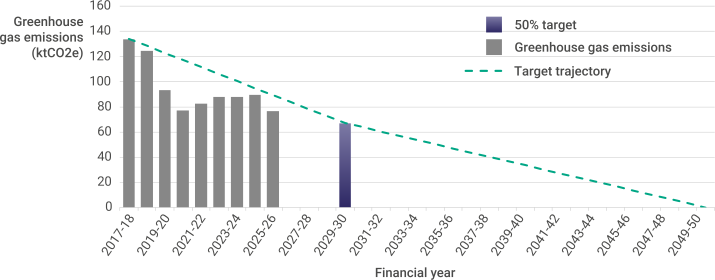
Figure note: UKRI’s annual greenhouse gas emissions from UK and overseas operations, shown relative to the trajectory required to meet our targets to reduce emissions by 50% by 2030 and to reach net zero by 2050. This figure includes scopes 1, 2 and 3 (Business travel and Transmission and Distribution losses) emissions from UKRI’s UK and overseas operations, including research vessels.
Emissions reduction case studies
During 2025-26, STFC’s ISIS facility has reduced carbon emissions by over 160tCO2e per year through a range of interventions, including upgrades to the synchrotron system to reduce electricity consumption, and improvements to the helium recovery system that reduce the energy required for reliquefication.
The British Antarctic Survey’s Discovery Building at Rothera, Antarctica, has achieved BREEAM Outstanding accreditation. The building, which opened in 2025, is on track to reduce Rothera’s carbon emissions by 22%. The building uses combined heat and power generators (that recover waste) to warm the building, has insulated external wall panels to improve heat retention, and has over 80 solar panels installed.
Emissions from business travel accounted for approximately 5% of UKRI’s total emissions in 2025-26, with approximately 75% related to international and overseas travel. In 2025-26, UKRI emitted 4,120 tCO2e and travelled 57.7 million kilometres on business travel. This represents a 37% reduction in emissions compared to the 2017-18 baseline year, and a 17% reduction in the distance travelled.
2025-26 is also the first year since the COVID-19 pandemic (2020-21) that both the emissions related to travel, and the distance travelled, decreased compared to the previous year – 31% and 2% respectively (see Figure 2). Much of the emissions reduction is the result of a decrease in the carbon intensity assigned to air travel by government; however, a reduction in the distances travelled on short-, long-haul and non-economy class flights have also contributed, and suggests progress is being made in this area. We aim to build on this reduction in future.
For a breakdown of our GGC-scope emissions, please refer to Tables 1a to e in the section ‘GGC Performance – reducing our domestic emissions’.
Figure 2: annual greenhouse gas emissions from domestic and international business travel
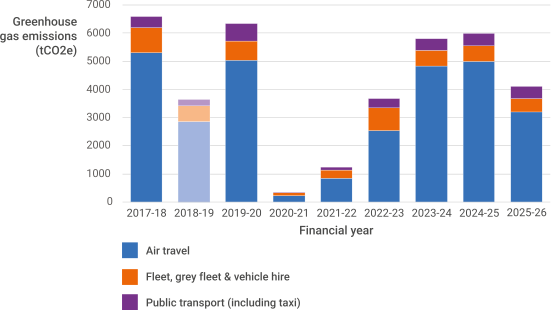
Figure note: annual greenhouse gas emissions from domestic and international business travel, shown by travel mode. Note that some business travel data for research councils is not available for 2018-19 due to incomplete records.
GGC performance – reducing our domestic emissions
This section provides a breakdown of UKRI’s GGC-scope emissions, related energy use and expenditure. The figures shown differ from those discussed in the main text, and shown in Figures 1 and 2, as they only include emissions from UKRI’s UK operations and business travel within the UK.
UKRI’s ‘Direct’ GGC-scope emissions (Table 1a, excluding ‘Owned transport’) have reduced 7% since 2024-25.
UKRI’s ‘Overall’ GGC-scope emissions (Tables 1a-c) have reduced 13% since 2024-25.
Table 1a. Scope 1 domestic greenhouse gas emissions (ktCO2e)
| Domestic greenhouse gas emissions | 2022-23 | 2023-24 | 2024-25 | 2025-26 |
|---|---|---|---|---|
| Fuel combustion | 11.00 | 9.60 | 10.80 | 10.30 |
| Owned transport | 0.03 | 0.04 | 0.04 | 0.05 |
| Fugitive emissions | 0.20 | 0.70 | 0.50 | 0.20 |
| Total | 11.30 | 10.30 | 11.30 | 10.50 |
Table 1b. Scope 2 domestic greenhouse gas emissions (ktCO2e)
| Domestic greenhouse gas emissions | 2022-23 | 2023-24 | 2024-25 | 2025-26 |
|---|---|---|---|---|
| Electricity | 28.7 | 33.5 | 33.7 | 28.1 |
| District heat & steam | 0.0 | 0.1 | 0.3 | 0.4 |
| Total | 28.7 | 33.6 | 33.9 | 28.5 |
Table 1c. Scope 3 domestic greenhouse gas emissions (ktCO2e)
| Domestic greenhouse gas emissions | 2022-23 | 2023-24 | 2024-25 | 2025-26 |
|---|---|---|---|---|
| Business travel (UK-only) | 1.1 | 1.1 | 1.1 | 1.0 |
| Transmission & distribution losses | 2.6 | 2.9 | 3.0 | 3.0 |
| Total | 3.8 | 4.0 | 4.1 | 3.9 |
Table note: the totals shown were calculated prior to rounding, as a result, some totals may differ from the sum of the rounded figures published in tables 1a to c.
Table 1d. Related energy consumption (GWh)
| Related energy consumption | 2022-23 | 2023-24 | 2024-25 | 2025-26 |
|---|---|---|---|---|
| Electricity (standard grid) | 108.1 | 123.2 | 143.4 | 140.3 |
| Electricity (green tariff) | 40.6 | 38.6 | 19.3 | 18.5 |
| Renewable electricity, generated onsite | 4.7 | 4.6 | 4.7 | 6.4 |
| Gas | 60.1 | 52.3 | 58.8 | 55.8 |
| LPG | 0.0 | 0.0 | 0.003 | 0.0 |
| Heat | 0.002 | 0.8 | 1.4 | 2.0 |
| Other | 0.3 | 0.3 | 0.2 | 0.3 |
Table notes: Electricity (green tariff) includes 100% renewable and zero carbon tariffs. Heat is purchased district heating.
Purchased district heating
Table 1e. Related expenditure (£m)
| Related expenditure | 2022-23 | 2023-24 | 2024-25 | 2025-26 |
|---|---|---|---|---|
| Expenditure on energy | 33.1 | 43.6 | 50.1 | 45.0 |
| Expenditure on accredited offsets | 0.0 | 0.0 | 0.0 | 0.0 |
| Expenditure on business travel (UK and overseas) | 5.3 | 7.5 | 7.9 | 8.6 |
Table note: UKRI does not purchase carbon offsets in line with the UKRI Position Statement on Carbon Offsetting.
Delivering sustainable digital research infrastructure
Use of Digital Research Infrastructure (DRI) is resource-intensive, can have a large environmental impact, and with trends towards greater use of AI and the speed and scale of data processing, its use is predicted to increase. As such, UKRI is taking steps to better understand and address the environmental impact of the DRI we use. Internally, three UKRI teams have achieved the GreenDISC Bronze standard, and externally, we have continued to support the Network for sustainable Digital Research Infrastructure Vision and Expertise (NetDRIVE) project, which targets sustainable working practices in the DRI communities. In 2025-26, NetDRIVE has developed open-access resources, including DRI sustainability training and procurement specifications to support the procurement of sustainable DRI. The project has also funded nine champions for transformational change and 13 community projects.
Supporting nature recovery
In addition to reducing emissions from our estate and business travel, UKRI has also implemented measures to support nature on our estate. In 2025-26, we commissioned Nature Recovery Plans (NRPs) for an additional eight sites, meaning all UKRI-owned sites in the UK (with material greenspace) now have NRPs in place. At sites with existing NRPs, we continued to implement the plans in 2025-26, including by incorporating recommendations into grounds maintenance contracts, conducting ecological monitoring surveys, and making biodiversity enhancements. The latter included pond construction, native tree and hedgerow planting, coppicing works, and the installation of bird, bee, bat and insect boxes. These actions have led to documented improvements in biodiversity at some sites, as illustrated by the case study below.
Monitoring nature recovery at MRC Harwell and the STFC Rutherford Appleton Laboratory
Throughout 2025-26, we have carried out active engagement with staff on biodiversity at our sites in Harwell. In summer 2025, MRC hosted a nature recovery workshop which encouraged staff to monitor biodiversity on the site, using iNaturalist to capture their findings. Continued monitoring by staff has recorded an 18% improvement in biodiversity on the site since an initial assessment was made in 2024. At the STFC Rutherford Appleton Laboratory (RAL), throughout spring and summer, lunchtime butterfly monitoring sessions were organised for staff. The sessions enabled staff to take part in structured, site- based biodiversity monitoring and use of citizen science to contribute data to the UK National Butterfly Monitoring Scheme.
Reducing the environmental impact of our supply chain and resource use
Supply chain
Having established that our Scope 3 – Supply chain emissions are material (see Figure 3), in 2025-26 we further developed our approach to reduce the environmental impact of the goods and services we procure. This included outlining a strategic approach to sustainable procurement in our refreshed strategy, beginning the development of a more detailed sustainable procurement action plan, and piloting a new tool to improve supplier engagement. Alongside this, in summer 2025, we reviewed the implementation of the UKRI Responsible Procurement Charter and consequently made adjustments to improve future delivery. Our Responsible Procurement Charter promotes the incorporation of appropriate sustainability considerations, including those in the Government Buying Standards, into contracts, and asks local contract managers to monitor adherence to the standards by suppliers.
Figure 3: scale of UKRI’s currently reported GHG footprint
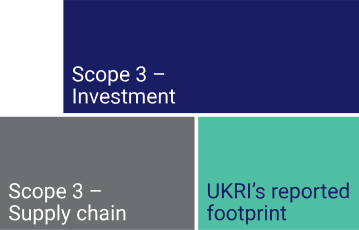
Figure note: illustration of the scale of UKRI’s currently reported GHG footprint, with recent estimates of UKRI’s emissions from Scope 3 Supply chain, and Scope 3 Investments.
Waste generation and management
In 2025-26, UKRI generated a total of 1,613 tonnes of waste, a reduction of 2% compared to 2024-25. Although only a modest reduction, the proportion diverted from landfill (99.9%), and the percentage recycled (49%), have both increased since 2024-25. Together, these figures demonstrate positive progress in reducing the environmental impact of our waste and reflect efforts to both reduce the need to dispose of items (see case study below) and to improve the segregation and categorisation of recycling and specialist waste.
We also continued to address the environmental impact of our Information and Communications Technology (ICT) waste, by expanding use of ICT reuse and recycling schemes. In 2025-26, we sent a total of 35.7 tonnes of ICT equipment to dedicated schemes and achieved a reuse percentage of 85% (by weight – see Table 3).
A summary of UKRI’s GGC-scope waste can be found in Tables 2a-e and 3 in the section: ‘GGC Performance – better management of our domestic waste and used ICT’, overleaf.
Figure 4: Annual waste generated by UKRI’s UK and overseas operations
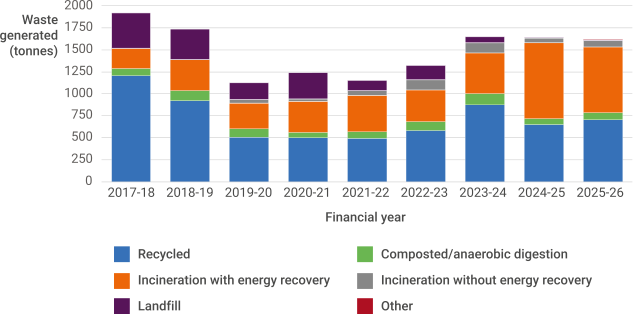
Figure note: annual waste generated by UKRI’s UK and overseas operations, shown according to the waste destination. The increase in waste generated between 2021-22 and 2023-24 reflects the return to normal operations following the COVID-19 pandemic.
Innovation to reduce disposable cup use at Polaris House
We have reduced single use items at our head office site in Swindon by ceasing use of disposable coffee cups in the restaurant, and installing an innovative self-service cup washer to support the use of reusable cups and encourage behaviour change. The Instarinse machine, which uses highly efficient steam cleaning technology, is the product of startup company Lavalabs. The company was supported by an Innovate UK R&D funding award in 2022, which enabled development of the technology and helped the business attract external investment, allowing it to take the product to market. This action has removed ~74,000 disposable cups each year from UKRI’s waste stream.
GGC performance: better management of our domestic waste and used ICT
This section provides a summary of UKRI’s GGC-scope waste, broken down by waste category and destination, and related expenditure. The figures shown differ from those discussed in the main text, and shown in Figure 4, as they only include waste generated by UKRI’s UK operations.
In 2025-26, UKRI generated 1,499 tonnes of waste (1,454 tonnes excluding major mineral).
In 2025-26, 60% of municipal waste was recycled and 99.96% was diverted from landfill.
Table 2a. Municipal waste, reported by waste destination (tonnes)
| Waste destination | 2022-23 | 2023-24 | 2024-25 | 2025-26 |
|---|---|---|---|---|
| Recycling | 527.5 | 768.1 | 562.2 | 596.4 |
| Anaerobic digestion | - | 13.4 | 46.1 | 63.0 |
| Composting | 96.2 | 112.3 | 25.7 | 23.1 |
| Incineration with energy recovery | 317.0 | 391.5 | 443.3 | 448.7 |
| Incineration without energy recovery | 22.7 | 20.9 | - | 1.1 |
| Landfill | 91.6 | 55.4 | 1.4 | 0.4 |
| Other | - | - | - | 0.0006 |
| Total | 1,055.0 | 1,361.6 | 1,078.7 | 1,132.7 |
| Percentage recycled (% | 59.1 | 65.6 | 58.8 | 60.3 |
| Percentage landfilled (% | 8.7 | 4.1 | 0.1 | 0.04 |
Table 2b. Major mineral waste, reported by waste destination (tonnes)
| Waste destination | 2022-23 | 2023-24 | 2024-25 | 2025-26 |
|---|---|---|---|---|
| Recycling | - | - | 3.2 | 41.6 |
| Incineration without energy recovery | - | - | - | 4.2 |
| Total | - | - | 3.2 | 45.8 |
Table 2c. Other (non-hazardous) waste, reported by waste destination (tonnes)
| Waste destination | 2022-23 | 2023-24 | 2024-25 | 2025-26 |
|---|---|---|---|---|
| Recycling | - | 3.9 | 49.3 | 23.2 |
| Incineration with energy recovery | - | 26.3 | 128.5 | 168.3 |
| Incineration without energy recovery | - | - | 8.6 | 10.2 |
| Landfill | 28.5 | 3.8 | - | - |
| Total | 28.5 | 33.9 | 186.4 | 201.7 |
Table 2d. Other (hazardous) waste, reported by waste destination (tonnes)
| Waste destination | 2022-23 | 2023-24 | 2024-25 | 2025-26 |
|---|---|---|---|---|
| Recycling | 0.9 | 3.3 | 34.1 | 32.3 |
| Incineration with energy recovery | - | 32.7 | 56.5 | 26.1 |
| Incineration without energy recovery | 76.1 | 80.4 | 42.9 | 60.3 |
| Landfill | 17.7 | 6.5 | 7.3 | 0.4 |
| Other/Unknown | - | - | - | 0.1 |
| Total | 94.7 | 122.9 | 140.7 | 119.3 |
Waste has been reported against four distinct categories to align with new GGC requirements and best practice. Note: The totals shown were calculated prior to rounding, as a result, some totals may differ from the sum of the rounded figures published in Tables 2a-d.
Table note: although four years of data is reported, the waste totals may not be directly comparable between years due to changes made to the way we record waste in 2024.
Table 2e. Related waste expenditure (£ million)
| Related waste expenditure | 2022-23 | 2023-24 | 2024-25 | 2025-26 |
|---|---|---|---|---|
| Total | 1.2 | 1.2 | 1.2 | 1.5 |
Table 3. ICT assets sent externally for reuse or disposal, reported by waste destination
| Waste destination | Units | Mass (tonnes) | Value returned (£) |
|---|---|---|---|
| Reuse (donated or sold) | 6,899 | 30,353 | 39,240.40 |
| Recycling | 1,972 | 5,380 | 0 |
| Incineration with energy recovery | 0 | 0 | 0 |
| Incineration without energy recovery | 0 | 0 | 0 |
| Landfill | 0 | 0 | 0 |
Table note: in the GGCs, ICT assets are defined as Category 3 or 11 electrical and electronic equipment.
Reducing our water consumption
In 2025-26, UKRI consumed 247,859m3 of potable water, which is similar to our consumption in 2024-25 (see Figure 5). We are taking steps to ensure our water consumption reduces in future by conducting water audits at sites (see case study overleaf) and by developing water plans which will outline the actions required to reduce consumption in the future.
For details of UKRI’s GGC-scope water consumption, please see Table 4 in the section ‘GGC Performance – reducing our domestic water consumption’ overleaf.
Figure 5: annual consumption of potable water by UKRI’s UK and overseas operations
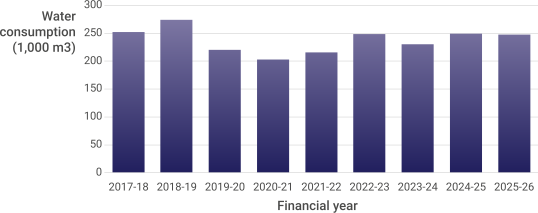
Figure note: the increase in water consumption between 2020-21 and 2022-23 reflects the return to normal operations following the COVID-19 pandemic.
Water audits identify future water savings across the MRC estate
During 2025, water audits were undertaken at key sites across the MRC estate to develop a water reduction plan for the period 2026-2031. The plan identifies ~34% of water savings in the MRC estate from specific, targeted interventions, including improvements to water management, optimisation of systems, and water reuse. A further ~10% of reductions are expected to occur through planned decarbonisation activities.
GGC performance: reducing our domestic water consumption
This section provides a breakdown of UKRI’s GGC-scope potable water consumption and related expenditure. The figures shown here differ from those discussed in the main text, and shown in Figure 5, as they only include water consumed by UKRI’s UK operations.
In 2025-26, UKRI consumed 247,757m3 of water, similar to in 2024-25
Table 4: Domestic water consumption (1,000 m3) and related expenditure (£m)
| Domestic water consumption and related expenditure | 2022-23 | 2023-24 | 2024-25 | 2025-26 |
|---|---|---|---|---|
| Potable water consumption | 248.50 | 229.9 | 248.70 | 247.8 |
| Expenditure on water | 0.78 | 1.1 | 0.78 | 1.2 |
Developing more sustainable research practice through our investments and collaborations
UKRI’s investments represent a significant proportion of our overall GHG emissions (see Figure 3) and represent an opportunity to leverage our influence to encourage more sustainable practice. In 2025-26, we recognised this publicly in our refreshed Environmental Sustainability strategy, by committing to embed appropriate environmental sustainability measures into our investments. We also published guidance on the Good Research Resource Hub to support researchers to address the environmental sustainability of their research.
Professor Sir Ian Chapman
Chief Executive and Accounting Officer
7 July 2026
3. Accountability Report
Professor Kate Royse, Director of STFC’s Hartree Centre, with the Mary Coombs Supercomputer which launched in October to enable industry breakthroughs using AI and advanced computing.
Corporate Governance Report
The Corporate Governance Report sets out the governance arrangements of UKRI. The following sections detail UKRI’s accountability to Parliament, how UKRI aligns to corporate governance best practice and comprises of:
- The Directors’ Report
- The Statement of Accounting Officer’s Responsibilities
- The Governance Statement
1. Directors’ Report
Statutory background
As UKRI’s CEO and sole Accounting Officer (AO), I, Professor Sir Ian Chapman, am accountable to the public via Parliament. Parliament monitors and influences UKRI’s work through its Select Committees and the Parliamentary and Health Services Ombudsman. Launched in April 2018, UKRI is an independent non-departmental public body of the Department for Science, Innovation and Technology (DSIT).
Siobhan Peters, UKRI’s Chief Finance Officer (CFO), concluded her transition period as interim AO in August 2025. Upon the completion of this period, I assumed the responsibilities of AO for the 2025-26 Annual Report and Accounts.
UKRI leadership
An overview of UKRI’s governance structure can be found within the Governance Statement. A list of Board and Committee members with their attendance for the period covering 1 April 2025 to 31 March 2026 can be found in the Governance Statement.
Registers of interest for UKRI’s Board and committees are published on our website.
Personal data-related incidents
No personal data incidents involving UKRI were assessed to have met the Information Commissioner’s Office (ICO) reporting requirement in 2025-26.
Freedom of information
386 Freedom of Information Act (FOIA) and the Environmental Information Regulations requests were received in 2025-26, an increase from 303 in 2024-25. The increase in requests resulted in a fall in the response rate, with 77% of requests responded to within statutory deadlines (compared to 89% for both 2024-25 and 2022-23). FOI processes are under review to improve request handling.
Two FOIA appeals were heard in 2025-2026. In October 2025 a First Tier Tribunal heard an appeal against UKRI having withheld information in response to an FOI request submitted in June 2024, which related to research integrity. The tribunal decision, issued in February 2026, dismissed the appeal and no further action was required. In January 2026 the Upper Tier Tribunal heard an appeal brought by UKRI challenging two connected March 2024 First Tier Tribunal decisions which rejected UKRI’s grounds to withhold information from FOIA requests made in 2017 and 2018. The requests related to the Engineering and Physical Sciences Research Council (EPSRC) Centres for Doctoral Training (CDT) 2013 exercise mid-term review. The hearing took place in January 2026, and the decision provided in April. One part of the Appeal was dismissed and UKRI was required to release the feedback to CDTs from the mid-term review. The second part of the Appeal, which involved submissions from a number of CDTs, was allowed and has been remitted to the Tribunal to be reconsidered.
2. Statement of Accounting Officer’s Responsibilities
Under the Higher Education and Research Act 2017, the Secretary of State for DSIT with the consent of HM Treasury, has directed UKRI to prepare a statement of accounts in the form and on the basis set out in the Accounts Direction. The accounts are prepared on an accruals basis and must give a true and fair view of the state of affairs of UKRI and of its income and expenditure, statement of financial position and cash flows for the financial year.
As UKRI’s AO, in preparing the accounts, I am required to comply with the requirements of the Government Financial Reporting Manual and, in particular, to:
- observe the Accounts Direction issued by the Secretary of State, including the relevant accounting and disclosure requirements, and apply suitable accounting policies on a consistent basis
- make judgements and estimates on a reasonable basis
- state whether applicable accounting standards as set out in the Government Financial Reporting Manual have been followed, and disclose and explain any material departures in the financial statements
- prepare the financial statements on a going concern basis
- confirm that the Annual Report and Accounts (ARA), as a whole, is fair, balanced and understandable and I take personal responsibility for the ARA, and the judgements required for determining that all reasonable steps have been taken to ensure the ARA as a whole is fair, balanced, and understandable.
Parts of this report relate to a period when a previous interim AO was in post. I have therefore obtained assurance from the interim AO in the preparation of the Annual Report and Accounts. The responsibilities of an AO, including responsibility for the propriety and regularity of the public finances for which the AO is answerable, for keeping proper records and for safeguarding UKRI’s assets, are set out in Managing Public Money published by HM Treasury.
As AO, I have taken all the steps that I ought to have taken, to make myself aware of any relevant audit information and to establish that UKRI’s auditors are aware of that information. So, as far as I am aware, there is no relevant audit information of which the auditors are unaware.
3. 2025-26 Governance Statement
Scope of responsibility
This Governance Statement, for which I take personal responsibility, describes the dynamics of UKRI, its governance, risk and internal control arrangements, and how successfully the organisation has coped with the challenges and opportunities presented this financial year.
This statement explains how UKRI has maintained a sound system of governance and taken significant steps to enrich internal control. It is my responsibility to ensure that sound governance underpins the achievement of UKRI’s policies, aims and objectives while safeguarding public funds and UKRI assets. I am also accountable for ensuring UKRI is administered prudently and economically and that resources are applied in accordance with HM Treasury’s Managing Public Money guidance and the responsibilities assigned to me by DSIT.
Governance framework
The UKRI framework document, which was updated by DSIT in November 2025, sets out the governance arrangements between UKRI and DSIT. UKRI governance arrangements enable clear accountability and efficient decision-making by:
- supporting development and delivery of our overall strategy
- enabling me to perform my role as accountable officer
- empowering each of the councils and executive chairs to take a leading role in their area, consistent with the commitment to subsidiarity in the Higher Education and Research Act 2017
Our main governance bodies are the UKRI Board and the Executive Committee (ExCo) – the latter provides strategic advice to the Board and is the day-to-day coordinating body for UKRI executive activity. Each of the nine councils has Council members who play a critical advisory role, supporting Executive Chairs to deliver UKRI’s strategy and mission.
Our new governance structure and delegations framework
This has been a transitional year for UKRI, with governance arrangements reviewed and reshaped to support organisational change and emerging priorities. During 2025-26 we have updated our delegation framework and reviewed the scope and structure of our committees to enable greater interrogation of risks and opportunities at sub-committee level, strengthening connectivity across the organisation and supporting informed decision-making.
These changes have strengthened oversight during a period of significant change and provide a more coherent and flexible governance framework to support delivery of UKRI’s mission. The governance structure and approach to delegations will be kept under review throughout 2026-27 to ensure they remain effective as the organisation continues to evolve.
UKRI top level governance committee structure
An organogram shows the UKRI Board is at the top, overseeing four committees:
- Audit and Risk Assurance Committee
- Board Investment Committee
- Growth Committee
- Nominations and Remuneration Committee
The Executive Committee sits alongside and is responsible for six committees:
- Digital and Data Strategy and Performance Committee
- Governance Risk and Assurance Review Committee
- Health and Safety Management Committee
- Operations and Estates Committee
- People and Workforce Planning Committee
- Strategic Finance and Investment Committee
A Joint National Consultative Committee is shown as a separate body.
UKRI Board overview
The UKRI Board (the Board) comprises a strong team of research and business leaders who collaborate with myself as CEO and my executive team to ensure that UKRI continues to be world leading in maximising the impact and value of public investment across the UK research and innovation system.
The Board is chaired by Sir Andrew Mackenzie and comprises myself as the CEO, the CFO and nine to 12 other non-executive members appointed by the Secretary of State for DSIT: The Baroness Bull, Annie Callanan, Rita Dhut, Priya Guha, Professor Nola Hewitt-Dundas, Professor Jane Norman, Russell Schofield-Bezer, Nigel Toon, and Ruwan Weerasekera. A representative of the Secretary of State for Science, Innovation and Technology also attends all Board meetings.
I stepped down as a non-executive member of the UKRI Board once my appointment as UKRI CEO was announced in February 2025. I remained on the Board as an observer until I formally took up the role of CEO on 20 August 2025, at which point I became a full member of the Board as CEO.
The Board is our top-level decision-making body and exercises full and effective control over the activities of UKRI. The Board provides strategic leadership, takes ownership of the principal strategic risks, and makes decisions on issues of major importance including key strategic objectives and targets, strategy, major decisions involving the use of financial and other resources, and substantive personnel issues including key appointments. By the end of 2026, the Board will commission and oversee a light-touch internal effectiveness review of its collective performance and governance arrangements. This will provide an opportunity to reflect on ways of working and any adjustments to governance arrangements as the Board transitions between Chairs. A formal external effectiveness review will be commissioned in 2027, with a clearly defined scope and success criteria. The findings of this review will be reported to the Board and the Audit and Risk Assurance Committee (ARAC) in late 2027.
The Board met six times during this financial year, and key areas discussed included:
- implementation of the UKRI Strategy and plans for the refreshed strategy in 2026
- shaping our future programme and development of the future operating model of UKRI
- the UKRI Framework for Performance, including the quarterly progress and performance reporting and the annual balanced scorecard
- UKRI’s risk management approach and the organisation’s risk appetite
- the spending review and operationalisation of allocations
- cross-cutting policy areas, including research commercialisation, people, culture and talent, UKRI’s international portfolio, including Horizon Europe and international prioritisation, and trusted research and innovation
- UKRI’s long-term direction and prioritisation around place
- UKRI’s cyber security, including discussions around the use of AI
- wider discussions about national security and defence
- horizon-scanning research and innovation trends
Minutes of the Board meetings are published on UKRI’s website. The Board’s approach to governance complies with the HM Treasury and Cabinet Office’s Corporate Governance in Central Government Departments: Code of Good Practice (the Code), the Public Sector Equality Duty and the Cabinet Office Code of Good Practice for Partnerships between departments and arm’s-length bodies.
The Board is supported by the Audit and Risk Assurance Committee, the Nominations and Remuneration Committee, the Growth Committee and the Board Investment Committee, which strengthens the independent challenge and advice provided by the Board to help guide our strategic investment portfolio.
Audit and Risk Assurance Committee
The Audit and Risk Assurance Committee (ARAC) is chaired by Ruwan Weerasekera. Russell Schofield-Bezer and Rita Dhut are non-executive Board members of ARAC and Rita Dhut is Deputy ARAC Chair. The Committee’s independent non-executive members are Philip Greenish, Karen Kröger and Alison Jarvis. Christina Coker and Fiona Sheridan left the Committee in April 2025.
I joined the ARAC as a non-executive Board member and Deputy Chair in September 2024 but left the membership of the ARAC in July 2025 ahead of becoming UKRI CEO. I now attend as AO, with the Chief Information Officer (CIO), Chief People Officer (CPO), CFO, Chief of Operational Delivery (CoOD) and UKRI Finance Director, as well as senior operational leads agreed with the Chair. The Board Chair, is also invited to attend and receives regular reports on the ARAC’s activity.
The role of the ARAC is to support the Board and myself as AO. It monitors the extent to which adequate controls are in place to ensure compliance with relevant codes and regulations and focuses on the risks to our organisation’s ability to achieve its objectives. It ensures that our approach to assurance meets organisational need. To do this the committee constructively, yet firmly, reviews and challenges the reports of management as well as our internal and external auditors, with a particular focus on governance, understanding of risks, the related control environment, and the integrity of our financial statements.
Meetings are attended by the National Audit Office (NAO), the Government Internal Audit Agency (GIAA) and a representative from DSIT. To build mutual understanding, a member of the DSIT Audit Committee has observed UKRI ARAC meetings on two occasions this year and the UKRI ARAC Chair is part of the network of audit committee chairs for arms-length public bodies sponsored by DSIT. To strengthen risk oversight and coverage, the ARAC Chair periodically attends the Board Investment Committee (BIC), and the BIC Chair attended ARAC in return.
The ARAC held seven full meetings in 2025-2026 and two additional meetings to provide independent challenge on the development of the ARA. To deepen its understanding of UKRI’s risk landscape, the committee visited and held a meeting at one of the facilities supported by UKRI.
The committee also worked closely with management in the review of the Medical Research Council Pension Scheme and the Research Councils’ Pension Scheme, ensuring that appropriate accounting policies and judgements had been scrutinised.
Throughout the year the committee has focused on:
- UKRI’s corporate governance and corporate risk management arrangements including management assurance and risk appetite, health and safety, security and resilience, workforce and wellbeing, ethics and values, grant accruals, joint ventures, complaints, raised concerns and continuous improvement of funding assurance and counter fraud
- Board, organisational and council level approaches to identifying, mitigating and reporting risks, and bringing risks within appetite
- ongoing monitoring of the implementation of significant audit recommendations from GIAA and NAO
- the risks associated with significant areas of business activity, change programmes and projects
- risk and assurance review reports, conducting deep dives on areas of particular significance; this financial year the ARAC has invited research council Executive Chairs to discuss their council and its risk environment with the Committee
Nominations and Remuneration Committee
The Nominations and Remuneration Committee (NomCo) is chaired by the Board Chair, Sir Andrew Mackenzie. Board members include Nigel Toon, Priya Guha, Ruwan Weerasekera and Professor Nola Hewitt-Dundas. I attend as CEO, with the CFO and CPO invited as attendees, without decision-making powers.
NomCo met four times during the year. It reports to and supports the Board by:
- maintaining oversight of senior leadership succession plans, appointments and awards
- determining the performance-related pay of the executive members of the Board
- providing assurance of remuneration policy to the Board
- providing assurance of performance-related policy and pay to the Board
- providing assurance of pension schemes and their governance to the Board
- maintaining oversight of the completion of annual appraisals for non-executive board members and senior executives
Growth Committee
The Growth Committee was established on 1 April 2025 and is chaired by Nigel Toon. Ruwan Weerasekera, Priya Guha, Professor Nola Hewitt Dundas, Russell Schofield Bezer and Rita Dhut are members. The CFO, Chief of Investment Planning and Strategy (CHIPS) and the Executive Chairs of Research England, ESRC, Innovate UK, and EPSRC regularly attend as standing attendees. The UKRI Chair and I as CEO have a standing invitation to attend.
The role of the committee is to support the Board in overseeing UKRI’s contribution to the UK’s growth agenda. The committee met seven times during the year. Key outcomes included:
- providing detailed challenge and advice on the Innovate UK strategic vision and prospectus, testing assumptions to strengthen delivery confidence
- supporting the development of the UKRI Commercialisation Impacts Dashboard, to improve visibility of commercialisation outcomes
- informing UKRI’s approach to IP exploitation; this work is now being progressed through the Executive Committee, with consultation underway and engagement with the Board planned for September
- enabling in-depth consideration of complex growth-related issues, helping to reduce pressure on Board agendas and improve the quality of strategic discussion
The committee continues to refine its objectives to ensure it provides effective support to UKRI’s growth mission.
UKRI Board Investment Committee
The Board Investment Committee (BIC) is chaired by Priya Guha, and its members are Nigel Toon, Professor Jane Norman and Annie Callanan, the Chair of the Infrastructure Advisory Committee (IAC), CHIPS, CFO and CoOD.
Regular attendees include myself as CEO, the Chairs of the Investment Advisory Working Group (IAWG), and the UKRI Infrastructure Portfolio Director.
The committee:
- strengthens the independent challenge and advice provided by the Board to help guide UKRI’s strategic investment portfolio
- promotes accountability for financial decision-making on investments by the Executive and provides additional assurance to the Board, the CEO and DSIT, on large, novel or contentious investments
- provides additional scrutiny and challenge on individual investment cases selected by the committee, to ensure our largest investments are:
- sustainable and in accordance with environmental, social and governance principles
- value for money
- deliverable
- aligned with UKRI’s strategic priorities
- reviews risks related to large-scale investment
- considers evaluations and lessons learned
BIC met four times during the year and undertook an outreach visit to the STFC UK Astronomy Technology Centre (ATC) at the Royal Observatory Edinburgh.
Throughout the year the committee provided review and challenge on topics as diverse as spending review and funding allocations, IAC and Digital Research Infrastructure priorities, investment risk, the Local Innovation Partnership Fund, Artificial Intelligence Research Resource, new digital investments, the National Infrastructure Roadmap Refresh, the Business Case pipeline and environmental sustainability.
Executive Committee
As CEO, I chair ExCo which provides strategic advice to the Board and constitutes UKRI’s executive leadership. ExCo comprises the nine Executive Chairs of the councils, alongside the CFO, CHIPS, CPO, CIO, CoOD, the Chief of External Affairs and Communications, and the UKRI Finance Director.
The committee meets a minimum of once a month (except August) and met 11 times during the year. It receives monthly finance and risk reports, and its areas of operational focus have included:
- governance, risk and assurance
- preparations for spending review, allocations of funding and operationalisation of allocations
- UKRI Framework for Performance, including the quarterly progress and performance reports, the balanced scorecard and development of the 2025-26 and 2026-27 key results
- right shaping UKRI’s portfolio
- development of the IS-8 programmes and their associated governance
- communications and external affairs
- delivering and refreshing our UKRI Strategy and strategic delivery plan
- staff performance and reward, including staff capability and capacity
- health and safety and staff wellbeing
- policy and delivery areas including place, international strategy and prioritisation, open access, public engagement, commercialisation, trusted research and innovation, approval of the environmental sustainability strategy, support for critical technologies, major infrastructure investments, equality, diversity and inclusion in the research and innovation system, and global staff mobility
- reviewing and approving investments and business cases in accordance with UKRI delegations
ExCo was supported by four sub-committees until December 2025: the Strategy Committee, the People, Finance and Operations Committee, the Health and Safety Management Committee, and the Workforce and Financial Planning Committee. In Q3 a review of the subcommittee structure was undertaken and from January 2026 a new suite of subcommittees was launched. This included dissolving the Strategy Committee, People Finance and Operations Committee, and the Workforce and Financial Planning Committee. The Health and Safety Management Committee remains unchanged. Six new subcommittees were launched: Strategic Finance and Investment Committee, People and Workforce Planning Committee, Governance, Risk and Assurance Review Committee, Operations and Estates Committee, Digital and Data Strategy and Performance Committee and the Organisational Change Committee.
Health and Safety Management Committee
The Health and Safety Management Committee (HSMC) is chaired by the CFO, with the CoOD as co-chair. The committee comprises the Deputy Director of Safety, Health and Environment, the Head of Operations, lead health and safety advisors from across UKRI and senior operational professionals representing estates, risk and human resources functions.
The committee is responsible for monitoring the capability and performance of health and safety management systems with the objective of safeguarding the health and safety of employees, contractors, tenants, facility users including students, or others who may be affected by our activities, regulatory compliance and for establishing and developing continuous improvement in health and safety performance.
HSMC met four times in the year and focused on UKRI’s health and safety:
- policy, strategy and health and safety codes
- management system components
- reporting, risk and performance
- occupational health and wellbeing
- internal health and safety audit reporting and outcomes
Membership was reviewed in early 2026 in line with the new the ExCo sub-committee structure.
Operations and Estates Committee
The Operations and Estates Committee (OEC) was established in January 2026 as a sub-committee of ExCo. The OEC is responsible for establishing, monitoring and advising ExCo on UKRI operational strategy and delivery. The OEC is chaired by the CoOD or their nominated deputy.
The committee’s membership comprises the CoOD, representative COOs from across the nine councils and senior functional lead professionals from across UKRI relevant to the OEC’s responsibilities.
The OEC meets twice a month and held its inaugural meeting in February 2026. The OEC discussed topics relating to:
- funding management
- shared business services
- estates management
- security and resilience
- commercial procurement and contracts
Strategic Finance and Investment Committee
The Strategic Finance and Investment Committee (SFIC) was established in January 2026 as a sub-committee of ExCo. The SFIC is responsible for monitoring and advising the Executive Committee on UKRI strategic financial management matters and investment options, including business cases. The SFIC is chaired by the CFO or their nominated deputy.
In addition to the CFO, the committee’s membership comprises the UKRI Finance Director, CHIPS, representative COOs from the nine councils and senior functional lead professionals from across UKRI relevant to the SFIC’s responsibilities. The Investment Advisory Working Group (IAWG) reports into SFIC.
The SFIC meets monthly and held its inaugural meeting in January 2026. The SFIC discussed topics relating to:
- investment planning
- current business case pipeline
- performance reporting
- no-cost extensions
- financial management
- risk appetite and management
- NAO infrastructure study recommendations
Digital and Data Strategy and Performance Committee
The Digital and Data Strategy and Performance Committee (DDSP) was established in January 2026, as a subcommittee of ExCo with delegated authority to oversee UKRI’s digital technology, data and cyber portfolio. It ensures alignment with government mandates and UKRI strategy and provides robust assurance over major technology and data decisions. DDSP reviews and approves key strategies, capability shifts and operating model changes, and acts as the escalation point for unresolved issues and significant incidents affecting operational resilience. Chaired by the CIO and comprising senior leaders from across UKRI, the committee meets quarterly to provide clear, accountable governance and has met once this financial year.
Governance Risk and Assurance Review Committee
The Governance, Risk and Assurance Review Committee (GRAR) was established in January 2026 as a sub-committee of ExCo. The GRAR supports ExCo with responsibilities relating to governance, financial control, risk management, accountability for public funds and investigations. The GRAR is chaired by the UKRI Finance Director, or the CFO as their nominated deputy.
The committee’s membership comprises the UKRI Finance Director, CFO and representative COOs from across the nine councils. Leads from areas of the organisation most relevant to GRAR’s responsibilities (such as Risk and Assurance, and Security and Resilience) are also invited to attend and report into meetings.
The GRAR meets quarterly and held its inaugural meeting in March 2026. The GRAR discussed topics relating to:
- UKRI’s Annual Report and Accounts (2025-26)
- funding assurance
- risk
- counter-fraud and bribery
- raising concerns
People and Workforce Planning Committee
The People and Workforce Planning Committee (PWP) was established in January 2026 as a sub-committee of ExCo. The PWP is responsible for providing strategic direction, oversight and assurance on UKRI’s People Strategy and Plan, workforce planning, and people and culture change activity.
The PWP is chaired by the CPO or the Deputy CPO and Director of HR Business Partnering as their nominated deputy. In addition, its membership comprises the UKRI Finance Director, representative COOs from across the nine councils, senior HR directors and a representative from the UKRI Communications team.
The committee meets monthly and met twice before the end of the 2025-2026 financial year. The PWP discussed topics relating to:
- UKRI People Strategy
- people policy
- learning and development
- reward and benefits
- culture, inclusion and wellbeing
- staff networks
Table of attendance for UKRI senior executive and non-executive boards and committees
The tables below sets out member and senior executive attendance for our key governance bodies. Where members were unable to attend meetings in person, they have been able to share their views in advance with the Chair.
Governance body attendance: Board Members
| Attendance | Board | ARAC | BIC | Growth | NomCo | ExCo |
|---|---|---|---|---|---|---|
| Number of meetings held | 6 | 8 | 4 | 7 | 4 | 11 |
| Sir Andrew Mackenzie | 6/6 | – | – | – | 4/4 | – |
| Professor Dame Ottoline Leyser (CEO | 1/2 | – | – | – | – | 3/3 |
| Professor Sir Ian Chapman (CEO | 4/4 | 3/4 | – | – | – | 7/7 |
| Siobhan Peters (CFO | 3/6 | – | 3/4 | – | – | 7/11 |
| The Baroness Bull | 6/6 | – | 3/4 | – | – | – |
| Annie Callanan | 6/6 | – | 4/4 | – | – | – |
| Rita Dhut | 6/6 | 6/8 | – | 5/7 | – | – |
| Priya Guha | 6/6 | – | 4/4 | 7/7 | 4/4 | – |
| Professor Nola Hewitt-Dundas | 6/6 | – | – | 5/7 | 4/4 | – |
| Professor Jane Norman | 4/6 | – | 3/4 | – | – | – |
| Russell Schofield-Bezer | 6/6 | 7/8 | – | 7/7 | – | – |
| Nigel Toon | 6/6 | – | 3/4 | 7/7 | 4/4 | – |
| Ruwan Weerasekera | 5/6 | 8/8 | – | 5/7 | 3/4 | – |
Governance body attendance: ARAC Independent Members
| Attendance | Board | ARAC | BIC | Growth | NomCo | ExCo |
|---|---|---|---|---|---|---|
| Number of meetings held | 6 | 8 | 4 | 7 | 4 | 11 |
| Christina Coker | – | 1/1 | – | – | – | – |
| Philip Greenish | – | 7/8 | – | – | – | – |
| Alison Jarvis | – | 6/8 | – | – | – | – |
| Karen Kroger | – | 8/8 | – | – | – | – |
| Fiona Sheridan | – | 1/1 | – | – | – | – |
| Professor Sir Ian Chapman(ahead of his appointment as UKRI CEO | – | 3/4 | – | – | – | – |
Governance body attendance: Executive Committee Members
| Attendance | Board | ARAC | BIC | Growth | NomCo | ExCo |
|---|---|---|---|---|---|---|
| Number of meetings held | 6 | 8 | 4 | 7 | 4 | 11 |
| Professor Dame Ottoline Leyser (CEO | – | – | – | – | – | 3/3 |
| Professor Sir Ian Chapman (CEO | 4/4 | 4/4 | – | – | – | 7/7 |
| Siobhan Peters (CFO | 3/6 | – | 3/4 | – | – | 7/11 |
| Christine Ashton (CIO | – | – | – | – | – | 8/11 |
| Angela Paradise (Interim CPO | – | – | – | – | – | 4/4 |
| Gemma Bailey (CPO | – | – | – | – | – | 7/7 |
| Mike Baker (CoOD | – | – | 0/1 | – | – | 5/7 |
| Juliette Meek (Finance Director | – | – | – | – | – | 6/6 |
| Daniel Shah (CHIPS – Job Share | – | – | 1/4 | – | – | 8/11 |
| Hugh Harris (CHIPS – Job Share | – | – | 3/4 | – | – | 3/11 |
| Poli Stuart-Lacey (Chief of External Affairs and Communications | – | – | – | – | – | 10/11 |
| Professor Christopher Smith (EC AHRC | – | – | – | – | – | 9/11 |
| Deputy for AHRC EC | – | – | – | – | – | 3/3 |
| Professor Anne Ferguson-Smith (BBSRC EC | – | – | – | – | – | 9/11 |
| Deputy for BBSRC EC | – | – | – | – | – | 2/2 |
| Stian Westlake (EC ESRC | – | – | – | – | – | 11/11 |
| Deputy for ESRC EC | – | – | – | – | – | 2/2 |
| Professor Charlotte Deane (EC EPSRC | – | – | – | – | – | 11/11 |
| Deputy for EPSRC EC | – | – | – | – | – | 1/1 |
| Tom Adeyoola (CEO Innovate UK | – | – | – | – | – | 6/11 |
| Deputy for Innovate UK EC | – | – | – | – | – | 4/4 |
| Professor Patrick Chinnery (EC MRC | – | – | – | – | – | 10/11 |
| Deputy for MRC EC | – | – | – | – | – | 1/1 |
| Professor Louise Heathwaite (EC NERC | – | – | – | – | – | 11/11 |
| Professor Dame Jessica Corner (EC Research England | – | – | – | – | – | 10/11 |
| Professor Michele Dougherty (EC STFC | – | – | 4/4 | – | – | 11/11 |
Table notes:
- Professor Dame Ottoline Leyser’s tenure as UKRI CEO ended on 28 June 2025.
- Professor Sir Ian Chapman was appointed to the Board from 1 March 2024. In February 2025 Professor Sir Ian formally stepped down as a Board member but continued to attend the Board as an observer. Professor Sir Ian remained an observer of the Board and an independent Non-Executive Member of ARAC until he took up the role of UKRI CEO on 20 August 2025.
- Alexandra Jones, Director General for Science, Innovation and Growth at DSIT, attended all Board meetings in year as representative of the Secretary of State for Science, Innovation and Technology. She is not a member of the Board.
- Christine Coker and Fiona Sheridan departed the UKRI ARAC at the end of their tenure in April 2025.
- Dr Stella Peace was appointed Interim Innovate UK’s Executive Chair on 1 October 2024; she stepped down on 20 April 2025 when the new Executive Chair was appointed.
- Tom Adeyoola joined UKRI as Innovate UK’s Executive Chair on 20 April 2025.
- Juliette Meek as UKRI Finance Director was appointed to ExCo as a formal member on 28 October 2025.
- Angela Paradise was appointed as Interim CPO on 6 January 2025, and left UKRI on 22 August 2025.
- Gemma Bailey was appointed as UKRI CPO on 11 August 2025.
- Michael Baker was appointed as UKRI CoOD on 1 September 2025.
In line with the ExCo Terms of Reference, if members cannot attend meetings they may authorise an appropriate colleague to represent them.
Councils overview
The councils provide advice to the Executive Chairs. Ordinary council members bring expertise and insight from their respective fields, offering constructive challenge and guidance to inform the development and implementation of the councils’ strategic delivery plans. These plans outline the collective actions required to deliver our strategy. Councils work in partnership with ExCo and the Board and meet jointly twice a year to address the UK’s major research and innovation challenges.
Each council consists of the council’s Executive Chair and between five and 12 non-executive ordinary members, one of whom is the Senior Independent Member. Each council met between four and six times last year. The full list of council members and councils’ Terms of Reference are published on our website.
Innovate UK Loans Ltd Special Purpose Vehicle
Innovate UK Loans Ltd is a wholly owned subsidiary of UKRI and part of Innovate UK’s delivery infrastructure. Through Innovate UK Loans Ltd, Innovate UK supports the UK’s best innovative businesses to undertake later stage R&D with a view to commercialisation, scale, and growth. As a wholly owned subsidiary, Innovate UK Loans Ltd is subject to the central government controls framework. The Innovate UK Loans Ltd ARA is subject to audit by the NAO and is consolidated with UKRI’s ARA. GIAA is responsible for the provision of internal audit services to UKRI, as set out in a Memorandum of Understanding, and provides internal audit services to Innovate UK Loans Ltd under this agreement. Further narrative and detail of their governance arrangements and financial results are available within the Innovate UK Loans Ltd ARA filed with Companies House.
Knowledge Transfer Network Ltd operating as Innovate UK Business Connect
Innovate UK Business Connect is the UK’s innovation network. It connects innovators and innovative businesses to contacts, opportunities, and networks, and accelerates UK-based business innovation, building trusted connections, collaborations and intelligence. Innovate UK Business Connect is a strategic delivery partner to Innovate UK, working to accelerate innovation and as part of UKRI, working to advance knowledge, improve lives, and create growth. Innovate UK Business Connect’s strategic plans and objectives and key results are aligned with Innovate UK’s Prospectus, the Government’s Industrial Strategy and other Sector Plans.
Governance, accountability, and operational requirements are set out in the UKRI and Innovate UK Business Connect Framework Agreement, Letter of Delegation and the Innovate UK Business Connect (KTN Ltd) Articles of Association. Operational requirements set out in the Framework document cover the agreement of an annual programme of work, business plan, financial and non-financial reporting regimes, and broader information sharing. Financial Statements are filed with Companies House.
STFC Innovations Ltd
STFC Innovations Limited (SIL) is a wholly owned subsidiary of UKRI and conducts activities in the field of commercialisation for STFC. SIL invests in a portfolio of start-up companies based on STFC intellectual property, commercially exploits STFC’s intellectual property through licence agreements and sales of services, and provides facilities for early-stage companies looking to scale up and grow. The SIL ARA is subject to audit and is consolidated within UKRI’s ARA. Further narrative and detail of their governance arrangements and financial results are available within the SIL ARA filed with Companies House.
Diamond Light Source Ltd
Diamond Light Source Ltd (DLS) was established in 2002 as a joint venture between STFC (which became part of UKRI in 2018) and the Wellcome Trust. UKRI holds an 86% shareholding. DLS is governed by its Board of Directors in accordance with the joint venture agreement.
The UKRI Accounting Officer is accountable for UKRI’s investment in DLS and the use of associated public funds. This accountability is exercised through UKRI’s role as shareholder, including oversight arrangements and representation.
The DLS ARA is subject to external audit and consolidated within the DSIT ARA. Further narrative and detail of DLS’s governance arrangements and financial results are available within the DLS ARA filed with Companies House.
Harwell Science and Innovation Campus Public Sector Limited Partnership (HSIC)
HSIC was created in 2008 between UKRI and UKAEA. The principal activity of HSIC is to manage and develop Harwell Campus as a partner in the Harwell Science and Innovation Campus LP alongside the private sector partner, Harwell Oxford Developments Limited. The HSIC ARA is subject to audit and is consolidated within UKRI’s ARA.
Further narrative and details of their governance arrangements and financial results are available within the HSIC ARA filed with Companies House. Further information on UKRI investments can be found in the Financial Statements, note 8.
Risk management
Capacity to handle risk
As AO, I have overall responsibility for ensuring there is an effective system of risk management, internal control, and assurance in place within UKRI for meeting all relevant statutory requirements, and for ensuring adherence to guidance. Further accountability and responsibility for elements of risk management are set out in UKRI’s risk management strategy and policy. An overview of the UKRI Risk Management Framework and details of the principal risks managed this year are set out in the Performance Report.
An important element of the UKRI Risk Management Framework is the UKRI Risk Appetite Statement. The statement is reviewed at a minimum frequency of every two years. The statement was refreshed in 2025-26, with the next review due in 2027-28. The new statement has been rolled out with additional guidance and training to embed implementation. UKRI is committed to ensuring that its risk appetite types and levels are reviewed to ensure that it supports optimal risk taking to achieve objectives.
Risk management framework
UKRI has a risk management framework designed to support risk informed decision-making focused on achieving our objectives. The framework provides a consistent approach to identifying, assessing, and mitigating enterprise risks through implementing and monitoring controls and actions to reduce risk to the levels the organisation is willing to accept in pursuit of objectives. The risk management framework includes a risk management policy, strategy, process and risk appetite statement.
UKRI’s risk management practices comply with the requirements of the five principles as set out in HM Government’s Orange Book. The practices and approaches are in turn supported by a central team of qualified risk business partners to embed effective risk management across UKRI. The risk and assurance management system provides an integrated and dynamic view of UKRI’s risks, issues, assurance framework, policies and control environment. The system continues to be developed and has delivered improved reporting enabling rich risk discussions and underpinning informed risk-based decision-making.
System of internal control
UKRI’s system of internal control is designed to support the achievement of our policies, aims and objectives while managing risk to an acceptable and proportionate level. The system is intended to manage, rather than eliminate, all risk; it therefore provides reasonable, not absolute, assurance of effectiveness. The internal control framework operates through an ongoing process to identify and prioritise the risks that could affect the achievement of UKRI’s objectives; to assess the likelihood and potential impact of those risks; and to ensure they are managed in an efficient and proportionate manner. The system of internal control and associated risk management processes have been in place throughout the year under review and up to the date of approval of the ARA. UKRI are currently undergoing an Employer Duties compliance check with HMRC.
Regularity and propriety
We are committed to upholding the highest standards of regularity and propriety, including fostering the right organisational culture and behaviours. We do not tolerate any form of fraud, bribery and corruption.
The key components in this regard are our:
- Counter Fraud, Bribery and Corruption strategy and policy
- Gifts and Hospitality policy
- Declarations of Interest policy
- Whistleblowing policy
- Complaints policy
I confirm that for 2025-26:
Neither I, nor my staff, authorised a course of action, the financial impact of which is that transactions infringe the regulatory requirements as set out in Managing Public Money:
- any novel, contentious or repercussive transactions were only undertaken after being approved by HM Treasury
- no new UKRI employees or contractors have received remuneration more than the amount approved by DSIT and HM Treasury
- within the operations of UKRI and our shared services provider, UKSBS, no instances of fraud have been identified that were assessed as material, taking into account both financial value and the nature and impact of the incident
Counter fraud
The Government Functional Standard GovS 013: Counter Fraud sets out expectations for the management of fraud, bribery and corruption risk across government organisations. The reorganisation of the UKRI counter fraud function continued during 2025-26. New counter fraud specialists were recruited in April 2025, and further improvements to the quality and consistency of thematic fraud risk assessments were delivered through the Fraud Risk Assessment Working Group.
A new Counter Fraud, Bribery and Corruption Strategy (2025-2028) received Board approval in July 2025. UKRI expects to be able to demonstrate significant improvements in alignment with the Functional Standard at the next independent assessment by the Public Sector Fraud Authority (PSFA).
An ongoing programme of fraud awareness is in place across UKRI, including a mandatory online fraud and bribery course for all staff. Additional bespoke training has been provided to teams operating in higher risk areas. This activity has been supplemented by fraud awareness training and staff participation in events organised by the DSIT Counter Fraud Expert Services (CFES) Team. UKRI was an active participant in International Fraud Awareness Week in November 2025.
UKRI employs a small team of trained counter fraud specialists who manage a varied caseload of referrals received from both internal and external sources. UKRI submits Consolidated Data Returns to the PSFA, capturing the activity and performance of the counter fraud function. The figures returned for 2025-26, covering fraud and error, were as follows:
- 87 referrals of fraud, bribery or corruption (82 in 2024-25)
- launched 37 new cases and closed 37 cases
- identified fraud and error of £12.09 million (£5.41 million 2024-25)
- prevented fraud of £0.53 million (£0.66 million 2024-25)
- recovered £9.58 million from grant participants (£6.58 million 2024-25)
- the counter fraud team achieved a return on investment of £17.22 for every £1 spent in 2025-26 and 246% of the target set with the PSFA at the start of the year
Gifts and hospitality
As a major funding organisation, we are aware that accepting or giving gifts or hospitality may affect how the organisation is perceived and may be seen to affect our decision-making and behaviour. The purpose of the UKRI Gifts and Hospitality Policy is to ensure that all staff are aware of their responsibilities and are vigilant in ensuring that we remain impartial and fair across the work we do.
The cost of gifts and hospitality offered by UKRI must be proportionate, preapproved and recorded on the Gifts and Hospitality Register. All offers of gifts or hospitality made to staff must be declared, regardless of whether they are accepted, and it is not standard practice for staff to accept such offers. In line with UKRI policy, any gift valued above £40 has either been surrendered or retained with the appropriate approval.
Declaration of Interests
We recognise the importance of transparency in maintaining effective governance and complying with the Nolan Principles of Public Life. The declaration of interests process provides assurance that potential or perceived conflicts are identified and managed appropriately, supporting the integrity of UKRI’s decision-making and operations.
All UKRI employees, and all individuals engaged to represent or act on behalf of UKRI or its affiliated organisations worldwide, are expected to adhere to high standards of professional and ethical conduct. They must declare any interests that could give rise to a conflict, or could reasonably be perceived as doing so, enabling UKRI to apply proportionate controls and ensure that organisational decisions remain impartial and in the public interest.
Interests are recorded and assessed in line with the Declaration of Interests (DoI) Policy, using a self-service electronic portal. Controls applied to mitigate identified conflicts are subject to management approval and recorded in the portal. Declarations of the Board, the ExCo and Council members are published annually on the UKRI website, and updated as required.
Whistleblowing
The UKRI Whistleblowing – Freedom to Speak Up Policy, last reviewed in 2022-23, encourages and enables employees to speak out when they encounter or suspect malpractice. Whistleblowing and ‘Freedom to Speak Up’ is viewed by UKRI as a positive act, which can make a valuable contribution to our efficiency and long-term success. Internal avenues for raising concerns are also supported by an external advice line through Protect. The policy is currently under review as part of the Raising Concerns project, with Trade Union consultation planned for July and publication to follow, taking account of feedback received.
UKRI aims to ensure concerns are investigated properly, sensitively and in confidence, and individuals are protected from any detrimental impacts because of raising a concern in good faith, in line with the Public Interest Disclosure Act.
Twenty-nine concerns were submitted in 2025-26, of which eight were assessed as being in scope of the UKRI Whistleblowing ‘Freedom to Speak up’ Policy and were investigated as a ‘’qualifying disclosure’ regarding alleged or actual malpractice. By comparison, in 2024-25, 19 concerns were submitted, of which eight were assessed as being in scope of the UKRI Whistleblowing ‘Freedom to Speak up’ Policy. The findings from each completed investigation are acted upon and a process has been established to identify and address lessons learned.
Complaints
We recognise that complaints present an opportunity to learn and make improvements to the way we operate and for our stakeholders. As an organisation we commit to operating a responsive, transparent, and fair complaints process.
We have an external UKRI Complaints webpage that outlines the process for external stakeholders to submit a complaint, what we can investigate, timescales for response and how to appeal. Further details about our internal processes are outlined in the UKRI Complaints Handling Procedure.
In 2025-26 we received 55 formal complaints (of these two were appeal complaints), compared to 60 in 2024-25. The top three categories of complaints related to grant decision-making, grant application processes and customer service. Following investigation, 48% of formal complaints were not upheld and 52% were either upheld or partially upheld as their outcome.
During 2025-26, there were three cases accepted by the Parliamentary and Health Service Ombudsman (PHSO) for review. By comparison, in 2024-25, there were no new cases accepted by the PHSO for review. Two case outcomes were received from the PHSO in 2025-26. Both were closed at the primary review stage and neither were upheld.
As part of our Complaints Annual Review 2025-26, we have identified priorities which will enable us to continue to strengthen our approach to complaint handling and improve stakeholder experience, including improving our reporting capabilities and ensuring continued alignment to complaints best practice guidance.
Raising concerns
UKRI seeks to make it easier for individuals to raise concerns across UKRI and within our community. We want to make the triage and processing of concerns more robust and consistent and to enable effective outcomes for all those involved in the process. We are currently procuring a reporting system, updating related policies and fully developing a triage and process map with the launch of the system in Q2 2026-27. To support, a pilot investigation team is also being established alongside access to mediation resources. This will be underpinned by revised policies, procedures and a new approach to the resourcing and delivery of investigations.
Modern slavery
We are committed to the principles of the Modern Slavery Act 2015 and the abolition of modern slavery and human trafficking. We seek to minimise the risk of modern slavery and human trafficking in our operations through a control framework which focuses on recruitment, selection and resource management, commercial supply chain arrangements, policy development for safeguarding and reporting of concerns, and employee awareness training. The latest UKRI Modern Slavery and Human Trafficking Statement published in September 2025 reported no concerns identified or reported by employees or third parties. During 2025-26 we have continued to monitor recruitment and commercial activity for modern slavery indicators.
Welsh Language Scheme
Our Welsh Language Scheme sets out how UKRI complies with the principles established by the Welsh Language Act and which services and communications are offered in Welsh. The scheme was prepared in accordance with guidelines issued by the Welsh Language Commissioner under Section 9 of the Act and was approved by the Welsh Language Commissioner on 8 April 2021.
Data and information governance
The CIO chairs the UKRI Data Digital and Data Strategy and Performance Committee (formerly Strategic Technology and Data Governance Committee), which meets quarterly, reporting to the ExCo, to provide strategic direction, oversight and ensure effective management, ethical use, and maximisation of technology and data assets in support of UKRI’s strategy. Data owners, accountable for data management, have been appointed and are working with the Chief Data Officer, alongside existing information governance policies, procedures, and controls to ensure that our data and information is valued, managed and protected. A new principal data and information governance risk has been agreed and will be reviewed regularly and managed through appropriate mitigating actions.
Security and Resilience
The UKRI Security & Resilience Strategy (2025-2029 streamline and refresh) and underpinning domain roadmaps have been approved during 2025-26, including formal endorsement by the myself as CEO. With increasing compliance to Government Functional Standard (GovS) 007: Security, the UKRI Security and Resilience (S&R) programme has been further operationalised with the golden thread from principal risks to child risk causes and mitigations, directly aligned to roadmap actions to reduce these risks. Organisational-level thematic objective-centric risks have been approved for each domain, under the overarching Security & Resilience Principal Risk. ExCo and Board oversight have commissioned deep dives of the principal risk and cyber risk below; planning has included an endorsed action plan to accelerate elements of risks to key deliverables, mapping and risk identification of the digital enterprise and develop more business area-delegated security risk management.
This new focus on risk to core strategic deliverables maintains the protection and enabling of UKRI’s new corporate strategy (2026-2031) to be published in spring 2026, and the security strategy can update accordingly. Further security capability is being built with mandatory training and targeted enhanced measures including accredited facilities and IT. New capacity for resilience including incident management, supply chain security and resilience and business maturity modelling have a solid plan. A much-needed robust enduring security and resilience resource model is being developed for the federated organisation; this is being moved towards already with an energetic champions network and launching a holistic security community in June 2026.
Prompt payment
UKRI’s policy is to comply with the Prompt Payment Code for the payment of invoices for goods and services. While our standard terms and conditions specify payment within 30 days of receipt, we aim to make payments within five working days. In 2025-26, UKRI paid 94% of undisputed invoices within 30 days (2024-25: 97%) and 58% within five working days (2024-25: 61%). During 2025-26 UKRI implemented a new ERP platform. Challenges with purchase-to-pay have impacted the prompt payment statistics.
Pay remit
I can confirm that UKRI is complying with Civil Service pay-setting requirements set out in guidance issued by HM Treasury.
Tax arrangements of public sector appointees
The government’s 2012 review of tax arrangements for public sector appointees highlighted the possibility of artificial arrangements to enable tax avoidance. Our directly hired senior employees are all paid through the payroll and controls exist to provide assurance that appropriate tax arrangements are in place to cover other in-year appointees. We provide DSIT with tax assurance evidence on a yearly basis, which forms part of their summary of DSIT tax assurance data at gov.uk.
Ministerial directions
There were no Ministerial directions given in 2025-26.
Projects
Project delivery
The UKRI Project Delivery Profession empowers over 450 professionals across UKRI to deliver complex projects more effectively. Through the provision of practical tools, training and support, it enhances capability and consistency across the organisation. Members can attend CPD events, participate in the government project delivery accreditation scheme, and join specialist networks in areas like risk, change and AI. By raising the profile of project delivery and enabling continuous improvement, the Project Profession helps UKRI achieve its strategic goals through a confident, skilled, and future-ready project community. Work is now beginning to look at the introduction of an Enterprise Portfolio Management Office alongside the recruitment of a Chief Programmes Officer to further support project and programme delivery in UKRI.
The Profession undertakes annual self-assessments against the Government Functional Standard GovS 002: Project Delivery (GovS) for compliance and assurance purposes. Specific Interest Groups continue to facilitate knowledge sharing and the development of best practice in key project management areas including risk management, benefits realisation and change management. The Project Profession centre holds and promotes a programme of learning and networking events, providing over 300 hours of continuing professional development to members.
A project management system is in use to provide UKRI with the ability to manage and report on projects, programmes and portfolios at any level improving the efficiency of delivery, effectiveness of reporting, and consistency in practice.
The Business Case Hub provides expertise covering HM Treasury’s Five Case Model, helping projects and programmes within the UKRI Major Projects Portfolio produce business cases that set projects up for successful delivery. Since its inception in 2020, the Business Case Hub has maintained its 100% success rate of first-time approval by DSIT, with a total of over £10 billion worth of programmes approved by the department.
Assurance
Review of effectiveness
As AO, I am responsible for ensuring that UKRI maintains a sound system of governance and internal control. In 2025-26 I drew on the work of the ARAC; ExCo and its supporting committees; the internal audit service provided by the GIAA; UKRI’s Funding Assurance and Management Assurance outcomes; the assurance opinion provided by the AO of UKSBS; and observations made by the NAO as our external auditors in their management letter and other reports, to inform my overall assessment.
Executive Accountability Exercise
UKRI operates an integrated framework of governance, risk management and assurance that combines ongoing assessment throughout the year through risk and assurance reviews and an annual Executive Accountability Exercise to provide an assessment at year end of assurance on legal, regulatory and government standards and delegations.
The framework identifies and evaluates the different sources of assurance using the three lines model, in line with The Orange Book guidance.
The Executive Accountability Exercise requires all members of ExCo to provide first line assurance on the areas of their delegation. These assurances are then evaluated through second line analysis, challenge meetings and a sample-based evidence review. The outcomes were reported to ExCo and ARAC.
The 2025-26 exercise has confirmed a majority of returns with assurance levels of high or medium ratings (33% high, 57% medium) and a minority of low assurance ratings (10% low). The analysis and review of the outcomes of the exercise have determined that the areas in which low assurance has been rated are not significant enough to impact an overall positive view of the UKRI control framework, with relevant actions in place to improve controls in 2025-26.
EAE Assurance Ratings 2025-26
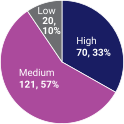
Government Internal Audit Agency annual opinion
The Head of Internal Audit (HIA) is required by the Public Sector Internal Audit Standards to provide me with an annual internal audit opinion and report. The HIA opinion is based primarily on the outcomes of audit engagements conducted during the 2025-26 financial year but is also informed by knowledge gained from meetings with senior management, and attendance at governance forums and review of associated papers.
The HIA provided me with an overall moderate assurance opinion which reflects that, although there are areas that could be improved, UKRI’s frameworks for governance, risk management and control are operating effectively to deliver strategic objectives. The HIA also provided me with moderate assurance opinions and analysis for each of the four Pillars of the Risk Control Framework (RCF) introduced in the 2023 update to the Orange Book on public sector Risk Management.
The HIA highlighted improvements to governance and management arrangements through the integration of the assurance and delegation frameworks, a revised governance structure to aid decision-making, along with a strengthened risk framework and a revised risk appetite statement. The HIA noted that progress had been achieved despite significant strategic and operational change. The pace of change and risks to organisational resilience and staff wellbeing have been highlighted as ongoing issues that we should focus upon.
The HIA reviewed two areas where controls were not found to be fully effective in 2025-26. These were IT Asset Management in relation to End User Devices and the Safeguarding arrangements at one of our units. Action plans have been agreed to address the recommendations arising from the work of internal audit by September 2026.
Assurance on our Funding
The requirement for Funding Assurance spans the entire research and innovation funding lifecycle, from designing our schemes to post-project reporting. I have received a report from the Director Risk Assurance, Counter Fraud and Investigations that identifies the sources of assurance and provides an overall moderate assurance opinion on the effectiveness of governance, risk management and internal control in relation to our research and innovation activity and expenditure.
UKRI Funding Assurance is designed to evaluate design and effectiveness of arrangements to comply with the functional standard GovS 015 Grants, public sector rules, laws and regulations applicable to UKRI, funding policies that we set requiring legal and regulatory compliance by organisations we fund, and UKRI commitments and obligations included in the Government response to the Independent Review of Research Bureaucracy. The previous Governance Statement recognised that unresolved high priority NAO Management Letter actions, including one related to Funding Assurance from 2021-22, was a significant issue. The 2024-25 Management Letter confirmed progress had been made towards resolving legacy actions. A new medium priority action was raised in its place to continue towards a fully integrated Funding Assurance approach. Work is ongoing to fully complete NAO actions with progress made during 2025-26.
The funding assurance work completed in 2025-26 reflects a fundamental redesign and rescope of the assurance process for organisations in receipt of research funding. Under our plans for 2026-27, UKRI will work towards having an entirely consistent assurance approach across the whole portfolio of research and innovation investments.
UKRI operates a three lines model for funding assurance. Under the model:
- first line: assurance provided by UKRI Teams directly involved in designing, delivering, and administering research and innovation funding activities
- second line: assurance provided by independent UKRI Teams assuring first line activity in UKRI or scrutinising compliance with grant terms and regularity of spend in funded organisations
- third line: internal audit, and other independent reviewers commissioned by UKRI
UKRI is also subject to NAO audit and other statutory reviews of its research and innovation activities and spend that are not directed by UKRI. Our 2025-26 funding assurance activities have been planned, documented and reported using the three lines model.
Positive first line assurance has been provided through EAE, exercises to understand and mitigate potential geopolitical and national security risks to the international collaborative research grant portfolio, and application of the Fraud Risk Assessment counter fraud discipline. First line checks within Innovate identified £1,689,000 ineligible costs removed before contract and £10,450,000 removed from claims before payment.
Second line funding assurance activities undertaken by different teams in UKRI are being coordinated by the Director Risk Assurance, Counter Fraud and Investigations. Overall, these activities support a positive opinion. Key findings are as follows:
- across 19 funding assurance reviews of Research Organisations, we reviewed £36 million from which £760,000 of ineligible costs were identified (2.1% error rate). We made seven recommendations to improve UKRI controls
- UKRI, as part of a consortium of five funders, have built and deployed a new digital platform to review the design of research organisation arrangements to comply with non-financial terms and conditions of funding. Sixteen organisations were reviewed in 2025-26 with all obtaining positive outcomes
- 17 data audits were completed by an external provider of Research England block-grants. No material or major issues were identified, providing positive assurance over the data and the systems and processes used to allocate funding
- sample testing £1,524,000 of Horizon Europe Guarantee expenditure identified £99,600 (6.5%) error which was either removed from claims before submission or repaid
- we have positive assurance outcomes of assurance work within BBSRC, MRC, and NERC over in-house and external centres institutes and units
- seven assurance assignments completed by the Management Assurance team and one critical control review. The assurance assignments resulted in one unsatisfactory, three limited assurance and three moderate assurance opinions. The recommendations arising from the negatively assured reviews are being managed by senior leadership with input from finance, commercial, and human resources teams.
Action is taken to address the specific and thematic findings from second line funding assurance reviews. When we identify ineligible expenditure charged to a UKRI grant it is removed from the claim before payment.
Third line assurance has been provided from GIAA. The internal audit programme of 21 reviews included 12 that directly relate to Research and Innovation governance, risk management or internal control. Eleven have been completed to final report stage. One has substantial assurance. Seven have moderate assurance, one is limited assurance and two reviews were advisory.
I have also received a letter providing assurance on payments made by UKRI from the AO of the Office for Students (OfS). The assurance covers regularity, propriety, and value for money in higher education providers in England that are primarily regulated by the OfS. The assurances are that:
- higher education providers have appropriate arrangements for financial management and accounting to mitigate the risk that funds are not used for the purposes given
- based on the funding assurance work completed by OfS there are no reports from external auditors for the academic year 2025-26 that would indicate any concerns which would be of interest to UKRI in relation to compliance with the terms and conditions of revenue grant funding from UKRI
In addition to these assurances the OfS continued its processes to collect and validate annual Transparent Approach to Costing (TRAC) data returns, for 2024-25, and to deliver this data to UKRI. This work includes a review of institutional declarations of compliance with the TRAC requirements as set out in TRAC guidance.
Shared services assurance
UKSBS is a company wholly owned by its public sector customers and shareholders: Department for Business and Trade, Department of Energy Security and Net Zero, DSIT and UKRI. The company aims to provide efficient HR and payroll, finance, procurement, and IT business services. The performance of UKSBS is managed robustly against agreed standards.
We receive assurance reports from UKSBS twice a year on the design and effectiveness of its internal control framework, and within the UKSBS Assurance Framework the company’s overall assurance status for the financial year 2025-26 remains moderate. UKSBS also receives its internal audit provision from GIAA and received an overall moderate audit opinion for 2025-26.
Quality assurance of business-critical models
Quality assurance of business-critical models is managed by the Analytical Leadership Group which identifies, reviews, and maintains a list of business-critical models. This approach utilises existing review processes and expertise within UKRI, with oversight from its Analytical Leadership Group, and aligns UKRI practice with recommendations and standards for analytical modelling as outlined in Managing Public Money, the MacPherson Review, and the Aqua Book.
National Audit Office – Value for Money study
The NAO report on the Value for Money study, UKRI: Providing Support Through Grants, was published in May 2025. The report concluded that UKRI and its predecessor bodies have helped support a globally respected R&I system, but noted that there is still more that UKRI could do to maximise the value for money it secures from supporting R&I. It contained five recommendations, four of which were completed by the end of the financial year and one that is due to close at the end of April 2026. UKRI has reported on its progress against the recommendations to the NAO, as well as to the Public Accounts Committee which discussed the report in a session in June 2025.
A new NAO Value for Money study was conducted during 2025-26 to examine how effectively DSIT and UKRI work together to develop and operate research infrastructure that meets the needs of government, researchers and industry. The report found that UKRI has introduced a more consistent and professional approach to funding research infrastructure but that there is more that UKRI can do to manage research infrastructure as a portfolio, making five recommendations for improvement. This report follows a similar study in 2016 on investment into science projects by the Department for Business, Skills and Innovation.
Significant issues
UKRI defines significant issues as factors that may have impacted our performance or hindered our ability to fully achieve objectives within the financial year. These challenges can vary in nature and addressing them promptly is key to ensuring that we can operate effectively.
Capacity and capability of staff
With clarity on our new mission and budget, our priority is to ensure the organisation has the capacity, capabilities and organisational resilience required to deliver at pace. The scale of change across UKRI, including Innovate UK’s strategic realignment, STFC’s major transformation programmes, delivery of the new People Strategy and Delivery Plan and wider organisational transformation, places significant demands on the workforce. The principal risk is that UKRI may not have the capacity, skills, organisational structures and ways of working required to deliver its future objectives as effectively as needed. Addressing this will require a rebalancing of skills and resources across the organisation. At the same time, the pace and scale of change create risks to organisational resilience, leadership capacity and colleague wellbeing if not carefully managed.
To address this, UKRI has established the Shaping Our Future programme, which includes workstreams focused on workforce planning, leadership capability, organisational design and professional services unification. These workstreams are assessing future capability requirements, reviewing the alignment of skills and resources to strategic priorities, strengthening leadership recruitment and development, and implementing more integrated operating models. The programme will inform decisions on workforce reshaping, capability development, redeployment and recruitment, helping to ensure UKRI is equipped to deliver its long-term objectives while maintaining organisational resilience and supporting colleague wellbeing.
Geopolitical events
Increasing complexity in geopolitical uncertainty, including instability and conflict, presents challenges in international collaboration. This not only places pressure on R&I partnerships but potentially also increases supply chain and national security risks. International collaboration remains fundamental to us ensuring our researchers and innovators continue to deliver world-leading R&I. We are continuing to develop our organisational resilience and ability to respond and remain adaptable in times of rapid change due to global challenges. We continue to update and evolve our Trusted Research and Innovation programme with the goal of creating a positive and risk-aware culture across our organisation and across the wider R&I ecosystem.
Global staff mobility
There are ongoing tax considerations relating to UKRI employees working overseas. During the year we have successfully employed a global mobility team working across all aspects of our international activities. Throughout this year we have worked with global taxation experts, international employment law experts and external advisors to improve and implement a new operating model for global mobility.
Portfolio management and evaluation
We need to maximise the value and impact of R&I funding by improving active portfolio management, ensuring agile expenditure forecasting in conjunction with DSIT, and improving performance evaluation including data collection and quality. We also need greater clarity on how grant lifecycle decisions affect ambition and risk, and to ensure UKRI’s culture supports well-managed risk-taking.
Project delivery
We have invested in a number of projects where the project delivery is at risk and the intended benefits may not be realised. To ensure project delivery is supported and we continue to maximise the impact of research and innovation, we are currently recruiting a Chief Programmes Officer with the aim of introducing an Enterprise Portfolio Management Office.
Systems stabilisation
The implementation of our Oracle Enterprise Resource Planning (ERP) platform successfully concluded during the year, with the system now being stable and performant. However, some finance process and data-related issues continued to affect delivery. ERP Hypercare concluded in December 2025, and further improvement activity focused on targeted remediation. Project Data remediation work addressed migration issues impacting year-end reporting. Challenges with Purchase-to-Pay persist, with mitigations including temporary additional accounts payable resource and a review of end-to-end Purchase-to-Pay processes. The Funding Service also required further improvement to support timely investment decisions, improved data collection and reduced manual workarounds for internal users. Other change investments have improved data capture and data flows across the organisation.
Data
Data is core to how UKRI makes decisions, manages risk, and demonstrates accountability for public funding. Over the past year, we have further strengthened controls, improved the reliability of our data, and reduced manual handling processes in response to recommendations from the National Audit Office.
In 2026-27, we will go further: by implementing more specific accountability for key data, improving transparency by replacing Gateway to Research, and providing improved tools for staff to analyse information. By doing this, we can better leverage our data by creating ‘golden sources’ that, for example, link investment decisions to benefit data. We will also expand our Metascience programme to generate deeper insight from UKRI data. These changes will support better portfolio management, more informed decision-making, and reduced delivery risk.
Sustainability and financing of the R&I sector
UK universities are under acute financial pressure, which is already leading some institutions to scale back or restructure research, with the potential to undermine capability across the wider R&I system. A reduced national capacity could limit delivery of our outcomes. Working with DSIT and sector partners, we are taking action to strengthen the financial sustainability of research, and work is ongoing to improve system-level monitoring. Equally, innovative companies often find their growth in the UK limited by access to scale capital, therefore ensuring access to finance for UK businesses is essential to enable us to deliver growth as part of our mission.
Conclusion
I have considered the accounts and evidence provided by colleagues across UKRI in preparing this Governance Statement, together with the independent advice and assurance from the ARAC and the GIAA.
This has been a transitional year for UKRI, with organisational change and associated pressures reflected in parts of the control environment. The GIAA Head of Internal Audit opinion for 2025-26 provides a moderate level of assurance, indicating that the framework of governance, risk management and internal control is broadly effective, but requires improvement in some areas. This is evidenced by a small number of control weaknesses, some low assurance Executive Accountability Exercise returns, and a number of principal risks remaining outside appetite.
These issues reflect the volume of enterprise technology change, alongside capacity and capability constraints. Actions are in place to address specific weaknesses in our corporate governance, risk management, and internal control arrangements with oversight from ARAC and the ExCo.
Notwithstanding this, I am satisfied that the issues are understood, actively managed, and subject to appropriate oversight. The system of governance, risk management and internal control has remained effective in identifying and responding to these issues and supporting delivery of UKRI’s objectives during 2025-26.
On this basis, I conclude that UKRI maintains a sound system of governance, risk management and internal control, while recognising that further improvements are being taken forward.
Remuneration and Staff Report 2025-26
The Remuneration and Staff Report sets out the UKRI remuneration policy and shows how this policy has been implemented.
Remuneration policy
The Chair and non-executive Board members receive a letter of appointment from our sponsoring Government Department (Department for Science, Innovation and Technology, DSIT).
They are not employees of UKRI although remuneration is made through UKRI payroll.
The sponsoring UK Government department advises UKRI of the rates they are required to pay, and these are reviewed with each new appointment. Board members may receive additional remuneration for attending advisory committees.
The Board Chair and Board members are defined as Office Holders. They are neither employees nor civil servants.
Appointments are usually made for up to four years. In exceptional cases members may be offered the possibility of re-appointment which cannot exceed 10 years in total.
Appointments are non-pensionable, and there are no superannuation payments relating to the fees paid to them. There is no compensation for loss of office.
Remuneration: audited information
| Remuneration (£ each year) | 2025-26 | 2024-25 |
|---|---|---|
| Board Chair | 29,500 | 29,500 |
| Board members | 9,180 | 9,180 |
| Board members with additional roles | 9,180 | 9,180 |
| Board members (Innovate Council and ARAC Chair | 16,065 | 16,065 |
| Board members (Board Investment Committee Chair | 14,688 | 14,688 |
Table notes:
- Board members should not receive additional honoraria for roles on committees unless it takes them over their contracted 20-day per-annum commitment, in which case they should submit a claim for payment at the daily rate.
- The Audit and Risk Assurance Committee (ARAC) Chair is an exception to the above rule and are entitled to an additional honorarium of £6,885 per year, with the expectation that these roles will require an additional 15 days of work.
- The Board Investment Committee Chair is an exception to the above rule and is entitled to an additional honorarium of £5,508 per year, with the expectation that this role will require an additional 12 days of work.
Board honoraria: audited information
| Board honoraria | Period of appointment From | Period of appointment To | Remuneration £000s 2025-26 | Remuneration £000s 2024-25 |
|---|---|---|---|---|
| Priya Guha | 20 Sep 21 | 19 Sep 27 | 10-15 | 25-30 |
| Ruwan Weerasekera | 20 Sep 21 | 19 Sep 27 | 15-20 | 30-35 |
| Nigel Toon(3 | 20 Sep 21 | 19 Sep 27 | – | – |
| Sir Andrew Mackenzie | 12 Jul 21 | 12 Jul 26 | 25-30 | 25-30 |
| Professor Nola Hewitt-Dundas | 01 Oct 22 | 30 Sep 28 | 5-10 | 5-10 |
| Annie Callanan | 28 Oct 24 | 27 Oct 27 | 5-10 | 0-5 |
| Rita Dhut | 28 Oct 24 | 27 Oct 28 | 5-10 | 0-5 |
| The Baroness Bull CBE | 01 Mar 24 | 29 Feb 28 | 5-10 | 5-10 |
| Professor Jane Norman | 28 Oct 24 | 27 Oct 28 | 5-10 | 0-5 |
| Russell Schofield-Bezer | 28 Oct 24 | 27 Oct 28 | 5-10 | 0-5 |
| Professor Sir Ian Chapman | 01 Mar 24 | 28 Feb 2025 | - | 5-10 |
| Siobhan Peters | 29 Jun 20 | - | - | - |
| Professor Dame Ottoline Leyser | 29 Jun 20 | 28 Jun 25 | - | - |
Table notes:
- Priya Guha is Chair of BIC, for which she is entitled to an honorarium. In 2024-25, this was back dated from 1 May 2022.
- Ruwan Weerasekera is Chair of ARAC, for which he is entitled to an honorarium. In 2024-25, this was back dated from 25 October 2021.
- Nigel Toon has declined to receive honoraria during his tenure on the Board.
- Professor Sir Ian Chapman was a member of the Board from March 2024 until February 2025 when he was announced as the incoming CEO of UKRI. He sat as an observer until his tenure began in August 2025.
- Siobhan Peters, Professor Sir Ian Chapman and Professor Dame Ottoline Leyser‘s remuneration is disclosed in the Senior Staff Remuneration Report
Chief Executive Officer (CEO), Chief Finance Officer (CFO) and Executive Chairs
Ministerial appointments (CEO, CFO and Executive Chairs) have their initial remuneration package, both the basic pay and the performance-related pay element, agreed by the relevant DSIT minister.
The Nominations and Remuneration Committee (NomCo) provides advice and recommendations to DSIT on the performance element of the pay package, changes in basic pay for existing role-holders, and the package for new recruitment exercises. The Committee also reviews and oversees the expenses arrangements of these appointments. Inputs include scrutiny of performance, benchmarking, recruitment and retention issues, compliance with equality duties and overall efficiency and affordability.
This advice is exchanged between the Chair of UKRI and the DSIT Permanent Secretary, where the context of wider public sector pay policy and Managing Public Money rules are relevant factors in decision making. The final decision on the performance-related pay elements of these ministerial appointees is taken by the DSIT Permanent Secretary.
When setting remuneration policy, the NomCo reviews and has regard to pay and employment conditions across UKRI and the wider public sector, especially when determining annual salary increases. This includes the Senior Civil Service Pay Award practitioner guidance published annually by the Cabinet Office.
Other senior employees
Remuneration for senior roles is linked to job weight, and a minimum salary for Deputy Director-equivalent posts has been introduced. The remuneration for new senior roles recruited into Medical Research Council (MRC) institutes is in line with their legacy pay arrangement as agreed at the establishment of UKRI.
The pay award dates for all senior employees and Executive Chairs were harmonised from 1 April 2020, and a harmonised performance management system was also introduced from this date.
The role of NomCo is to ensure that remuneration arrangements support the strategic aims of UKRI and enable the recruitment, motivation and retention of senior staff, while complying with public-sector pay policy and other requirements.
Previously the UKRI senior staff remuneration table gave details of each Operational Leadership Team (OLT) members who also sit on ExCo. OLT members, although present at ExCo, represent their functional area, with no specific decision rights for UKRI organisation wide unless signed off by the chair of Ex Co. This table shows the members of ExCo or UKRI Board members who have authority for controlling major activities across the whole of UKRI.
Senior staff remuneration table: audited information
| Senior staff | 2025-26 Salary £000 | 2025-26 Bonus £000 | 2025-26 Benefits in kind £000 | 2025-26 Pension benefits £000 | 2025-26 Total £000 | 2024-25 Salary £000 | 2024-25 Bonus £000 | 2024-25 Benefits in kind £000 | 2024-25 Pension benefits £000 | 2024-25 Total £000 |
|---|---|---|---|---|---|---|---|---|---|---|
| Professor Sir Ian Chapman – UKRI Chief Executive | 180-185 | – | – | – | 180-185 | – | – | – | – | – |
| Professor Dame Ottoline Leyser – Chief Executive | 65-70 | 10-15 | – | – | 80-85 | 245-250 | 10-15 | – | – | 260-265 |
| Siobhan Peters – Chief Finance Officer | 190-195 | 15-20 | – | 128 | 335-340 | 180-185 | 5-10 | – | 113 | 305-310 |
| Professor Christopher Smith – AHRC Executive Chair | 165-170 | – | – | 24 | 190-195 | 160-165 | 5-10 | – | 22 | 190-195 |
| Professor Anne Ferguson-Smith – BBSRC Executive Chair | 140-145 | – | – | 45 | 185-190 | 100-105 | – | – | 40 | 140-145 |
| Stian Westlake – ESRC Executive Chair | 165-170 | 10-15 | – | 43 | 220-225 | 125-130 | 10-15 | – | 51 | 190-195 |
| Professor Charlotte Deane – EPSRC Executive Chair | 150-155 | 5-10 | – | 21 | 180-185 | 140-145 | – | – | 19 | 160-165 |
| Tom Adeyoola – Innovate UK Executive Chair | 200-205 | – | – | 78 | 280-285 | – | – | – | – | – |
| Dr Stella Peace – Interim Innovate UK Executive Chair | 5-10 | – | – | 2 | 5-10 | 70-75 | – | – | 14 | 85-90 |
| Professor Patrick Chinnery – MRC2 Executive Chair | 175-180 | – | – | 26 | 200-205 | 165-170 | – | – | 24 | 190-195 |
| Professor Louise Heathwaite – NERC Executive Chair | 140-145 | – | – | 21 | 160-165 | 140-145 | – | – | 20 | 160-165 |
| Professor Dame Jessica Corner – Research England Executive Chair | 165-170 | 15-20 | – | 52 | 235-240 | 160-165 | 20-25 | – | 61 | 240-245 |
| Professor Michele Dougherty – STFC Executive Chair | 140-145 | – | – | 21 | 160-165 | 35-40 | – | – | 5 | 40-45 |
Table notes:
- Professor Sir Ian Chapman commenced the role of Chief Executive Officer in August 2025. The FYE salary banding is 295-300. Employer pension contributions for 2025-26 of £53,501.05 is due to Capita and will be paid in 2026-27.
- Professor Dame Ottoline Leyser is an employee of the University of Cambridge and was on secondment to UKRI. The values shown above are the amounts reimbursed (excluding Pension and National Insurance Contributions) to the University of Cambridge. VAT is payable on the total amount invoiced but is not included in the figures above. Professor Dame Ottoline Leyser stepped down as Chief Executive Officer in June 2025. The 2025-26 figure includes a backdated pay award for the SCS Pay increase in 2022-23. The FYE salary banding is 235-240.
- Siobhan Peters salary for 2025-26, includes an uplift for the period of time (30 June 2025 to 20 August 2025) that she was acting Accounting Officer.
- Professor Christopher Smith is an employee of the University of St Andrews and on secondment to UKRI. The values shown are the amounts reimbursed (excluding Pension and National Insurance Contributions) to the University of St Andrews. Value Added Tax (VAT) is payable on the total amount invoiced but is not included in the figures above.
- Professor Anne Ferguson-Smith commenced the role of BBSRC Executive Chair in July 2024, her appointment was fixed for five years until 30 June 2029 at 80%. The FTE salary banding is 175-180.
- Professor Charlotte Deane is an employee of the University of Oxford and is on secondment to UKRI at 80%. The values shown above are the amounts reimbursed (excluding Pension and National Insurance Contributions) to the University of Oxford. VAT is payable on the total amount invoiced but is not included in the figures above. Professor Deane commenced the role of EPSRC Executive Chair in January 2024. The FTE salary banding is 185-190
- Tom Adeyoola commenced the role of Innovate UK Executive Chair in April 2025. The FYE salary banding is 210-215.
- Dr Stella Peace commenced the role of interim Innovate UK Executive Chair in October 2024 and she stepped down in April 2025 when the new Executive Chair was appointed. The FYE banding is 140-145.
- Professor Patrick Chinnery is an employee of the University of Cambridge and is on secondment to UKRI at 80%. The values shown above are the amounts reimbursed (excluding Pension and National Insurance Contributions) to the University of Cambridge. VAT is payable on the total amount invoiced but is not included in the figures above. The FTE salary banding is 220-225.
- Professor Louise Heathwaite is an employee of Lancaster University and is on secondment to UKRI at 80%. The values shown above are the amounts reimbursed (excluding Pension and National Insurance Contributions) to Lancaster University. VAT is payable on the total amount invoiced but is not included in the figures above. The FTE salary banding is 175-180.
- Professor Michele Dougherty is an employee of Imperial College and is on secondment to UKRI at 80%. The values shown above are the amounts reimbursed (excluding Pension and National Insurance Contributions)to Imperial College. VAT is payable on the total amount invoiced but is not included in the figures above. Professor Dougherty commenced her role in January 2025. The FTE salary banding is 175-180.
In addition, please note:
- bonuses paid in the financial year 2025-26 relate to the performance year 2024-25, unless otherwise stated
- the value of pension benefits accrued during the year is calculated as (the real increase in pension multiplied by 20) plus (the real increase in any lump sum) less (the contributions made by the individual). The real increases exclude increases due to inflation or any increase or decrease due to a transfer of pension rights. The pension benefit disclosure for secondees or those in a partnership pension scheme is not equivalent to the pension benefit.
Salary and allowances, benefits in kind and bonuses
Salary paid in 2025-26 includes salary and any allowances. It does not include severance payments, reimbursement of expenses, employer pension contributions or the cash equivalent transfer value of pensions.
The monetary value of benefits in kind covers any benefits provided by the employer and treated by HMRC as a taxable emolument. There were no benefits in kind paid to any UKRI Executives in 2025-26 (Nil in 2024-25).
Decisions on whether to award non-consolidated performance awards to Directors are made by the CEO in conjunction with the NomCo. Decisions are strictly performance-based. They are made in accordance with the Cabinet Office’s Guidance for the Approval of Senior Pay document, published in July 2023, and the Cabinet Office Senior Civil Service Pay Award Practitioner Guidance (Annual), as well as the annual Senior Salaries Review Board report and any guidance from HM Treasury, Cabinet Office or DSIT. Directors are awarded non-consolidated awards based on how well they achieved or exceeded the personal objectives given to them at the beginning of the appraisal period.
Awards to Directors for their 2025-26 performance will be paid in 2026-27, following the internal moderation processes, and will be included within next year’s report.
Reporting bodies are required to disclose the relationship between the remuneration of the highest paid Director in their organisation and the median remuneration of the organisation’s workforce (see fair pay disclosure below).
Compensation on early retirement or loss of office for senior staff: audited information
In 2025-26, there were no payments for compensation on early retirements or loss of office for senior staff. In 2024-25 compensation for loss of office was £32,283. Individual payments are not disclosed as doing so would conflict with UKRI’s legal obligation under Data Protection Act 2018.
Senior staff pension table: audited information
| Senior staff pension | Accrued pension at pension age at 31 March 2026 and related lump sum | Real increase in pension and related lump sum at pension age | CETV at 31 March 2026 | CETV at 31 March 2025 | Real increase in CETV | Employer contribution to partnership pension account |
|---|---|---|---|---|---|---|
| Chief Executive and Executive Chairs | £000 | £000 | £000 | £000 | £000 | Nearest £100 |
| Siobhan Peters – Chief Finance Officer | 85-90 plus a lump sum of 40-45 | 5-7.5 plus a lump sum of 0-2.5 | 1,802 | 1,595 | 108 | – |
| Professor Anne Ferguson-Smith – BBSRC Executive Chair | 5-10 | 2.5-5 | 98 | 49 | 38 | – |
| Stian Westlake – ESRC Executive Chair | 5-10 | 2.5-5 | 116 | 79 | 26 | – |
| Tom Adeyoola – Innovate UK Executive Chair | 0-5 | 2.5-5 | 64 | – | 47 | – |
| Stella Peace – Interim Innovate UK Executive Chair | – | – | – | – | – | 1,500 |
| Professor Dame Jessica Corner – Research England Executive Chair | 15-20 | 2.5-5 | 342 | 275 | 45 | – |
Table notes:
- The senior staff pension table shows pension data relating only to individuals paid through the UKRI payroll.
- Member of the partnership pension scheme.
- No pension data is available for Professor Sir Ian Chapman, employer pension contributions due for 2025-26, will be paid in 2026-27, Capita will then provide full accrued pension benefits.
- Accrued pension benefits included in this table for any individual affected by the Public Service Pensions Remedy have been calculated based on their inclusion in the legacy scheme for the period between 1 April 2015 and 31 March 2022, following the McCloud judgement. The Public Service Pensions Remedy applies to individuals that were members, or eligible to be members, of a public service pension scheme on 31 March 2012 and were members of a public service pension scheme between 1 April 2015 and 31 March 2022. The basis for the calculation reflects the legal position that impacted members have been rolled back into the relevant legacy scheme for the remedy period, and that this will apply unless the member actively exercises their entitlement on retirement to decide instead to receive benefits calculated under the terms of the Alpha scheme for the period from 1 April 2015 to 31 March 2022.
- Opening balances for pension disclosures for some members are not consistent with the closing balances reported in the prior year. This is due to the availability in 2025-26 of more up to date data relevant to the calculation of the prior year benefits.
Fair pay disclosure: audited information
The highest paid director for UKRI receives remuneration as salary with no allowances; For the financial year 2025-26 this was £295,000.00-£300,000.00. This is a 20.2% increase against last year’s salary and allowance band of £245,000.00-£250,000.00. This was 6.4 times the median salary and allowance component of the workforce. This is a further increase compared to last year (2024-25 ratio of median salary was 5.7). The change to the ratio from 2024-25 to 2025-26 is a result of the CEO’s negotiated salary for a new appointment.
The highest paid director’s PRP and Bonus fell from £12,500 (mid-point of the banding, 10-15,000) in 2024-25 to nil in 2025-26. Reflecting the new negotiated salary conditions for the direct UKRI appointment.
In 2025-26 no employees received remuneration in excess of the highest-paid director. Remuneration excluding the highest paid executive as an annualised amount including PRP and bonuses ranged from £15,000-£20,000 to £220,000-£225,000.
Excluding the highest paid director, the average total remuneration has increased by £1,963.76 from £50,699.95 to £52,357.48 – an increase of 3.27%. This is the result of the 2025 pay award of 3% and improvements in how staff can access bonus nomination processes.
The Mean ‘Salary and allowances’ (excluding Max and PRP or other bonus payments) rose by 3.05% from £49,859.02 to £51,378.64 in 2025-26.
The Mean ‘PRP and Bonus’ rose from £804.99 in 2024-25 to £978.72 in 2025-26. This is a 21.58% increase, although this is a relatively large increase in absolute terms it still represents a small fraction of UKRI paybill and is in line with PRP and bonus budget allocation.
There are a few reasons for this increase. Firstly more bonus payments were made to staff who had left before march payroll in 2024-25. This is in line with reduced turnover rates in 2025-26 noted elsewhere in the staff report. If the payments to 2024-25 leavers were included the increase would be around 12% instead. We have also attributed the increase to improved nomination systems within SHARP Fusion. Historically UKRI has struggled to spend its full PRP and Bonus allocation, but a clear communication strategy in relation to the rollout of nomination journeys for Instant and In Year awards (which are the payment types that saw increase in 2025-26) has ensured that UKRI is more effectively deploying these awards.
The Mean, Minimum and all Median points all rose. The minimum rose most significantly following an uplift to some non-standard grades with all annualised salaries now being paid in line with UKRI pay awards. The 2025 pay remit agreed with DSIT is in line with in the Civil Service Pay Remit Guidance, 2025-26. We took the decision not to seek permission for increases beyond the guidance in 2025.
There has been a restatement of 2024-25 PY figures due to changes in the underlying methodology used to calculate these figures.
UKRI fair pay disclosure
| UKRI | 2025-26 Total remuneration | 2025-26 Pay ratio | 2025-26 Salary component | 2024-25 Total remuneration | 2024-25 Pay ratio | 2024-25 Salary component |
|---|---|---|---|---|---|---|
| Highest paid Director | £297,500.00 | £297,500.00 | £262,500.00 | - | £235,000.00 | |
| 25th percentile | £38,960.00 | 7.6 | £38,022.00 | £37,525.00 | 7.0 | £36,825.00 |
| Median | £47,860.00 | 6.2 | £46,750.00 | £46,426.00 | 5.7 | £45,196.00 |
| 75th percentile | £60,006.00 | 5.0 | £58,346.00 | £58,205.00 | 4.5 | £57,015.00 |
Table notes:
- mid-point of banded remuneration (to nearest £5,000 banding applied to salary and allowance component)
As a separate legal entity, Innovate UK Knowledge Transfer Network operating as Innovate UK Business Connect pay ratios and highest paid directors are presented separately in the following table.
Innovate UK Business Connect fair pay disclosure
| IUKBC | Salary | Pay ratio | Salary component | Allowance component |
|---|---|---|---|---|
| Highest paid director | 145,000 | 1 | 145,000 | Nil |
| 25th percentile | 40,000 | 3.63 | 40,000 | Nil |
| Median | 50,267 | 2.88 | 50,267 | Nil |
| 75th percentile | 59,616 | 2.43 | 59,616 | Nil |
Table note: mid-point of banded remuneration.
Details of pension schemes
Most employees of UKRI are members of one of the three occupational pension schemes: the Research Councils Pension Scheme (RCPS), Medical Research Council Pension Scheme (MRCPS) and Civil Service Pension Scheme (CSPS).
UKRI complies with auto-enrolment legislation by enrolling eligible employees into a qualifying occupational pension scheme. Most staff employed by UKRI are entered into the CSPS arrangements.
Staff who are employed at MRC institutes in Cambridge, London and Harwell are enrolled in the MRCPS. Staff who were previously employed by AHRC, BBSRC, EPSRC, ESRC, Innovate UK, MRC, NERC, Research England and STFC, who had their employment transferred to UKRI through a statutory staff Transfer Scheme on 1 April 2018, are entitled to remain in their pension scheme, including if they take up a new post on UKRI terms and conditions.
Members of relevant pension schemes at 31 March 2026
- RCPS – 2,582
- MRCP – 1,092
- CSPS – 4350
Research Councils Pension Scheme (RCPS)
The RCPS is a defined benefit scheme funded from employer and employee contributions and annual Grant-in-Aid from DSIT on a pay-as-you-go basis. The benefits are by analogy to the Principal Civil Service Pension Scheme (PCSPS), except that while the schemes provide retirement and related benefits based on final or average emoluments, redundancy and injury benefits are administered and funded by UKRI. The scheme is administered by the Joint Superannuation Service, with the associated Grant-in-Aid managed by UKRI. The scheme accounts are prepared by UKRI on behalf of the UKRI Chief Executive, as the Accounting Officer of the RCPS. Separate accounts are published for the pension scheme.
Employees may be in one of four defined benefit schemes: either a ‘Final Salary’ scheme (classic, classic plus or premium) or a Career Average scheme (nuvos). Pensions payable are increased annually in line with changes in the Consumer Price Index (CPI). Employees’ contributions vary between 4.6 and 8.05% depending on the employee’s earnings. The employer’s contribution is agreed by the RCPS Management Board on the recommendation of the Government Actuary’s Department (GAD) and is currently set at 26.0% of pensionable pay.
RCPS employee contribution rates for 2025-26
| Annualised pensionable earnings | Normal member contribution rate (%) |
|---|---|
| Up to £34,799 | 4.60 |
| £34,800-£56,000 | 5.45 |
| £56,001-£150,000 | 7.35 |
| £150,001 and above | 8.05 |
The employer’s contribution to the RCPS for 2025-26 was £37.6 million (2024-25: £35.4 million).
Contributions are set at a level that is expected to be sufficient to pay the required benefits falling due in the same period, with future benefits earned during the current period to be paid out of future contributions.
Formal actuarial valuations are used to determine employer and employee contribution rates. The RCPS Management Board commissioned the scheme actuary, the Government Actuary’s Department (GAD) to undertake a new actuarial valuation as at 31 March 2022. The valuation reflects HMT 2023 Valuation Directions, including changes to the Superannuation Contributions Adjusted for Past Experience (SCAPE) discount rate announced in the Spring 2023 Budget, and demographic assumptions based on Office for National Statistics (ONS) mortality and population projections as well as scheme-specific factors and assumptions proposed by GAD and approved by the RCPS Management Board. GAD completed the valuation in 2024 and the RCPS Management Board agreed that the current employer contribution rate of 26.0% shall be maintained.
As an alternative to the RCPS, a Partnership Pension Account was made available to new staff from 1 October 2002, based on the portable Stakeholder Pension introduced by the Government in 2001. This is a defined contribution scheme. The employers pay the RCPS 0.8% of pensionable pay to cover death in service and ill-health benefits. The employers pay the balance to the employee’s private pension provider. The employer contribution for 2025-26 was £1,043,916 (2024-25: £1,164,670). The employer’s 0.8% death in service Partnership contribution for 2025-26 was £15,933 (2024-25: £14,454).
Further details of the RCPS can be found at jsspensions.nerc.ac.uk.
Medical Research Council Pension Scheme (MRCPS)
Details of the Medical Research Council Pension Scheme are disclosed in Note 10 of the Financial Statements.
Civil Service Pension Schemes
UKRI has a statutory requirement to participate in the Civil Service Pension Scheme (ref. Higher Education and Research Act 2017 Sch. 9 Para 8(6)). The Civil Service Pension arrangements comprise the PCSPS and alpha, a new scheme set up in April 2015. Generally, all new employees joining on UKRI Terms and Conditions are enrolled in the alpha pension scheme.
Alpha provides benefits on a career-average basis with a normal pension age equal to the member’s State Pension Age (or 65 if higher).
These statutory arrangements are unfunded, with the costs of benefits met by monies voted by Parliament each year. Pensions payable under classic, premium, classic plus, nuvos and alpha are increased annually in line with Pensions Increase legislation.
Employee contributions are salary-related and range between 4.60 to 8.05%.
Civil Service employee contribution rates for 2025-26
| Annualised pensionable earnings | Normal member contribution rate (%) |
|---|---|
| Up to £34,700 | 4.60 |
| £34,800-£56,000 | 5.45 |
| £56,001-£150,000 | 7.35 |
| £150,001 and above | 8.05 |
The accrued pension quoted is the pension that the member is entitled to receive when they reach pension age, or immediately on ceasing to be an active member of the scheme if they are already at or over pension age. Pension age is 60 for members of classic, premium and classic plus, 65 for members of nuvos, and the higher of 65 or State Pension Age for members of alpha.
The pension figures quoted for officials show pension earned in PCSPS or alpha, as appropriate. Where the employee has benefits in both the PCSPS and alpha, the figure quoted is the combined value of their benefits in the two schemes but note that part of that pension may be payable from different ages.
The scheme actuary valued the PCSPS as at 31 March 2020. Further details about the Civil Service Pension Scheme.
During 2025-26, employer contributions of £59,534,219 (2024-25: £48,490,435) were payable to the Scheme at one of four rates up to 28.97% of pensionable earnings, based on salary bands.
Other pension schemes
UKRI also paid contributions during the year to five other multi-employer pension schemes for specific groups of employees. These schemes are:
- The Principal Non-Industrial Superannuation Scheme (PNISS) of the UK Atomic Energy Authority (UKAEA) (1 employee)
- The National Employment Saving Trust (NEST), the Government’s workplace pension scheme (76 employees)
- RCPS Partnership Scottish Widows (25 employees)
- RCPS Partnership Standard Life (13 employees)
- CSPS Partnership Legal & General (107 employees)
In addition, Knowledge Transfer Network (KTN) Ltd, operating as Innovate UK Business Connect, operates a defined-contribution scheme, into which Innovate UK Business Connect makes employer contributions of up to 10%. The scheme is provided and administered by Scottish Widows (294 employees).
Cash Equivalent Transfer Value
A Cash Equivalent Transfer Value (CETV) is the actuarially assessed capitalised value of the pension scheme benefits accrued by a member at a point in time. The benefits valued are the member’s accrued benefits and any contingent spouses’ pension payable from the scheme.
A CETV is a payment made by a pension scheme or arrangement to secure pension benefits in another scheme or arrangement when the member leaves a scheme and chooses to transfer the benefits accrued in their former scheme.
The figures shown in the senior staff pension table relate to the benefits that the individual has accrued because of their total membership of the pension scheme. They also include any additional pension benefit accrued to the member as a result of their purchasing additional years of pension service or buying additional pension benefits at their own cost. CETVs are worked out in accordance with The Occupational Pension Schemes (Transfer Values) (Amendment) Regulations 2008, and do not take account of any actual or potential reduction to benefits resulting from Lifetime Allowance Tax which may be due when pension benefits are taken.
Real increase in the value of the CETV
This reflects the increase in CETV that is funded by the employer. It does not include the increase in accrued pension due to inflation, nor contributions paid by the employee (including the value of any benefits transferred from another pension scheme or arrangement), and it uses common market valuation factors for the start and end of the period.
Staff report
Staff numbers: number of persons employed at 31 March 2026 – audited information
| UKRI | 2025-26 Headcount | 2025-26 FTE | 2024-25 Headcount | 2024-25 FTE |
|---|---|---|---|---|
| Permanent Fixed-term employees | 8,436 | 8,149.2 | 8,542 | 8,244 |
| Temporary & Contract staff | 386 | 379.1 | 412 | 384 |
| Secondments | 31 | 22.7 | 47 | 35 |
| Total number of staff | 8,853 | 8,551.0 | 9,001 | 8,663 |
Permanent staff headcount and FTE decreased compared to last year. This decrease was predominately within Permanent and Fixed-term employees although there were decreases across all staff categories. The decrease in Permanent and Fixed-term employees was largely driven by a Voluntary Exit Scheme in STFC, with 84 exits taking place in February 2026. The VE Scheme offered eligible staff the opportunity to leave the organisation on a voluntary basis with a financial package, while supporting the goal of aligning headcount with future needs in a managed way. Alongside an ongoing prioritisation exercise, the VE scheme was a key part of efforts to resolve a funding gap within STFC.
FTE attributed to Operational Expenditure was largely flat across 2025-26 and closed the year at 2601.9 FTE compared to 2580 in 2024-25. Excepting the large drop in FTE within STFC, there have been no significant changes within UKRI although Research Excellent Framework activity did see Research England grow from a headcount of 102 to 122 with further increases expected in 2026-27. UKRI’s ability to maintain headcount in direct science-facing areas without targeted Voluntary Exit activity is an indication that a number of people initiatives such as the ‘Talent Attraction Framework’ and Stem Pay bands are addressing longstanding recruitment and retention challenges in direct science-facing roles.
As a separate employer Innovate UK Business Connect information is provided below.
Innovate UK Business Connect staff numbers: number of persons employed at 31 March 2026 – audited information
| IUKBC | 2025-26 Headcount | 2025-26 FTE | 2024-25 Headcount | 2024-25 FTE |
|---|---|---|---|---|
| Permanent and Fixed-term employees | 308 | 294.4 | 289 | 284.3 |
| Temporary and Contract staff | 14 | 13.5 | 17 | 14.8 |
| Secondments | 3 | 2.6 | 1 | 1.0 |
| Total number of staff | 325 | 310.5 | 307 | 300.1 |
Staff related costs: audited information
| UKRI | 2025-26 Permanently employed staff £000 | 2025-26 Temporary staff £000 | 2025-26 Total £000 | 2024-25 Total £000 |
|---|---|---|---|---|
| Wages and salaries | 422,846 | 43,120 | 465,966 | 451,240 |
| Social security costs | 68,466 | - | 68,466 | 49,908 |
| Other pension costs | 109,064 | - | 109,064 | 108,547 |
| Staff severance costs | 7,731 | - | 7,731 | 6,812 |
| Subtotal | 608,107 | 43,120 | 651,227 | 616,687 |
| Less recoveries in respect of outward secondments | -767 | - | -767 | -751 |
| Total | 607,340 | 43,120 | 650,460 | 615,936 |
Staff-related costs covers UKRI’s total pay bill, which encompasses relevant expenditure for research facing and professional support staff, including staff costs at Innovate UK Business Connect added to the group since 2023−24. Our Organisation Strategic Objective includes a priority to make UKRI an efficient, effective, and agile organisation; this includes targets to reduce operating expenditure and professional support FTE. These costs are themselves a sub-set of our staff related costs.
Sickness absence
Sickness absence | 2025-26 Days | 2025-26 Working days | 2024-25 Days | 2024-25 Working days |
|---|---|---|---|---|
| Total days of absence | 52,046 | 42,806 | 60,864 | 50,603 |
| Frequency of absences lasting longer than 28 days | 396 | 396 | 389 | 389 |
| Total days of long-term absence | 21,306 | 15,718 | 23,872 | 17,609 |
| Average days of sick absence per person in UKRI | 5.9 | 4.9 | 7.3 | 6.0 |
Recorded numbers of working days lost to sickness in UKRI dropped across 2025-26. In part this is attributed to challenges to recording of absence across the implementation of the new Oracle Fusion payroll and people system as part of UKRI’s SHARP project. Absence rates in May and June were around 70% of what we might normally expect, with the decrease purely in Fusion users, (there was no comparative decrease in Innovate workers, who use Workday to record sickness and absence).
UKRI HR and management monitor employee sick absences continuously, with sickness absence followed up by a return-to-work interview in line with UKRI sickness absence policy. Short-term and long-term absence are managed on a case-by-case basis with appropriate support from an occupational health assessor based on referrals to occupational health provider Cordell. This is also supported by HR advice from the central team. At the end of March 2026, of 315 open cases being supported by Central HR, 79 involved an occupational health referral (72 were raised to support the occupational health referral, the remaining seven were initially raised for other reasons and have led to a subsequent OH referral and complex case support).
Occupational health cases are long-term open interests on the staff requiring ongoing and sustained support. UKRI also tracks details of complex casework where efficient processes can improve resolution times. Across 2025-26, a total of 725 separate cases were handled by the Central HR Team (There are some additional cases managed locally that are not reflected in the central data), with an average resolution time of five months for cases that require direct intervention by HR caseworkers to resolve. This is part of an ongoing trend in reducing the average resolution time for complex casework from a high of nine months in 20/21 to six months in 2024-25 and now five months in 2025-26.
Staff numbers by sex
UKRI Pay bands | Headcount Male | Headcount Female | Headcount Unknown | Headcount Total | FTE Male | FTE Female | FTE Unknown | FTE Total |
|---|---|---|---|---|---|---|---|---|
| Directors (X&Y) | 90 | 69 | 1 | 160 | 85.1 | 65.6 | 1.0 | 151.7 |
| Senior managers (G&H) | 346 | 258 | - | 604 | 332.5 | 247.9 | - | 580.4 |
| Other employees (A-F) | 4,211 | 3,725 | 153 | 8,089 | 4,132.0 | 3,536.0 | 150.9 | 7,818.9 |
| Total | 4,647 | 4,052 | 154 | 8,853 | 4,549.6 | 3,849.5 | 151.9 | 8,551.0 |
UKRI unknown male/female records are in relation to contingent labour resource who do not routinely complete this information.
Innovate UK Business Connect staff numbers by sex
| IUKBC pay bands | Headcount Male | Headcount Female | Headcount Unknown | Headcount Total | FTE Male | FTE Female | FTE Unknown | FTE Total |
|---|---|---|---|---|---|---|---|---|
| Directors( IUK BC 1&2) (X&Y) | 4 | 3 | - | 7 | 4.0 | 3.0 | - | 7.0 |
| Senior managers (IUK BC 3)(G&H) | 12 | 15 | 2 | 29 | 11.6 | 13.4 | 2.0 | 27.0 |
| Other employees(IUK BC 4-7) (A-F) | 116 | 153 | 4 | 273 | 110.2 | 147.2 | 4.0 | 261.4 |
| Total | 132 | 171 | 6 | 309 | 125.8 | 163.6 | 6.0 | 295.4 |
UKRI unknown male/female records are in relation to contingent labour resource who do not routinely complete this information.
Staff numbers by ethnicity
As at 31 March 2026, 5,542 (62.5%) staff shared their ethnicity information (including those indicating they wished to withhold information) on our central People and Payroll systems. This is an increase of 369 staff and a sharing rate increase of 5.5 percentage points (sharing rates in 2024-25 were 57%). The increase in sharing rates is attributed to engagement activity led by the central HR EDI team, which included updates to lists of values within the updated Fusion People data system and guidance published through The Source internal website. Increased sharing rates have indicated that there is a more representative distribution in UKRI with distribution rising to 12% (from 10% in 2024-25) of Black, Asian, Mixed and minority ethnic staff.
| Ethnic group | Year-end number of staff | Percentage |
|---|---|---|
| Black, Asian, Mixed and minority ethnic | 646 | 7.3% |
| White | 4,534 | 51.2% |
| Ethnicity withheld | 362 | 4.1% |
| Ethnicity not reported | 3,311 | 37.4% |
| Total | 8,853 | 100% |
Distribution of staff sharing ethnicity details
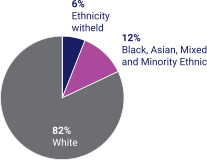
To be consistent with the Higher Education Statistical Authority (body responsible for analysis of higher education in UK and a useful comparator/benchmark for UKRI), census categories and other public bodies, UKRI uses the terms, ‘Black, Asian, Mixed and minority ethnic’ when presenting summary data rather than using the specific categories of data collected.
Staff numbers by disability
As at 31 March 2026, 672 (8%) staff shared their disability identity on our central people and payroll systems. Although numbers of staff reporting a disability have increased slightly as a result in updated Fusion lists of values, the presentation of the personal details in Fusion has not made it clear that staff should share ‘No’ disability where appropriate, leading to a large increase in data being ‘not reported’ for disability.
| Disability | Year end staff | Percentage |
|---|---|---|
| Yes | 292 | 3.3% |
| No | 224 | 2.5% |
| Disability withheld | 156 | 1.8% |
| Disability not reported | 8,181 | 92.4% |
| Total | 8,853 | 100% |
Distribution of staff sharing disability details
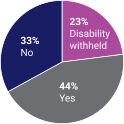
Staff turnover
| Turnover | 2025-26 | 2024-25 |
|---|---|---|
| All staff turnover | 12.3% | 13.5% |
| Employee turnover | 9.9% | 10.4% |
| Resignation rate | 4.7% | 4.8% |
Turnover in 2025-26 was very similar overall compared to 2024-25. With changes to historical patterns of exits in science-facing areas being sustained for a third year, turnover rates are now consistently comparable to professional support roles. This has been attributed to the impact of people initiatives such as the STEM pay scale introduction, Talent Attraction Framework and other local retention initiatives. Although similar across the year as a whole there is an indication that turnover is slowing with the number of Q4 leavers being below historical norms.
UKRI has some known turnover hotspots:
Despite the significant improvements, turnover is above appetite in STEM areas. We believe that for junior staff the perceived lack of career progression and pay progression are key drivers; and for world-class senior scientists, we still cannot directly compete on pay rates with the private sector. UKRI has initiated a number of interventions to address this. In partnership with DSIT, the STEM pay case has reduced compensation disparities with our competitors, particularly across specialist and niche technical areas. Further steps on pay include aims to link pay to competences and career development to ensure key talent investments are retained. UKRI has also focused on growing internal talent to improve retention and maintain strong corporate memory. Out of 1,569 appointments in 2025-26, 593 (38%) were to an internal candidate of which 270 (17%) were on promotion.
Within research-facing roles, turnover is typically highest within the early career grades (Bands A-D). Turnover then declines in the junior leadership (Bands E and F). Band F has the lowest average turnover for research-facing roles.
Given the challenges in recruiting ‘Science’ staff, we would consider all turnover in these areas to be ‘high’, but targeted resourcing activity and initiatives such as the Talent Attraction Framework’ have ensured the staffing levels in these areas are mostly stable.
Conversely in professional support areas, Band F has one of the highest turnover rates. There are particularly elevated rates of turnover within IT and Systems, Change and Projects, Analysis and Estates functions.
Turnover is highest in ‘Other’ grades which comprise contingent labour and other temporary non-standard contracts (such as NERC Mariners). The short duration of these contracts and the points at which they’re retained mean turnover in specific areas can exceed 100% in a year. Although this means the turnover rate is high, these are largely planned exits in line with project timetables and no specific action is being undertaken to change these rates.
Reporting of civil service and other comprehensive schemes – exit packages
Audited information
Exit package cost band | Number of compulsory redundancies 2025-26 | Number of compulsory redundancies 2024-25 | Number of other departures agreed 2025-26 | Number of other departures agreed 2024-25 | Total number of exit packages by cost band 2025-26 | Total number of exit packages by cost band 2024-25 |
|---|---|---|---|---|---|---|
| <£10k | 3 | - | 26 | 13 | 29 | 13 |
| £10k-£25k | 13 | 1 | 64 | 36 | 77 | 37 |
| £25k-£50k | 10 | 3 | 41 | 32 | 51 | 35 |
| £50k-£100k | 5 | 1 | 45 | 51 | 50 | 52 |
| £100k-£150k | - | - | 5 | 3 | 5 | 3 |
| £150k+ | - | - | - | 1 | - | 1 |
| Total no. by type | 31 | 5 | 181 | 136 | 212 | 141 |
| Total value of exit packages accounted for in year (£) | 894,731 | 187,835 | 7,018,055 | 6,381,604 | 7,912,786 | 6,569,439 |
The table above shows the total cost of exit packages agreed and accounted for in 2025-26 (2024-25 comparative figures are also given). £5,302,454 exit costs were paid in 2025-26, the year of departure (2024-25: £6,464,970). 2024-25 figures have been updated to take into account exit packages that were omitted
Redundancy costs have been paid in accordance with either the provisions of the Research Councils Compensation Scheme, which mirrors the terms of the Principal Civil Service Compensation Scheme, a statutory scheme made under the Superannuation Act 1972, or the provisions of the Medical Research Council Redundancy Compensation Scheme.
Cabinet Office approval was granted to run a voluntary exit scheme in 2025-26 and was launched in summer 2025. The scheme was launched as part of efforts to resolve a £75 million funding gap in STFC and the first wave of voluntary exits was achieved in February 2026. These 84 exits are part of a commitment to reduce FTE in STFC from 3,211 at December 2024 to 3,051.
As well as the ongoing prioritisation exercise which will inform STFC’s future portfolio, the VE Scheme is a key part of a broader transformation plan and will help address some of our immediate challenges. It offers eligible staff the opportunity to leave the organisation on a voluntary basis with a financial package, while supporting our goal of aligning our headcount with our future needs in a managed way.
Health and safety
We work together in innovative ways to deliver an ambitious agenda, drawing on the depth and breadth of our expertise and the diversity of our portfolio. We are committed to maintaining high standards of health, safety and wellbeing for our employees and for all those who work with us or may be affected by our activities.
Performance: health and safety
UKRI has continued to transition towards more agile and hybrid ways of working. Health and Safety (H&S) teams support our people to ensure they continue to work safely. Within our operational research environments, the Natural Environment Research Council’s British Antarctic Survey and British Geological Survey have continued to maintain certification to the ISO 45001 Health and Safety Management Systems standard, providing assurance that robust controls are in place to manage risk.
UKRI delivers a coordinated, organisational wide Health and Safety programme through a federated model that recognises the different contexts in which our people work. Oversight is provided by the Health and Safety Management Committee (HSMC) and the Health and Safety Consultation Committee (HSCC), which focus on the effectiveness of arrangements, review policy, and oversee targeted audits. The HSCC meets formally once per year with regular locally delegated engagement taking place throughout the year. Health and safety performance and emerging issues are reported through established governance routes to the Executive Committee, the Audit, Risk and Assurance Committee (ARAC), and the UKRI Board.
During financial year 2025-26, injury incidents reduced while non injury reporting increased, reflecting a positive and open reporting culture in which people feel encouraged to report incidents and learn from them. The average injury incident rate was 27 per 1,000 staff, with a non injury incident rate of 147 per 1,000 staff. Most reported incidents were minor in nature. Regulatory reportable incidents also reduced overall, with three injuries reported to the Health and Safety Executive (HSE) during the FY, remaining below the HSE national benchmark.
An HSE Improvement Notice, relating to exposure to metalworking fluids under the Control of Substances Hazardous to Health Regulations 2002, was received early in the year. This was addressed and complied with within the required timeframe, and additional controls have been implemented to strengthen protections and reduce the likelihood of recurrence.
Expenditure on consultancy
Expenditure on consultancy in 2025-26 was £397,640 (2024-25: £105,659). The increase in year is due to work on business cases and wider programme collaboration.
Expenditure on contingent labour
Expenditure on contingent labour in 2025-26 was £43.1 million (2024-25: £49.9 million) and shows a small decrease as some transformation programmes ended.
Off-payroll engagements (more than £245 per day and longer than six months)
All payroll workers at UKRI are on arrangements in which supplier agencies process their payments through PAYE to ensure full tax compliance. The only exception to this is in the rare cases where the HMRC Tool has shown that an off-payroll worker’s engagement arrangements fall outside of the scope of the Intermediaries Legislation IR35.
Fourteen workers were identified as being subject to this circumstance in 2025-26 of which 12 were confirmed as paid more than £245 per day. One has since left and 11 were still retained on 31 March 2026. All workers identified were subject to off-payroll legislation.
Table 1: Highly paid off-payroll worker engagements as at 31 March 2026, earning £245 per day or greater
| Highly paid off-payroll worker engagements | UKRI |
|---|---|
| Number of existing engagements as of 31 March 2026 | 269 |
| Of which: | |
| Number that have existed for less than one year at time of reporting | 108 |
| Number that have existed for between one and two years at time of reporting | 54 |
| Number that have existed for between two and three years at time of reporting | 34 |
| Number that have existed for between three and four years at time of reporting | 27 |
| Number that have existed for four or more years at time of reporting | 46 |
Table 2: All highly paid off-payroll workers engaged at any point during the year ended 31 March 2026, earning £245 per day or greater (Source: FREM 25-26 6.5.40)
| Highly paid off-payroll workers engaged | UKRI |
|---|---|
| Number of temporary off-payroll workers engaged during the year ended 31 March 2026 | 350 |
| Of which: | |
| Number not subject to off-payroll legislation | - |
| Number subject to off-payroll legislation and determined as in-scope of IR35 | 338 |
| Number subject to off-payroll legislation and determined as out-of-scope of IR35 | 12 |
| Number of engagements reassessed for compliance or assurance purposes during the year | 33 |
| Of which: number of engagements that saw a change to IR35 status following review | - |
Table 3: For any off-payroll engagements of board members or senior officials with significant financial responsibility, between 1 April 2025 and 31 March 2026 (Source: FREM 25-26 6.5.44)
| Off-payroll engagements of board members or senior officials with significant financial responsibility | UKRI |
|---|---|
| Number of off-payroll engagements of board members or senior officials with significant financial responsibility, during the financial year (1) | - |
| Total number of individuals on payroll and off-payroll that have been deemed ‘board members or senior officials with significant financial responsibility’, during the financial year. This figure should include both on payroll and off-payroll engagements. (2) | 23 |
Employee engagement
People are central to the success of UKRI, and the organisation is working to establish a range of communications and engagement channels to ensure staff understand the importance of what they do and can connect their contributions to the success of UKRI’s strategic objectives. We are committed to effective engagement with staff and taking forward their suggestions and ideas. We do this through:
- Day-to-day leadership and management at every level in the organisation
- An effective partnership with recognised Trade Unions through a Joint National Consultative Committee, which represents staff on a range of matters including pay, benefits, pensions and organisational change
- Regular updates to staff by senior executives which are accessible by all staff irrespective of their working location. This provides staff with updates on corporate initiatives and also provides the opportunity for employees to ask challenging questions of the executive
- ‘The Source’ providing a central online portal for all UKRI staff, covering news, events and resources, complemented by additional material for each local business area
- The ‘Viva Engage’ platform, facilitating networking and social interaction amount UKRI staff
People survey
As an NDPB, UKRI does not participate in the Civil Service People Survey.
Through an independent market research company, DJS, UKRI ran the 2025 People Survey. The survey is the annual centrepiece of an ongoing programme of employee engagement, which seeks out and responds to colleagues’ views. This insight helps shape our priorities for change throughout the organisation. UKRI understands that different areas of our organisation have different strengths and face different challenges. DJS Research have been working with colleagues throughout UKRI to design a survey that is relevant for all parts of the organisation.
The Employee Engagement team work with a network of Champions from across UKRI to develop and support localised action plans in each part of the organisation in response to the survey’s findings.
Participation in the 2025 survey declined compared with 2024, falling from 59% to 53%. Overall, the 2025 results present a largely consistent picture with the previous year, although there are several points to note.
There has been modest improvement in a number of areas. Satisfaction with diversity and inclusion has increased, suggesting slightly greater confidence than in previous years. Satisfaction with pay and reward has also risen. The Employee Engagement Index has increased to 59, its highest level to date and one point higher than in 2024, although it remains below the Civil Service average.
Wellbeing indicators have broadly stabilised or shown slight improvement following the decline observed in 2023. This includes a notable increase in agreement that UKRI cares about colleague wellbeing and attributed to the growing number of wellbeing champions and more consistent offering across UKRI.
Several areas show some decline and continue to present challenges. Satisfaction with senior leadership decreased, particularly across several of the larger councils, negatively influencing broader organisational perceptions. Satisfaction with development and progression opportunities has also fallen. Perceptions of organisational processes have declined further, with only 34% of respondents agreeing that processes support efficient working, compared to 40% who disagree. This is the first time since the survey began in 2022 that disagreement has exceeded agreement on this measure.
Free text comments highlight frustration with the rollout of Oracle Fusion and the limited prior consultation, as well as the ongoing workarounds required for The Funding Service, and the resulting knock on impacts on efficiency and morale.
As in previous years, there remains significant variation in responses at local council level.
The 2025-26 period has been one of transition, Professor Sir Ian Chapman took up post as Chief Executive alongside other key members of the Senior Leadership team in the same month the survey was launched. As a result, there has been limited opportunity for the new leadership group to address the staff survey findings at a UKRI wide level.
Staff policies
Policies are being reviewed and updated to reflect best practice and improve clarity.
Policies are assessed against best practice, including language. They incorporate feedback received from staff, staff networks, HR and Trade Unions. UKRI is a disability confident employer and ensures full and fair consideration to applications made by disabled people. UKRI monitors casework and provides a ‘reasonable adjustment toolkit’ to managers to support continuing employment of staff that become disabled during the period of their employment. This activity is support by various disability related staff networks throughout UKRI.
Learning and development
Learning and development opportunities are available to all UKRI employees, covering core skills, compliance training, leadership and management development, vocational training, apprenticeships and specialist skills.
As part of UKRI’s future workspace discussions, uncertainty from line managers, particularly around having re-entry conversations and the structuring of work in a hybrid world, was tackled through extended support from the then Learning and Development team. The team implemented a range of activities and signposted line managers to them. These activities, supported line managers as individuals, as well as providing team and self-directed support.
Leadership training programmes have continued to be a focus for UKRI in 2025-26. This included follow-ups to the 2023-24 launches of Leadership Through Change Phase 2 & conclusion of Emerging Leadership Programme (ELP) and Inspirational Leadership Programme (ILP) pilots, with additional schemes being run based on findings from the initial cohorts. These initiatives are a suite of leadership development programmes connected with the purpose of equipping leaders throughout UKRI to drive the changes required to achieve our vision of creating an outstanding research and innovation system in the UK.
Analysis of the 2024-25 scheme indicated that the leadership training positively affects promotion, with the increase in promotion from Internal moves. Additionally, there is a high proportion of Level Transfer from both Internal Move and Intra-Area Move In showing a correlation between staff mobility and these programmes, so continued investment in these programmes is building a strong leadership capability in UKRI.
Wellbeing
The UKRI Wellbeing team has responsibility for leading Wellbeing activities and initiatives across UKRI, signposting resources to support line managers in having confident conversations with their teams.
UKRI’s Wellbeing Plan aims to create a healthy workplace that supports the physical, mental, social and financial wellbeing of our people where they can flourish and reach their potential. This will in turn create a healthier and more resilient workforce, who can deliver UKRI priorities and contribute to UKRI’s strategic objective to create a world-class organisation.
UKRI has increased coverage of ‘wellbeing champions’ throughout 2025-26. These champions encourage a clear and consistent approach to Wellbeing across UKRI, enabling activity to be aligned to both the needs of the organisation and those of our employees.
This approach enables Councils to structure their wellbeing provision, to be consistent and increase the impact of wellbeing intervention across UKRI.
The benefits of an effective Wellbeing provision include a reduction in absenteeism, creating a happier workforce, boosting productivity and motivation, attracting as well as retaining talent, and improving employee engagement. All are essential to UKRI’s Employee Experience.
Equality, diversity and inclusion (EDI)
Our Workforce EDI plan sets out how we will build a more inclusive culture at UKRI, to offer opportunity for all, and to develop the diversity of people and thought we need to be a world-class organisation. We have been able to drive this work through a series of projects understanding staff experiences and started to develop more targeted actions to make UKRI a more inclusive organisation.
Trade unions
UKRI has a recognition agreement with the following Trade Unions: The British Medical Association (BMA), The FDA, Prospect, The Public and Commercial Services Union (PCS), Unite the Union (Unite), The University and College Union (UCU), Nautilus International (Nautilus), and The Rail, Maritime and Transport Union (RMT) for the purposes of collective bargaining. UKRI also recognises the Independent Pilots’ Union (IPA) for collective bargaining with BAS pilots. UKRI engages with unions through a Joint Negotiation and Consultative Committee at an organisational level, Local Joint Consultative Committees at some sites, and Joint Council Consultative Committees at Council level.
Senior civil servant pay structure
| Minimum (£) | Maximum (£) | Number of staff | On payroll | Off payroll |
|---|---|---|---|---|
| £70,001 | £80,000 | 3 | 3 | - |
| £80,001 | £90,000 | - | - | - |
| £90,001 | £100,000 | 37 | 34 | 3 |
| £100,001 | £110,000 | 41 | 41 | - |
| £110,000 | £120,000 | 24 | 23 | 1 |
| £120,001 | £130,000 | 22 | 20 | 2 |
| £130,001 | £140,000 | 11 | 11 | - |
| £140,001 | £150,000 | 7 | 6 | 1 |
| £150,001 | £160,000 | 3 | 3 | - |
| £160,001 | £170,000 | 5 | 4 | 1 |
| £170,001 | £180,000 | - | - | - |
| £180,001 | £190,000 | 1 | - | 1 |
| £190,001 | £200,000 | - | - | - |
| £200,001 | - | 5 | 3 | 2 |
Table Notes:
Based on Full Time Equivalent salary as at 31 March 2026 not pro rata amount. SCS identified based on UKRI band equivalents X,Y or Contingent Labour ‘Other’ bands where the CL occupant has line management responsibility equivalent to a substantive senior civil servant.
Parliamentary Accountability and Audit Report
The Parliamentary Accountability and Audit Report brings together key accountability documents including:
- Parliamentary accountability disclosures
- The Certificate and Report of the Comptroller and Auditor General to the House of Commons
Regularity of expenditure
UKRI expenditure is compliant with the framework of authorities against which we are audited. This includes any relevant legislation, legal principles, such as subsidy control, procurement law or other legal requirements, and HM Treasury consent where required.
Losses and special payments: audited information
The total losses and special payments incurred by UKRI in the year were £2,598,743 (2024-25: £416,947). Three special payments including one special severance payment of £44,926 and an ex-gratia payment of £23,657 were made during 2025-26. One individual loss exceeded £300,000. This £1,817,533 relates to the net impact of written-off debts for Advanced Oncotherapy PLC, the company entered into a 15-year lease agreement, with UKRI, for the use of part of a building. The company are now in administration with 0% expectation of any receipt of funds as an unsecured creditor. Secured creditors will be paid a very small % in the £.
Gifts
There were no gifts made by UKRI above £300,000.
Remote contingent liabilities: audited information
In addition to contingent liabilities reported within the meaning of IAS 37, we also report liabilities for which the likelihood of a transfer of economic benefit in settlement is too remote to meet the definition of contingent liability.
UKRI had one remote contingent liability at 31 March 2026.
UKRI (STFC) collaborates with international partners in the funding, management and operation of technical facilities which are not owned by UKRI. In the event of a decision to withdraw from any of these arrangements, it is likely that UKRI would assist in the search for a replacement partner to ensure that technical commitments were met. The most significant international collaborations are in respect of the European Organisation for Nuclear Research (CERN) and the European Southern Observatory (ESO). For both facilities there is the possibility that we would be obliged to contribute to decommissioning costs arising from a decision taken to discontinue operations. The decisions to decommission are not wholly within UKRI’s control.
Audit fees: audited information
The cost of the external audit for UKRI was £641,000 (2024-25: £548,000), the statutory audit fee for STFC Innovations Ltd (SIL) was £16,400 (2024-25: £17,500) and the statutory audit fee for Innovate UK Loans Limited was £151,000 (2024-25: £147,000) and the statutory audit fee for Innovate UK Business Connect was £38,148 (2024-25: £29,750). During the year, £5,200 has been accrued for the statutory audit of one predecessor body not closed at 31 March 2026. All of the above fees exclude VAT. VAT is charged to UKRI and the predecessor bodies at 0% and Innovate UK Loans Limited, SIL and Innovate UK Business Connect at 20%.
Remuneration of £6,050 (2024-25: £3,500) for Innovate UK Business Connect’s external auditors and £4,920 (2024-25: £6,000) for SIL’s external auditors for non-audit work carried out for Innovate UK Business Connect and SIL respectively, these figures exclude VAT charged at 20%.
Fees and charges: audited information
Fees are set to comply with the cost allocation and charging requirements set out in HM Treasury and Office of Public Sector Information guidance.
Facilities are offered to EU users, commercial users and external users. Users are charged a unit cost based on direct operating costs and annual quantity of access, with an allowance for overheads.
Disclosure does not include recovery from other bodies to cover direct costs of grants paid from programmes funded jointly with other organisations.
We have identified £48,456,904 material items to which disclosure requirements apply in 2025-26.
STFC: other income
Programme delivery, scientific facilities, goods and services are offered to EU users, other government departments, commercial users and external users.
The default position for facilities, goods and services provided is that users are charged a cost based on direct operating costs and annual quantity of access, with an allowance for overheads to achieve full economic cost recovery.
Prices for facilities, goods and services provided by STFC are calculated to differentiate between the type of service and access charged for.
| Income item | £ | Description |
|---|---|---|
| STFC – other income | £29,325,270 | Charged for facilities and goods and services |
Innovate UK: programme delivery recharge
Innovate UK recharged Other Government Departments to recover the costs arising from the evaluation, assessment and monitoring of grants issued to meet the common policy objectives of UKRI and relevant Other Government Departments and EU grant awarders.
Agreements with Other Government Departments relating to revenue seek to cover incurred direct and indirect costs, either by direct recharge of costs incurred retrospectively or via a formula contribution to costs associated with the programme.
No subsidy or overcharging arose from provisions of relevant facilities, goods and services
| Income item | £ | Description |
|---|---|---|
| Innovate UK – programme delivery recharge | £19,131,634 | Recharges for grant delivery costs |
Government functional standards
Government Functions enable excellence and consistency in the delivery of public services. Functional standards are set by each function to provide direction and advice for people working in and with the UK government. They bring together and clarify what needs to be done, and why, for different types of functional work. They are mandated for use in departments and their arm’s length bodies. UKRI maintains self-assessments against each functional standard and actions are in place to better align to functional standards where our practices are not consistent with mandatory requirements.
Professor Sir Ian Chapman
Chief Executive and Accounting Officer
7 July 2026
THE CERTIFICATE AND REPORT OF THE COMPTROLLER AND AUDITOR GENERAL TO THE HOUSES OF PARLIAMENT
Opinion on financial statements
I certify that I have audited the financial statements of UK Research and Innovation and its Group for the year ended 31 March 2026 under the Higher Education and Research Act 2017.
The financial statements comprise UK Research and Innovation and its Group’s:
- Consolidated Statement of Financial Position as at 31 March 2026;
- Consolidated Statement of Comprehensive Net Expenditure, Consolidated Statement of Cash Flows and Consolidated Statement of Changes in Taxpayers’ Equity for the year then ended; and
- the related notes including the significant accounting policies.
The financial reporting framework that has been applied in the preparation of the Group financial statements is applicable law and UK adopted International Accounting Standards.
In my opinion, the financial statements:
- give a true and fair view of the state of UK Research and Innovation and its Group’s affairs as at 31 March 2026 and their net expenditure for the year then ended; and
- have been properly prepared in accordance with the Higher Education and Research Act 2017 and Secretary of State directions issued thereunder.
Opinion on regularity
In my opinion, in all material respects, the income and expenditure recorded in the financial statements have been applied to the purposes intended by Parliament and the financial transactions recorded in the financial statements conform to the authorities which govern them.
Basis for opinions
I conducted my audit in accordance with International Standards on Auditing (UK) (ISAs UK), applicable law and Practice Note 10 Audit of Financial Statements and Regularity of Public Sector Bodies in the UK (2024). My responsibilities under those standards are further described in the Auditor’s responsibilities for the audit of the financial statements section of my certificate.
Those standards require me and my staff to comply with the Financial Reporting Council’s Revised Ethical Standard 2024. I am independent of UK Research and Innovation and its Group in accordance with the ethical requirements that are relevant to my audit of the financial statements in the UK. My staff and I have fulfilled our other ethical responsibilities in accordance with these requirements.
I believe that the audit evidence I have obtained is sufficient and appropriate to provide a basis for my opinion.
Conclusions relating to going concern
In auditing the financial statements, I have concluded that UK Research and Innovation and its Group’s use of the going concern basis of accounting in the preparation of the financial statements is appropriate.
Based on the work I have performed, I have not identified any material uncertainties relating to events or conditions that, individually or collectively, may cast significant doubt on UK Research and Innovation and its Group’s ability to continue as a going concern for a period of at least twelve months from when the financial statements are authorised for issue.
My responsibilities and the responsibilities of the Accounting Officer with respect to going concern are described in the relevant sections of this certificate.
The going concern basis of accounting for UK Research and Innovation and its Group is adopted in consideration of the requirements set out in HM Treasury’s Government Financial Reporting Manual, which requires entities to adopt the going concern basis of accounting in the preparation of the financial statements where it is anticipated that the services which they provide will continue into the future.
Other information
The other information comprises information included in the Annual Report, but does not include the financial statements and my auditor’s certificate thereon. The Accounting Officer is responsible for the other information.
My opinion on the financial statements does not cover the other information and, except to the extent otherwise explicitly stated in my certificate, I do not express any form of assurance conclusion thereon.
My responsibility is to read the other information and, in doing so, consider whether the other information is materially inconsistent with the financial statements or my knowledge obtained in the audit, or otherwise appears to be materially misstated.
If I identify such material inconsistencies or apparent material misstatements, I am required to determine whether this gives rise to a material misstatement in the financial statements themselves. If, based on the work I have performed, I conclude that there is a material misstatement of this other information, I am required to report that fact.
I have nothing to report in this regard.
Opinion on other matters
In my opinion the part of the Remuneration and Staff Report to be audited has been properly prepared in accordance with Secretary of State directions issued under the Higher Education and Research Act 2017.
In my opinion, based on the work undertaken in the course of the audit:
- the parts of the Accountability Report subject to audit have been properly prepared in accordance with Secretary of State directions made under the Higher Education and Research Act 2017; and
- the information given in the Performance and Accountability Reports for the financial year for which the financial statements are prepared is consistent with the financial statements and is in accordance with the applicable legal requirements.
Matters on which I report by exception
In the light of the knowledge and understanding of UK Research and Innovation and its Group and their environment obtained in the course of the audit, I have not identified material misstatements in the Performance and Accountability Reports.
I have nothing to report in respect of the following matters which I report to you if, in my opinion:
- adequate accounting records have not been kept by UK Research and Innovation and its Group or returns adequate for my audit have not been received from branches not visited by my staff; or
- I have not received all of the information and explanations I require for my audit; or
- the financial statements and the parts of the Accountability Report subject to audit are not in agreement with the accounting records and returns; or
- certain disclosures of remuneration specified by HM Treasury’s Government Financial Reporting Manual have not been made or parts of the Remuneration and Staff Report to be audited is not in agreement with the accounting records and returns; or
- the Governance Statement does not reflect compliance with HM Treasury’s guidance.
Responsibilities of the Accounting Officer for the financial statements
As explained more fully in the Statement of Accounting Officer’s Responsibilities, the Accounting Officer is responsible for:
- maintaining proper accounting records;
- providing the C&AG with access to all information of which management is aware that is relevant to the preparation of the financial statements such as records, documentation and other matters;
- providing the C&AG with additional information and explanations needed for his audit;
- providing the C&AG with unrestricted access to persons within UK Research and Innovation and its Group from whom the auditor determines it necessary to obtain audit evidence;
- ensuring such internal controls are in place as deemed necessary to enable the preparation of financial statements to be free from material misstatement, whether due to fraud or error;
- preparing financial statements which give a true and fair view in accordance with Secretary of State directions issued under the Higher Education and Research Act 2017;
- preparing the annual report, which includes the Remuneration and Staff Report, in accordance with Secretary of State directions issued under the Higher Education and Research Act 2017; and
- assessing UK Research and Innovation and its Group’s ability to continue as a going concern, disclosing, as applicable, matters related to going concern and using the going concern basis of accounting unless the Accounting Officer anticipates that the services provided by UK Research and Innovation and its Group will not continue to be provided in the future.
Auditor’s responsibilities for the audit of the financial statements
My responsibility is to audit, certify and report on the financial statements in accordance with the Higher Education and Research Act 2017.
My objectives are to obtain reasonable assurance about whether the financial statements as a whole are free from material misstatement, whether due to fraud or error, and to issue a certificate that includes my opinion. Reasonable assurance is a high level of assurance but is not a guarantee that an audit conducted in accordance with ISAs (UK) will always detect a material misstatement when it exists. Misstatements can arise from fraud or error and are considered material if, individually or in the aggregate, they could reasonably be expected to influence the economic decisions of users taken on the basis of these financial statements.
Extent to which the audit was considered capable of detecting non-compliance with laws and regulations including fraud
I design procedures in line with my responsibilities, outlined above, to detect material misstatements in respect of non-compliance with laws and regulations, including fraud. The extent to which my procedures are capable of detecting non-compliance with laws and regulations, including fraud is detailed below.
Identifying and assessing potential risks related to non-compliance with laws and regulations, including fraud
In identifying and assessing risks of material misstatement in respect of non-compliance with laws and regulations, including fraud, I:
- considered the nature of the sector, control environment and operational performance including the design of UK Research and Innovation and its Group’s accounting policies.
- inquired of management, UK Research and Innovation’s head of internal audit and those charged with governance, including obtaining and reviewing supporting documentation relating to UK Research and Innovation and its Group’s policies and procedures on:
- identifying, evaluating and complying with laws and regulations;
- detecting and responding to the risks of fraud; and
- the internal controls established to mitigate risks related to fraud or non-compliance with laws and regulations including UK Research and Innovation and its Group’s controls relating to UK Research and Innovation’s compliance with the Higher Education and Research Act 2017, and Managing Public Money;
- inquired of management, UK Research and Innovation’s head of internal audit and those charged with governance whether:
- they were aware of any instances of non-compliance with laws and regulations;
- they had knowledge of any actual, suspected, or alleged fraud;
- discussed with the engagement team including relevant component audit teams regarding how and where fraud might occur in the financial statements and any potential indicators of fraud.
As a result of these procedures, I considered the opportunities and incentives that may exist within UK Research and Innovation and its Group for fraud and identified the greatest potential for fraud in the following areas: revenue recognition, posting of unusual journals, complex transactions, bias in management estimates and recognition of grant expenditure. In common with all audits under ISAs (UK), I am required to perform specific procedures to respond to the risk of management override.
I obtained an understanding of UK Research and Innovation and its Group’s framework of authority and other legal and regulatory frameworks in which UK Research and Innovation and its Group operate. I focused on those laws and regulations that had a direct effect on material amounts and disclosures in the financial statements or that had a fundamental effect on the operations of UK Research and Innovation and its Group. The key laws and regulations I considered in this context included the Higher Education and Research Act 2017, Managing Public Money, employment law, pensions legislation and tax legislation.
Audit response to identified risk
To respond to the identified risks resulting from the above procedures:
- I reviewed the financial statement disclosures and testing to supporting documentation to assess compliance with provisions of relevant laws and regulations described above as having direct effect on the financial statements;
- I enquired of management, the Audit and Risk Assurance Committee concerning actual and potential litigation and claims;
- I reviewed minutes of meetings of those charged with governance and the Board and internal audit reports;
- I addressed the risk of fraud through management override of controls by testing the appropriateness of journal entries and other adjustments; assessing whether the judgements on estimates are indicative of a potential bias; and evaluating the business rationale of any significant transactions that are unusual or outside the normal course of business; and
- I reviewed the reports produced by the in-house Funding Assurance and Counter Fraud teams and made enquiries of management based on my review.
I communicated relevant identified laws and regulations and potential risks of fraud to all engagement team members including significant component audit teams and remained alert to any indications of fraud or non-compliance with laws and regulations throughout the audit.
A further description of my responsibilities for the audit of the financial statements is located on the Financial Reporting Council’s website. This description forms part of my certificate.
Other auditor’s responsibilities
I am required to obtain sufficient appropriate audit evidence to give reasonable assurance that the expenditure and income recorded in the financial statements have been applied to the purposes intended by Parliament and the financial transactions recorded in the financial statements conform to the authorities which govern them.
I communicate with those charged with governance regarding, among other matters, the planned scope and timing of the audit and significant audit findings, including any significant deficiencies in internal control I identify during my audit.
Report
I have no observations to make on these financial statements.
Gareth Davies
Comptroller and Auditor General
Date: 10 July 2026
National Audit Office
157-197 Buckingham Palace Road
Victoria
London SW1W 9SP
4. Financial statements
Consolidated Statement of Comprehensive Net Expenditure for the year ended 31 March 2026
Comprehensive net expenditure 2025-26
| Expenditure | Note | 2025-26 UKRI (£000) | 2025-26 Consolidated (£000) | 2024-25 UKRI (£000) | 2024-25 Consolidated (£000) |
|---|---|---|---|---|---|
| Total operating income | 2 | -774,148 | -837,538 | -868,770 | -925,187 |
| Staff costs | 3 | 626,107 | 651,227 | 594,851 | 616,687 |
| Purchase of goods and services | 4.1 | 738,133 | 753,678 | 750,426 | 765,680 |
| Depreciation and impairment charges | 4.2 | 300,461 | 315,023 | 225,067 | 236,258 |
| Research and Innovation | 4.3 | 8,687,134 | 8,690,168 | 9,202,306 | 9,208,247 |
| Provision expense | 4.4 | -2,935 | 2,506 | 12,858 | 13,027 |
| Other operating expenditure | 4.5 | -46,782 | -46,782 | -36,461 | -36,397 |
| 10,302,118 | 10,365,820 | 10,749,047 | 10,803,502 | ||
| Net operating expenditure | 9,527,970 | 9,528,282 | 9,880,277 | 9,878,315 | |
| Taxation | 5 | 13,552 | 12,289 | 9,232 | 9,196 |
| Finance income | -2,657 | -7,349 | -1,623 | -6,423 | |
| Finance expenditure | -40,495 | -30,352 | -29,054 | -21,836 | |
| Net expenditure for the period | 9,498,370 | 9,502,870 | 9,858,832 | 9,859,252 |
Comprehensive net expenditure 2025-26: other comprehensive expenditure
| Expenditure | 2025-26 UKRI (£000) | 2025-26 Consolidated (£000) | 2024-25 UKRI (£000) | 2024-25 Consolidated (£000) |
|---|---|---|---|---|
| Net (gain)/loss on revaluation of property, plant and equipment | -76,326 | -76,362 | -49,986 | -49,986 |
| Net loss/(gain) on revaluation of intangible assets | -15,381 | -15,381 | -84,572 | -84,572 |
| Net (gain)/loss on revaluation of investments | -4,466 | -4,819 | 5,679 | 7,830 |
| Cash flow hedge | -20,680 | -20,680 | -2,021 | -2,021 |
| Actuarial (gain)/loss on defined benefit pension plan | -17,599 | -17,599 | -48,984 | -48,984 |
| Total comprehensive net expenditure for the period | 9,363,918 | 9,368,029 | 9,678,948 | 9,681,519 |
Consolidated Statement of Financial Position for the year ended 31 March 2026
Consolidated statement of financial position 2025-26: non-current assets
| Non-current assets | Note | 2025-26 UKRI (£000) | 2025-26 Consolidated (£000) | 2024-25 UKRI (£000) restated | 2024-25 Consolidated (£000) restated |
|---|---|---|---|---|---|
| Property, plant and equipment | 6 | 3,495,354 | 3,496,152 | 3,455,652 | 3,456,107 |
| Intangible assets | 7 | 155,338 | 155,338 | 168,103 | 168,103 |
| Investment property | 5,670 | 5,670 | 5,695 | 5,695 | |
| Investments in group undertakings | 8 | 925,442 | 932,703 | 874,232 | 881,115 |
| Financial assets | 9 | 11,399 | 126,514 | 11,399 | 131,322 |
| Pension asset | 10 | 957,247 | 957,247 | 893,838 | 893,838 |
| Trade and other receivables | 11 | 136,947 | 20,861 | 127,079 | - |
| 5,687,397 | 5,694,485 | 5,535,998 | 5,536,180 |
Consolidated statement of financial position 2025-26: current assets
| Current assets | Note | 2025-26 UKRI (£000) | 2025-26 Consolidated (£000) | 2024-25 UKRI (£000) restated | 2024-25 Consolidated (£000) restated |
|---|---|---|---|---|---|
| Assets held for sale | - | - | 282 | 282 | |
| Derivatives | 15,822 | 15,822 | - | - | |
| Trade and other receivables | 11 | 883,168 | 900,365 | 960,289 | 966,746 |
| Cash and cash equivalents | 12 | 673,928 | 691,300 | 508,770 | 529,812 |
| 1,572,918 | 1,607,487 | 1,469,341 | 1,496,840 | ||
| Total assets | 7,260,315 | 7,301,972 | 7,005,339 | 7,033,020 |
Consolidated statement of financial position 2025-26: current liabilities
| Current liabilities | Note | 2025-26 UKRI (£000) | 2025-26 Consolidated (£000) | 2024-25 UKRI (£000) restated | 2024-25 Consolidated (£000) restated |
|---|---|---|---|---|---|
| Trade and other payables | 13 | -1,319,990 | -1,354,313 | -1,558,497 | -1,580,359 |
| Derivatives | - | - | -4,858 | -4,858 | |
| Provisions | 14 | -16,549 | -24,706 | -18,317 | -21,034 |
| -1,336,539 | -1,379,019 | -1,581,672 | -1,606,251 | ||
| Total assets less current liabilities | 5,923,776 | 5,922,953 | 5,423,667 | 5,426,769 |
Consolidated statement of financial position 2025-26: non-current liabilities
| Non-current liabilities | Note | 2025-26 UKRI (£000) | 2025-26 Consolidated (£000) | 2024-25 UKRI (£000) restated | 2024-25 Consolidated (£000) restated |
|---|---|---|---|---|---|
| Trade and other payables | 13 | -144,414 | -144,874 | -125,802 | -126,084 |
| Derivatives | - | - | - | - | |
| Provisions | 14 | -180,109 | -180,109 | -179,361 | -179,361 |
| -324,523 | -324,983 | -305,163 | -305,445 | ||
| Total assets less total liabilities | 5,599,253 | 5,597,970 | 5,118,504 | 5,121,324 |
Consolidated statement of financial position 2025-26: taxpayers’ equity and other reserves
| Taxpayers' equity and other reserves | Note | 2025-26 UKRI (£000) | 2025-26 Consolidated (£000) | 2024-25 UKRI (£000) restated | 2024-25 Consolidated (£000) restated |
|---|---|---|---|---|---|
| General fund | -2,958,257 | -2,954,223 | -2,549,998 | -2,550,456 | |
| Revaluation reserve | -1,550,054 | -1,552,805 | -1,532,626 | -1,534,988 | |
| Intellectual property reserve | -133,695 | -133,695 | -142,042 | -142,042 | |
| Pension reserve | -957,247 | -957,247 | -893,838 | -893,838 | |
| Total reserves | -5,599,253 | -5,597,970 | -5,118,504 | -5,121,324 |
Table note: The figure of the restated amounts can be seen in Note 1.29.
Professor Sir Ian Chapman
Chief Executive and Accounting Officer
7 July 2026
Consolidated Statement of Cash Flows for the year ended 31 March 2026
Consolidated statement of cash flows 2025-26: cash flows from operating activities
| Cash flows from operating activities | Note | 2025-26 UKRI (£000) | 2025-26 Consolidated (£000) | 2024-25 UKRI (£000) | 2024-25 Consolidated (£000) |
|---|---|---|---|---|---|
| Net expenditure for the period | SoCNE | -9,498,370 | -9,502,870 | -9,858,832 | -9,859,252 |
| Adjustments for non-cash transactions | 15 | 207,733 | 233,364 | 157,755 | 177,036 |
| Decrease/(Increase) in trade and other receivables | 11 | 67,253 | 45,520 | -92,645 | -85,832 |
| (Decrease)/Increase in trade and other payables | 13 | -214,183 | -201,144 | 118,906 | 119,499 |
| (Decrease)/Increase in provisions | 14 | -1,019 | 4,420 | 15,665 | 15,832 |
| Net cash outflow from operating activities | -9,438,584 | -9,420,710 | -9,659,151 | -9,632,717 |
Consolidated statement of cash flows 2025-26: cash flows from investing activities
| Cash flows from investing activities | Note | 2025-26 UKRI (£000) | 2025-26 Consolidated (£000) | 2024-25 UKRI (£000) | 2024-25 Consolidated (£000) |
|---|---|---|---|---|---|
| Purchase of property, plant and equipment | 6 | -230,111 | -230,768 | -205,112 | -205,380 |
| Purchase of intangible assets | 7 | -2,864 | -2,864 | -13,604 | -13,604 |
| Purchase of investment property | - | - | - | - | |
| Investment in joint ventures | 8 | - | - | - | - |
| Other investments | 8 | - | -404 | - | -100 |
| Investment in Loans | 9.1 | - | -20,464 | - | -16,290 |
| Proceeds of disposal of investments | - | 377 | - | - | |
| Proceeds of disposal of assets held for sale | 282 | 282 | - | - | |
| Proceeds of disposal of property, plant and equipment | 73 | 73 | 774 | 774 | |
| Net cash outflow from investing activities | -232,620 | -253,768 | -217,942 | -234,600 | |
| Net cash outflow before financing activities | -9,671,204 | -9,674,478 | -9,877,093 | -9,867,317 |
Consolidated statement of cash flows 2025-26: cash flows from financing activities
| Cash flows from financing activities | Note | 2025-26 UKRI (£000) | 2025-26 Consolidated (£000) | 2024-25 UKRI (£000) | 2024-25 Consolidated (£000) |
|---|---|---|---|---|---|
| Grant-in-aid received from DSIT | 9,842,078 | 9,842,078 | 9,687,609 | 9,687,609 | |
| Lease repayments | -5,716 | -6,112 | -5,133 | -5,526 | |
| Net cash inflows from financing activities | 9,836,362 | 9,835,966 | 9,682,476 | 9,682,083 | |
| Net increase/(decrease) in cash and cash equivalents | 165,158 | 161,488 | -194,617 | -185,234 | |
| Cash and cash equivalents at the beginning of the period | 508,770 | 529,812 | 703,387 | 715,046 | |
| Cash and cash equivalents at the end of the period | 673,928 | 691,300 | 508,770 | 529,812 |
Consolidated Statement of Changes in Taxpayers’ Equity for the year ended 31 March 2026
Consolidated statement of changes in taxpayers’ equity 2025-26: consolidated
| Consolidated | General fund (£000) | Revaluation reserve (£000) | Pension reserve (£000) | Intellectual property reserve (£000) | Total reserves (£000) | |
|---|---|---|---|---|---|---|
| Balance at 1 April 2025 | -2,550,456 | -1,534,988 | -893,838 | -142,042 | -5,121,324 | |
| Retained surplus b/fwd from Subsidiary | -8 | - | - | - | -8 | |
| Grant-in-aid from DSIT | -9,842,078 | - | - | - | -9,842,078 | |
| Net expenditure for the period | 9,502,870 | - | - | - | 9,502,870 | |
| Movements in reserves: Net gain on revaluation of property, plant and equipment | 6 | - | -76,362 | - | - | -76,362 |
| Movements in reserves: Net gain on revaluation of intangible assets | 7 | - | - | - | -15,381 | -15,381 |
| Movements in reserves: Net loss on revaluation of investments | 8 | - | -4,819 | - | - | -4,819 |
| Movements in reserves: Cash flow hedge | - | -20,680 | - | - | -20,680 | |
| Movements in reserves: Actuarial gain in the pension scheme | 10 | - | - | -17,599 | - | -17,599 |
| Movements in reserves: Contributions from other employers in the pension scheme | - | - | -2,589 | - | -2,589 | |
| Movements in reserves: Transfers between reserves | -64,551 | 84,044 | -43,221 | 23,728 | - | |
| Balance at 31 March 2026 | -2,954,224 | -1,552,805 | -957,247 | -133,695 | -5,597,970 |
Consolidated statement of changes in taxpayers’ equity 2025-26: parent
| Parent | Note | General fund (£000) | Revaluation reserve (£000) | Pension reserve (£000) | Intellectual property reserve (£000) | Total reserves (£000) |
|---|---|---|---|---|---|---|
| Balance at 1 April 2025 | -2,549,998 | -1,532,626 | -893,838 | -142,042 | -5,118,504 | |
| Retained surplus b/fwd from Subsidiary | - | - | - | - | - | |
| Grant-in-aid from DSIT | -9,842,078 | - | - | - | -9,842,078 | |
| Net expenditure for the period | 9,498,370 | - | - | - | 9,498,370 | |
| Movements in reserves: Net gain on revaluation of property, plant and equipment | 6 | - | -76,326 | - | - | -76,326 |
| Movements in reserves: Net gain on revaluation of intangible assets | 7 | - | - | - | -15,381 | -15,381 |
| Movements in reserves: Net loss on revaluation of investments | 8 | - | -4,466 | - | - | -4,466 |
| Movements in reserves: Cash flow hedge | - | -20,680 | - | - | -20,680 | |
| Movements in reserves: Actuarial gain in the pension scheme | 10 | - | - | -17,599 | - | -17,599 |
| Movements in reserves: Contributions from other employers in the pension scheme | - | - | -2,589 | - | -2,589 | |
| Movements in reserves: Transfers between reserves | -64,551 | 84,044 | -43,221 | 23,728 | - | |
| Balance at 31 March 2026 | -2,958,257 | -1,550,054 | -957,247 | -133,695 | -5,599,254 |
Consolidated Statement of Changes in Taxpayers’ Equity for the year ended 31 March 2025
Consolidated statement of changes in taxpayers’ equity 2024-25: consolidated
| Consolidated | Note | General fund (£000) | Revaluation reserve (£000) | Pension reserve (£000) | Intellectual property reserve (£000) | Total reserves (£000) |
|---|---|---|---|---|---|---|
| Balance at 1 April 2024 | -2,676,966 | -1,553,914 | -808,617 | -72,500 | -5,111,997 | |
| Retained surplus b/fwd from Subsidiary | 17 | - | - | - | 17 | |
| Grant-in-aid from DSIT | -9,687,609 | - | - | - | -9,687,609 | |
| Net expenditure for the period | 9,859,252 | - | - | - | 9,859,252 | |
| Movements in reserves: Net gain on revaluation of property, plant and equipment | 6 | - | -49,986 | - | - | -49,986 |
| Movements in reserves: Net gain on revaluation of intangible assets | 7 | - | - | - | -84,572 | -84,572 |
| Movements in reserves: Net loss on revaluation of investments | 8 | - | 7,830 | - | - | 7,830 |
| Movements in reserves: Cash flow hedge | - | -2,021 | - | - | -2,021 | |
| Movements in reserves: Actuarial gain in the pension scheme | 10 | - | - | -48,984 | - | -48,984 |
| Movements in reserves: Contributions from other employers in the pension scheme | - | - | -3,254 | - | -3,254 | |
| Movements in reserves: Transfers between reserves | -45,150 | 63,103 | -32,983 | 15,030 | - | |
| Balance at 31 March 2025 | -2,550,456 | -1,534,988 | -893,838 | -142,042 | -5,121,324 |
Consolidated statement of changes in taxpayers’ equity 2024-25: parent
| Parent | Note | General fund (£000) | Revaluation reserve (£000) | Pension reserve (£000) | Intellectual property reserve (£000) | Total reserves (£000) |
|---|---|---|---|---|---|---|
| Balance at 1 April 2024 | -2,676,071 | -1,549,401 | -808,617 | -72,500 | -5,106,589 | |
| Retained surplus b/fwd from Subsidiary | - | - | - | - | - | |
| Grant-in-aid from DSIT | -9,687,609 | - | - | - | -9,687,609 | |
| Net expenditure for the period | 9,858,832 | - | - | - | 9,858,832 | |
| Movements in reserves: Net gain on revaluation of property, plant and equipment | 6 | - | -49,986 | - | - | -49,986 |
| Movements in reserves: Net gain on revaluation of intangible assets | 7 | - | - | - | -84,572 | -84,572 |
| Movements in reserves: Net loss on revaluation of investments | 8 | - | 5,679 | - | - | 5,679 |
| Movements in reserves: Cash flow hedge | - | -2,021 | - | - | -2,021 | |
| Movements in reserves: Actuarial gain in the pension scheme | 10 | - | - | -48,984 | - | -48,984 |
| Movements in reserves: Contributions from other employers in the pension scheme | - | - | -3,254 | - | -3,254 | |
| Movements in reserves: Transfers between reserves | -45,150 | 63,103 | -32,983 | 15,030 | - | |
| Balance at 31 March 2025 | -2,549,998 | -1,532,626 | -893,838 | -142,042 | -5,118,504 |
Notes to the Accounts
1. Statement of Accounting policies
UK Research and Innovation (UKRI) is an executive non-departmental public body established by the UK Parliament. The principal accounting policies applied in the preparation of these consolidated financial statements are set out below. These policies have been applied consistently to all the years presented unless otherwise stated.
NOTE 1.1 Basis of accounting
The consolidated Financial statements have been prepared in accordance with the Accounts Direction issued by the Secretary of State for Business, Energy and Industrial Strategy, with approval of HM Treasury, in pursuance of Section 14(2) of Schedule 9 of the Higher Education and Research Act 2017.
The consolidated Financial statements have been prepared in accordance with the 2025-26 Government Financial Reporting Manual (FReM) issued by HM Treasury. The accounting policies contained in the FReM apply International Financial Reporting Standards (IFRS) as adapted or interpreted for the public sector context.
Where the FReM permits a choice of accounting policy, the accounting policy judged to be most appropriate to the particular circumstances of UKRI for the purpose of giving a true and fair view has been selected. The particular policies adopted by UKRI are described below. They have been applied consistently in dealing with items that are considered material to the consolidated Financial statements.
Going concern
UKRI is dependent on funding from DSIT to meet liabilities falling due within future years. The 2025 Spending Review announced record public R&D investment. DSIT allocated £38.6 billion to UKRI across the SR period to financial year 2029-30. DSIT published details of its allocation plans in October 2025 and the budget allocations for UKRI to FY 2029-30 were published in December 2025.
It has been considered appropriate to adopt a going concern basis for the financial statements. UKRI monitors future levels of commitment to ensure they remain within anticipated budgets.
NOTE 1.2 Accounting convention
The consolidated Financial statements have been prepared under the historical cost convention modified to include the fair value of property, plant and equipment and financial instruments to the extent required or permitted under IFRS as set out in the relevant accounting policies.
The consolidated Financial statements are presented in pounds sterling and all values are rounded to the nearest thousand (£’000), except where indicated otherwise.
NOTE 1.3 Presentational currency
UKRI’s principal place of business is Polaris House, Swindon and pounds sterling is the functional currency. Transactions denominated in a foreign currency are translated into sterling at the rate of exchange on the date of each transaction. In preparing financial statements, monetary assets and liabilities denominated in foreign currencies are translated at the rates prevailing at the reporting date. All translation differences of monetary assets and liabilities are included in net expenditure for the year.
NOTE 1.4 Basis of consolidation
The Group comprises:
- UK Research and Innovation (UKRI)
- STFC Innovations Limited, (SIL) principal place of business Rutherford Appleton Laboratory, Didcot
- Innovate UK Loans Limited principal place of business Polaris House, Swindon
- Knowledge Transfer Network Limited operating as Innovate UK Business Connect principal place of business Business Design Centre, Upper Street, London
- UKRI prepares financial statements in accordance with the FReM. Innovate UK Loans Limited prepares financial statements in accordance with the FReM where it complies with the Companies Act. SIL and Innovate UK Business Connect Limited prepare accounts under UK-adopted International Accounting Standards. For those bodies that do not prepare financial statements in accordance with the FReM, adjustments are made at consolidation, if necessary, where differences would have a significant effect on the financial statements.
NOTE 1.5 Changes in accounting policy, new accounting standards adopted in the year
UKRI has implemented changes to accounting policy in line with updates made to the FreM and has adopted new accounting standard IFRS 17, this has had no material effect on UKRI.
In 2025-26, HM Treasury introduced revisions to the FReM following the non-investment asset thematic review. The changes affect both Intangible Assets and Property, Plant and Equipment (PPE) valuation regimes within the FReM.
From 1 April 2025, the FReM removes the requirement to apply a revaluation model for intangible assets. Intangible assets are now measured at deemed cost, accumulated amortisation, and impairment.
Accordingly:
- intangible assets previously held at valuation have been treated as deemed cost at the transition date
- subsequent measurement is on a cost model basis
- no further revaluations are undertaken
For PPE, the FReM introduces a revised approach to valuation cycles:
- assets continue to be held at current value in existing use
- full valuations are required at least every five years
The changes to PPE revaluation align with UKRI’s current valuation schedule and are not material. Further information can be found in Notes 1.15 and Note 1.16.
NOTE 1.6 Future accounting standards
IFRS 18 will replace IAS 1 and is effective for annual reporting periods beginning on or after the 1 January 2027 in the private sector. The impact of IFRS 18 on the Public Sector is still being assessed, and a decision has not yet been taken on an implementation date. This is not expected to have a material effect on UKRI.
IFRS 19 allows eligible subsidiaries to apply IFRS Accounting Standards with reduced disclosure requirements and is effective for annual reporting periods beginning on or after the 1 January 2027 in the private sector. The impact of IFRS 19 on the Public Sector is still being assessed, and a decision has not yet been taken on an implementation date. This is not expected to be material to UKRI.
NOTE 1.7 Grant-in-aid
In line with the FReM, grant-in-aid for revenue purposes are recognised as a financing flow and thus credited to the General Fund.
NOTE 1.8 Income
Revenue is recognised when goods are delivered and title has passed, and services in the accounting period in which the service is rendered.
Grant Income receivable and funding for collaborative projects are recognised as income over the period in which UKRI recognised the related costs for which the grant or funding is intended to compensate in accordance with IAS 20.
Commercial income is recognised in line with the satisfaction of performance obligations in line with the terms of contract or license agreement, as per IFRS 15. A performance obligation may be satisfied at a point in time (typically for the transfer of goods) or over time (typically for the transfer of services). Commercial income includes royalties, rental of facilities for use by third parties, property rental or canteen/restaurant revenue.
NOTE 1.9 Deferred income
UKRI receives funding for projects to support UKRI research, separate from grant-in-aid provided by DSIT. Such funding is received from the UK public sector, charities, and from the European Commission (EC). Some funding may involve payment for projects in advance of the accounting period to which it relates.
Where there is a variance between activity in the accounting period and received funding, income will be deferred when there is a condition which makes the grant repayable or returnable. Where no such condition exists income is not deferred. (DSIT grant-in-aid funding cannot be classified as deferred income).
NOTE 1.10 Staff costs
Staff costs are recognised as expenses when UKRI becomes obliged to pay them, including the cost of any unused leave entitlement.
NOTE 1.11 Grants and training awards payable
Research grants, fellowships and studentships
Research grants and fellowships are paid on an instalment basis in accordance with an agreed payment profile. Grant payments made in advance or in arrears are accounted for on a prepayments or accruals basis in the financial statements. Where the grant documentation does not specify a pre-agreed payment profile or other matching considerations, obligations are recognised in full. Studentship payments are paid on a quarterly instalment basis in advance or arrears directly to the research institute.
Where the profile indicates that an unclaimed or unpaid amount, or both, exists at the Statement of Financial Position date, such sums are accrued in the financial statements. Where the profile indicates a payment of grant that is yet to be utilised by the recipient, a prepayment is recognised.
Innovate UK grants
Innovate UK grant expenditure only is recognised in the period in which eligible activity creates an entitlement in line with the terms and conditions of the grant.
Where activity has been undertaken but no grant claim has been received an accrual will be made. The routes for accruals to arise include, if a claim has been submitted but not yet approved on the system, if participants have forecast expenditure but a claim has not yet been submitted or if the project has a retention cap and the claim expenditure has been submitted and approved but the retention cap has been reached. The physical payment is withheld from the participant once they reach their retention cap and the amount over and above the retention cap will continue to build until they have submitted their final claim and documentation. Here the accrual represents the balance that has been claimed over the maximum payment. Accrued grants are charged to the Statement of Comprehensive Net Expenditure based on estimates (see Note 1.28) and are included in accruals in the Statement of Financial Position.
Research England formula-based grants
Most grants are paid on an agreed profile, as a contribution to research costs within institutions.
The profiles are periodically updated throughout the academic year, and as such no financial year end accruals are expected for these streams of expenditure.
Other Research England grants
For Research England grants, such as the Strength in Places Fund, which fund agreed and specified eligible activity, expenditure is recognised in the period in which eligible activity creates an entitlement in line with the terms and conditions of the grant.
Future commitments at the Statement of Financial Position date are disclosed in Note 16.
Research England formula-based grants
Most grants are paid on an agreed profile, as a contribution to research costs within institutions.
The profiles are periodically updated throughout the academic year, and as such no financial year end accruals are expected for these streams of expenditure.
Other Research England grants
For Research England grants, such as the Research England Development, which fund agreed and specified eligible activity, expenditure is recognised in the period in which eligible activity creates an entitlement in line with the terms and conditions of the grant.
Future commitments at the Statement of Financial Position date are disclosed in Note 16.
NOTE 1.12 Ownership of equipment purchased with grants
Equipment purchased by an institution using UKRI grants belongs to the institution and is not included in UKRI property, plant and equipment. UKRI reserves the right through its grant conditions to determine the disposal of such equipment and how any disposal proceeds are to be used. Where there have been donations of equipment back to UKRI the values have been immaterial.
NOTE 1.13 Taxation
UKRI is subject to corporation tax on taxable profits. Taxable profits are generally generated from Commercial activities shown in Note 1.8. Current tax assets and liabilities are measured at the amount expected to be recovered from or paid to HM Revenue and Customs, based on tax rates and laws that are enacted or substantively enacted by the reporting date.
Tax expense recognised within the period includes payment on account for the current period and changes in the amount expected to be recovered from or paid to HM Revenue and Customs, relating to current and prior periods.
Where applicable, current tax assets and liabilities expected to be recovered from or paid to HM Revenue and Customs include amounts relating to Innovate UK Loans Limited, including relief on losses incurred by Innovate UK Loans Limited.
UKRI recognises and discloses information in line with IAS 12 regarding deferred tax assets and liabilities arising from taxable temporary differences, meaning differences between the carrying amount of an asset or liability in the statement of financial position and its tax base. The calculation is based upon an estimation of UKRI’s commercial activity, previously agreed with HMRC to be 9%, and reviewed on an annual basis and the tax rate applied is 25%. Further information is disclosed in Note 5.
NOTE 1.14 Value added tax
As UKRI is partially exempt for VAT purposes, all expenditure and non-current asset purchases are shown exclusive of VAT except in the following circumstances:
- irrecoverable VAT is charged to the Statement of Comprehensive Net Expenditure and included under the relevant expenditure heading irrecoverable VAT on the purchase of an asset is included in additions
- Residual input tax reclaimable by the application of the partial exemption formula is taken to the Statement of Comprehensive Net Expenditure as a reduction of expenditure.
The net amount due to, or from, HM Revenue and Customs in respect of VAT is included within other receivables and payables on the Statement of Financial Position.
NOTE 1.15 Intangible assets
Recognition
Expenditure on intangible assets is capitalised where the cost is £25,000 or more and is applied on a grouped basis using a threshold of £25,000 where the elements in substance form a single asset.
Subsequent acquisitions of less than £25,000 in value which are of the same nature as existing grouped assets are appended. Otherwise, expenditure on intangible assets which fall below £25,000 is charged as an expense in the Statement of Comprehensive Net Expenditure.
Measurement
Intangible assets are initially measured at cost in line with IAS 38. For separately acquired assets, cost comprises the purchase price and any directly attributable costs to prepare the asset for its intended use. The cost of internally generated assets comprises all directly attributable costs necessary to create, produce and prepare the asset to be capable of operating in the manner intended by management. Patents were subject to annual revaluation in prior periods and this has now ceased in line with the FReM. The previous revalued amount is deemed to be the cost from 2025. No other intangible assets were subject to revaluation.
Impairment
Intangible assets are monitored for any indication of impairment. At the end of each reporting period, tests for impairment are carried out for any such asset with an indefinite useful life or in the course of development.
Where indications of impairment exist, and any possible differences are estimated to be significant (10% of materiality/greater than £1 million), the recoverable amount of the asset is estimated and, where this is less than the carrying amount of the asset, an impairment loss is recognised in the Statement of Comprehensive Net Expenditure.
Where an impairment loss is subsequently reversed, the reversal is credited in the Statement of Comprehensive Net Expenditure, up to the amount of the original loss, adjusted for amortisation that would have been charged if the loss had not been recognised.
Amortisation
Amortisation is provided on all intangible assets from the date at which they are available for their intended use at rates calculated to write off the cost of each asset (less any estimated residual value) on a straight-line basis over its expected useful economic life. UKRI reviews and updates the remaining useful economic lives of its assets each year. The estimated useful economic lives of the intangible assets currently in service are summarised as below:
- Internally developed software 3 to 5 years
- Software licenses Up to 15 years (subject to the length of the license)
- Internally developed websites 2 to 5 years
- Data sets 5 to 10 years
- Patents up to 15 years (subject to the length of agreement)
Disposals
When scrapping or disposing of an intangible asset, the carrying amount is written off to the Statement of Comprehensive Net Expenditure and a loss (or gain) is recognised and reported net of any disposal proceeds.
NOTE 1.16 Property, plant and equipment
Recognition
Expenditure on the acquisition, creation or enhancement of property, plant and equipment is capitalised on an accruals basis, provided that it is probable that the future economic benefit, including service potential, associated with the item will flow to UKRI and the cost of the item can be measured reliably. A capitalisation threshold of £25,000 is applied to all asset classes. Expenditure below this value is charged as an expense in the Statement of Comprehensive Net Expenditure.
Property, plant and equipment usually comprises single assets. However, capitalisation is applied on a grouped basis using a threshold of £25,000 where the elements in substance form a single asset. Furthermore, where an item includes material components with significantly different useful economic lives, those components are capitalised separately and depreciated over their specific useful economic lives.
Expenditure that maintains, but does not add to, an asset’s potential to deliver future economic benefits or service potential (meaning repairs and maintenance) is charged as an expense when it is incurred.
Any capital funding provided by UKRI to independent institutes relating to UKRI-owned assets (buildings leased to the institutes or ships operated by them) is accounted for as a non-current asset addition in the property, plant and equipment note based on the construction costs during the year up to the Statement of Financial Position date.
Measurement
Property, plant and equipment are initially measured at cost, comprising the purchase price plus any costs attributable to bringing the asset to the location and condition necessary for it to be capable of operating in the manner intended by management. The initial estimate of the costs of dismantling and removing the item and restoring the site on which it is located are recognised as a provision where an obligation to dismantle or remove the asset arises from its acquisition or usage. The related expense is recognised as a provision expense in the Statement of Comprehensive Net Expenditure.
For professional valuation, per FReM all operational assets are measured at Existing Use Value (EUV), assets for which this cannot be readily determined via reference to the open market, due to the uniqueness arising from its specialised nature and design, are valued on a depreciated replacement cost basis.
Assets not held for their operational capacity, are valued in accordance with IAS 40 at Fair Value, which is defined (via IFRS 13) as the price that would be received to sell an investment property in an orderly transaction between market participants at the measurement date.
Assets are thereafter carried in the Statement of Financial Position using the following measurement bases:
- Land, buildings, Polar research stations, ships and aircraft are professionally revalued every five years and in the intervening period relevant indices are used
- For professional valuation, specialised assets (those for which a market value cannot be readily determined, due to the uniqueness arising from its specialised nature and design) are valued on a depreciated replacement cost basis in line with the FReM, for non-specialised assets, market value in existing use is used where this can be established
- All other tangible assets are subject to annual indexation using relevant indices
- Indexation is not applied to assets under construction. Any surplus on revaluation is taken to a revaluation reserve
- For furniture, fixtures and fittings where an asset pool is maintained replacements on a one-to-one basis are charged directly to the Statement of Comprehensive Net Expenditure in the year of replacement
Impairment
All major assets (Land, Buildings, Ships, Aircraft and STFC facilities) are actively managed to ensure any sign of impairment is quickly identified, and if not capable of remedy, recognised as an impairment. When professional valuations occur, reports are reviewed to ensure any potential impairments are factored into judgements and dealt with appropriately.
Other assets are subject to sampling via the annual verification and validation exercises; this acts as a check on the normal processes for managing equipment to ensure damage or loss is identified and dealt with in a timely manner. A targeted risk-based approach is taken to assess all assets within 18 months of the end of their useful life plus a randomly selected check of 10% by number of the relevant asset population (excluding major assets and assets under construction).
Assets under construction are reviewed at least once per year to track progress, identify whether any costs need to be moved to resource, and to provide a basis for both accounting judgements on treatment and for updating depreciation forecasts.
In instances where such exercises identify damage/loss that should have been recognised earlier, processes are reviewed to ensure they are fit for purpose. Judgement is used by the Financial Control team to ensure impairments are assessed accurately using Third Party evidence such as valuations where the impact is material. All impairments are subject to approval by the Financial Controller before they are recognised.
Depreciation
Assets under construction are not depreciated until the asset is brought into use.
Depreciation is provided on all property, plant and equipment, apart from assets under construction, from the date at which they are available for their intended use at rates calculated to write off the cost of each asset (less any estimated residual value) on a straight-line basis over its expected useful economic life. Increased depreciation charges arising from revaluations are matched by transfers from the revaluation reserve to the general fund. Assets that are under construction are not depreciated until such time as they are available for their intended use.
UKRI reviews and updates the remaining useful economic life of its assets each year. The estimated useful lives of the assets currently in service are summarised as follows:
- Freehold land: not depreciated
- Leasehold land: up to 60 years (subject to the length of the lease)
- Freehold buildings: up to 60 years
- Leasehold buildings: up to 60 years (subject to the length of the lease)
- Decommissioning assets: up to 60 years (matched to related assets)
- Scientific equipment: 3 to 30 years
- IT equipment: up to 20 years
- Other plant and machinery: 3 to 30 years
- Furniture, fixtures and fittings: up to 10 years
- Motor vehicles: up to 15 years
- Polar research stations: up to 60 years
- Ships: 20 to 50 years
- Aircraft: 15 to 50 years
Disposals
When scrapping or disposing of property, plant and equipment, the carrying amount is written off to the Statement of Comprehensive Net Expenditure and a loss (or gain) is recognised and reported net of any disposal proceeds. On disposal of a revalued asset, the resulting element of the revaluation reserve that is realised is transferred directly to the general fund.
NOTE 1.17 Non-current assets held for sale
Non-current assets are classified as held for sale if their carrying amount will be recovered through a sale transaction rather than through continuing use. This condition is regarded as met only when the sale is highly probable, the asset is available for immediate sale in its present condition, management are committed to the sale and completion is expected within one year of the date of classification.
The asset is revalued immediately before reclassification and carried at the lower of this amount and fair value, less selling costs. Assets held for sale are not depreciated. Where there is a subsequent reduction in fair value, the loss is reported in the Statement of Comprehensive Net Expenditure, and increases are only recognised as gains in the Statement of Comprehensive Net Expenditure up to the amount of any previously reported losses.
NOTE 1.18 Investments in subsidiaries, joint arrangements and associates
UKRI’s investment in subsidiaries are accounted for in accordance with IAS 27 at fair value and in line with IFRS 9.
UKRI’s investments in joint ventures and associates are accounted for using the equity method of accounting in both the separate UKRI financial statements and the consolidated financial statements in line with IAS 28. This is the method required by that standard and FReM.
The investment in an associate or joint venture is initially recorded at cost and is subsequently adjusted to reflect UKRI’s share of the net profit or loss of the associate or joint venture. Where appropriate, UKRI adjusts information from the investee’s financial records to bring it in line with the FReM.
Investments in joint venture and associates would be impaired if evidence of an impairment existed in accordance of the requirements of FReM and international accounting standards.
Details of UKRI’s investments in Joint Ventures and Associates can be found in Note 8, including adjustments made to the investee’s financial information.
NOTE 1.19 Financial instruments
UKRI recognises and measures financial instruments in accordance with IFRS 9 Financial Instruments as interpreted by the FReM.
A financial asset or financial liability is measured initially at fair value plus, for an item not at fair value through profit or loss, transaction costs that are directly attributable to its acquisition or issue.
UKRI derecognises a financial asset when the contractual rights to receive future cash flows from the financial asset expire or it transfers the rights to receive the contractual cash flows in a transaction in which substantially all of the risks and rewards of ownership of the financial asset are transferred or in which UKRI neither transfers nor retains substantially all of the risks and rewards of ownership and does not retain control of the financial asset.
UKRI derecognises a financial liability when its contractual obligations are discharged, cancelled or expired.
Innovation loans
Loans to borrowers issued by Innovate UK loans Limited are designed to stimulate later stage innovation and are offered on non-commercial terms including a below market rate of interest.
Innovation loans: competitions 1-5 and 6-8 cohorts
These cohorts of loans pass the business model test (where the objective of the business model is to hold the financial assets to collect the contractual cash flows) and the cash flows characteristics test; therefore, the loans are held at amortised cost. In accordance with IFRS 9, amortised cost loans are recognised at fair value at initial recognition. A fair value adjustment is required for innovation loans because a rate of interest is charged that is below the market rate (non-commercial terms). The fair value approach uses reference rates set by using a market-based approach for commercial interest rates following the commission of independent expert advice.
Further details will be disclosed in Innovation UK Loans Ltd’s statutory accounts.
Interest income is calculated using the effective interest method and is recognised in the Statement of Comprehensive Net Expenditure.
If, at the reporting date, the credit risk on a financial instrument has not increased significantly since initial recognition, a loss allowance equal to 12-month expected credit losses (based on the probability of default within the next 12 months) is recognised.
Where credit risk has increased significantly since initial recognition, lifetime expected losses are recognised. In these circumstances, interest revenue is calculated on the gross carrying amount of the asset.
For loans, which are assessed to be credit impaired or defaulted, a lifetime expected credit loss is recognised and interest revenue is calculated on the net carrying amount net of credit allowance.
Innovation loans will be written off at the point when any further recoveries are unlikely or become uneconomical to pursue. At this point, any remaining provision held against a credit-impaired (or defaulted) loan asset will be taken to the Statement of Comprehensive Net Expenditure and the value of the loan written off in the Statement of Financial Position.
Innovation loans: Innovation Continuity Loans and Convertible Loan Notes
Innovation Continuity Loans and Convertible Loan Notes differ from loans issued under Competitions 1-5 and 6-8 including Future Economy cohorts by including equity conversion features. The inclusion of these features mean that they do not meet the test to show that the IFRS 9 cash flow characteristics are solely payments of principal and interest; these loans have been classified as fair value through profit and loss. No expected credit loss is recognised for these loans consequently, nor any expected credit loss provision for loss against irrevocable commitments (FVTPL).
The approach used to calculate the FV at origination of innovation loans including discount rates is refreshed for the recalculation of the FVs of loans classified as FVTPL at the reporting date. The assumptions for estimating the arm’s length commercial interest rate taking of an individual borrower’s credit rating and the cashflow projections are updated to the position at the reporting date to arrive at a proxy FV at the reporting date. This approach for FVTPL loans at reporting date was updated from using EU risk guidelines and reference rates to setting a market-based approach for commercial rates in 2023/24 – see the comments above for amortised cost loans for the impact of this change.
These loans are outside the scope of IFRS 9 Effective Interest Rate requirements. Interest income accrued is part of the FV calculation. Other income includes the movement of FVTPL loans after the fair value adjustment on initial recognition to the fair value of reporting date, excluding contractual interest receivable.
Innovation Continuity Loans and Convertible Loan Notes will be written off at the point when any further recoveries are unlikely or become uneconomical to pursue.
NOTE 1.20 Trade and other receivables
Under IFRS 9, trade and other receivables are measured at amortised cost. In line with the FReM, the simplified approach will be adopted and any loss allowances will be recognised at an amount equal to expected lifetime credit losses.
NOTE 1.21 Trade and other payables
Trade and other payables are recognised in the period in which related money, goods or services are received or when a legally enforceable claim against UKRI is established, or when the corresponding assets or expenses are recognised.
NOTE 1.22 Cash and cash equivalents
Cash and cash equivalents comprise cash-in-hand and other short-term highly liquid investments which, being readily convertible to known amounts of cash, are subject to negligible risk of changes in value, and have an original maturity of three months or less. Any bank overdraft amounts without the right of offset are included within trade payables and other liabilities.
NOTE 1.23 Risks
Due to the non-trading nature of its activities, and the way in which UKRI is financed, UKRI is not exposed to the degree of financial risk faced by non-public sector entities. UKRI has only very limited powers to borrow or invest surplus funds. Financial assets and liabilities are generated by day-to-day operational activities and, with the exception of foreign currency hedges, are not held to change the risks facing UKRI in undertaking its activities.
UKRI is subject to foreign exchange risk through the maintenance of bank accounts in foreign currencies to deal with day-to-day overseas transactions including international subscriptions. This risk is actively managed by UKRI via foreign currency hedges.
Innovation loans are exposed to credit risk. Credit risk is the risk of a customer or a counterparty failing to meet their financial obligations. Credit risk also encompasses refinance risk and concentration risk. Refinance risk is the risk of loss arising when a repayment of loan occurs later than originally anticipated. Concentration risk is the risk of loss arising from insufficient diversification. Further details on credit risk are disclosed in Note 10 in this set of financial statements.
NOTE 1.24 Provisions
Provisions are recognised and measured in accordance with IAS 37 Provisions, Contingent Liabilities and Contingent Assets. Where the time value of money is material, provisions are discounted to present value using HM Treasury’s real discount rates, except in the case of the Institute Laue-Langevin (ILL) decommissioning provision, where the underlying provision that determines UKRI’s share of the provision has been calculated using a discount rate of 4.65% (2025: 4.78%), in accordance with the Fifth Protocol to the Intergovernmental Convention, as agreed by the members of ILL.
NOTE 1.25 Leases
Per IFRS 16, at the inception of a lease contract, assets and liabilities are recognised at the discounted value of the minimum lease payments (excluding VAT, which is expensed) on a straight-line basis over the term of the lease) and shown as leased assets and lease liabilities within the accounts (asset values also include any prepaid rent, lease incentives and direct costs). In instances where no interest rate is stated within the lease, the HMT discount rate in effect at the commencement of the lease is used.
UKRI has made use of the exemptions to exclude short-term leases (1 year or less), and those where the underlying asset is classified as of “low value”, this is deemed to be £25,000 for the group, which is the capitalisation threshold for UKRI. Leases subject to the exemptions are recognised in the Statement of Comprehensive Net Expenditure with rental income plus initial direct costs incurred in arranging the lease, including incentives to the lessee to enter into the lease, recognised on a straight-line basis over the lease term.
Lease assets will be depreciated over the life of the lease; where they relate to assets held at fair value (including land and buildings), they will be subject to the same revaluation treatments as other assets within the category.
Lease liabilities are adjusted during the year to reflect both the repayments made and the impact of interest on the balances outstanding. Buildings are recognised as leased assets only if the building itself is leased from the lessor. The value of these assets will include any capital costs incurred in their construction (including lease premiums), and any subsequent improvement works to the building that will belong to the lessor at the end of the lease. The value of such leased building additions, where material, will be disclosed within the PPE note.
In instances where the land has been leased and then constructed-on by UKRI, the land will be included under leased assets and the buildings under freehold.
Where a lease comes to an end and the lease liability has been extinguished, lease assets will also be derecognised as disposals, these normally being of zero net book value at the point (the lives being tied to the lease term). Where a lease is terminated early, the remaining liability will be released via a lease reassessment shown under PPE in the accounts with the related lease assets also being derecognised as disposals (the NBVs having been reduced via the lease reassessment). In both cases any difference between the liability and asset net book values will be recognised under Other operating expenditure in the SoCNE.
All new leases are reviewed to ensure that any requirement to rectify dilapidations is appropriately provided for via provision covering the discounted estimated future costs.
Rentals payable under operating leases, including benefits received and receivable as incentives to enter into the leases, are expensed on a straight-line basis over the term of the lease.
UKRI as lessor
Amounts due from lessees under finance leases are recognised as receivables at the amount of UKRI’s net investment in the lease. Finance lease income is allocated to accounting periods to reflect a constant periodic rate of return on UKRI’s net investment outstanding in respect of the leases.
Operating leases: UKRI as lessor
Assets subject to operating leases are recognised in the Statement of Financial Position with rental income plus initial direct costs incurred in arranging the lease, including incentives to the lessee to enter into the lease, recognised on a straight-line basis over the lease term.
Operating leases: UKRI as lessee
Rentals payable under operating leases, including benefits received and receivable as incentives to enter into the leases, are expensed on a straight-line basis over the term of the lease.
NOTE 1.26 Pensions
Retirement benefits to employees of UKRI are generally provided by:
- the Research Councils’ Pension Scheme (RCPS)
- the Civil Service Pension Scheme (CSPS)
- the Medical Research Council Pension Scheme (MRCPS)
- UK Atomic Energy Authority (UKAEA)
- National Employment Savings Trust (NEST)
RCPS and CSPS members can transfer to the Partnership Pension scheme. Partnership is a Defined Contribution arrangement provided for RCPS by Scottish Widows and Standard Life and by Legal and General for the CSPS.
The RCPS, CSPS and UKAEA are unfunded Defined Benefit pension schemes and the MRCPS is a funded Defined Benefit pension scheme. The treatment of the different pension schemes is explained below.
NEST is a Defined Contribution workplace pension scheme.
Unfunded Defined Benefit pension schemes
The RCPS, CSPS and UKAEA pension schemes are public sector pension schemes and, as required by the Government Financial Reporting Manual, it is the scheme (rather than the employer) that reports the expected value of future pension payments. Employers whose employees are members of these pension schemes account for the scheme as a defined contribution plan, with employer contributions charged to the Statement of Comprehensive Net Expenditure in the period to which they relate.
Funded Defined Benefit pension schemes
Employer superannuation costs of the MRCPS are based on an actuarially-derived calculation under IAS 19: see Note 10. The defined benefit plan requires contributions to be made to separately administered funds. The cost of providing benefits under the defined benefit plan is determined using the projected unit credit actuarial valuation method.
Actuarial gains and losses are recognised in full as income or expense in the Statement of Comprehensive Net Expenditure.
The past service cost is recognised as an expense on a straight-line basis over the average period until the benefits become vested. If the benefits are already vested immediately following the introduction of, or changes to, a pension plan, past service cost is recognised immediately.
The defined benefit asset (or liability) is the aggregate of the present value of the defined benefit obligation and actuarial gains and losses (not recognised reduced by past service cost not yet recognised) and the fair value of plan assets, out of which the obligations are to be settled directly. If such an aggregate shows a surplus, the asset is measured at the lower of this aggregate, or the aggregate of cumulative unrecognised net actuarial losses and past service cost and the present value of any economic benefits, available in the form of refunds, from the plan or reductions in the future contributions to the plan. The net asset is recognised as UKRI derives benefits from the reduced contributions to the scheme. The critical judgements and assumptions are explained in Note 1.28.
Defined Contribution pension schemes
Contributions are charged to the Statement of Comprehensive Net Expenditure when they become payable. UKRI has no further liabilities in respect of benefits to be paid to members. UKRI pays a nominal contribution to the main schemes for provision of Death in Service benefits for Partnership scheme members (0.5% of pensionable pay for CSPS and 0.8% for RCPS).
NOTE 1.27 Contingent assets and liabilities
Contingent assets and liabilities are disclosed in accordance with IAS 37 Provisions, Contingent Liabilities and Contingent Assets.
Where an outflow of economic benefits from a past event is possible but not probable, UKRI discloses a contingent liability. No disclosure is made for those contingencies where crystallisation is considered to be remote or the amounts involved are immaterial.
Where an inflow of economic benefits from a past event is probable, UKRI discloses a contingent asset. No disclosure is made where realisation is considered to be possible, but not probable, or the amounts involved are immaterial.
NOTE 1.28 Judgements, estimates and assumptions
Funded Pension Scheme
The determination of the pension cost and defined benefit obligation (liabilities) of the Medical Research Council Pension Scheme depends on the selection of certain assumptions, which include the discount rate, inflation rate, salary growth, mortality rates and expected rate of return. The pension assets include £343 million of property investments and approximately £522 million of unquoted equity investments, which are estimates and are based on fund manager, and valued by the expert valuation reports as at 31 March 2026. In order to do this they rely upon the returns of fund managers, some fund managers returns will be based on valuations as at 31 December 2025. See Note 10 for further details.
Under the scheme rules the employer is entitled to any surplus once the last member has died (termed ‘gradual settlement of liabilities’). As UKRI has an unconditional right to realise any surplus, there is no asset ceiling applied.
Property, plant and equipment
A number of judgements have been made around valuation of PPE, useful economic lives, depreciation rates and indices used. These have been more fully explained in Note 1.16 above.
Grant accruals and prepayments
Financial statements include a grant accrual for each project (including fellowships, studentships and grants) where it has been determined that there is an unclaimed amount at the year-end that is due to participants.
Given the nature of this estimate and the history of recipients not spending, and therefore not being reimbursed for, their full entitlement, an expected future underspend percentage is calculated based on historic data of underspend against payment profile and applied to the year-end balance.
Recognition of research grants and fellowships expenditure, and payment profiles
UKRI judges that there is an alignment between the payment profile, the underlying activity it supports, and costs incurred by grant recipients, as referenced in Note 1.11. UKRI makes this judgement because the majority of costs incurred by grant recipients are similarly linear (for example, direct costs of employing researchers and overheads associated with a grant), and therefore sufficiently aligned with the payment profile of the grant, such that it is the most reasonable and appropriate basis for recognising expenditure.
Based on detailed analysis of the full UKRI Research and Fellowship Grants portfolio, it has been established that any non-standard profiled grants following a more variable profile during the life of a project, for example, due to specified milestones within the approved grant agreement, are limited to less than 5.3% of total UKRI grant expenditure. It remains in line with historic sampling results which consistently show this average for these research council grant types within the overall portfolio year-on-year.
The current grant profiling policy output represents a true and fair reflection of the economic activity being undertaken, as supported by the update of grant activities through ongoing submissions from research organisations, in line with UKRI terms and conditions. This results in the reprofiling of grants on system, ensuring that expenditure is captured as incurred and recognised in the appropriate accounting period.
Innovate UK grant accrual
The grant accrual is based on participants’ forecast of expenditure submitted with their latest claim. For a number of large non-core projects, the Innovate UK Business Connect and Catapult Centres, Innovate UK contacts the participants directly to obtain further information and assurances on claims due at the year-end date. For those grants that are based on procurements, Innovate UK confirms the accruals based on purchase orders raised for the period. The grant accrual as at 31 March 2026 was £507.9 million (31 March 2025: £779.1 million).
The major sources of uncertainty in the estimate relate to the profiling of incurring and defraying the project costs that create the entitlement to the grant, and the amount of the grant not utilised at the end of the project. The projects funded by Innovate UK are typically collaborations between private businesses and academia; this aspect introduces a degree of interdependency between project partners that may impact on the timing of individual work packages. In addition, projects are typically two to five years long, which permits a degree of flexibility for grant recipients in the scheduling of their project activity. These projects seek to develop new technology-based products and services for future markets and, as such, are inherently uncertain in terms of their success and, related to this, the project duration and activity costs ultimately incurred.
Decommissioning provisions
Calculation of the decommissioning provision for scientific facilities uses assumptions and estimates to forecast the cost of the work to be undertaken, based on the latest decommissioning plans, technology and any legal requirements. Internal experts provide a profiled estimate of the current cost of the work to be undertaken which is then translated into a provision using discount and inflation rates provided by HMT. The estimates and assumptions are reviewed annually, any future changes could significantly change the provision.
UKRI has recognised a provision of £120.2 million (2024-25: £108.8 million) for its share of the decommissioning costs of the ILL; this has been taken to be its share of the ILL decommissioning provision recognised in the ILL latest accounts. The calculation by the ILL assumes that the ILL will shut down in 2030 and decommissioning will be completed in 2057. The main sources of uncertainty are associated with future developments in waste processing and site rehabilitation technology, and with nuclear and conventional safety constraints and environmental requirements. The value of UKRI provision will also be affected by the EUR:GBP exchange rate.
Note 1.29 Prior period adjustment (uneliminated internal balances)
In accordance with IAS 8 (Accounting Policies, Changes in Accounting Estimates and Errors) and the Government Financial Reporting Manual (FReM), a retrospective restatement has been applied to the comparative figures for the financial year ended 31 March 2025.
Nature of the error
During the current financial year, UKRI identified that during previous years transactions between Innovate and UKRI International for the Horizon guarantee were not eliminated during the counterparty process. With the implementation of intra-company journals within Oracle Fusion all intra-company balances have been eliminated during the counterparty process relating to the consolidation of internal operations. For a year on year comparator the transactions and outstanding balances between all internal business units within the UKRI reporting boundary should be eliminated upon consolidation in previous reporting periods.
This oversight resulted in a symmetrical overstatement of assets and liabilities within the Statement of Financial Position (SoFP), specifically inflating both Trade and Other Receivables and Trade and Other Payables.
Financial impact and effect on Financial Statements
To correct this error, a retrospective adjustment has been made to eliminate these internal balances from the comparative 2024-25 financial columns. Gross Trade and Other Receivables have been reduced by £68 million, and Gross Trade and Other Payables have been reduced by an identical £68 million as at 31 March 2025.
Because the uneliminated debtor and creditor items were equal and internal to the entity, this correction represents a contraction of the balance sheet only. There is nil impact on:
- the total assets less total liabilities and the total reserves
- the opening or closing Taxpayers’ Equity (Reserves)
- the Statement of Comprehensive Net Expenditure (SoCNE) for the prior period
- the entity’s budget outturn against Departmental Expenditure Limits (DEL) or Annually Managed Expenditure (AME)
The financial statement line items affected by this restatement are detailed in the disclosure table.
Impact on the Statement of Financial Position (SoFP) as at 31 March 2025 is shown in the following tables for both UKRI and Consolidated figures.
Impact on the Statement of Financial Position: current assets
| Current assets | UKRI As previously reported (£000) | UKRI Adjustment/ internal elimination (£000) | UKRI As restated (£000) | Consolidated As previously reported (£000) | Consolidated Adjustment/ internal elimination (£000) | Consolidated As restated (£000) |
|---|---|---|---|---|---|---|
| Trade and other receivables | 1,028,039 | -67,750 | 960,289 | 1,034,496 | -67,750 | 966,746 |
| Total assets | 7,073,089 | -67,750 | 7,005,339 | 7,100,770 | -67,750 | 7,033,020 |
Impact on the Statement of Financial Position: current liabilities
| Current liabilities | UKRI As previously reported (£000) | UKRI Adjustment/ internal elimination (£000) | UKRI As restated (£000) | Consolidated As previously reported (£000) | Consolidated Adjustment/ internal elimination (£000) | Consolidated As restated (£000) |
|---|---|---|---|---|---|---|
| Trade and other payables | -1,626,247 | 67,750 | -1,558,497 | -1,648,109 | 67,750 | -1,580,359 |
Impact on the Statement of Financial Position: taxpayers’ equity and other reserves
| Taxpayers' equity and other reserves | UKRI As previously reported (£000) | UKRI Adjustment/ internal elimination (£000) | UKRI As restated (£000) | Consolidated As previously reported (£000) | Consolidated Adjustment/ internal elimination (£000) | Consolidated As restated (£000) |
|---|---|---|---|---|---|---|
| Total reserves | -5,118,504 | - | -5,118,504 | -5,121,324 | - | -5,121,324 |
2. Total operating income
| Operating income | 2025-26 UKRI £000 | 2025-26 Consolidated £000 | 2024-25 UKRI £000 | 2024-25 Consolidated £000 |
|---|---|---|---|---|
| Current grants from Central Government | -57,493 | -92,029 | -49,388 | -85,138 |
| Current grants from European Commission | -5,042 | -5,036 | -4,476 | -4,483 |
| Current grants from private sector | -76,145 | -76,145 | -69,131 | -69,131 |
| Income from other government departments and public sector | -541,750 | -541,986 | -645,786 | -645,924 |
| Rental income | -10,804 | -10,804 | -14,252 | -14,252 |
| Sales of goods and services | -32,326 | -32,333 | -34,395 | -34,675 |
| Other income | -50,588 | -79,205 | -51,342 | -71,584 |
| Total | -774,148 | -837,538 | -868,770 | -925,187 |
Operating income decreased by £87 million, of which the large movements were in relation to a £104 million decrease in income from other government departments and small offsetting increases and decreases in other areas.
The decrease in income from other government departments was largely driven by Innovate UK, which saw several large programmes either concluding or had seen the bulk of their activity occur in 2024-25 such as the Technology Missions Fund and ISCF.
3. Staff costs
| Costs | 2025-26 UKRI £000 | 2025-26 Consolidated £000 | 2024-25 UKRI £000 | 2024-25 Consolidated £000 |
|---|---|---|---|---|
| Wages and salaries | 445,118 | 465,966 | 433,177 | 451,420 |
| Social security costs | 66,144 | 68,466 | 48,102 | 49,908 |
| Other pension costs | 107,114 | 109,064 | 106,760 | 108,547 |
| Total | 618,376 | 643,496 | 588,039 | 609,875 |
| Staff severance costs | 7,731 | 7,731 | 6,812 | 6,812 |
| Grand total | 626,107 | 651,227 | 594,851 | 616,687 |
The increase in wages and salaries can largely be explained by the on average 3% pay increase.
The increase in social security increases can be largely explained by the increase in employers contribution from 13.8% to 15% and by decreasing the starting rate from £9,100 to £5,000.
The 3% increase in pension rate in line with the pay award was largely offset by a reduction in employers contribution to those members to the MRC pension from 16% to 6.5%. Details of staff severance costs are given in the Staff Report.
4.1 Purchase of goods and services
| Purchase of goods and services | 2025-26 UKRI £000 | 2025-26 Consolidated £000 | 2024-25 UKRI £000 | 2024-25 Consolidated £000 |
|---|---|---|---|---|
| Rentals under operating leases | 10,738 | 10,829 | 8,467 | 8,549 |
| Finance, HR, IT and support costs | 37,464 | 37,573 | 29,349 | 29,604 |
| Accommodation and office equipment costs | 214,188 | 219,593 | 192,854 | 198,081 |
| Consultancy and legal expenditure | 398 | 398 | 106 | 106 |
| Training and other staff costs | 7,528 | 7,873 | 7,311 | 7,466 |
| Travel and subsistence costs | 21,634 | 23,263 | 21,977 | 23,703 |
| Advertising and publicity | 5,166 | 5,750 | 4,525 | 4,308 |
| Professional services | 71,855 | 74,556 | 96,435 | 99,452 |
| Auditors’ remuneration | 646 | 893 | 553 | 747 |
| Programme management and administration of grants and awards | 4,777 | 9,210 | 6,314 | 10,895 |
| Professional and international subscriptions | 297,420 | 297,420 | 320,011 | 320,011 |
| Recharges | 14,028 | 13,913 | 14,047 | 14,128 |
| Other purchase of goods and services cost | 52,291 | 52,407 | 48,477 | 48,630 |
| Total | 738,133 | 753,678 | 750,426 | 765,680 |
The purchase of goods and services decreased by £12 million, which could be mainly explained by a £7 million increase on finance, HR, IT and support costs, a £21 million increase in accommodation costs, a £24 million decrease in professional service and a £23 million decrease professional and international subscriptions.
Finance, HR, IT and support costs increase was mainly explained by a £8 million increase in the UKSBS charges associated with the introduction of the Fusion IT system.
Accommodation increases were mainly as a result of the costs associated with the new London head office of £7 million, an increase of NERC estates costs of £5 million and an STFC estates maintenance backlog catch up of £5 million.
The decrease across professional services can be explained by a £8 million reduction in the SHARP programme due to the go live of Oracle Fusion, a decrease in lower assessor and monitoring costs in Innovate UK as fewer competitions and projects progressed ahead of the new Spending Review period of 11 million and a decrease of £5 million in IBM support for the Hartree Centre in STFC.
International subscriptions fell by £23 million, which is largely explained by a £12 million reduction in the Square Kilometre Array (SKA) of 2025 contribution, a £32 million reduction in SKA additional funding from 2024-25, a £16 million increase correction of a misposting of the European Molecular Biology Laboratory (EMBL) from 2024-25 and £3 million increase in contributions paid to ESS.
4.2 Depreciation and impairment charges
| Depreciation and impairment charges | 2025-26 UKRI £000 | 2025-26 Consolidated £000 | 2024-25 UKRI £000 | 2024-25 Consolidated £000 |
|---|---|---|---|---|
| Depreciation | 206,078 | 206,439 | 201,270 | 201,697 |
| Amortisation of intangible assets | 31,500 | 31,500 | 21,429 | 21,429 |
| Impairment of PPE | - | - | 11 | 11 |
| Impairment of financial assets | 62,022 | 62,022 | - | - |
| Impairment of investment properties | - | - | - | - |
| Expected Credit Loss | 861 | 15,062 | 2,357 | 13,121 |
| Total | 300,461 | 315,023 | 225,067 | 236,258 |
Overall depreciation increased by £4.7 million and is made up of:
- Depreciation of buildings has increased by £3.1 million following the revaluation of the BBSRC estate in December 2025 and the significant amount of STFC Buildings that came into service during 2024-25.
- Depreciation of plant, equipment, fixtures and fittings has decreased by £2.9 million due to the change in the capitalisation threshold from £10,000 to £25,000 and the impact this has had on disposals (£69.2 million in 2024-25 and £82.2 million in 2025-26).
- Depreciation of IT equipment has increased by £3.0 million, in line with the significant transfers into this category as major projects have come online in the last two years (£18.5 million in 2024-25 and £16.7 million in 2025-26).
- Transport depreciation has increased by £1.5 million due to the changes made to align the period over which the benefits of improvement works to the NERC research vessels are achieved via giving these works a shorter useful economic life.
Amortisation of patents has increased by £8.7 million following significant additions and revaluations during the last two years (£84.6 million in 2024-25 and £15.4 million in 2025-26). Amortisation of software has increased by £1.4 million following the significant increase in additions in 2024-25 (from £1.8 million to £10.8 million).
See Note 6 Property, plant & equipment for more details of the various valuation and impairment exercises.
4.3 Research and innovation
| Research and innovation | 2025-26 UKRI £000 | 2025-26 Consolidated £000 | 2024-25 UKRI £000 | 2024-25 Consolidated £000 |
|---|---|---|---|---|
| Core funding | 1,359,933 | 1,362,390 | 1,336,235 | 1,341,500 |
| Research England funding | 2,433,712 | 2,433,712 | 2,500,727 | 2,500,727 |
| Institutes, Catapults, Centres & Networks | 614,613 | 614,613 | 557,747 | 558,423 |
| Knowledge Exchange, Translation and Commercialisation | 201,632 | 201,632 | 221,631 | 221,631 |
| COVID-19 research | 433 | 433 | -1,005 | -1,005 |
| International | 22,556 | 22,556 | 35,808 | 35,808 |
| Talent | 729,500 | 729,500 | 682,592 | 682,592 |
| Other costs – core research | 77,855 | 77,855 | 57,989 | 57,989 |
| Core research | 5,440,234 | 5,442,691 | 5,391,724 | 5,397,665 |
| Infrastructure | 476,528 | 476,528 | 387,081 | 387,081 |
| World Class Labs | 436,710 | 436,710 | 490,613 | 490,613 |
| Cross-cutting funds – core | 27,974 | 27,974 | 94,107 | 94,107 |
| Strategic Themes | 73,984 | 73,984 | 74,330 | 74,330 |
| Strength In Places Fund | 48,409 | 48,409 | 55,446 | 55,446 |
| Other costs – non-core research | 10,575 | 10,575 | 1,473 | 1,473 |
| Non-core research | 1,074,180 | 1,074,180 | 1,103,050 | 1,103,050 |
| Cross-cutting funds – non-core | 1,240 | 1,240 | 225,024 | 225,024 |
| Technology Missions Fund | 57,491 | 57,491 | 214,552 | 214,552 |
| Other costs – R&D other | 42,087 | 42,087 | 62,913 | 62,913 |
| R&D Other | 100,818 | 100,818 | 502,489 | 502,489 |
| Institutes, Catapults, Centres & Networks | 380,632 | 380,632 | 350,877 | 350,877 |
| Innovation Policy & other | 294,089 | 294,089 | 453,725 | 453,725 |
| International | 100,973 | 100,973 | 88,659 | 88,659 |
| SMART | 47,575 | 47,575 | 55,282 | 55,282 |
| Biomedical Catalyst | 32,711 | 32,711 | 49,290 | 49,290 |
| Fast Start | 7,813 | 7,813 | 609 | 609 |
| DfT Zero emission HGV technologies | 25,283 | 25,283 | 107,366 | 107,366 |
| Innovation | 889,076 | 889,076 | 1,105,808 | 1,105,808 |
| ODA | 50,858 | 50,858 | 57,049 | 57,049 |
| DSIT Managed Programmes | 648,672 | 648,672 | 597,215 | 597,215 |
| EU Programmes | 483,296 | 483,873 | 444,971 | 444,971 |
| Ringfenced Capital | 1,182,826 | 1,183,403 | 1,099,235 | 1,099,235 |
| Total | 8,687,134 | 8,690,168 | 9,202,306 | 9,208,247 |
UKRI’s Research and Innovation expenditure decreased in 2025-26 by £518 million from £9,208 million to £8,690 million.
Core research and non-core research largely remained consistent with prior years with some areas off setting decreases in expenditure against increases in expenditure in other areas. Core research increased by £46 million and non-core research decreased by £29 million.
R & D other expenditure fell by £400 million across the year, primarily due to reduction in Cross-cutting funds expenditure of nearly £224 million which was largely as a result of Faraday Batteries Phase 2 and the conclusion of ISCF Wave 3 programmes at the end of the spending review (SR). The Faraday Batteries challenge fell by £64 million and the ISCF Wave 3 programmes across areas such as Life Sciences, Manufacturing, Quantum, and Decarbonisation fell by over £160 million. In addition, the Technology Missions Fund (TMF) spend dropped by £157 million across areas such as Future Telecoms, Quantum, Bio and AI as most of the spend was in 2024-25 year and the programme is ramping down.
Innovation expenditure decreased by £217 million due to large negative downwards movements in expenditure in Innovate UK co-funding, Future Economy in the innovation and policy area, and the Department for Transport (DfT) Zero emission heavy goods vehicle (HGV) technologies programme as these effectively wound down for the SR. These contributed to falls in expenditure of £127 million, £67 million, and £68 million, respectively. These were off set slightly by increases in Catapults expenditure of £30 million, Quantum Networking of £20 million and Emerging Technologies of £10 million. It should be noted also that for 2025-26 funding for the DfT Zero emission HGV technologies programme has changed to an invoicing arrangement so minimal spend reported and no allocation received.
Ringfenced Capital expenditure increased by £91 million, just over £51 million related to Managed Programmes and £39 million was in relation to EU Programmes, offset by reductions in ODA spend as UKRI continued to support existing projects to their conclusion. Managed Programmes spend increased due to the launch of the AI Safety Institute (AISI) partnership, additional funding for Our Future Health, and completion of AIRR phase one. EU Programmes increased spend due to the significant increase in the onboarding of grants from Horizon Europe in prior financial years.
4.4 Provision expense
| Provision expense | 2025-26 UKRI £000 | 2025-26 Consolidated £000 | 2024-25 UKRI £000 | 2024-25 Consolidated £000 |
|---|---|---|---|---|
| Provision expense – Early retirement | 57 | 57 | 86 | 86 |
| Provision expense – Other provisions | -208 | -208 | 10,570 | 10,570 |
| Provision expense – Loan commitments | - | 5,441 | - | 169 |
| Provision expense – Decommissioning | -2,784 | -2,784 | 2,202 | 2,202 |
| Total | -2,935 | 2,506 | 12,858 | 13,027 |
The Public Expenditure System paper produced by HM Treasury lays down the discount rates to be used. The very long- term discount rate increased from 4.55% to 5.07%, the long-term rate increased from 4.81% to 5.32%, medium-term rate increased from 4.07% to 4.22% and the short-term rate decreased from 4.03% to 3.64%.
The provision credit is mainly due to the movement in discount rates.
4.5 Other operating expenditure
| Other operating expenditure | 2025-26 UKRI £000 | 2025-26 Consolidated £000 | 2024-25 UKRI £000 | 2024-25 Consolidated £000 |
|---|---|---|---|---|
| Revaluation – investment property | 25 | 25 | -135 | -135 |
| Loss on disposal – assets held for sale | - | - | - | - |
| Profit on disposal – PPE | -66 | -66 | -238 | -238 |
| Loss on disposal – PPE | 2 | 2 | 69 | 69 |
| Loss on disposal of other investments | - | - | - | 64 |
| Share of (profits) on joint venture and associates | -46,743 | -46,743 | -36,157 | -36,157 |
| Total | -46,782 | -46,782 | -36,461 | -36,397 |
The movement can be explained by the increase of £10 million in the Diamond Light Source share of profit in 2025-26.
5. Taxation and deferred taxation
| Taxation | 2025-26 UKRI (£000) | 2025-26 Consolidated (£000) | 2024-25 UKRI (£000) | 2024-25 Consolidated (£000) |
|---|---|---|---|---|
| Corporation tax: taxable profit for the year | 24,970 | 19,917 | 19,080 | 18,936 |
| Corporation tax at 25% | 6,242 | 4,979 | 4,770 | 4,734 |
| Prior year corporation tax | - | - | - | - |
| Total corporation tax | 6,242 | 4,979 | 4,770 | 4,734 |
| Deferred tax: origination and reversal of temporary differences | 7,310 | 7,310 | 4,462 | 4,462 |
| Total deferred tax | 7,310 | 7,310 | 4,462 | 4,462 |
| Taxation | 13,552 | 12,289 | 9,232 | 9,196 |
Corporation tax: current and prior years
Tax charges for current year relate only to corporation tax incurred by UKRI and Innovate UK Loans Limited in the normal course of business. UKRI has recognised an accrual of £4.9 million for 2025-26 based on an initial calculation of the tax liability. This may be subject to change prior to final submission of the UKRI 2025-26 Corporation tax return during 2026-27.
A taxation rate of 25% is defined for the 2025-26 period (2024-25: 25%).
Deferred taxation
Factors that may affect future tax changes.
All deferred tax assets and liabilities have been calculated using a tax rate of 25%. A corporation tax rate of 25% for profits over £0.25 million has been set with effect from 1 April 2023. UKRI has assumed that taxable profits will be above £0.25 million in future periods.
Detail of Deferred Tax Assets and Liabilities
| Parent Asset Category | Deferred Tax (Asset) / Liability recognised in the Statement of Financial Position 2025-26 £000 | Deferred Tax (Asset)/ Liability recognised in the Statement of Comprehensive Expenditure 2025-26 £000 |
|---|---|---|
| Tangible fixed assets | 60,117 | 60,117 |
| Intangible assets | - | - |
| Investment property | 358 | 358 |
| Investments in joint ventures | - | - |
| Investment in associates | - | - |
| Other investments | - | - |
| Pension reserve | 21,538 | 21,538 |
| Provisions | -19 | -19 |
| Capital losses | - | - |
| Total | 81,994 | 81,994 |
6. Property plant and equipment
6a. Property plant and equipment: cost or valuation 2025-26
| Consolidated | Land (£000) | Buildings (£000) | Plant, equipment, fixtures and fittings (£000) | IT equipment (£000) | Transport (£000) | Assets under construction (£000) | Total (£000) |
|---|---|---|---|---|---|---|---|
| At 1 April 2025 | 408,138 | 2,829,145 | 1,718,693 | 196,570 | 508,782 | 414,752 | 6,076,080 |
| Additions | 162 | 14,434 | 52,040 | 6,314 | 3,557 | 154,261 | 230,768 |
| Disposals | - | -325 | -82,215 | -20,824 | -1,436 | - | -104,800 |
| Transfers | - | 126,942 | 36,880 | 16,649 | -353 | -180,680 | -562 |
| Revaluation | 9,533 | 180,163 | 29,356 | 10,166 | -1,450 | - | 227,768 |
| Lease Remeasurement | - | 1,876 | - | - | - | - | 1,876 |
| Impairment | - | - | - | - | - | -62,022 | -62,022 |
| At 31 March 2026 | 417,833 | 3,152,235 | 1,754,754 | 208,875 | 509,100 | 326,311 | 6,369,108 |
6b. Property plant and equipment: depreciation 2025-26
| Consolidated | Land (£000) | Buildings (£000) | Plant, equipment, fixtures and fittings (£000) | IT equipment (£000) | Transport (£000) | Assets under construction (£000) | Total (£000) |
|---|---|---|---|---|---|---|---|
| At 1 April 2025 | -36,752 | -1,140,817 | -1,089,359 | -130,300 | -222,745 | - | -2,619,973 |
| Charged in period | -1,530 | -69,068 | -76,367 | -34,184 | -25,290 | - | -206,439 |
| Disposals | - | 325 | 82,205 | 20,824 | 1,438 | - | 104,792 |
| Transfers | - | -30 | 30 | 72 | - | - | 72 |
| Revaluation | -998 | -127,449 | -17,100 | -6,720 | 859 | - | -151,408 |
| Impairment | - | - | - | - | - | - | - |
| At 31 March 2026 | -39,280 | -1,337,039 | -1,100,591 | -150,308 | -245,738 | - | -2,872,956 |
6c. Property plant and equipment: net book value 2025-26
| Consolidated | Land (£000) | Buildings (£000) | Plant, equipment, fixtures and fittings (£000) | IT equipment (£000) | Transport (£000) | Assets under construction (£000) | Total (£000) |
|---|---|---|---|---|---|---|---|
| At 31 March 2026 | 378,553 | 1,815,196 | 654,163 | 58,567 | 263,362 | 326,311 | 3,496,152 |
| At 31 March 2025 | 371,386 | 1,688,328 | 629,334 | 66,270 | 286,037 | 414,752 | 3,456,107 |
6d. Property plant and equipment: asset financing 2025-26
| Consolidated | Land (£000) | Buildings (£000) | Plant, equipment, fixtures and fittings (£000) | IT equipment (£000) | Transport (£000) | Assets under construction (£000) | Total (£000) |
|---|---|---|---|---|---|---|---|
| Owned | 244,675 | 1,720,632 | 654,163 | 58,567 | 263,335 | 326,311 | 3,267,683 |
| Leased | 133,878 | 94,564 | - | - | 27 | - | 228,469 |
| At 31 March 2026 | 378,553 | 1,815,196 | 654,163 | 58,567 | 263,362 | 326,311 | 3,496,152 |
6e. Property plant and equipment: cost or valuation 2024-25
| Consolidated | Land (£000) | Buildings (£000) | Plant, equipment, fixtures and fittings (£000) | IT equipment (£000) | Transport (£000) | Assets under construction (£000) | Total (£000) |
|---|---|---|---|---|---|---|---|
| At 1 April 2024 | 400,106 | 2,623,853 | 1,670,271 | 186,750 | 498,945 | 520,308 | 5,900,233 |
| Additions | 15 | 20,303 | 41,667 | 8,558 | 4,998 | 129,839 | 205,380 |
| Disposals | -151 | -4,026 | -69,249 | -19,947 | -619 | 31 | -93,961 |
| Transfers | -107 | 141,834 | 71,234 | 18,484 | 1,062 | -235,426 | -2,919 |
| Revaluation | 8,275 | 51,671 | 4,781 | 2,725 | 4,396 | - | 71,848 |
| Lease Remeasurement | - | -4,490 | - | - | - | - | -4,490 |
| Impairment | - | - | -11 | - | - | - | -11 |
| At 31 March 2025 | 408,138 | 2,829,145 | 1,718,693 | 196,570 | 508,782 | 414,752 | 6,076,080 |
6f. Property plant and equipment: depreciation 2024-25
| Consolidated | Land (£000) | Buildings (£000) | Plant, equipment, fixtures and fittings (£000) | IT equipment (£000) | Transport (£000) | Assets under construction (£000) | Total (£000) |
|---|---|---|---|---|---|---|---|
| At 1 April 2024 | -34,346 | -1,065,035 | -1,075,820 | -117,407 | -197,197 | - | -2,489,805 |
| Charged in period | -1,531 | -65,882 | -79,349 | -31,170 | -23,765 | - | -201,697 |
| Disposals | - | 3,756 | 69,059 | 19,947 | 594 | - | 93,356 |
| Transfers | - | 507 | -503 | - | 31 | - | 35 |
| Revaluation | -875 | -14,163 | -2,746 | -1,670 | -2,408 | - | -21,862 |
| Impairment | - | - | - | - | - | - | - |
| At 31 March 2025 | -36,752 | -1,140,817 | -1,089,359 | -130,300 | -222,745 | - | -2,619,973 |
6g. Property plant and equipment: net book value 2024-25
| Consolidated | Land (£000) | Buildings (£000) | Plant, equipment, fixtures and fittings (£000) | IT equipment (£000) | Transport (£000) | Assets under construction (£000) | Total (£000) |
|---|---|---|---|---|---|---|---|
| At 31 March 2025 | 371,386 | 1,688,328 | 629,334 | 66,270 | 286,037 | 414,752 | 3,456,107 |
| At 31 March 2024 | 365,760 | 1,558,818 | 594,451 | 69,343 | 301,748 | 520,308 | 3,410,428 |
6h. Property plant and equipment: asset financing 2024-25
| Consolidated | Land (£000) | Buildings (£000) | Plant, equipment, fixtures and fittings (£000) | IT equipment (£000) | Transport (£000) | Assets under construction (£000) | Total (£000) |
|---|---|---|---|---|---|---|---|
| Owned | 239,735 | 1,603,861 | 629,334 | 66,270 | 285,993 | 414,752 | 3,239,945 |
| Leased | 131,651 | 84,467 | - | - | 44 | - | 216,162 |
| At 31 March 2025 | 371,386 | 1,688,328 | 629,334 | 66,270 | 286,037 | 414,752 | 3,456,107 |
Land additions are for a new lease relating to an existing Right of Use lease asset.
Building additions include £13.184 million for Right of Use lease assets relating to new leases (including £4.964 million for the new lease on STFC’s Boulby Mine site, £4.916 million for UKRI’s new London offices, £2.532 million for the a new lease on the Hartree Building at STFC’s Daresbury site and £0.693 million for a new lease of Innovate UK Business Connect’s London site). UKRI has entered into a lease with the NAO for the rental of office space within NAO’s London premises. The lease arrangement between UKRI and the NAO is an arms length transaction undertaken in the normal course of business and the amount involved is not material to either UKRI or the NAO.
Lease Remeasurement costs £1.737 million for UKRI’s Polaris House office and £0.010 million for Innovate UK Business Connect’s Edinburgh office.
Transport additions include £0.013 million for Right of Use lease assets relating to new leases.
Depreciation of Buildings charged during the year includes £7.676 million for leasehold assets.
Building disposals include £0.325 million of cost and accumulated depreciation relating to leases that have now ended.
Transport disposals include £0.022 million of cost and accumulated depreciation relating to a lease that has now ended.
Included under transfers are:
- £94.533 million (2024-25 nil) for NERC’s British Antarctic Survey Discovery Building at its Rothera base
- £33.313 million (2024-25 £0.326 million) for STFC’s Supercomputing Centre at Daresbury
- £15.774 million (2024-25 nil) for STFC’s Hartree National Centre for Digital Innovation
Assets under construction additions include:
- £21.056 million (2024-25 £8.690 million) for STFC’s ISIS Neutron and Muon Source
- £17.168 million (2024-25 £5.978 million) for STFC’s Vulcan facility
- £22.778 million (2024-25 £26.738 million) for NERC’s Antarctic Infrastructure Modernisation Programme and other Antarctic projects
Included in Assets under construction are:
- £42.005 million (2024-25 £11.600 million) for STFC’s ISIS Neutron and Muon Source
- £39.456 million (2024-25 £19.732 million) for STFC’s Vulcan facility
- £53.879 million (2024-25 £131.693 million) for NERC’s Antarctic Infrastructure Modernisation Programme and other Antarctic projects
UKRI aligns with the FreM requirement requiring PPE to be revalued every five years. In line with the updated FreM guidance UKRI has brought forward previous revaluations and continues to undertake a rolling programme of professional revaluations with the maximum period between revaluations not exceeding five years.
BBSRC land and buildings were professionally revalued during 2025-26, as at 30 November 2025, by Carter Jonas LLP, Chartered Surveyors, an independent valuer. Land and buildings were valued in accordance with the appropriate sections of the current RICS Professional Standards (PS) and Our Valuation Report is prepared in accordance with the appropriate sections of the current RICS Valuation – Global Standards (incorporating the IVSC, International Valuation Standards) and the UK national supplement (the ‘Red Book’).
MRC & STFC Land and buildings (excluding STFC’s Rutherford Appleton Laboratory) were professionally revalued during 2023-24, as at 31 December 2023 by Carter Jonas LLP, Chartered Surveyors, an independent valuer. Land and buildings were valued in accordance with the appropriate sections of the current RICS Professional Standards (PS) and the valuation report was prepared in accordance with the appropriate sections of the current RICS Valuation – Global Standards (incorporating the IVSC, International Valuation Standards) and the UK national supplement (the ‘Red Book’).
STFC Land and buildings at the Rutherford Appleton Laboratory were professionally valued during 2022-23 as at 31 March 2023 by Avison Young Limited, Chartered Surveyors, an independent valuer. Land and buildings were valued in accordance with the relevant HM Treasury guidance, cross-referencing to IFRS 13 subject to variations to meet the specific reporting standards adopted by Government bodies. This effectively provides that assets should be assessed to Fair Value, with non-specialised operational assets valued on the basis of Market Value for Existing Use (the equivalent of Existing Use value) and specialist operational assets assessed according to a Depreciated Replacement Cost approach. Non-operational, surplus and investment assets are valued to their underlying Market Value.
NERC and EPSRC UK land and buildings were professionally revalued during 2021-22 as at 31 December 2021 by Carter Jonas LLP, Chartered Surveyors, an independent valuer. Land and buildings were valued in accordance with appropriate sections of the current RICS Professional Standards (PS), and in accordance with the appropriate sections of the current RICS Valuation – Global Standards (incorporating the IVSC, International Valuation Standards) and the UK national supplement (the ‘Red Book’), and are prepared either on a Market Evidence or a Depreciated Replacement Cost basis.
NERC’s Antarctic buildings were professionally revalued during 2021-22, as at 31 March 2021 by Powis Hughes Ltd, Chartered Surveyors, an independent valuer. Buildings were valued at Fair Value as defined by the International Accounting Standards Committee (IASC) under IFRS 13 as the basis of value in accordance with the Royal Institute of Chartered Surveyors (RICS) Valuation Global Standards 2020 (effective from 31 January 2020) and the UK Supplement (together with the Red Book) on a Depreciated Replacement Cost basis.
NERC’s research ships (RRS Sir David Attenborough, RRS Discovery, and RRS James Cook) were valued by Clarksons Valuations Limited during 2023-24, as at 31 October 2023. All NERC aircraft were revalued by the International Bureau of Aviation Group Limited in 2023-24 as at 2 November 2023.
The consolidated PPE note includes £2.187 million (2024-25 £1.483 million) of cost and £1.389 million (2024-25 £1.028 million) of accumulated depreciation under Buildings that relate to Right of Use lease assets and leasehold improvements for Innovate UK Business Connect; these are excluded from the UKRI PPE number within the Statement of Financial Position.
The impairment of assets under construction relates to a sensitive commercial negotiation, with a company that has entered insolvency, which is currently ongoing.
7. Intangible assets
7a. Intangible assets 2025-26: cost or valuation
| Cost or valuation | Patents and Licences (£000) | Software Intangibles (£000) | Assets under development (£000) | Total (£000) |
|---|---|---|---|---|
| At 1 April 2025 | 485,437 | 88,680 | 4,197 | 578,314 |
| Additions | 15,381 | 1,224 | 1,640 | 18,245 |
| Disposals | - | -6,484 | - | -6,484 |
| Transfers | - | 768 | -206 | 562 |
| Impairment | - | - | - | - |
| At 31 March 2026 | 500,818 | 84,188 | 5,631 | 590,637 |
7b. Intangible assets 2025-26: amortisation
| Amortisation | Patents and Licences (£000) | Software Intangibles (£000) | Assets under development (£000) | Total (£000) |
|---|---|---|---|---|
| At 1 April 2025 | -343,414 | -66,797 | - | -410,211 |
| Charged in period | -23,728 | -7,772 | - | -31,500 |
| Disposals | - | 6,484 | - | 6,484 |
| Transfers | - | -72 | - | -72 |
| Impairment | - | - | - | - |
| At 31 March 2026 | -367,142 | -68,157 | - | -435,299 |
7c. Intangible assets 2025-26: net book value
| Net book value | Patents and Licences (£000) | Software Intangibles (£000) | Assets under development (£000) | Total (£000) |
|---|---|---|---|---|
| At 31 March 2026 | 133,676 | 16,031 | 5,631 | 155,338 |
| At 1 April 2025 | 142,023 | 21,883 | 4,197 | 168,103 |
7d. Intangible assets 2024-25: cost or valuation
| Cost or valuation | Patents and Licences (£000) | Software Intangibles (£000) | Assets under development (£000) | Total (£000) |
|---|---|---|---|---|
| At 1 April 2024 | 400,865 | 74,974 | 2,185 | 478,024 |
| Additions | 73,418 | 10,750 | 2,854 | 87,022 |
| Disposals | - | -488 | - | -488 |
| Transfers | - | 3,444 | -842 | 2,602 |
| Revaluation | 11,154 | - | - | 11,154 |
| Impairment | - | - | - | - |
| At 31 March 2025 | 485,437 | 88,680 | 4,197 | 578,314 |
7e. Intangible assets 2024-25: amortisation
| Amortisation | Patents and Licences (£000) | Software Intangibles (£000) | Assets under development (£000) | Total (£000) |
|---|---|---|---|---|
| At 1 April 2024 | -328,384 | -60,886 | - | -389,270 |
| Charged in period | -15,030 | -6,399 | - | -21,429 |
| Disposals | - | 488 | - | 488 |
| Transfers | - | - | - | - |
| Revaluation | - | - | - | - |
| Impairment | - | - | - | - |
| At 31 March 2025 | -343,414 | -66,797 | - | -410,211 |
7f. Intangible assets 2024-25: net book value
| Net book value | Patents and Licences (£000) | Software Intangibles (£000) | Assets under development (£000) | Total (£000) |
|---|---|---|---|---|
| At 31 March 2025 | 142,023 | 21,883 | 4,197 | 168,103 |
| At 31 March 2024 | 72,481 | 14,088 | 2,185 | 88,754 |
8. Investments in group undertakings
| Investments in group undertakings | Notes | 2026 UKRI £000 | 2026 Consolidated £000 | 2025 UKRI £000 | 2025 Consolidated £000 |
|---|---|---|---|---|---|
| Investments in joint ventures | 8.1 | 912,344 | 912,344 | 862,486 | 862,486 |
| Investments in associates | 8.2 | 10,064 | 10,064 | 10,064 | 10,064 |
| Other investments | 8.3 | 3,033 | 10,295 | 1,682 | 8,565 |
| Total | - | 925,442 | 932,703 | 874,232 | 881,115 |
8.1 Investments in joint ventures
| Investments in joint ventures | FCI £000 | DLSL £000 | ILL £000 | HSIC £000 | Other £000 | Total Joint Ventures £000 |
|---|---|---|---|---|---|---|
| At 1 April 2025 | 462,614 | 289,068 | 45,313 | 64,088 | 1,403 | 862,486 |
| Additions | - | - | - | - | - | - |
| Transfers | - | - | - | - | - | - |
| Revaluation | 5,101 | -2,871 | 885 | - | - | 3,115 |
| Impairments | - | - | - | - | - | - |
| Share of joint venture profit/(loss | 813 | 45,972 | - | - | -42 | 46,743 |
| At 31 March 2026 | 468,528 | 332,169 | 46,198 | 64,088 | 1,361 | 912,344 |
| At 1 April 2024 | 456,219 | 263,835 | 46,752 | 64,088 | 1,403 | 832,297 |
| Additions | - | - | - | - | - | - |
| Transfers | - | - | - | - | - | - |
| Revaluation | 5,129 | -8,900 | -1,439 | - | - | -5,210 |
| Impairments | - | - | - | - | - | - |
| Share of joint venture profit/(loss | 1,266 | 34,133 | - | - | - | 35,399 |
| At 31 March 2025 | 462,614 | 289,068 | 45,313 | 64,088 | 1,403 | 862,486 |
The revaluation of investment in the Francis Crick Institute (FCI) relates to the adjustment required to account for differences in accounting policy between UKRI and FCI. The adjustment is taken to the revaluation reserve.
The revaluation of investment in Diamond Light Source Limited (DLSL) relates to the adjustment required to account for differences in accounting policy between UKRI and DLSL. The adjustment is taken to the revaluation reserve.
The revaluation of investment in ILL relates to the movement in UKRI share of the ILL capital investment reserve. The adjustment is taken to the revaluation reserve.
HSIC shows no movement for 2025-26.
The Francis Crick Institute Limited (FCI)
The FCI is a UK registered charity and limited company formed in partnership with Cancer Research UK, University College London, Kings College London, Imperial College of Science, Technology and Medicine and the Wellcome Trust. The Institute became operational on 1 April 2015. The entity is designed to allow the delivery of the scientific aims of the joint venture.
The FCI’s objectives as set out in its Articles of Association are ‘the advancement of human health and education for the benefit of the public by the promotion and carrying out, directly and indirectly, of all aspects of biomedical research and innovation’.
The funding of the project was via capital contributions leading to shares. The UKRI investment in the FCI is represented by issued shares. The investment is therefore valued under the equity method in accordance with the arrangements of IFRS 11 Joint Arrangements as a Joint Venture and additional disclosures regarding the investment are made under IFRS 12 Disclosure of Interests in Other Entities. The principal place of business is Midland Road, London. The proportion of share capital of the Francis Crick Institute that the UKRI holds is 41.9%.
Summarised financial information relating to the FCI is presented below:
| Summarised financial information | 2025-26 £000 | 2024-25 £000 |
|---|---|---|
| Current assets | 224,702 | 191,258 |
| Non-current assets | 432,710 | 455,175 |
| Current liabilities | -99,844 | -90,805 |
| Total | 557,568 | 555,628 |
| Revenue | 247,854 | 230,712 |
| Profit/(loss) from continuing activities | 251 | -10,243 |
| Other financial information | 2025-26 £000 | 2024-25 £000 |
|---|---|---|
| Cash and cash equivalents | 37,127 | 26,785 |
| Depreciation and amortisation | -43,459 | -41,827 |
Other information | 2025-26 £000 | 2024-25 £000 |
|---|---|---|
| Capital commitments | 5,591 | 6,803 |
| Grant commitments | - | - |
A lease dated 7 June 2012 between the original founders and the FCI grants land at Brill Place, Camden, London (site of the FCI) to the FCI. The lease term is for a period of 55 years at peppercorn rent. The land had been revalued by Carter Jonas, Chartered Surveyors, as at 31 December 2023. The valuation was carried out in accordance with RICS Valuation Manual, as amended in April 2010, known as the revised ‘Red Book’, at Market Value. The MRC’s interest in the land is recorded at £9.2 million (2018 £6 million) and reflected in the financial statements accordingly.
Diamond Light Source Limited (DLSL)
UKRI has an 86% interest in DLSL, a company incorporated and operating in the UK. DLSL is a synchrotron science facility. Its purpose is to produce intense beams of light to be used in scientific research, and the principal activities are research and experimental development in natural sciences and engineering. The principal place of business is Diamond House, Harwell Science and Innovation Campus, Didcot.
DLSL is a separate structured vehicle under the joint control of UKRI and the Wellcome Trust. UKRI has a residual interest in its net assets. Under IFRS 11 this joint arrangement is classified as a joint venture and has been included in the consolidated accounts using the equity method.
UKRI holds 86% of the ordinary share capital and 100% of the non-voting redeemable shares in DLSL. The purpose of the redeemable shares is to provide for the funding of irrecoverable VAT incurred during the construction and operation of the synchrotron facility.
DLSL is consolidated using the equity method based on UKRI’s net share of the ordinary shares and after adjusting DLSL financial statements for differences in accounting policy.
Summarised financial information relating to the DLSL is presented below:
Summarised financial information | 2025-26 £000 | 2024-25 £000 |
|---|---|---|
| Current assets | 58,420 | 46,394 |
| Non-current assets | 381,666 | 329,859 |
| Current liabilities | -49,306 | -37,776 |
| Non-current liabilities | -47,036 | -48,026 |
| Total | 343,744 | 290,451 |
| Revenue | 180,333 | 164,292 |
| Profit/(loss) from continuing activities | 53,456 | 69,690 |
Other financial information | 2025-26 £000 | 2024-25 £000 |
|---|---|---|
| Cash and cash equivalents | 31,308 | 24,319 |
| Depreciation and amortisation | -34,477 | -36,320 |
| Other information | 2025-26 £000 | 2024-25 £000 |
|---|---|---|
| Capital commitments | 74,525 | 63,611 |
| Grant commitments | 2,063 | - |
Institut Laue-Langevin (ILL)
UKRI has a 33% shareholding and 27.5% net interest (31 March 2025: 27.5% net interest) in the ILL; an international research centre for neutron science, incorporated and operating in France. UKRI is the UK representative and, along with the French and German Foreign Ministries, jointly controls the ILL. The ILL is a separate structured vehicle and UKRI has a residual interest in its net assets. Under IFRS 11 this joint arrangement is classified as a joint venture and has been included in the consolidated accounts using the equity method. ILL prepares accounts to 31 December (in euros); they are produced in accordance with French accounting rules and principles. The principal place of business is Paul Langevin Societe Civile 71, Avenue des Martyrs, 38000 Grenoble.
Summarised financial information relating to the ILL is presented below:
Summarised financial information | 2025-26 £000 | 2024-25 £000 |
|---|---|---|
| Current assets | 109,120 | 104,655 |
| Non-current assets | 588,757 | 549,668 |
| Current liabilities | -66,926 | -65,584 |
| Non-current liabilities | -458,440 | -418,584 |
| Total | 172,511 | 170,155 |
| Revenue | 125,209 | 115,144 |
| Profit/(loss) from continuing activities | - | - |
Other financial information | 2025-26 £000 | 2024-25 £000 |
|---|---|---|
| Cash and cash equivalents | 62,624 | 61,862 |
| Depreciation and amortisation | -17,001 | -15,114 |
| Other information | 2025-26 £000 | 2024-25 £000 |
|---|---|---|
| Capital commitments | - | - |
| Grant commitments | - | - |
Harwell Science and Innovation Campus Public Sector Limited Partnership (HSIC PubSP)
UKRI has a 29% (31 March 2025 – 29%) interest in HSIC PubSP, a company incorporated and operating in the UK. Management and control of PubSP is jointly shared by UKRI and the UKAEA, with financial interests reflecting the relative contributions of the partners; under IFRS 11 the joint arrangement is classified as a joint venture and is equity accounted. The principal activity of HSIC PubSP is to manage and develop the Harwell Campus as a partner in the Harwell Science and Innovation Campus LP alongside the private sector partner, Harwell Oxford Developments Limited. The principal place of business is Royal Observatory Edinburgh, Blackford Hill, Edinburgh.
Summarised financial information relating to HSIC is presented below:
| Summarised financial information | 2025-26 £000 | 2024-25 £000 | ||
|---|---|---|---|---|
| Current assets | 26,983 | 26,231 | ||
| Non-current assets | 146,952 | 171,590 | ||
| Current liabilities | -23 | -25 | ||
| Non-current liabilities | - | - | ||
| Total | 173,912 | 197,796 | ||
| Revenue | - | - | ||
| Profit/(loss) from continuing activities | -23,885 | 51,440 |
| Other financial information | 2025-26 £000 | 2024-25 £000 |
|---|---|---|
| Cash and cash equivalents | 26,602 | 26,230 |
| Depreciation and amortisation | - | - |
| Other information | 2025-26 £000 | 2024-25 £000 |
|---|---|---|
| Capital commitments | - | - |
| Grant commitments | - | - |
Other Joint Ventures
Daresbury Science And Innovation Campus (DSIC)
UKRI has a 50% (31 March 2025 – 50%) interest DSIC Public Sector, a company incorporated and operating in the UK. Management and control of DSIC is jointly shared by UKRI and the Halton BC, under IFRS 11 the joint arrangement is classified as a joint venture and is equity accounted. The principal activity of DSIC is to manage and develop the Daresbury Campus as a partner in the Daresbury Science and Innovation Campus LP alongside the private sector partner, Langtree Property. The principal place of business is Daresbury Laboratory, Keckwick Lane, Daresbury, Warrington Chesire WA4 4AD. This forms the whole balance of the other category.
Alan Turing Institute (ATI)
The Alan Turing Institute, headquartered in the British Library, London, was created as the national institute for data science in 2015. In 2017, as a result of a government recommendation, we added artificial intelligence to our remit. ATI was established as a charity by joint venturers UKRI and five founding universities – Cambridge, Edinburgh, Oxford, UCL and Warwick. The charity is registered and is a company limited by guarantee governed by its Articles of Association and a joint venture agreement with the founder members. ATI are not consolidated within UKRI’s accounts.
UK Shared Business Services Ltd (Registered in England)
UKRI holds one Non-Government Department (NGD) £1 share in UK Shared Business Services Ltd. DSIT holds one Government department (GD) £1 share carrying 51% of the votes. All other stakeholders, including UKRI, each hold 1 NGD share with a combined vote of 49%. UKSBS is consolidated into DSIT accounts directly due to their GD share.
8.2 Investments in associates
| Investments in associates | 2026 UKRI £000 | 2026 Consolidated £000 | 2025 UKRI £000 | 2025 Consolidated £000 |
|---|---|---|---|---|
| Opening balance | 10,064 | 10,064 | 9,306 | 9,306 |
| Impairment | - | - | - | - |
| Transfers | - | - | - | - |
| Profit/loss | - | - | 758 | 758 |
| Total | 10,064 | 10,064 | 10,064 | 10,064 |
The UK Innovation & Science Seed Fund LP (UKI2SF)
The UKI2S is an independently managed capital venture fund, which is backed by government, was established to invest in technologies developed from publicly funded research. UKRI is a limited partner in the fund and has invested £37 million. UKI2S was previously known as the Rainbow Seed Fund and changed its name on 8 February 2018. UKRI do not consolidate any figures for UKI2S on the basis that it is established as a seed fund and any investment will be re-invested in UKI2S. We account for UKI2S as an associate as we are one special partner of five in UKI2S.
Anglia Innovation Partnership (AIP) LLP (formerly Norwich Research Park (NRP) LLP)
BBSRC’s investment of £833,000 in AIP LLP is an equal share of a £2.5 million capital investment made by three landowners of the NRP in 2011-12, (BBSRC, John Innes Foundation, and the University of East Anglia). The NRP LLP was formed between the NRP Partners – which consist of the three landowners, the Norfolk and Norwich University Hospital, the John Innes Centre, The Sainsbury Laboratory, and the Earlham Institute – with the aim of transforming the NRP into a world-leading centre for research and innovation in life and environmental science, as well as delivering significant economic benefits and growth in jobs, as a result of the government’s £26 million capital investment in the facilities and infrastructure on the NRP. Its registered address is Cetrum, Norwich Research Park, Norwich, Norfolk NR4 7UG.
Babraham Research Campus Ltd (BRCL) (formerly Babraham Bioscience Technologies Ltd (BBT))
UKRI currently holds 25% of shares in BRCL, with a nominal value of £6.6 million, with the Babraham Institute holding the remaining 75%. This equity stake in BRCL will ensure that £50 million of government investment to date in the Babraham Research Campus facilities and infrastructure, and in any future developments, will deliver economic growth and job creation. This will be achieved through the creation of an environment where life science businesses can focus on developing their science and building their business in a supportive and highly networked community, helping to create new medicines, jobs and growth, and maximising the impact of UK science. BRCL is incorporated in England and Wales. Its registered address is Babraham Hall, Babraham, Cambridge, Cambridgeshire CB22 3AT.
Plant Bioscience Ltd (PBL)
110 ordinary shares at 10p each, representing one third of the issued share capital of PBL, a company incorporated in England and Wales. UKRI holds 110 ordinary shares at 10p each, representing one third of the issued share capital of PBL, with the John Innes Centre and the Sainsbury Laboratory also holding a third each of the shares with the same nominal value. All of the shareholders have therefore equal voting rights. PBL offers an extensive range of technologies for licensing in Life Sciences including those in Agriculture, Food & Nutrition, Microbiology, Biotechnology and related Life Science industries. These technologies have been sourced by PBL from research institutes and universities worldwide. PBL is a company incorporated in England and Wales. Its registered address is John Innes Centre, Norwich Research Park, Colney Lane, Norwich, NR4 7UH.
Rothamsted Enterprises Ltd (REL) (formerly Rothamsted Centre for Research and Enterprise (ROCRE))
UKRI holds one ordinary share at 100p, representing 20% of the issued share capital of REL. Lawes Agricultural Trust and Rothamsted Research each hold two ordinary shares, or 40% of the remaining issued share capital. Government has invested £10.9 million in REL facilities and infrastructure alongside investments from the other shareholders. REL’s primary aim is to promote collaboration and innovation through providing the facilities and expertise for start and scale up agricultural technology and food businesses to prosper and establish the Rothamsted Campus as a world class centre for research and innovation in food security, green energy, and climate change. REL is incorporated in England and Wales. Its registered address is Rothampstead Research, West Common, Harpenden, Hertfordshire, AL5 2JQ.
Aberystwyth Innovation and Enterprise Campus Ltd (AIEC)
UKRI holds 25 ordinary shares in AIEC, valued at £25, representing 25% of the issued share capital. Aberystwyth University holds the remaining 75% of issued share capital. Government has invested £12 million, out of a total investment of £40.5 million, to provide world-leading facilities managed by AIEC at Aberystwyth University’s Goggerdan campus. AIEC’s primary aims are to support innovation and promote industrial and academic collaboration, within the biotechnology, agri-tech, and food and drink sectors, while facilitating the development of spin-out companies and inward investment so as to drive economic growth through the creation of high
value-add jobs and thriving knowledge-based companies. AIEC is incorporated in England and Wales. Its registered address is Aiec Office Block, Gogerddan, Penrhyncoch, Aberystwyth, Ceredigion, SY23 3EE.
8.3 Other investments
| Other investments | 2026 UKRI £000 | 2026 Consolidated £000 | 2025 UKRI £000 | 2025 Consolidated £000 |
|---|---|---|---|---|
| Opening balance | 1,682 | 8,565 | 2,151 | 11,149 |
| Additions | 0 | 404 | - | 100 |
| Revaluation | 1,351 | 1,704 | -469 | -2,620 |
| Impairments | - | - | - | - |
| Disposals | - | -378 | - | -64 |
| Total | 3,033 | 10,295 | 1,682 | 8,565 |
8.4 Subsidiary Undertakings
STFC Innovations Limited (SIL)
STFC Innovations Limited (SIL), a company registered and operating in the UK, is a wholly owned subsidiary of UKRI. SIL was established to manage and commercially exploit intellectual property owned by UKRI for the benefit of the UK economy in accordance with HM Government policy. It’s registered address is R71 Rutherford Appleton Laboratory, Harwell Science and Innovation Campus, Didcot OX11 0QX.
SIL is consolidated in UKRI’s financial statements in accordance with IFRS 10. In 2025-26 SIL recorded a loss of £0.7 million. Its net surplus of capital and reserves at 31 March 2026 was £2.9 million.
Innovate UK Loans Limited
Innovate UK Loans Limited, a company registered and operating in the UK, is a wholly owned subsidiary of UKRI. Innovate UK Loans Limited was incorporated on 22 February 2018 to implement a programme of innovation loans for the benefit of the UK economy in accordance with HM Government policy. It’s registered office is Polaris House, North Star Avenue, Swindon, Wiltshire SN2 1FL.
Innovate UK Loans Limited is consolidated in UKRI’s financial statements in accordance with IFRS 10. In 2025-26 Innovate UK Loans Limited recorded a post tax loss of £5.2 million. Its total reserves at 31 March 2026 was £6.1 million.
Knowledge Transfer Network (KTN) operating as Innovate UK Business Connect
Knowledge Transfer Network (KTN) operating as Innovate UK Business Connect, a company limited by guarantee, registered and operating in the UK, is a wholly controlled subsidiary of UKRI. It’s registered address is Suite 218, Business Design Centre, 52 Upper Street, Islington, London N1 0QH.
Innovate UK Business Connect exists to connect innovators with new partners and new opportunities, helping to accelerate ambitious ideas into real-world solutions. Businesses make up the core of its network, but its diverse connections span government, funders, research and the third sector. This overview and connectivity enable it to take partners, clients and communities through the complex landscape of research, development and innovation.
Innovate UK Business Connect is consolidated in UKRI’s financial statements in accordance with IFRS10. In 2025-26 Innovate UK Business Connect recorded a surplus of £0.1 million. Its total reserves at 31 March 2026 was £3.5 million.
9. Financial Assets
9.1 Loans
| Loans | 2026 UKRI £000 | 2026 Consolidated £000 | 2025 UKRI £000 | 2025 Consolidated £000 |
|---|---|---|---|---|
| Opening balance | 11,399 | 131,322 | 11,399 | 133,838 |
| Additions | - | 37,011 | - | 30,625 |
| Loans repaid | - | -16,546 | - | -14,335 |
| Expected credit loss | - | -14,200 | - | -10,744 |
| Amortisation | - | 4,088 | - | 3,841 |
| Fair value movement – Day 1 | - | -7,541 | - | -5,157 |
| Fair value movement – FVTPL | - | -7,620 | - | -6,746 |
| Total | 11,399 | 126,514 | 11,399 | 131,322 |
9.1.1 Loans analysis
The loans are further spilt between Innovate UK Loans Limited and a loan to Daresbury SIC LLP (DSIC), which is a joint venture between UKRI and Halton Borough Council. The Innovate UK Loans Limited loans receive contractual interest in a range from 3.7% to 7.4%, while the DSIC loan’s contractual interest rate is 3%. The loan to DSIC is not currently being repaid and no further loans have been granted.
Loans analysis 2025-26
| Loans | UKRI - DSIC (£000) | UKRI - IUKLL (£000) | UKRI - Total (£000) | Consolidated - DSIC Amt cost (£000) | Consolidated - IUKLL Amt cost (£000) | Consolidated - IUKLL FVTPL (£000) | Consolidated - Total (£000) |
|---|---|---|---|---|---|---|---|
| At 1 April 2025 | 11,399 | - | 11,399 | 11,399 | 85,051 | 34,872 | 131,322 |
| Additions | - | - | - | - | 37,011 | - | 37,011 |
| Loans repaid | - | - | - | - | -10,859 | -5,687 | -16,546 |
| Expected credit loss | - | - | - | - | -14,200 | - | -14,200 |
| Amortisation | - | - | - | - | 4,088 | - | 4,088 |
| Fair value movement – Day 1 | - | - | - | - | -7,541 | - | -7,541 |
| Fair value movement – FVTPL | - | - | - | - | - | -7,620 | -7,620 |
| At 31 March 2026 | 11,399 | - | 11,399 | 11,399 | 93,550 | 21,565 | 126,514 |
Loans analysis 2024-25
| Loans | UKRI - DSIC (£000) | UKRI - IUKLL (£000) | UKRI - Total (£000) | Consolidated - DSIC Amt cost (£000) | Consolidated - IUKLL Amt cost (£000) | Consolidated - IUKLL FVTPL (£000) | Consolidated - Total (£000) |
|---|---|---|---|---|---|---|---|
| At 1 April 2024 | 11,399 | - | 11,399 | 11,399 | 74,747 | 47,692 | 133,838 |
| Additions | - | - | - | - | 30,625 | - | 30,625 |
| Loans repaid | - | - | - | - | -8,261 | -6,074 | -14,335 |
| Expected credit loss | - | - | - | - | -10,744 | - | -10,744 |
| Amortisation | - | - | - | - | 3,841 | - | 3,841 |
| Fair value movement – Day 1 | - | - | - | - | -5,157 | - | -5,157 |
| Fair value movement – FVTPL | - | - | - | - | - | -6,746 | -6,746 |
| At 31 March 2025 | 11,399 | - | 11,399 | 11,399 | 85,051 | 34,872 | 131,322 |
Innovation continuity loans (ICLs) are classified as FVTPL following a detailed assessment of an equity conversion clause on the cash flow characteristics of these loans. ICLs were made available to support the continuation of innovation by Innovate UK award recipients who are SMEs or third sector organisations that found themselves facing a sudden shortage or unavailability of funds resulting directly from the COVID-19 pandemic. The intention of the equity conversion feature is defensive, to support the recovery of any outstanding capital and interest.
Maximum credit risk exposure
The maximum credit risk exposure is calculated by adding the balance sheet carrying value of loans advanced (net of expected credit loss provisions) to the irrevocable loan commitments that are not yet advanced (and so are not recognised on the balance sheet), less provisions on these commitments. The maximum credit risk exposure totalled £165.2 million at 31 March 2026 (2025: £146.3 million).
Staging & credit quality (amortised cost loans only)
UKRI’s most substantial exposure to credit risk relates to the lending by Its subsidiary Innovate UK Loans Limited. More detailed disclosure is available in the published statutory accounts of this subsidiary.
The nature of innovation loans is such that this type of lending is expected to have a relatively higher credit risk profile compared to lower-risk commercial lending secured on a range of tangible and intangible assets at the market interest rates that private sector financial institutions typically offer. Innovate UK Loans Limited adopts robust credit risk management policies designed to recognise and manage the risks arising from the portfolio. At 31 March 2026 there were 34 innovation loans classified as amortised cost with a significant increase of credit risk and 52 loans that were credit impaired (defaults) (at 31 March 2025 there were 40 loans with a significant increase of credit risk and 29 loans with credit impairment (defaults)), as defined by the Innovate UK Loans Limited’s staging transfer criteria, at the end of the financial year.
A consequence of the classification of innovation continuity loans as FVTPL is that these loans are outside the scope of ECL provisions and the provisions for irrevocable commitments, and so provisions cannot be made for these loans, to avoid double counting, as such loans already have fair value adjustments which reflect an assessment of recoverability.
The table below shows the loan balances and provisions for DSIC and amortised cost Innovate UK Loans Limited innovation loans, by the following risk grade:
- stage 1 – credit risk at origination
- stage 2 – significant increase of credit risk
- stage 3 – credit impaired (defaults)
Loan balance and provisions by risk grade
31 March 2026
Amortised cost loans only: loan balance
| Risk grade | Stage 1 (£000) | Stage 2 (£000) | Stage 3 (£000) | Total (£000) |
|---|---|---|---|---|
| DSIC non-graded | 11,399 | - | - | 11,399 |
| Strong (AAA to A-) | - | - | - | - |
| Good (BBB+ to BBB-) | 5,040 | - | - | 5,040 |
| Satisfactory (BB+ to BB-) | 36,658 | - | - | 36,658 |
| Weak (B+ to B-) | 32,836 | 15,219 | - | 48,055 |
| Bad/financial difficulties (CCC+ and below) | 116 | 11,666 | - | 11,782 |
| Default/credit-=impaired (D) | - | - | 29,464 | 29,464 |
| Total | 86,049 | 26,885 | 29,464 | 142,398 |
Amortised cost loans only: provisions
| Risk grade | Stage 1 (£000) | Stage 2 (£000) | Stage 3 (£000) | Total (£000) |
|---|---|---|---|---|
| DSIC non-graded | - | - | - | - |
| Strong (AAA to A-) | - | - | - | - |
| Good (BBB+ to BBB-) | 30 | - | - | 30 |
| Satisfactory (BB+ to BB-) | 662 | - | - | 662 |
| Weak (B+ to B-) | 1,501 | 2,022 | - | 3,523 |
| Bad/financial difficulties (CCC+ and below) | 20 | 3,750 | - | 3,770 |
| Default/credit-=impaired (D) | - | - | 29,464 | 29,464 |
| Total | 2,213 | 5,772 | 29,464 | 37,449 |
Although ICLs are outside the scope of ECL provisions, Innovate UK Loans Limited manages the credit risks of ICLs on exactly the same basis as other innovation loans and is exposed to the same risks of default.
Innovation Loans: Level 3 unobservable inputs
Level 3 inputs for fair value measurement are those derived from valuation techniques that include inputs for financial assets and liabilities that are not based on observable market data (unobservable inputs). The only Level 3 unobservable inputs into financial assets that are recorded in the Statement of Financial Position are for fair values at origination for amortised cost innovation loans and FVTPL loans measured at fair value at reporting date as per the loan analysis 9.1.1 table above. The market-based unobservable approach used is described in the accounting estimate section above. Further details are published in Innovate UK Loans Limited’s annual accounts.
10. Funded Pension Scheme
The MRC operates a funded pension scheme (MRC Pension Scheme – MRCPS). The scheme is a defined benefit scheme that prepares its own scheme statements. For members joining prior to 1 April 2018 benefits are 1/80th of pensionable salary for the last year of service multiplied by the years (including fractions) of service and a lump sum of three times annual pension. From 1 April 2018, new members have been receiving pension benefits on career average pensionable salary and retirement age linked to State pension age. The annual accrual rate is 1/60th for each year of service, with a lump sum available through pension commutation. Most members pay contributions of 6.5% pensionable earnings to the Scheme.
Following the transfer of MRC research units and employees to universities, a Universities section was set up (effective January 2014) to account for the obligations to individuals that remain in the MRCPS. During the period obligations of £2.1 million were recognised under Section 75 (S.75) of the 1995 Pensions Act in respect of liabilities of transferred employees; the Universities section, has been set up within MRCPS to manage S.75 liabilities. These costs are reflected in the valuation of the Scheme.
Under section 222 of the Pensions Act 2004, every scheme (or section of a scheme) is subject to the Statutory Funding Objective, which is to have sufficient and appropriate assets to cover its Technical Provisions, which represent the present value of benefits to which members are entitled based on pensionable service to the valuation date. This is assessed at least every 3 years using assumptions agreed between the Trustee and the Employer, and the actuarial review will inform the required MRCPS contribution rate. The Scheme actuary is Aon UK Ltd.
The results of the 2022 valuation were agreed by the Trustee and the Employer in December 2023 and showed that the MRC Section had a surplus of assets over liabilities of £582.6m, and the Universities Section had a surplus of £24.4m. A combined surplus of £607.0m. These surpluses corresponded to funding levels of 148% and 124% for the MRC and Universities Sections respectively.
The present MRCPS employers’ contribution rate is 6.5% in 2025-26 (2024-25: 16%).
The contributions due to the scheme are set out in the schedule of contributions for each section. The most recent schedule of contributions for the MRC section was signed on 14 March 2025 and the Universities section was signed on 21 December 2023 and are due to be reviewed following the next actuarial valuation of the scheme, which is due to be carried out as at 31 December 2025 and is due to report later in 2026.
The following payments are due in 2026-27:
MRC Section
- By the members: 6.5% of pensionable pay
- By MRC: 6.5% of pensionable pay
- By other employers: 7.4% of pensionable pay
The total contribution expected to be paid into the MRC section in 2026-27 is £7m.
University Section
- By the members: 6.5% of pensionable pay
- By the universities: 16.9% of pensionable pay
- By MRC: 13.3% of pensionable pay
The total contribution expected to be paid into the University section in 2026-27 is £5m.
On the technical provisions bases, we estimate that the duration on each section’s Technical Provisions basis at 31 March 2026 is 13.9 years for the scheme as a whole.
The valuation used for IAS 19 disclosures has been based on the data for the most recent actuarial valuations as at 31 December 2019, and updated to take account of the requirements of IAS 19 in order to assess the liabilities of the scheme at 31 March 2023. The mortality assumptions included within the figures are that male and female members who retire at typical ages will live to approximately age 87 and 89 respectively.
The Scheme continues to consider the potential impact of the High Court & Court of Appeal judgements in the Virgin Media (VM) litigation. The VM litigation relates to amendments made to private sector and not public sector schemes and as a result it does not expressly deal with whether section 37 confirmations are required for relevant amendments made to public sector schemes.
Public Service Scheme amendments during the relevant period would have been made by legislation (meaning by primary legislation or regulations). The general position in public law is that legislation remains valid law until it is revoked or repealed by subsequent legislation or in the case of regulations specifically declared void by a court. The Scheme therefore continues to administer benefits and recognise liabilities in accordance with the relevant scheme regulations currently in force.
a. Financial assumptions used to calculate scheme liabilities
| Financial assumptions used to calculate scheme liabilities | 2025-26 % | 2024-25 % |
|---|---|---|
| Rate of increase on pensionable salaries | 3.85 | 3.70 |
| Rate of increase on pension payments | 2.85 | 2.70 |
| Discount rate | 6.10 | 5.65 |
| Inflation rate | 2.85 | 2.70 |
| Expected return on equities | 6.10 | 5.65 |
| Expected return on bonds | 6.10 | 5.65 |
| Expected return on overall fund | 6.10 | 5.65 |
The results of any actuarial calculation are inherently uncertain because of the assumptions which must be made. The table below indicates the approximate effects on the actuarial liability as at 31 March 2026 of changes to the main actuarial assumptions.
| Change in assumption | Approximate effect on total liability (£m) | Approximate effect on total liability (£m) |
|
|---|---|---|---|
| Discount rate | -0.5% | +6.8% | 74 |
| Rate of increase in earnings | -0.5% | -0.7% | -7 |
| Rate of increase in pensions | -0.5% | -5.3% | -57 |
| Member’s experience mortality one year younger | - | 3.50% | 38 |
b. Analysis of Actuarial gain
| Analysis of Actuarial gain | 2025-26 £000 | 2024-25 £000 |
|---|---|---|
| Actual return less expected return on pension scheme assets | -11,582 | -101,939 |
| Experience gains arising on the scheme liabilities | -6,152 | -7,548 |
| Changes in demographic assumptions | -10,090 | 3,406 |
| Changes in financial assumptions | 45,423 | 155,065 |
| Actuarial gain (note 10g) | 17,599 | 48,984 |
c. Analysis of actuarial gain expressed as a percentage of the scheme’s assets and liabilities at the statement of financial position date
| Analysis of actuarial gain expressed as percentage | 2025-26 % | 2024-25 % |
|---|---|---|
| Actual return less expected return on pension scheme assets | -0.57 | -5.12 |
| Experience (loss) arising on the scheme liabilities | -0.57 | -0.69 |
| Actuarial gain | 1.62 | 4.46 |
d. The assets and liabilities in the scheme
| Assets | 2025-26 £000 | 2024-25 £000 |
|---|---|---|
| Equities | 521,730 | 551,668 |
| Property | 343,901 | 360,159 |
| Bonds | 996,202 | 816,484 |
| Cash | 178,907 | 263,854 |
| Total | 2,040,740 | 1,992,165 |
| Actuarial value of liability | -1,083,493 | -1,098,327 |
| Surplus at end of period | 957,247 | 893,838 |
Bonds contain assets that have a quoted market price in an active market. As at March 2026, the value of those assets are £964 million.
An investment strategy is in place which has been developed by the pension trustee, in consultation with the Employer to mitigate the volatility of liabilities, to diversify investment risk and to manage cash. To this end the majority of assets are invested in growth assets, which in the long term are expected to yield a greater return than would be available for fixed income assets such as bonds and gilts.
e. Change in assets during the year
| Change in assets | 2025-26 £000 | 2024-25 £000 |
|---|---|---|
| Asset at beginning of year | 1,992,165 | 2,041,559 |
| Interest income (expected return for prior year) | 111,137 | 95,955 |
| Total contributions | 13,853 | 19,288 |
| Net transfers in | -717 | -2,764 |
| Administrative expenses paid from scheme assets | -4,489 | -3,132 |
| Benefits paid | -59,627 | -56,802 |
| Actuarial (loss) | -11,582 | -101,939 |
| Assets at end of year | 2,040,740 | 1,992,165 |
f. Change in liabilities during the year
| Change in liabilities | 2025-26 £000 | 2024-25 £000 |
|---|---|---|
| Liabilities at beginning of year | 1,098,327 | 1,232,942 |
| Current service cost (including employee contributions) | 13,929 | 18,278 |
| Interest expense | 60,762 | 57,596 |
| Past service costs | 0 | 0 |
| Net transfers in | -717 | -2,764 |
| Benefits paid | -59,627 | -56,802 |
| Actuarial (gain) | -29,181 | -150,923 |
| Liabilities at end of year | 1,083,493 | 1,098,327 |
g. The movements in the scheme surplus
| Movements in the scheme surplus | 2025-26 £000 | 2024-25 £000 |
|---|---|---|
| Surplus at the start of the period | 893,838 | 808,617 |
| Current service costs net of employee contributions | -13,929 | -18,278 |
| Employer contributions | 13,853 | 19,288 |
| Past service costs | - | - |
| Administrative expenses paid from scheme assets | -4,489 | -3,132 |
| Other finance income (note 10h) | 50,375 | 38,359 |
| Actuarial gain (note 10b) | 17,599 | 48,984 |
| Surplus at end of period | 957,247 | 893,838 |
h. Other finance income
| Other finance income | 2025-26 £000 | 2024-25 £000 |
|---|---|---|
| Expected return on pension scheme assets | 111,137 | 95,955 |
| Interest on pension scheme liabilities | -60,762 | -57,596 |
| Net return – other finance income (note 10g) | 50,375 | 38,359 |
11. Trade and other receivables
11a. Trade and other receivables: due within one year
| Trade and other receivables | 2026 UKRI (£000) | 2026 Consolidated (£000) | 2025 UKRI (£000) - restated | 2025 Consolidated (£000) - restated |
|---|---|---|---|---|
| Trade receivables | 215,122 | 219,640 | 203,866 | 205,895 |
| Other receivables | 759 | 766 | 26,346 | 26,360 |
| Prepayments | 231,074 | 231,639 | 212,782 | 213,865 |
| Accrued income | 404,319 | 416,426 | 506,044 | 509,375 |
| Contract assets | 31,892 | 31,892 | 11,251 | 11,251 |
| Total receivables | 883,168 | 900,365 | 960,289 | 966,746 |
11b. Trade and other receivables: due after more than one year
| Trade and other receivables | 2026 UKRI (£000) | 2026 Consolidated (£000) | 2025 UKRI (£000) - restated | 2025 Consolidated (£000) - restated |
|---|---|---|---|---|
| Other receivables | 136,947 | 20,861 | 127,079 | - |
| Prepayments | - | - | - | - |
| Total | 136,947 | 20,861 | 127,079 | - |
Accrued income has decreased by £93 million. The decrease mainly relates to Innovate UK as follows:
- Manufacturing, Materials and Mobility (Clean Maritime & Zero Emissions) decreased by £120m as the bulk of grant activity was in 2024-25
- Low Cost Nuclear which decreased by £60m as the activity ceased in 2024-25
- In 2025-26 ATI and the Battery Innovation Programme started and increased the accrual by £95m that was not required for 2024-25
Trade receivables were restated from last year by £68 million. This has been eliminated from both trade receivables and trade payables and relates to intra-company items being removed in relation to balances between Innovate UK and International for Horizon Europe for 2024-25.
12. Cash and cash equivalents
| Cash and cash equivalents | 2026 UKRI (£000) | 2026 Consolidated (£000) | 2025 UKRI (£000) | 2025 Consolidated (£000) |
|---|---|---|---|---|
| Balance at 1 April | 508,770 | 529,812 | 703,387 | 715,046 |
| Net change in cash and cash equivalent balances | 165,158 | 161,488 | -194,617 | -185,234 |
| Balance at 31 March | 673,928 | 691,300 | 508,770 | 529,812 |
| Balances at 31 March held at: Government Banking Service | 644,300 | 654,379 | 455,492 | 471,052 |
| Balances at 31 March held at: Commercial banks and cash in hand | 29,629 | 36,921 | 53,278 | 58,760 |
| Total | 673,928 | 691,300 | 508,770 | 529,812 |
13. Trade and other payables
13a. Trade and other payables: amounts falling due within one year
| Trade and other payables | 2026 UKRI (£000) | 2026 Consolidated (£000) | 2025 UKRI (£000) - restated | 2025 Consolidated (£000) - restated |
|---|---|---|---|---|
| VAT | -5,712 | -5,743 | -4,959 | -4,969 |
| Other taxation and social security | -11,686 | -11,686 | -11,485 | -11,485 |
| Trade and other payables | -17,264 | -34,057 | -74,696 | -89,980 |
| Accruals | -264,380 | -267,171 | -199,504 | -202,089 |
| Grant accruals | -940,361 | -940,361 | -1,203,839 | -1,203,839 |
| Deferred income | -65,200 | -79,544 | -56,497 | -60,295 |
| Lease liability | -3,472 | -3,836 | -3,207 | -3,391 |
| Contract liabilities | -11,915 | -11,915 | -4,310 | -4,310 |
| Total | -1,319,990 | -1,354,313 | -1,558,497 | -1,580,358 |
13b. Trade and other payables: amounts falling due after more than one year
| Trade and other payables | 2026 UKRI (£000) | 2026 Consolidated (£000) | 2025 UKRI (£000) - restated | 2025 Consolidated (£000) - restated |
|---|---|---|---|---|
| Deferred tax | -81,994 | -81,994 | -74,684 | -74,684 |
| Grant Accrual | - | - | - | - |
| Lease liability | -62,420 | -62,880 | -51,118 | -51,400 |
| Total | -144,414 | -144,874 | -125,802 | -126,084 |
13c. Trade and other payables: analysis of lease liability movements
| Trade and other payables | 2026 UKRI (£000) | 2026 Consolidated (£000) | 2025 UKRI (£000) - restated | 2025 Consolidated (£000) - restated |
|---|---|---|---|---|
| Lease Repayments | 5,716 | 6,112 | 5,133 | 5,526 |
| Lease Interest | -1,684 | -1,734 | -1,600 | -1,627 |
| Lease Remeasurements | -1,866 | -1,876 | 4,506 | 4,490 |
| New Leases | -13,734 | -14,426 | -5,367 | -5,617 |
| Total | -11,568 | -11,924 | 2,673 | 2,772 |
13d. Trade and other payables: analysis of expected timing of lease liability cash flows
| Trade and other payables | 2026 UKRI (£000) | 2026 Consolidated (£000) | 2025 UKRI (£000) - restated | 2025 Consolidated (£000) - restated |
|---|---|---|---|---|
| Not later than one year | -3,472 | -3,836 | -3,207 | -3,391 |
| Later than one year and not later than five years | -15,140 | -15,601 | -10,199 | -10,542 |
| Later than five years | -47,280 | -47,279 | -40,919 | -40,858 |
| Balance at 31 March | -65,892 | -66,716 | -54,325 | -54,791 |
Trade payables have decreased by £55 million. £32 million of the decrease relates to a timing difference on when the final Innovate UK year end pay run occurred. As the final pay run for 2025-26 was a week later than in 2024-25 (due to Easter processing dates). This enabled a greater number of suppliers to be included on the final payrun.
Trade payables were restated from last year by £68 million. This has been eliminated from both trade receivables and trade payables and relates to intra-company items being removed in relation to balances between Innovate UK and International for Horizon Europe for 2024-25.
Grants accruals have decreased by £263 million, this mostly related to decrease in year end accruals for Innovate UK Managed programmes. A number of programmes, such as Industrial Strategy Challenge Fund and Technology Missions Fund, closed in 2024-25 and there is much reduced spend in 2025-26.
14. Provisions for liabilities and charges
14a. Provisions for liabilities and charges: consolidated
| Consolidated | 2025-26 (£000) | 2024-25 (£000) |
|---|---|---|
| Balance at 1 April | 200,395 | 184,563 |
| Provided in the period | 17,155 | 14,875 |
| Provisions not required written back | -13,645 | -2,809 |
| Provisions utilised in the period | -1,470 | -590 |
| Reclassification of ICLs irrevocable commitment reversals | - | - |
| Change in the discount rate | -1,004 | 961 |
| Unwinding of discount | 3,384 | 3,395 |
| Balance at 31 March | 204,815 | 200,395 |
14b. Provisions for liabilities and charges: analysis of expected timing of cash flows
| Analysis of expected timing of cash flows | 2025-26 (£000) | 2024-25 (£000) |
|---|---|---|
| Not later than one year | 24,706 | 21,034 |
| Later than one year and not later than five years | 7,952 | 12,645 |
| Later than five years | 172,157 | 166,716 |
| Balance at 31 March | 204,815 | 200,395 |
14c. Provisions for liabilities and charges: analysis of provisions
| Analysis of provisions | 2025-26 (£000) | 2024-25 (£000) |
|---|---|---|
| Decommissioning: ISIS | 31,175 | 42,421 |
| Decommissioning: ILL | 120,223 | 108,763 |
| Decommissioning: Other | 33,629 | 34,863 |
| Early retirement | 832 | 995 |
| Other provisions | 18,956 | 13,353 |
| Total | 204,815 | 200,395 |
The ILL decommissioning provision of £120.2 million (2024−25: £108.8 million) is UKRI’s share of the ILL’s decommissioning provision disclosed in its Financial Statements for the year ended 31 December 2025, produced in accordance with French accounting rules and principles and compatible with IFRS. ILL calculated its provision using a discount rate of 4.65% (2024−25: 4.78%). The main sources of uncertainty are around future developments in waste processing and site rehabilitation technology, changes in nuclear and conventional safety constraints and environmental requirements, future inflation and the EUR:GBP exchange rate.
End of Life (EoL) – no decision has yet been made on the EoL of the ILL facility; the current plan assumes that the reactor will be shut down in 2030 and decommissioning completed in 2057. The timing of the EoL will determine the start date of the decommissioning plan, which will impact the future costs of decommissioning and the discounting of the provision.
Discount rate used for ILL – if the HM Treasury PES (2025) discount rates for general provisions had been used, the provision would decrease by £5.5 million. Exchange rate – a change of 10% in the EUR:GBP exchange rate would result in a movement of £12 million in the provision.
UKRI places reliance on the detailed Decommissioning Feasibility Study that was produced by the ILL in conjunction with the CEA (French Atomic Energy Commission) in 2019 and the subsequent review by the Decommissioning Costs Working Group (DCWG) as to its reasonableness concerning the decommissioning costs and timescale. The DCWG concluded that it was content with the current estimate of the ILL decommissioning costs and the key assumptions used are a reasonable base case.
The membership of the DCWG comprised representatives from the UK, Germany and France with experience in the nuclear industry and nuclear decommissioning.
ISIS decommissioning includes:
- £23.1 million (2024−25: £29.3 million) for the decommissioning (and radioactive waste disposal) of the ISIS Spallation Neutron Source facility; decommissioning is expected to begin in 2045 and be completed in 2105.
- £8.1 million (2024−25: £13.2 million) for construction of a Waste Separation Facility (WSF) to handle the higher activity waste (HAW) produced by the ISIS facility. A significant proportion of ISIS waste is HAW, which is the most expensive and difficult to prepare for disposal. The WSF will handle and segregate the waste to minimise the cost for transportation and disposal. Construction is forecast to be completed in 2028−29.
Decommissioning provisions have been discounted to present value using discount (and inflation) rates provided by HM Treasury.
15. Adjustments for non-cash transactions
| Adjustments for non-cash transactions | 2025-26 UKRI £000 | 2025-26 Consolidated £000 | 2024-25 UKRI £000 | 2024-25 Consolidated £000 |
|---|---|---|---|---|
| Depreciation and impairment charges | 299,610 | 299,961 | 222,710 | 223,137 |
| Other operating expenditure | -46,780 | -46,781 | -36,462 | -36,399 |
| Non-cash movements in ECL Loans | - | 14,200 | - | 10,744 |
| Non-cash movements in FV loans | - | 15,161 | - | 11,903 |
| Amortisation of loans | - | -4,088 | - | -3,841 |
| Non-cash movements in Right of Use assets | -1,876 | -1,876 | 4,490 | 4,490 |
| Non-cash movements in Subsidiary Gen Fund | - | 8 | - | -15 |
| IAS19 Pension costs | -43,221 | -43,221 | -32,983 | -32,983 |
| Total | 221,586 | 233,364 | 177,043 | 196,324 |
16. Commitments
Consolidated
16.1 Capital and capital grant commitments
| Contracted capital commitments at 31 March 2026 not otherwise included in these accounts | 2025-26 (£000) | 2024-25 (£000) |
|---|---|---|
| Property, plant and equipment | 488,619 | 549,975 |
| Intangible assets | 10 | - |
| Total | 488,629 | 549,975 |
Capital commitments by year
| As represented by UKRI Entity | Not later than one year £000 | Later than one year but not later than five years £000 | Later than five years £000 | Total £000 |
|---|---|---|---|---|
| BBSRC | 122,158 | 297,380 | – | 419,538 |
| MRC | 5,536 | - | – | 5,536 |
| NERC | 7,726 | 12,971 | – | 20,697 |
| STFC | 38,419 | 4,439 | – | 42,858 |
| Total | 173,839 | 314,790 | – | 488,629 |
These are capital grant commitments relating to capital projects. The commitments comprise the following material items:
- a capital commitment of £253 million over a 5 year period to the Infrastructure Fund: Wave 1-Full project-
John Innes Centre - a capital commitment of £53 million over a 4 year period to the Data Resources For the Life Sciences Programme
- a capital commitment of £30 million over a 2 year period to support strategic science investments
16.2 Grant commitments
| Grant commitments | 2025-2026 UKRI £000 | 2024-2025 £000 |
|---|---|---|
| Not later than one year | 4,667,269 | 4,956,030 |
| Later than one year but not later than five years | 5,288,298 | 6,731,552 |
| Later than five years | 177,712 | 399,277 |
| Total | 10,133,279 | 12,086,859 |
UKRI have multi-year contractual obligations for grants. These are legal contracts that are not captured in the comprehensive statement of financial position but will become an expense at a future date.
UKRI Group Grant commitments include:
- a commitment of £301 million over a three year period to the High Value Manufacturing & Materials Catapult Programme
- a commitments of £178 million over a three year period to the Francis Crick Institute (FCI). See note 9 for further details of the FCI
16.3 International subscriptions
UKRI had the following commitments in respect of membership of international collaborations.
International subscribers 2025-26
| Organisation | Within one year (£000) | Between one year and five years (£000) | After five years (£000) | Total (£000) |
|---|---|---|---|---|
| European Organization for Nuclear Research (CERN | 177,739 | 110,422 | - | 288,161 |
| Institut Laue-Langevin (ILL | 20,491 | 87,560 | 62,741 | 170,792 |
| European Synchrotron Radiation Facility (ESRF | 9,385 | 40,133 | 7,679 | 57,197 |
| European Molecular Biology Laboratory (EMBL | 22,365 | - | - | 22,365 |
| European Organisation for Astronomical Research in the Southern Hemisphere (ESO | 32,997 | 16,791 | - | 49,788 |
| European X-Ray Free-Electron Laser Facility GMBH (XFEL | 6,765 | 29,192 | 5,848 | 41,805 |
| Square Kilometre Array (SKA | 14,649 | 44,152 | - | 58,801 |
| Other | 14,789 | 61,643 | - | 76,432 |
| Total | 299,180 | 389,893 | 76,268 | 765,341 |
International subscribers 2024-25
| Organisation | Within one year (£000) | Between one year and five years (£000) | After five years (£000) | Total (£000) |
|---|---|---|---|---|
| European Organization for Nuclear Research (CERN | 170,708 | 99,236 | - | 269,944 |
| Institut Laue-Langevin (ILL | 19,481 | 81,147 | 81,701 | 182,329 |
| European Synchrotron Radiation Facility (ESRF | 8,901 | 25,130 | - | 34,031 |
| European Molecular Biology Laboratory (EMBL | 23,845 | 24,586 | - | 48,431 |
| European Organisation for Astronomical Research in the Southern Hemisphere (ESO | 30,887 | 15,554 | - | 46,441 |
| European X-Ray Free-Electron Laser Facility GMBH (XFEL | 6,708 | 28,200 | 13,043 | 47,951 |
| Square Kilometre Array (SKA | 18,895 | 48,882 | 6,487 | 74,264 |
| Other | 702 | 41,468 | - | 42,170 |
| Total | 280,127 | 364,203 | 101,231 | 745,561 |
17. Contingent liabilities
UKRI recognises a contingent liability for its share of Institut Laue-Langevin (ILL) staff related commitments that will arise on the closure of the facility. The contingent liability will become a provision when a detailed closure plan has been documented and communicated to all those affected.
UKRI recognises a contingent liability against operations linked to global fiscal operations. We are continuing to investigate historic activity and to ensure future compliance across all operational sites.
18. Related party transactions
UKRI is a non-departmental public body sponsored by DSIT. For the purposes of International Accounting Standard 24, DSIT is regarded as a related party. During the year UKRI had various material transactions with DSIT and DESNZ, namely UK Space Agency and UK Atomic Energy Authority. In addition, UKRI also had a number of related transactions with UK SBS Limited.
The accounts provide disclosure of all material transactions with those who are recognised as key management personnel as per IAS 24 ‘Related Parties’. This is taken to be those members of staff who are included under Executive Directors’ remuneration in the Remuneration Report and all UKRI Board members.
During the year, UKRI had transactions with other government departments and with other central government bodies, such as; Department for Business and Trade; Department for Energy Security and Net Zero; Intellectual Property Office; Foreign, Commonwealth & Development Office; Department for International Development; Department for Environment, Food & Rural Affairs; Department of Health & Social Care; Department for Transport; and Ministry of Defence. UKRI also had transactions with devolved administrations, such as the Scottish Government and the Welsh Government.
During the year UKRI entered into no new awards or contracts funded by UKRI where UKRI Board members or Executive Directors are the principal investigator.
The following aggregated payments were made by UKRI in respect of funded awards or contracts to Institutions where Executive Directors, Board members or their close family members were employed during the year.
Aggregated payments to institutions
| Organisation | Board Member or Director (relationship where involvement is not direct) | Position | Amount awarded (-£) |
|---|---|---|---|
| Channel Four Television Corporation | Tom Adeyoola | Non-Executive Director | 4,229 |
| Digilab Solutions LTD | Nigel Toon | Board Member | 211,648 |
| Digital Catapult | Priya Guha | Co-Chair | 25,703,127 |
| Ebsco International Inc | Annie Callanan | President | 17,058 |
| Foundation for Science & Technology | Daniel Shah | Trustee | 154,165 |
| Gonville & Caius College, Cambridge | Professor Patrick Chinnery | Director | 20,214 |
| Institute of Physics (IOP | Professor Michele Dougherty | President | 54,795 |
| Intrinsic Semiconductor Technologies Limited | Nigel Toon | Board Member | 111,036 |
| Muscular Dystrophy UK | Professor Patrick Chinnery | Vice President | 7,996 |
| Priya Guha Ltd | Priya Guha | Director | 3,600 |
| Queen Mary University of London | Karen Kroger | Chief Financial Officer | 99,571,672 |
| Queens University Belfast | Nola Hewitt-Dundas | Pro Vice-Chancellor | 46,702,153 |
| Seagate Technology (Ireland) Ltd | Nola Hewitt-Dundas | Co-Investigator* | 6,052,623 |
| UK Shared Business Services Ltd | Michael Baker | Non-Executive Director | 41,500,609 |
| University of Cambridge | Professor Anne Ferguson-Smith / Professor Dame Ottoline Leyser | Arthur Balfour Professor of Genetics / Regius Professor | 398,861,394 |
| University of Lincoln | Russel Schofield Bezer | Deputy Board Chair & Chair | 22,722,939 |
| University of Nottingham | Jane Norman / Professor Dame Jessica Corner | President and Vice Chancellor / Emeritus Professor | 164,487,387 |
| University of Oxford | Professor Charlotte Deane | Co-Director | 458,079,150 |
| University of Plymouth | Alison Jarvis | CFO and Board Chair | 22,736,760 |
| University of Southampton | Alison Jarvis / Philip Greenish | Executive Director / Pro Chancellor | 153,396,073 |
Table note: A co-investigator is a key researcher who partners with the principal investigator to lead, develop, and execute a research project.
UKRI also has related party transactions with its joint ventures; the Crick, DLSL, Daresbury SIC LLP, HSIC PubSP, and Alan Turing. These are disclosed in the following table.
Transactions with joint ventures
| Joint venture | Type of transaction | Transaction amount expense/income (£000) | Baleance debtor/creditor (£000) |
|---|---|---|---|
| The Francis Crick Institute | Operations funding | 64,435 | -362 |
| The Francis Crick Institute | Sale and purchase of goods and services | -1 | - |
| Diamond Light Source | Sale of goods and services | -1,179 | 427 |
| Diamond Light Source | Purchase of goods and services | 1,109 | - |
| Diamond Light Source | Operations funding | 147,908 | -8,712 |
| Institute Laue-Langevin | Operations funding | 19,569 | - |
| Institute Laue-Langevin | Purchase of goods and services | 6 | - |
| Institute Laue-Langevin | Sale of goods and services | -2 | - |
| Daresbury SIC LLP | Purchase of goods and services | 958 | 45 |
| Daresbury SIC LLP | Loan Notes interest | -684 | - |
| Harwell Science and Innovation Campus General Partner Ltd | Purchase of goods and services | 2,178 | - |
| Alan Turing Institute | Operations funding | 17,939/-102 | 340 |
| Alan Turing Institute | Sale of goods and services | -56 | - |
UKRI sponsors nine research institutes, which conduct long-term, mission-orientated research using specialist facilities that are in line with UKRI’s priorities. UKRI provides Strategic Programme Grants to the institutes to fund specific research programmes. The sponsored institutes have separate charitable status, and an independent governing body oversees the institutes’ activities.
Transactions with UKRI-sponsored institutes
| UKRI-sponsored institute | Type of transaction | Transaction amount expense/income (£000) | Baleance debtor/creditor (£000) |
|---|---|---|---|
| Babraham Institute | Operations funding | 21,312 | -698 |
| The Pirbright Institute | Operations funding | 39,636 | -3,432 |
| Quadrum Institute Bioscience | Operations funding | 16,735 | -2,986 |
| John Innes Centre | Operations funding | 58,781 | -5,785 |
| Rothamstead Research | Operations funding | 22,130 | -67 |
| The Earlham Institute | Operations funding | 11,104 | -551 |
| UK Biobank Limited | Operations funding | 45,984 | -1,536 |
| UK Dementia Research Institute | Sale and Purchase of goods and services | -5 | 0 |
| UK Dementia Research Institute | Operations funding | 25,175 | - |
| Health Data Research UK | Operations funding | 22,250 | 577 |
| Babraham Research Campus Ltd | Operations funding | 871 | -249 |
| Anglia Innovation Partners LLP | Operations funding | 640 | -840 |
| Aberystwyth Innovation and Enterprise Campus Ltd | Operations funding | 530 | -100 |
| Rothamsted Enterprises Ltd | Operations funding | 1,249 | -558 |
19. Financial instruments and derivatives
IFRS 7, Financial Instruments: Disclosures, requires disclosure of the role which financial instruments have had during the period in creating or changing the risks that UKRI faces in undertaking its activities. Specifically: (a) the significance of financial instruments affecting financial position and performance; and (b) the nature and extent of risks arising from financial instruments to which it is exposed. As a result of the largely non-trading nature of its activities and the way it is financed, UKRI is not exposed to the degree of financial risk faced by businesses. Moreover, financial instruments play a limited role in creating or changing risk around its operational activities.
Liquidity risk
UKRI’s net revenue resource requirements are largely funded by the grant-in-aid from its sponsor department. The capital expenditure is also financed through the grant-in-aid. UKRI is therefore not exposed to significant liquidity risks.
Market risk
The assets most exposed to market risk are the funded pension. An investment strategy is in place which has been developed by the pension trustee, in consultation with the Employer to mitigate the volatility of assets, to diversify investment risk and to manage cash. To this end the majority of assets are invested in growth assets, which in the long term are expected to yield a greater return than would be available for fixed income assets such as bonds and gilts.
Interest rate risk
UKRI has a low level of exposure to interest rate fluctuations; it does not actively seek to invest cash in money markets. Any excess funds held outside of the Government Banking Systems banking framework, which could attract interest, are maintained in low-level current accounting arrangements, as part of its banking arrangements with Lloyds Banking Group.
Foreign currency risk
UKRI maintains US Dollar, Euro and Swiss Francs bank accounts in order to deal with day-to-day transactions.
Foreign currency risk arises when UKRI enters into transactions denominated in a foreign currency. UKRI makes payments in Euros and Swiss Francs for the UK’s membership to the international collaborations of CERN, ESO, ESRF and ILL. To minimise the currency risk, UKRI policy is to take out forward contracts arranged by the Bank of England to cover up to 90% of its annual international subscriptions due over the course of the current spending review period.
Execution of this policy is subject to DSIT approval. DSIT may consider other aspects beyond UKRI’s immediate financial considerations in evaluating the business case for hedging, for example, sector reform and related budgetary uncertainty, and potential to manage risks across the department.
Receivables and creditor risk
Financial assets and liabilities are held at fair value and changes in values are recognised in the Statement of Comprehensive Net Expenditure. The fair value of UKRI’s financial assets and liabilities are equivalent to the carrying amount unless stated above. UKRI has limited powers to borrow or invest funds; financial assets and liabilities are generated by day-to-day operational activities and are not held to change the risks facing the council in undertaking its activities. Of current outstanding trade debt, 32% is more than 30 days old.
Credit risk
Innovation loans are exposed to credit risk, which is the risk of a customer or a counterparty failing to meet their financial obligations. Credit risk also encompasses refinance risk and concentration risk. Refinance risk is the risk of loss arising when a repayment of a loan occurs later than originally anticipated. Concentration risk is the risk of loss arising from insufficient diversification. Further details on credit risk are disclosed in Note 10 in this set of financial statements.
20. Events after the reporting period
In accordance with the requirements of IAS 10 Events after the Reporting Period, events after the Statement of Financial Position are considered up to the date on which the Accounts are authorised for issue. This is interpreted as the same date as the date of the Certificate and Report of the Comptroller and Auditor General. There have been no such events.